Why warmup routines matter in esports is simple: a warmup gets your hands, eyes and attention working at match speed before the first round starts, so the opening minutes stop being the weakest part of your game. Most players skip it, then blame their rank. The routine does not need to be long or fancy. It needs to be repeatable, specific to what you are about to do, and short enough that you will still do it on a bad evening.
What follows covers what a warmup actually is, why warmup routines matter in esports, and how to build one that fits your schedule and the game you play.
Table of Contents
- 1What Is an Esports Warmup Routine?
- 2Why Do Warmup Routines Matter in Esports?
- 3How Warmups Improve Reaction Time and Focus
- 4The Physical Warmup Your Body Needs
- 5Building a Game-Specific Mental Warmup
- 6A Practical Esports Warmup Routine
- 7How to Adapt Warmups by Game Genre
- 8How to Know Your Warmup Is Working
- 9Common Warmup Mistakes to Avoid
- 10Frequently Asked Questions
- 11How long should I warm up before a match?
- 12How long before a match should I start warming up?
- 13Should I warm up in an aim trainer or in the game itself?
- 14How do I warm up without burning out before the match?
- 15Is a mental warmup necessary for gaming?
- 16What should I do if my hands or wrists hurt during a warmup?
- 17Start With One Repeatable Routine
What Is an Esports Warmup Routine?
An esports warmup routine is a repeatable preparation process you run before a session or a match. It usually has four parts: physical activation, mental readiness, control practice, and coordination work with your team. It is not the same thing as playing a few casual games while you wait for the queue to pop.
Casual play is what most people call warming up, and it does something useful. It gets the mouse moving and the screen readable. What it usually skips is the deliberate part: the specific actions you will need today, the mental state you want to walk into the match with, and the small physical prep that keeps your wrists and shoulders out of the way.
A useful rule of thumb is that a warmup should end with you feeling ready and slightly more awake than when you started, not tired. If you finish it sweaty and irritated, you did a workout, not a warmup.
Why Do Warmup Routines Matter in Esports?
Warmup routines matter because competitive performance depends on readiness far more than raw talent. A player who is ready starts a round faster, commits to fewer avoidable mistakes, and communicates more calmly. Repeating the same preparation before every match also turns a variable state into a known one, which is where the confidence and tilt benefits come from.
The specific reasons:
- Fewer slow starts. Your first two rounds stop feeling sluggish, because you have already run the actions you need.
- Smoother movement. Tracking and target acquisition feel cleaner once your hands are warm and your posture is set.
- Better attention. Short, focused blocks before a match train you to hold one task, which is a different skill from playing for hours.
- Control familiarity. You notice immediately if your sensitivity, keybinds or audio settings feel wrong, while you still have time to fix them.
- Confidence from evidence. A routine gives you a small, repeatable proof that your hands work today, which calms nerves.
- Cleaner communication. Team warmups get everyone’s voice and call style into the same rhythm before pressure arrives.
- Fewer tilt triggers. A bad warmup session can put you in a bad mood before the match even loads. A planned one usually does not.
- Better self-awareness. You learn which part of your game is actually warm and which part is cold, so you know where to spend your session.
- Less physical discomfort. A short hand, wrist and shoulder routine lowers the chance of the niggles that wreck a long session.
- Reproducible results. Repeat the same thing weekly and you can actually tell whether your practice is working.
Players on r/GlobalOffensive and r/VALORANT describe the version of this that matters most to them: not raw mechanics, but walking into the match already switched on. The top-ranking thread on this whole topic is about deathmatch being a poor warmup for anyone who tilts easily, which is exactly the point. The routine has to put you in the state you want to play from.
How Warmups Improve Reaction Time and Focus
Reaction time improves because of readiness, not because a warmup makes you permanently faster. Going from cold to gradually more demanding work raises your arousal in stages, and your sensory system picks up signals more reliably at that level than when you have been sitting still.
There is research behind this. A pilot study titled “A Single Bout of Exercise Improves Accuracy in Video Gaming” reported that a short bout of physical exercise before play improved gaming accuracy in the sample tested. It was a small study and it does not mean a warmup turns anyone into a better player, but it supports the general principle that a short activation period before a fine motor task is not superstition.
Motor learning research points the same way. Skills are picked up well through short, repeated attempts with clear feedback, and the pattern you practise first is the pattern your nervous system reaches for most easily under pressure. A warmup that rehearses your actual aiming and movement patterns is giving your system a head start on the exact thing you will be asked to do.
Attention works the same way. Ten minutes of focused tracking is a form of attention training. It is easier to hold focus for the opening round of a match if you have recently held focus for ten minutes on purpose rather than switching between tabs for an hour.
Now the myths. No warmup gives you a fixed millisecond improvement you can bank on, and no routine replaces practice. Anyone promising a number is selling something. The honest claim is narrower and still useful: a warmup makes your current level show up sooner and more reliably.
The Physical Warmup Your Body Needs
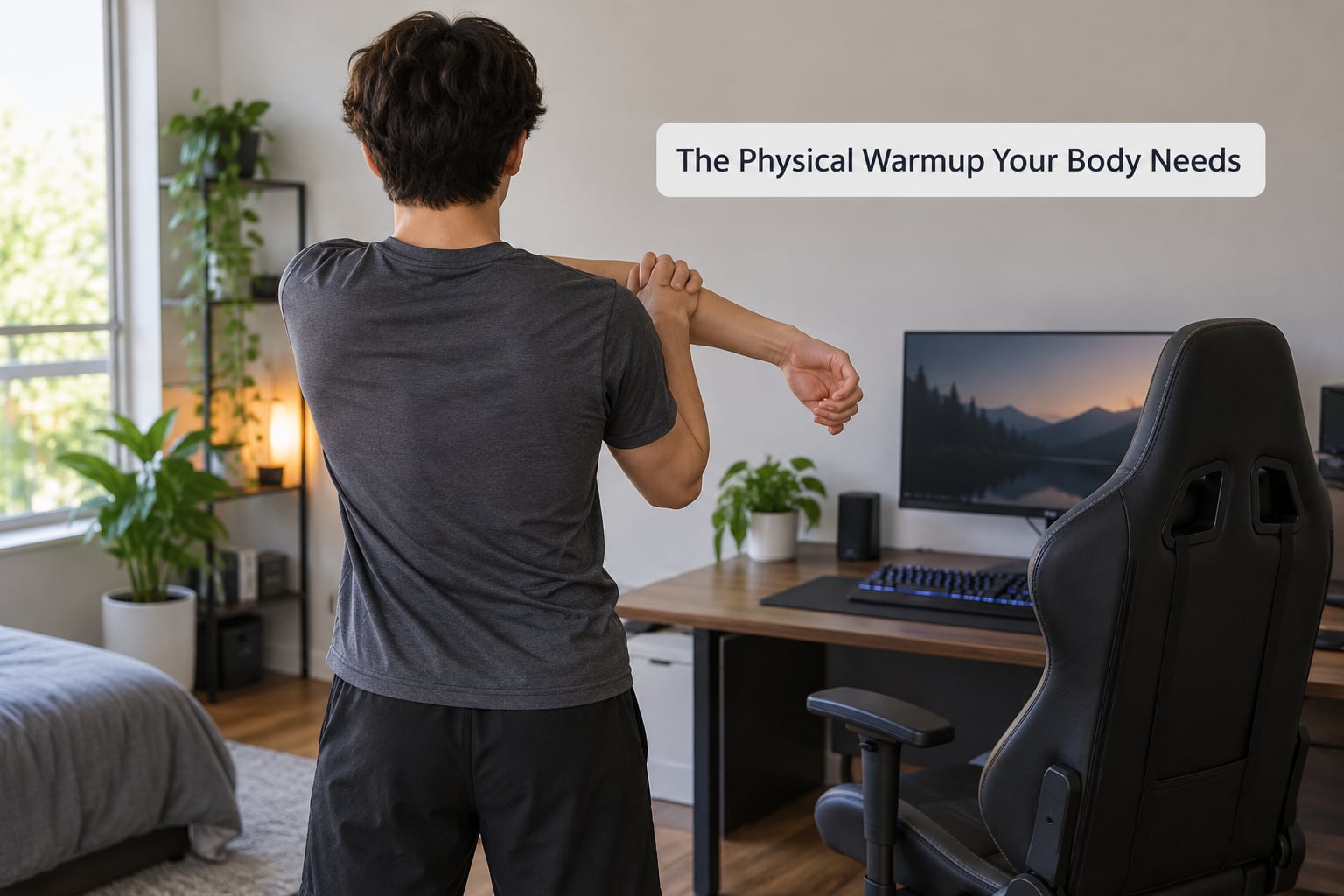
Long desk sessions load the same small muscles for hours. A two-to-three minute physical block before you sit down is cheap insurance, and it is the part most players skip entirely.
- Posture. Adjust the chair so your forearms are roughly level and your feet are flat before anything else. Bad posture at the start stays bad for hours.
- Shoulders and upper back. Slow circles backward and forward, then reach each arm across your chest. Five reps each side is plenty.
- Wrists. Gentle extension and flexion with the elbow straight, then the same with a loose fist. Do not force it.
- Hands and forearms. Open and close the hands a few times, then shake them out. Wrist extensors fatigue during long sessions, and tired hands feel shakier than they are.
- Hips. Stand, take a few steps, and rotate your hips gently. This matters more than expected if you have been sitting for an hour first.
- Eyes. Look away from the screen to something far away for 20 seconds, and blink deliberately a dozen times. Screen-heavy sessions produce real eye strain.
Work inside a comfortable range and never push through pain. Sharp pain, numbness or tingling is a signal to stop and get it checked rather than something to warm around.
Building a Game-Specific Mental Warmup
A mental warmup takes three to five minutes and does the job of settling you into a deliberate state. Start by naming one intention for the session in a single sentence, such as play slower on the first two rotations.
Then review something concrete. Look at the map, the opponents, or your own notes from the last loss. Reviewing beats fantasising, because it gives your attention real material to hold onto.
Next, visualize two or three situations you are likely to face: a messy opening fight, a lost round where you stayed calm, a clean trade you executed on purpose. Run them at normal speed, with the sounds you would actually hear.
Controlled breathing comes next, and it sounds softer than it is. Four seconds in, six seconds out, around ten cycles, is usually enough to lower the physical restlessness that comes with queueing. Long exhales are what does the work.
Finish by picking one focus for the first round only. One target, one process goal, one thing to repeat. A single instruction is easier to hold onto than a list of six, and it gives you something concrete to come back to when the round turns messy.
A Practical Esports Warmup Routine
Here is a structure that scales. Block the time you actually have, and drop the pieces you cannot fit rather than rushing them.
| Block | What it does | Common mistake |
|---|---|---|
| Physical activation | Posture, shoulders, wrists, hands, eyes | Skipping it entirely because it feels pointless |
| Mental reset | Intention, review, visualization, breathing | Skipping it on days you feel “already warmed” |
| Control practice | Slow, accurate reps of core actions | Starting at maximum speed and staying inaccurate |
| Specific work | The one skill you want warm today | Training a weakness instead of what you will play |
| Live transfer | Real game situations, real settings | Finishing on a trainer and never playing live |
| Team sync | Comms and call style | Only doing this when a scrim is booked |
A ten-minute version. Two minutes physical, two minutes breathing and intention, three minutes slow control practice on your main aim pattern, three minutes live play, done.
A twenty-minute version. Three minutes physical, three minutes mental, five minutes control practice, four minutes of your specific skill, five minutes live play or team comms.
A thirty-minute version for qualifiers and match days. Add a tactical review block, and give yourself a real break before you queue. Thirty minutes is already generous; longer than that and you are warming down.
Between maps in a tournament, run a much shorter version: water, two minutes of movement, a couple of minutes of the action you will open on, and a reset of your focus line. Between rounds, breathe and change nothing about your setup.
How to Adapt Warmups by Game Genre
Shooters lean on control practice and tracking, so spend your specific block there. MOBAs and strategy games reward mechanical calm and decision quality, so the mental block and live review carry more weight than aim drills. Fighting games need the most specific work of all: your actual character, a short set of the moves you will use, then matches.
Battle royales sit in between, since positioning and rotation decisions matter as much as mechanics, so include a review of the drop and rotation plan. Strategy titles need almost no physical practice and a lot of clarity, so put the time into build orders and scouting notes.
Whatever the genre, the last five minutes should be live play, not drills. You want to finish warm in the thing you are about to do.
How to Know Your Warmup Is Working
Readiness is observable if you check for it instead of guessing. Signs of a warmup that is working: your movement feels smooth rather than clicky, your attention holds through a quiet sequence, your controls feel familiar, your decisions are consistent from the first moments, and your voice stays level when something goes wrong.
Now the weak signals. If your hands feel shaky and inaccurate, you are likely in the control block too long or started too fast. If you feel wired but unfocused, the mental block probably came too late or too short. If you feel drained, the whole thing was too long.
If your communication is sloppy but your mechanics are fine, move the team block earlier. If everything feels good but your strategy is off, the problem is your review, not your warmup.
Match the fix to the one weak element rather than rebuilding the routine. A warmup does not need to be perfect. It needs to be repeatable, and repeatable routines can be corrected over weeks rather than rebuilt every session.
Common Warmup Mistakes to Avoid
Grinding before competition. Long high-intensity sessions right before a match leave you fatigued. The warmup should be shorter than your practice session.
Copying pro routines wholesale. Players learn by watching pro warmups and copying the sequence, which is useful, but a pro’s 90-minute block is built around a match day. Copy the order, not the length.
Making it too long. Past roughly 30 minutes, more warmup usually makes you worse, not better.
Changing the routine constantly. A new routine every day gives you nothing to compare against week to week. Write it down and run it the same way for two weeks before you judge it.
Hopping sensitivity mid-routine. If you practise in a trainer at a different sensitivity than your game uses, the warmup does not transfer. Use your game settings, or accept that the block was practice rather than warmup.
Skipping breaks. Standing up for two minutes between blocks is not wasted time, and it helps more than most people expect.
Expecting a performance boost every time. Warmups raise readiness and consistency. They are not a multiplier, and treating them as one sets you up to feel cheated on the days they only work normally.
Walking into a tilt spiral. The worst version of this mistake is a warmup that makes you angry. If deathmatch consistently leaves you agitated, it is not your warmup. Swap it for a practice range or a focus block and stop looking at the scoreboard.
Frequently Asked Questions
How long should I warm up before a match?
Ten to twenty minutes is the useful range for most players. Ten minutes is enough on a normal evening; twenty minutes fits qualifiers and match days. Beyond thirty minutes you are usually starting to lose sharpness. The best routine is the shortest one you will actually do consistently, because a repeatable fifteen minutes beats a perfect plan you abandon in a week.
How long before a match should I start warming up?
Finish your warmup about five minutes before you are due on stage or in the queue. That gap lets your arousal settle without going cold, and it leaves time for water, a final settings check and a quiet reset. Starting much earlier means you are sitting warm and doing nothing, which is how you cool down before the match instead.
Should I warm up in an aim trainer or in the game itself?
Use both, in that order. A trainer or practice range is better for slow, accurate reps of the pattern you want warm, and it removes the scoreboard distraction. Finish in the game itself, because the last block should look like the match. Players who train only in trainers often report that none of it carries into ranked play.
How do I warm up without burning out before the match?
Keep the whole thing under twenty minutes, start slow, and cap the specific work block at five minutes. Intensity should rise, not start high. If your hands are already trembling or your focus is fraying, stop that block and move to live play, which is lighter and transfers better. A tired warmup is worse than none.
Is a mental warmup necessary for gaming?
It matters most in exactly the situations people find hardest: after a bad loss, before a qualifier, or when a queue feels tense. Three to five minutes of intention, brief review, visualization and slow breathing gives your attention something specific to hold and lowers the restlessness that shows up as early mistakes. Many players find this part more useful than the aim block.
What should I do if my hands or wrists hurt during a warmup?
Stop the movement that triggered it. Discomfort that eases with gentle movement is different from sharp pain, numbness or tingling, and those three mean you should stop for the day and get it assessed rather than warming around it. Check your setup next: mouse grip, desk height and chair position cause most desk-related hand problems over time.
Start With One Repeatable Routine
Pick a time budget you can hit on your worst evening, not your best one. Fifteen minutes is a good first target. Write down six steps: physical activation, one intention, slow control practice, one specific skill, live play, and a short reset.
Run that same sequence for two weeks before you change anything. Afterward, note what actually felt effective and what felt like a box you were ticking, and cut the second one.
Consistency is the whole point. A routine you run twice a month is preparation in name only, while the same ten minutes you repeat every session becomes part of how you play.