Trying out for an amateur esports team comes down to three things: pick a game and a role, find a team with a real opening, and show up prepared enough that the coaching staff can trust you with a roster spot. Most tryouts are not a single 30-minute match. They are usually a scrim block, a VOD review, or a short trial period, and the staff is scoring your comms and attitude as hard as your aim.
The whole process takes somewhere between a week and a month for most people. You send an application, wait for a reply, play one or two sessions with the existing roster, then either get offered a trial stint or a polite no. This guide walks through that process step by step, including the parts most guides skip: what to actually put in your application, what happens inside the tryout itself, and how to check whether an organization is worth your evening hours.
Table of Contents
- 1What You Need
- 2How to Try Out for an Amateur Esports Team: Step-by-Step
- 3How to Try Out for an Amateur Esports Team: Choose Your Game and Role
- 4How to Try Out for an Amateur Esports Team: Find Real Opportunities
- 5How to Try Out for an Amateur Esports Team: Prepare a Strong Application
- 6How to Try Out for an Amateur Esports Team: Complete the Trial or Scrimmage
- 7How to Try Out for an Amateur Esports Team: Follow Up and Evaluate the Offer
- 8Common Mistakes
- 9Frequently Asked Questions
- 10Do amateur esports teams pay their players?
- 11What rank do I need to try out for an amateur team?
- 12Do I need a team to try out for an amateur esports team?
- 13Can I try out for a team remotely?
- 14How long does an esports tryout process take?
- 15Is it too late to join an amateur esports team in my thirties?
- 16Final Advice
What You Need
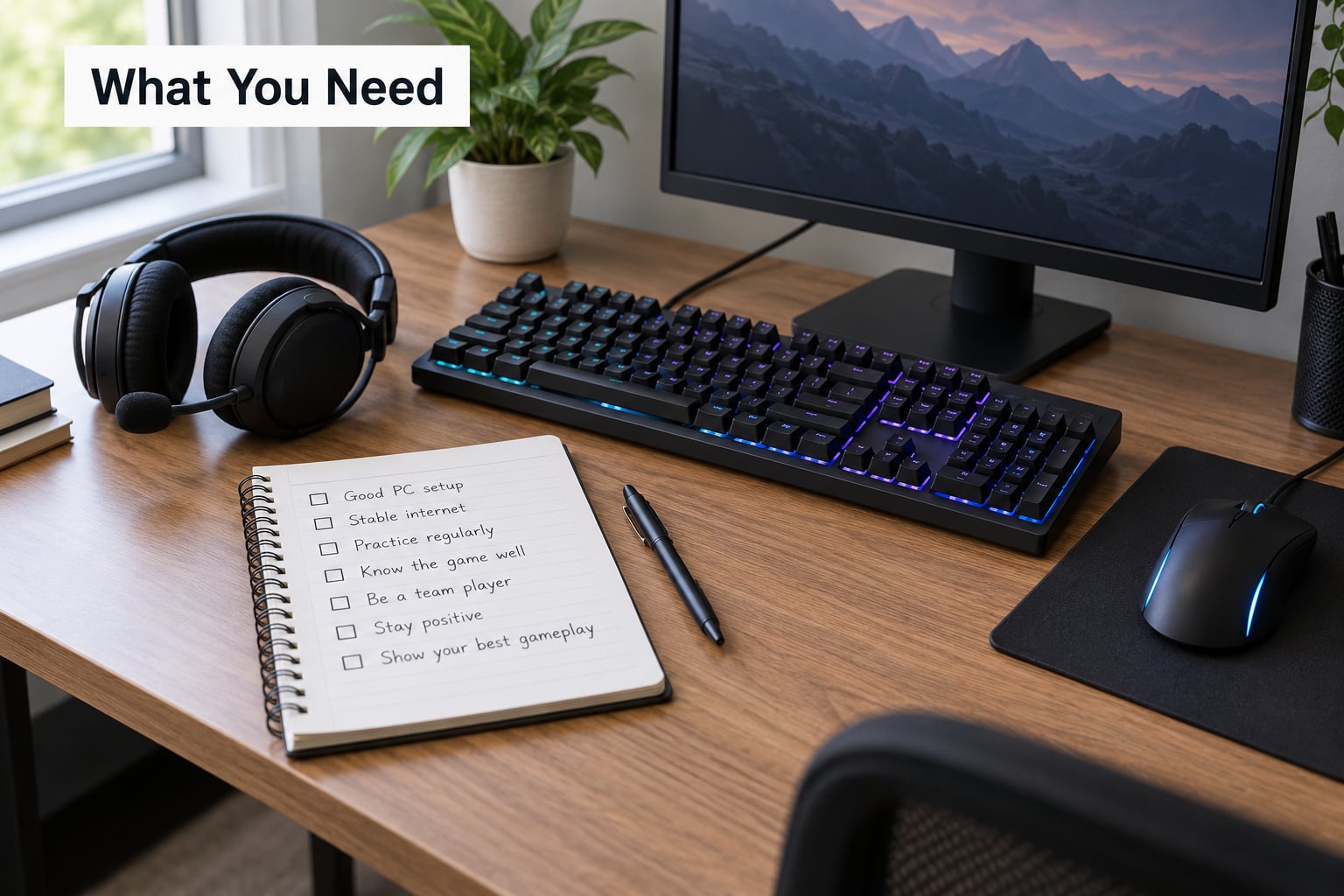
You do not need a pro-grade setup. You need a working one, plus a handful of things a coordinator will ask about.
- A stable account with a competitive history. Ranked progress, tournament placements, or a tracker link. If your match history is 200 casual games and nothing else, a few weeks of ranked helps.
- Reliable equipment and a stable connection. Wired ethernet if you can get it. Nobody wants to lose a trial scrim to lag, and coordinators notice when the same person keeps dropping.
- Comms ability. Clear, short callouts over voice chat. Say it once, say it clearly, move on.
- Availability you can actually keep. Amateur rosters typically practice three to five evenings a week. Know your real schedule before you apply, not the one you hope for.
- A way to track applications. A simple spreadsheet with team name, contact, date sent, format offered, and reply status. You will forget otherwise.
One more thing worth having: someone who has played organized team games before, or a community where you can scrim now. Solo queue habits, such as taking every fight, are much easier to unlearn with a practice partner than on your own.
How to Try Out for an Amateur Esports Team: Step-by-Step
Here is the full process in the order it actually happens, from choosing a title to following up after a trial week.
- Choose one game and one role. Pick the title you can play at an organized level, then pick the specific role you want to fill.
- Find teams that are actively recruiting. Check Discord recruiting servers, LFG platforms, tournament forums, subreddit team posts, and school or workplace leagues.
- Research the team before you apply. Read their recent results, roster, game title, and schedule.
- Prepare your materials. A short highlight clip, your rank or stat line, your role, and your availability.
- Write a short, specific application. Ten lines that prove you looked at their roster, not a mass message.
- Confirm the format before the session. Ask whether it is a scrim, a VOD review, an open application, or a trial week.
- Play inside the team system. Follow the calls, trade where your role says to trade, and do not go hero.
- Ask good questions at the end. Roster status, practice nights, team goals, what success looks like.
- Follow up in writing within 24 hours. Short, professional, and specific to the session you played.
How to Try Out for an Amateur Esports Team: Choose Your Game and Role
Choosing a game is mostly about where organized amateur play actually happens for your region. Valorant, Counter-Strike 2, Overwatch 2, Rocket League, Apex Legends, Fortnite, and Marvel Rivals all have active amateur and open-qualifier circuits. Pick the one where you can already queue with a regular group, because a tryout is a team evaluation, not a solo skill test.
Then narrow it to a role. Amateur rosters most often need an in-game leader, an entry player, a support, or a flex, and the tryout will be scored against that expectation. Check the roster page of each team you are considering so you can see which slot is actually open. Teams advertise a role for a reason, and applying for a role they already have filled is an easy way to get ignored.
Look at the level too. A team playing weekly open qualifiers wants reliability and structure. A team playing a regional circuit wants a defined role and someone who can commit to a full practice block. Both are valid paths, but the ask is different, and the application should match it.
How to Try Out for an Amateur Esports Team: Find Real Opportunities
Players on competitive subreddits ask the same question constantly: where are the teams that are actually recruiting? The honest answer is that openings are posted in places with a lot of noise, and you have to filter.
| Where to look | What it is | How to use it |
|---|---|---|
| Community Discord servers | Per-game communities with recruiting or LFG channels | Mute notifications, read the rules, then post your role, rank, rank region, and available nights in the recruiting channel |
| LFG team-finder platforms | Profile-based matchmaking for players and groups | Write a real profile with your main role and hours, not a one-line name |
| Open tournaments and qualifiers | Community cups and open brackets | Enter with a temporary stack of five; many amateur orgs scout open brackets |
| Subreddit and forum team posts | Teams advertising open roster spots | Reply in the thread rather than DM, so other applicants can see you are not spamming |
| School, college, and workplace leagues | Institutional clubs and internal leagues | Often the lowest-friction entry, with fixed practice nights and beginner-friendly rosters |
| Direct outreach to managers | Contacting the person who runs the roster | Only after you have read the org’s recent results, and only once |
Community consensus from players in r/ValorantCompetitive is simple: get onto any roster at any level and start playing tournaments with them, because playing with strangers is the fastest way to find a permanent group. Players in r/leagueoflegends report the same pattern, with most amateur orgs finding players through recruiting channels and Discord servers in their opening weeks.
How do you verify a team is real? Look for a named manager or head coach, a recent match history, a Discord server with actual conversation in it, and an org page that has existed for a while. An account that appeared yesterday with no results and no roster history is not a tryout, it is a risk.
How to Try Out for an Amateur Esports Team: Prepare a Strong Application
Recruiters spend very little time on each message. A messy, unspell-checked DM with no research is close to an instant rejection, and that is feedback the collegiate esports directors give constantly. Your application has about ten seconds to prove three things: you can play the role, you can commit to the schedule, and you have read what this team is doing.
A complete application contains:
- The game and the role you are applying for.
- Your current rank or a relevant stat line.
- Your region and time zone.
- Your availability on a normal week.
- A link to a highlight clip or a few VOD timestamps.
- One sentence on why this specific team interests you.
Here is a short example that fits in a Discord DM or an email body:
Hi, I am a second-lot controller player in VALORANT, currently Ascendant on NA, and I saw your second roster is looking for a flex. I can play initiators and controllers and I am free Sunday through Thursday from 7pm onward, most weeks. Here is a 90-second clip of two recent ranked matches. I watched your last two open qualifier runs and like how you set up your B executes, and I would be happy to run a scrim block whenever fits. Thanks for reading.
Keep it under fifteen lines, use your real in-game name, and check spelling once. A short message that fits in one screen reads far better than an essay about your esports dreams.
How to Try Out for an Amateur Esports Team: Complete the Trial or Scrimmage
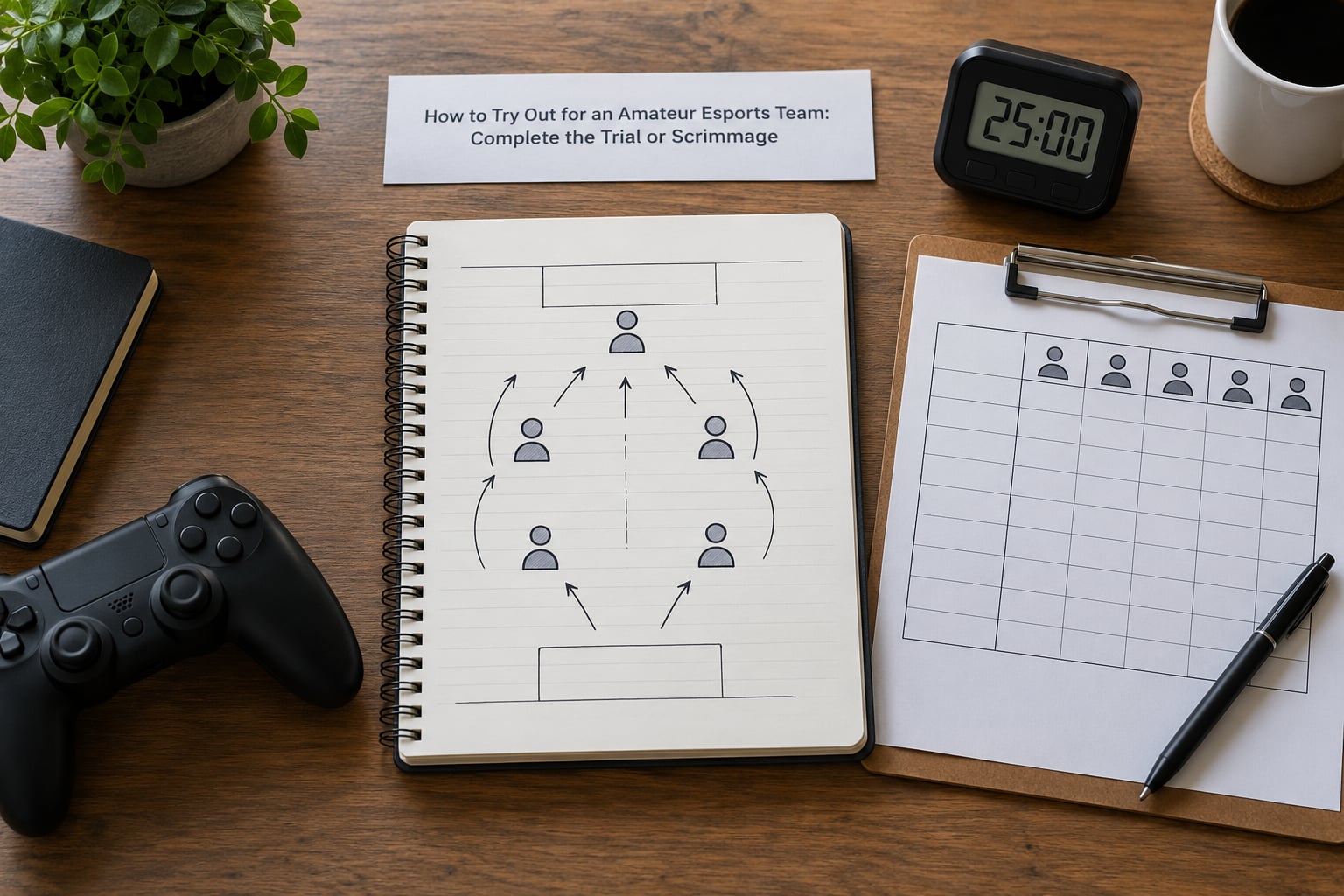
Tryout nerves are normal and they show up in threads before almost every session. The fix is preparation, not confidence. Warm up the same way you would on a match day, set up your audio and recording tools an hour early, and know the team’s default setup before they ask you for it.
Understand the format first, because the four common ones are graded differently.
| Format | Typical length | What evaluators watch | How to prep |
|---|---|---|---|
| Open application | Async, a few days | Rank, availability, attitude in writing | Write clearly, answer every question, attach a clip |
| VOD review | 20 to 40 minutes | Decision-making, comms, positioning habits | Submit clean clips with context, not just highlights |
| Scrim tryout | One to three games | Role discipline, comms, coachability | Learn the team calls, trade for your entry, stay calm |
| Trial week | One to two weeks | Consistency, attendance, fit with the roster | Block your calendar, log every session, ask for feedback |
Inside a scrim, play the system rather than your own game. That means trading when your role says to trade, taking the coverage rotation instead of the third duel, and calling information early even when you are not sure. The player who makes four clean calls and one bad call usually beats the player with three highlights and constant positioning arguments.
Ask for one piece of feedback at the end, and actually take it. Staff read your reaction to criticism as closely as they read your stats. Do not over-explain every play. A two-line recap of what you saw, plus one question, reads as coachable.
How to Try Out for an Amateur Esports Team: Follow Up and Evaluate the Offer
Send a thank-you message the next day. Two or three sentences: name the session, mention one thing you want to work on, and confirm your availability. That is the whole message. Follow-up is genuinely one of the easiest ways to stand out, because most applicants go quiet.
Before you say yes to anything, get clear answers on the basics. How long is the trial period, and is it paid? What nights are mandatory, and how many hours a week is that in practice? What is the team trying to achieve this season? Who else is on the roster, and who is coaching? If the answers are vague, that is a data point.
Most amateur rosters are unpaid, and you should assume that going in. There may be prize winnings, and a prize split policy should be in writing before you commit. A team that promises a stipend for a regional open bracket should be treated as unusual rather than lucky.
Watch for red flags: pressure to pay a join fee, no named staff, no match history, a Discord that empties out after the announcement, a manager who will not state the practice schedule, or any request for money, gift cards, or bank details. Walk away from all of those without a second conversation.
Common Mistakes
- Applying without reading anything about the team. One line about their recent result or their current roster need fixes this instantly.
- Sending only highlights. Clips show what you did, not why. A VOD with context shows your decision-making, which is what coaches actually need.
- Promising hours you cannot keep. Missing two scrims in a trial week usually ends the trial. State your real schedule in the application.
- Going silent on comms. If your team cannot hear your callouts, your mechanics do not matter. Use a mic from the first session.
- Playing heroically. Ego rounds look terrible in review even when they win. Follow the calls for the whole session.
- Never asking questions. Asking about the schedule, the roster, and the goals shows you are thinking like a team member, not a hopeful applicant.
- Accepting an unclear agreement. No written answer on length, schedule, or prize splits means no informed decision. Get it in a Discord message you can scroll back to.
- Mass-applying. Twenty identical messages in one evening is a pattern anyone can spot, and it does not help your odds.
Frequently Asked Questions
Do amateur esports teams pay their players?
Usually not. The large majority of amateur rosters are unpaid, and many players cover their own entry fees, travel, and gear. Some teams share prize winnings from tournaments, and a few community events pay small stipends or gift cards, but treat that as a bonus rather than a plan. Ask about the prize split in writing before you commit to a trial period, and never pay a joining fee to be on a roster.
What rank do I need to try out for an amateur team?
Enough to be credible in the role, and nothing more. Amateur teams care about a consistent rank, not an exceptional one, because they need reliable players more than highlights. Check the rank the team actually recruits at before applying, and pick a role where your current rank already sits comfortably. If you are applying well above your level, expect the tryout to be about learning fast rather than competing.
Do I need a team to try out for an amateur esports team?
No, and most successful applicants do not have one. Teams recruit individuals precisely because their roster is incomplete, and tryout sessions are played with the existing roster. If you have never scrimmed, join a community Discord and run a few pickup games first so your comms habits are already formed. Playing with strangers regularly is the fastest way to get comfortable in a tryout.
Can I try out for a team remotely?
Yes, and most amateur tryouts are remote over Discord and online voice comms. Expect a voice channel check before your first session, since clear comms matter more than most applicants expect. A small number of teams run in-person or LAN tryouts, usually in a metro area with an active local scene. Ask which format applies when you first make contact, and test your audio and connection the day before.
How long does an esports tryout process take?
Anywhere from a few days to a month. An open application may be reviewed within 48 hours, while a trial week adds a full practice block plus a review meeting. If you have not heard back after about a week, send one short, polite follow-up. If the silence continues after that, move on and keep applying, because teams rotate rosters constantly and an opening can reappear weeks later.
Is it too late to join an amateur esports team in my thirties?
No. Amateur rosters are community teams made up of students, working adults, and career changers, and age is not a screening criterion anywhere in the process. What does matter is availability, comms, and showing up consistently. Some titles reward mechanical ability more than others, so pick a role and a team whose schedule fits your life rather than assuming age is the barrier.
Final Advice
If you do three things this week, you will be ahead of most people who say they want to try out. First, commit to one game and one role, and play enough ranked to be comfortable there. Second, research five real teams and note the open slot, the competition level, and the practice nights for each.
Third, cut one clean 90-second clip and write the ten-line application while those five teams are still in front of you. Rank on its own will not get you contacted, and a short specific message beats a long hopeful one.
That is the whole process. Learning how to try out for an amateur esports team comes down to being findable, being specific, and being someone a coach can trust to show up on Tuesday. Keep your tracker updated and apply to a new team each week until something clicks.