A skill floor is the minimum ability a player needs to be useful. A skill ceiling is the maximum ability a game, mechanic or character can reward. Knowing how skill ceilings and skill floors work tells you, before you sink a hundred hours into something, whether it will fit the player you actually are.
That sounds like a small distinction. It is the one that decides whether you spend your evening learning a fighting game’s frame data or quietly uninstalling it in week two.
Updated for October 2026.
Table of Contents
- 1What Are Skill Ceilings and Skill Floors?
- 2A Quick Example of How Skill Ceilings and Skill Floors Diverge
- 3How Skill Ceilings and Skill Floors Shape Match Performance
- 4What Is a Skill Ceiling?
- 5What Is a Skill Floor?
- 6Skill Ceiling vs. Skill Floor: Key Differences at a Glance
- 7Which Player Archetypes Sit at Each Extreme?
- 8How Do Mechanics, Decision-Making, and Game Knowledge Affect the Limits?
- 9How Do Match Conditions Change Ceiling and Floor Performance?
- 10How Can You Measure Your Own Ceiling and Floor?
- 11Why Rankings and Leaderboards Can Mislead You
- 12Can a Player Raise Either Limit?
- 13Frequently Asked Questions
- 14Does a high skill ceiling mean someone is always the best player?
- 15Why can a player with a high skill floor outperform a flashy player?
- 16Is rank a reliable way to measure a skill ceiling?
- 17How many games are needed to estimate a skill floor?
- 18Can a player have a high skill ceiling but a low skill floor?
- 19How do team roles affect skill ceiling and skill floor?
- 20Conclusion
What Are Skill Ceilings and Skill Floors?
A skill floor is the level below which a player stops contributing. A skill ceiling is the level above which improvement still buys something real.
The cleanest version of the metaphor comes from an r/gaming thread titled “Please, I’m begging you, use skill floor correctly.” A real ceiling stops you going higher, so a skill ceiling is the limit of how far up you can climb. A real floor stops you going lower, so a skill floor is the limit of how far down you can fall. People get the second one backwards constantly, which is why the same word ends up meaning opposite things in different threads.
Community definitions usually land in the same place. An r/OverwatchUniversity explainer describes a skill floor as the minimum level of ability required to be effective with a hero, and a skill ceiling as the level of skill required to use that hero to its maximum potential. Both are about one hero or one game at a time, and both are about ability rather than time spent.
A Quick Example of How Skill Ceilings and Skill Floors Diverge
Take League of Legends, the default reference point in community threads. Garen is the usual shorthand for a low skill floor: a new player can push a button, win a trade and get something useful out of the match. Aphelios is the usual shorthand for a high skill ceiling: almost everything he does requires timing, target selection and positioning that beginners do not have.
Put those two in the same lane and the match gets decided by the floor, not the ceiling. The Garen player is at their dependable level from the first minute. The Aphelios player has a spectacular round three and an empty round seven.
How Skill Ceilings and Skill Floors Shape Match Performance

Ceiling decides the best round you can produce. Floor decides how many of the remaining rounds you keep. Those are different jobs, and a team only needs both.
Match-specific outcomes are where the ceiling shows. One flawless flank, a one-versus-three hold, a perfect read that a pro would call a highlight. These moments are real ability, but they are a sample size of one, and they depend on a teammate landing a body shot at the right second.
Consistency is where the floor shows. It is the boring, repeatable part: rotating on time, not over-committing, keeping the resource you need for the objective fight. A player with a middling ceiling and a strong floor will usually outscore a player with a monster ceiling and no floor, because a team loses more from three bad rounds than it gains from one great one.
That is also why one clip is weak evidence. A spectacular play tells you what a player’s ceiling looks like for roughly eight seconds. It says nothing about round fourteen.
What Is a Skill Ceiling?
A skill ceiling is the maximum performance a player can demonstrate under favourable conditions: the right map, a fair matchup, teammates who are not feeding, enough time to execute the plan.
Four inputs push a ceiling up, and they are worth separating because they train differently.
Mechanical potential. Can the hands execute the sequence? Sustained actions per minute, frame-perfect inputs and a reliable combo are mechanical ceiling territory. You raise this at the keyboard or pad, often alone.
Decision-making. Is the right option picked under pressure? A player who spots the flank before it happens has a high decision ceiling even if their execution is average.
Game knowledge. How much of the system is actually understood? Cooldowns, spawn timings, resource maths and matchup specifics form a knowledge ceiling, and it is the part most players underestimate.
Adaptability. Can the plan change mid-round? Reading an unfamiliar patch or a new opponent is the adaptability ceiling, and it is the one that most reliably separates a good player from a great one over a long season.
What Is a Skill Floor?
A skill floor is the minimum performance a player can maintain across repeated games, including the bad ones. It is the “you must be this tall to ride this ride” gate.
A low floor means basic understanding is enough to participate effectively. In Overwatch, community explanations point to fast respawns and the near-total absence of permanent loss as the reason the floor stays low: get eliminated, be back in a match in seconds, no spiral. You will be bad, you will lose, and the game will keep handing you a fresh round to lose in.
A high floor is a real barrier to entry. If a game punishes every beginner mistake with a long walk back and no progress, the floor sits high, and players who cannot clear it never see the rest of the game. They leave before they ever reach the part they would have liked.
Consistency is the whole point of measuring a floor. Is the player average, or is the player reliably average with occasional disasters? The second player has a lower floor than the first, even if the first has a higher peak.
Skill Ceiling vs. Skill Floor: Key Differences at a Glance
| Point of comparison | Skill ceiling | Skill floor |
|---|---|---|
| Definition | The maximum ability a game or character can reward | The minimum ability needed to be effective |
| What it measures | Potential under favourable conditions | Dependable baseline performance |
| When it shows | Rare, memorable rounds | Most rounds, including the bad ones |
| Strength | Rewards long practice and study | Keeps a new player in the game |
| Weakness | Easy to ignore until you are ready for it | A high one locks casual players out entirely |
| Best evidence | A specific play under the right conditions | Ten or more matches of similar results |
| Common player label | Potential, ceiling, learning curve | Baseline, consistency, accessibility |
| Practical question | How much is there left to learn? | How much do I need to know to stop being useless? |
The pairing most players are hunting for is a low skill floor with a high skill ceiling. That is the configuration sold as easy to learn, hard to master: forgiving when you start, deep once you stay.
Which Player Archetypes Sit at Each Extreme?
The high-ceiling specialist. Their best work is genuinely excellent, and it depends on conditions. Give them the right matchup and a coordinated team and they will run the game over. Hand them a messy lobby and the result drops to ordinary.
The high-floor generalist. Rarely has the single best play in the game. What they have is a match where nothing goes wrong, which is worth more than one spectacular round across a whole session. In ranked play, this archetype climbs steadily and rarely tops the leaderboard.
The volatile performer. A wide gap between the two numbers: an unpredictable night. Some sessions are brilliant, some are rough, and the sample does not tell you which one is the real player until you have more data.
The developing player. Often a wide range rather than a high or low one, because knowledge is growing faster than execution. The floor rises quickly at this stage, the ceiling moves slowly.
Treat these as descriptions of how someone played lately, not as identities. A high-ceiling specialist who learns map timings can become a high-floor generalist without losing a single top-end play.
How Do Mechanics, Decision-Making, and Game Knowledge Affect the Limits?
Mechanics mostly raise the ceiling. Raw input skill sets the fastest top-end performance available, and it is the easiest number to grind, which is why tournament coverage fixates on it.
Knowledge raises both, quietly. Knowing that a fight is unwinnable from the current state stops you feeding, which lifts your floor immediately, and knowing the shortcut into position raises the ceiling without touching your hands at all.
Decision-making sits in between. Under time pressure, decisions get worse, and the gap between a player’s ceiling and floor widens exactly when the match matters most. A player whose worst moments are decision errors has a decision problem, not a mechanical one, and the fix is review rather than drill.
Here is the practical read: mechanics drop when hands are tired or the game is unfamiliar, knowledge drops when you face something unstudied, decisions drop when you are rushed. Fix the one that actually breaks in your losses.
How Do Match Conditions Change Ceiling and Floor Performance?
Almost nothing in a match is a pure read on skill, which is why people argue about the same player for years.
Teammates. Two capable players on a bad team perform worse than either would alone. That drags the observed floor down without either player changing.
Opponents. A ceiling only exists against something. A dominant player in an empty lobby looks average.
Map and mode knowledge. Players who know a map’s timings convert the same positioning into far more value. A win condition you understand is a skill floor nobody has to teach you.
Time pressure. Slow, deliberate systems compress the gap between a high floor and a low one. Fast, punishing systems let a high ceiling run away with the match.
Role. A support player and a carry asked to swap often have very different measured floors. Comparing raw numbers across roles is comparing different jobs.
Communication. A high-ceiling player with no comms is a coin flip. A high-floor player with good comms is the most valuable person in many lobbies.
Patches. A reworked character or hero can move a floor within a single patch. In a hero shooter, a simplification that makes the ability harder to misuse pushes the floor up and often drops the ceiling slightly, because there is less room for creative use. Balance notes describe that change as a floor change even when the numbers barely move.
How Can You Measure Your Own Ceiling and Floor?
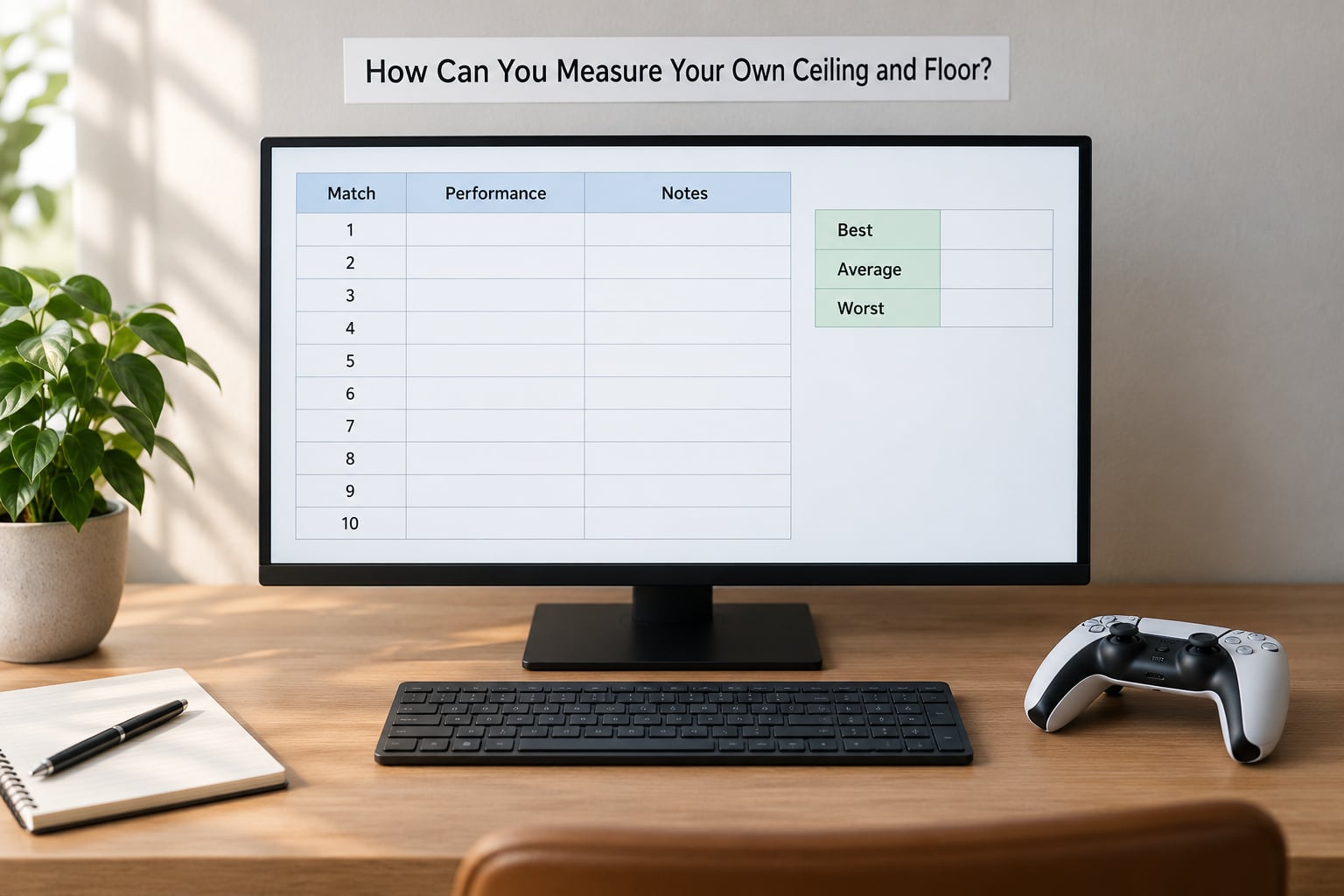
Ten matches is enough to get a rough read on your floor, and it is the smallest sample that resists a single bad night. Here is the method.
1. Log ten recent matches. One row each. Keep it to facts you can check: role played, map or mode, result, and a number that reflects your contribution rather than the scoreboard.
2. Mark your best case. The single match where you played closest to your potential. That is your ceiling marker for this patch and role, not for the whole game.
3. Mark the repeated low case. The level you hit two or more times. One bad match is noise; a level you hit repeatedly is your floor.
4. Average the middle. The typical match sits between those two markers, and it is the honest number to quote when someone asks how you are doing.
5. Note the role each time. A floor measured only in one role is not your floor. Track a role you enjoy and a role you avoid separately, and compare them.
6. Add objective results last. Win rate is a team output. Use it as context, never as the measurement itself.
Then repeat the log after a month. A rising floor with a flat ceiling means your consistency improved. A rising ceiling with a flat floor means your peaks are getting better while your bad nights are not.
Why Rankings and Leaderboards Can Mislead You
A rank is a compressed number built from a result that several people produced. Read carefully, it tells you something real about recent performance in one role on one account.
Read loosely, it is the most over-trusted skill estimate in gaming. Team games average away individual contribution, so a strong player carried by a weak team ranks like an average player. Skill-based matchmaking keeps the field tight, which caps the visible ceiling: the difference between ranks shrinks, and the ladder stops being a place where exceptional play shows.
Small samples bite too. Placement matches are noisy, and a bad week reads exactly like a skill drop. Time-limited ladders add a fourth problem, since a season’s leaderboard rewards whoever played the most during that season.
Role imbalance makes cross-role comparison worse, because a role that farms objectives scores more without needing more skill. And a single player’s rank is a different question from a game’s ceiling, which is a property of the game rather than of anyone in it.
Use rank as one data point about form. Use ten matches, one role, and your own logged numbers for anything else.
Can a Player Raise Either Limit?
Both, and they respond to different training. The ceiling grows through volume plus review: play the situations you lose, watch what you did instead, correct one thing per session. The floor grows through repetition under ordinary conditions, because consistency is a skill in its own right.
Team feedback does more for the floor than solo practice does. If a coach or a reviewing teammate points out that you over-commit in the first two minutes, fixing that single habit will show up in your average before any aim or combo work does.
Knowledge lifts both, and it is the cheapest input to add. Studying one character’s matchups or one map’s timings pays off across every match you will play for months.
Set the goal honestly. A realistic target is “my floor rises over the next twenty matches,” not a rank you will hit next week. Rank follows form; it does not precede it.
Frequently Asked Questions
Does a high skill ceiling mean someone is always the best player?
No. A high skill ceiling is potential under the right conditions, not a permanent advantage. That player still needs a coordinated team, a fair matchup and enough map knowledge to convert the advantage. In a bad lobby, a high-ceiling player and a high-floor player often finish with identical results, which is exactly why a single match tells you so little.
Why can a player with a high skill floor outperform a flashy player?
Because team results come from the many rounds, not the memorable ones. A high-floor player rarely loses a round outright: they keep resources, they do not feed, they arrive on time. A flashy player might win one round spectacularly and then lose the next six quietly. Over a full match, the boring wins compound and the highlight does not.
Is rank a reliable way to measure a skill ceiling?
Rank is a weak proxy. It compresses team outcomes into one number, skill-based matchmaking flattens the visible difference between tiers, and placement matches are noisy. It is also tied to a single role and often a single account. For a real read on a ceiling, log ten recent matches in the same role and mark the best one.
How many games are needed to estimate a skill floor?
Around ten is the practical minimum. Fewer and one bad night skews everything, which is why a single match is useless for judging consistency. Ten is enough to spot a level you hit more than once, which is the thing a floor actually is. Keep logging after that, because role, patch and teammates all move the number around.
Can a player have a high skill ceiling but a low skill floor?
Yes, and it is the most common pattern among new players in fast, punishing games. They can execute a spectacular play when the moment is clean, then lose ordinary rounds through impatience, over-commitment and poor positioning. The gap usually closes through review and repetition rather than more practice at the flashy part, which they can already do.
How do team roles affect skill ceiling and skill floor?
Roles change both numbers, which is why cross-role comparison breaks down. A farming role produces objective results without demanding much execution, so it inflates a measured floor. A carry role hides your bad rounds in teammates’ good ones. Matchmaking also assigns skill expectations per role, so a support player ranked low may simply be playing the harder job.
Conclusion
The ceiling is what you could become on your best night. The floor is what you can do on your worst one, and it is the number that decides most matches.
Open your last ten matches tonight and fill in one row for each: role, result, contribution. Mark the best as your ceiling and the level you hit more than once as your floor. That log takes twenty minutes and it will tell you more than a rank ever did, because from there you can work on the thing that is actually holding you back instead of the part that already looks good on a highlight reel.