Free-to-play games are profitable because the price of admission is zero, which pulls in a very large audience cheaply, and the studio then recovers its costs from the small share of players who spend on cosmetics, battle passes, subscriptions, ads and convenience. Most players pay nothing at all. That is not a flaw in the model. It is the model.
The reason people keep asking why some games are free but still profitable is that the arithmetic looks broken from the outside. A team spends years and a serious budget on a game, the store says Free, and a year later the game is being updated every month by a team that never got paid a cent to begin with.
Here is the honest version: nothing about a free game is free. The cost moves. It moves off the player who never spends, onto the player who spends a lot, and sometimes onto the developer, who discovers the math only works at a scale they did not hit. Let me walk through the whole thing, including the part where studios lose money doing this well.
Table of Contents
- 1Why Some Games Are Free but Still Profitable
- 2What Does Free-to-Play Mean for Players and Developers?
- 3How Do Free Games Make Money?
- 4Why Some Games Are Free but Still Profitable in Practice
- 5How Advertising Can Fund a Free Game
- 6How In-App Purchases Turn Players Into Customers
- 7What Role Do Subscriptions and Battle Passes Play?
- 8How Player Retention Creates Long-Term Profit
- 9Why Scale Matters for Free Browser and Mobile Games
- 10What Is the Difference Between Revenue, Profit, and Sustainability?
- 11Which Free-Game Models Work Best?
- 12Why Do Some Free Games Lose Money?
- 13What Should Players Look for in a Free-to-Play Game?
- 14Frequently Asked Questions
- 15Can a game really be free and profitable without charging a subscription?
- 16Why are so many free games designed around in-app purchases?
- 17Is a free-to-play game really free, or are players still paying?
- 18How do free games make money from players who never spend?
- 19Is pay-to-win the main reason free games are profitable?
- 20Conclusion
Why Some Games Are Free but Still Profitable
Because the zero price is not a gift, it is the cheapest marketing channel in entertainment.
Consider what a studio would have to do with a boxed game. It builds awareness, sells units, and every sale generates revenue on day one. With a free game, the studio can spend a fraction of that on ads and simply give the game away. Anyone who taps the link and installs it is a potential customer who cost the studio nothing but the server time and a few cents of hosting.
From there, three things do the work. A small percentage of players pay real money inside the game. A larger group returns often enough that ads and subscriptions have something to sell. And the whole player base becomes an audience that can be pointed at a sequel, a console release, or a physical product later on.
The free tier, in other words, is marketing that pays for itself. A sixty-second trailer reaches people. A free download reaches people who already gave the game a try.
What Does Free-to-Play Mean for Players and Developers?
Free-to-play means no upfront purchase price, not no cost. The distinction matters because several different business models get lumped together under the same word.
Free-to-play (F2P) is the full game with no purchase price. Freemium is the same thing with a cut-off: the game works but a meaningful part of it sits behind a paywall. Ad-supported means the developer takes money from advertisers and gives you the game in exchange for your attention. Pay-to-play (P2P) is a purchase price with no extras, sometimes called premium or buy-to-play.
A free trial is a fourth thing entirely. You get a slice of the game, the clock is running, and the purchase decision comes later.
For the developer, removing the price tag usually widens the funnel dramatically. A game that would have sold twenty thousand copies at a set price can reach two million players at no cost per install. More players means more chances to find the people who will pay, and more chances to find the ones who will watch a rewarded ad.
For the player, it means the risk also drops to nothing. Try it, abandon it, no loss. That is the trade most players are happy to make, even the ones who later spend.
How Do Free Games Make Money?
Seven streams cover the overwhelming majority of free-to-play revenue. Most real titles run two or three of them at once, weighted differently depending on audience size and session length.
- In-app purchases (microtransactions) for premium currency, cosmetics, character upgrades, consumables and convenience items.
- Battle passes and season passes, a recurring paid track that resets every few weeks and bundles a themed set of rewards.
- Subscriptions and memberships for ongoing benefits, extra storage, or access to a related service.
- Advertising, split into banner, interstitial, video and rewarded formats that either interrupt play or pay the player directly.
- Cosmetic-only stores, including skins, weapon wraps, emotes and finishers on competitive titles where power cannot be bought.
- Cross-promotion, where a studio advertises its own other games to an audience it already owns for almost nothing.
- Sponsorships, licensing and merchandise, plus data-supported services such as brand partnerships built around audience data.
The same seven streams land very differently depending on who is playing.
| Revenue model | Who pays | Best fit | Main trade-off |
|---|---|---|---|
| In-app purchases | A small share of players who spend repeatedly | Mobile, RPG, live-service games | Can slide toward pay-to-win |
| Battle pass / season pass | Regular players who want the whole reward track | Competitive and live-service titles | Completion pressure and time limits |
| Subscription | Players who dislike large one-off sums | MMOs, shooters, multi-title ecosystems | Churn once the novelty fades |
| Advertising | Advertisers, indirectly | Hyper-casual, browser and mobile games | Interrupts play and eats attention |
| Cosmetics only | Players who want identity, not power | Competitive shooters and MOBA-style games | Requires a competitive scene to sell to |
| Cross-promotion | No direct payer | Studios with several titles | Only works with an existing audience |
| Licensing / merchandise | Partners and fans | Games with strong art or characters | Small, unpredictable, hard to forecast |
Why Some Games Are Free but Still Profitable in Practice
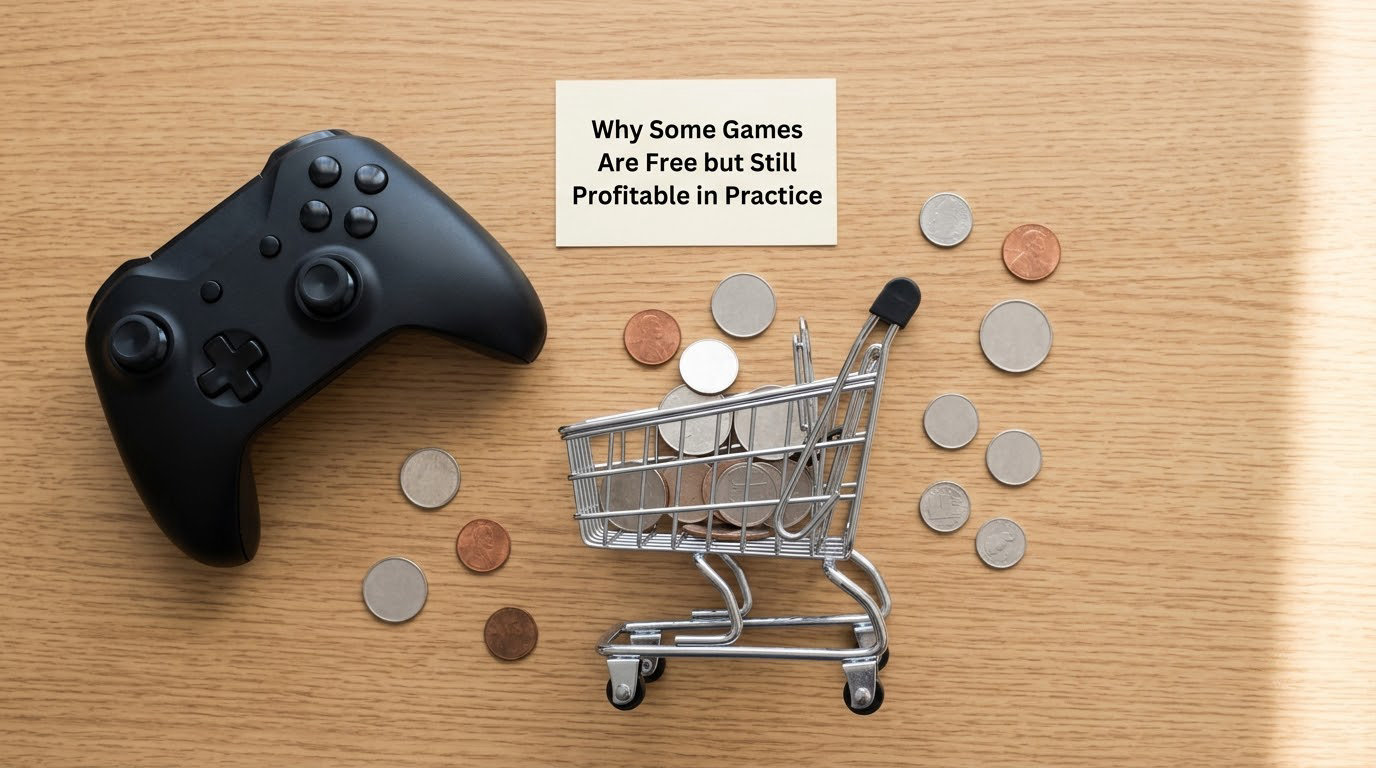
It helps to run a small hypothetical. Imagine a team spends the equivalent of a mid-sized production on a live-service game and releases it at no charge. They buy installs, and say a tenth of a million players show up in the first month.
Now the revenue math. If only two percent of players ever spend, and the typical spender hands over a modest amount across a year, the majority of the total comes from a slice of the base well under one percent. One in a thousand players can end up paying more over a year than a boxed game ever cost at launch. That concentration is the whole trick.
Advertising fills the gap from everyone else. A fraction of a cent per view across millions of daily sessions becomes a real number, which is why browser and mobile games can operate on tiny per-player revenue and still support a full staff.
The catch is timing. Money arrives slowly and unevenly, which is why some free games look healthy for two years and then fold.
How Advertising Can Fund a Free Game
Advertising is the oldest revenue stream on this list, and the only one where the player is not the customer at all.
Banner ads sit at the edge of the screen. Interstitial ads play between rounds or levels. Rewarded video is the clever one: the player chooses to watch a short ad in exchange for something useful, like a reward, a respawn or an extra life. Players tend to accept rewarded ads far more willingly because they see the value themselves.
Sponsorships work the same way at a larger scale. A drinks brand or a handset maker pays for placement, and the game hosts the campaign. Hyper-casual titles built around this arrangement have been profitable for years on installs alone.
There is a limit, though. Every ad costs attention, and attention is the resource the whole business runs on. Studios that pile on interstitials watch session length and retention fall, which reduces the ad impressions that justified the change in the first place. That is why the format is usually capped, even though nobody is stopping them.
Platform rules also shape this. Mobile stores take their own cut, and the split between in-app purchases and in-app ads differs by platform and region, which is why the same game can behave like two different businesses on two different devices.
How In-App Purchases Turn Players Into Customers
In-app purchases are the engine most free games run on, because they let the studio charge according to how attached a player is rather than how much the game is worth to them.
It usually starts with a premium currency bought with real money and then spent in game. That two-step exists for a reason: it lets the studio set its own price points independent of what the real currency converter charges, and it makes the number in the corner of the screen look smaller than the receipt does.
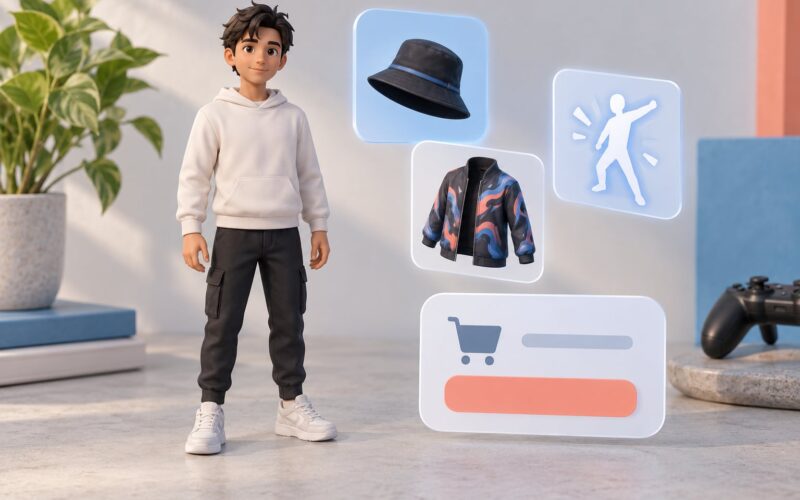
The category splits cleanly into what affects power and what does not. Cosmetics, skins and finishers change appearance only. Upgrades, faster progression and stronger characters change outcomes. Players tolerate the first group without complaint and fight the second one hard, which is why competitive shooters such as the big battle royale and MOBA-style games keep their stores cosmetic-only.
On top of that sit consumables, convenience unlocks, and the grind itself. When a resource takes an unreasonable amount of time to earn, the store offers a shortcut, and the shortcut becomes the product. Players who are patient often finish a free game without spending at all. That is not an oversight in the design. It is the free tier doing its job.
What Role Do Subscriptions and Battle Passes Play?
Battle passes are the clearest recent example of how a free game makes money more predictably than from scattered impulse buys.
The pitch is a themed track of rewards, unlocked by playing through the season, with a paid tier that unlocks the premium track and adds a handful of bonus items. The value looks steep compared with buying the same items one at a time, which is the reason people buy one or two a year and refuse to buy a third.
What makes it effective as a business is the timer. The track resets, so the same spend recurs without a new product, and skipping a season means missing everything in it rather than falling behind by a small margin.
Subscriptions do something similar with less drama. A monthly fee bundles currency, storage, or access to a related title in exchange for a steady amount and a predictable player relationship. The risk is churn: a subscription that is not noticed on the card statement each month is a subscription that gets cancelled.
The honest comparison is optional membership against automatic paid access. Optional membership asks players to choose each month, and many decline. A pass with an expiry date makes the choice once and then makes it stick.
How Player Retention Creates Long-Term Profit
A free game earns nothing on the install day, so the number that matters is how long players stay.
Retention widens the pool of people who might convert. A player who leaves in three days has almost no chance to buy anything. A player who stays six months has seasons, events, progress to finish, and a habit. The difference between those two players is often the difference between a loss and a profit.
That is the real reason live-service games ship updates, balance patches, new characters and seasonal events. Players tend to read generosity, and it is not unreasonable. The business view is starker: an event creates a reason to log in, and a login is an opportunity to sell.
Community trust sits underneath all of it. Studios that sell power, or that gut the free content pool after a launch, lose the audience that makes the model work. A free game with no players has no revenue model at all, however clever the store.
Why Scale Matters for Free Browser and Mobile Games
The zero upfront revenue only works at volume, and volume brings its own bill.
Servers, support staff, updates and rewards all scale with the audience rather than staying flat. A game with a hundred thousand players can be run by a small team out of a shared backend. A game with fifty million needs regions, anti-cheat, dedicated live-operations staff and a support queue that never closes.
This is why hyper-casual and browser games look so cheap per user and still add up, and why a modest studio can be profitable on a title a larger team would struggle to support. It is also why the same genre swings so hard between success and shutdown. The studio that lands a hit inherits a support problem it never planned for.
Region matters here too. Pricing tiers let a studio sell a small amount in markets where a standard price would exclude most players, which widens the paying base without changing the game.
What Is the Difference Between Revenue, Profit, and Sustainability?
Revenue is what comes in. Profit is what is left after everything else, and on a free game the gap is wide.
The costs sit on both sides of the ledger. Development and art come first and are largely fixed. Then come servers and hosting, payment processing and the platform store cut, marketing to acquire players, customer support, and the ongoing live-operations work that a live-service title requires to stay worth returning to.
A title with fifty million dollars of gross and thirty million dollars of costs made twenty million dollars and had a bad year. That combination is common enough that most free-game shutdowns are not caused by a lack of players. They are caused by costs that grew faster than revenue.
Sustainability is the longer question: whether the game can keep paying for itself after the launch spike fades. A game whose revenue comes mostly from one good week is a marketing success. A game whose revenue comes from a stable core of returning players has a business.
Which Free-Game Models Work Best?
The right model follows the audience, not the studio’s preference.
- Competitive shooters and MOBAs live on cosmetics and battle passes. Power is sold to nobody, so the store stays open to everyone and the scene stays healthy.
- Live-service RPGs and gacha titles live on characters, upgrades and time-limited offers. They earn well and they attract the heaviest criticism, often at once.
- MMOs and long-running worlds usually combine a subscription with a store, which smooths out the revenue but adds churn.
- Hyper-casual and browser games live on advertising alone. Small per-player revenue is fine at enough installs.
- Mixed models work best in practice: ads to fund the free tier, purchases for the engaged few, and a pass for the regulars.
A single model applied everywhere tends to underperform. The reason is that paying players are a small minority in every genre, and finding them is the actual skill.
Why Do Some Free Games Lose Money?
Low retention is the root cause. If players leave before the store ever opens, nothing else matters.
Weak monetization follows: a store that sells nothing, or prices set so high that only the biggest spenders respond. Then come the generosity problems, where rewards and currency piles up so players never feel the need to buy, which is pleasant for players and fatal for the studio.
Pay-to-win backlash is a business risk rather than an ethics point. Sell power in a competitive game and a loud group of players leaves, taking their friends and their spending with them. The title survives on whales, which is exactly the concentration that makes the model fragile.
Infrastructure costs creep up quietly, and support load scales with every million players. On top of that, live-service games depend on an income stream that can dip without warning, which is hard to plan around, and too many studios are living off a launch spike they never learn to replace.
Then the shutdown, which is what players worry about most. Every live-service game is on the same curve, and every one of them ends eventually. That is not a secret, it is a business requirement. The pattern has repeated so often that by 2026 it is easier to assume a date than to be surprised by one.
What Should Players Look for in a Free-to-Play Game?
It is possible to enjoy these games without spending, but it helps to know what you are looking at.
Check whether the store sells cosmetics or power. That single question separates the games most players recommend from the ones they complain about.
Then look at whether the free tier is genuinely playable end to end. A patient player should be able to finish the content, even slowly. If progression is impossible without a purchase, the free label is doing marketing work rather than describing the product.
Pay attention to ads too. Nonintrusive banners and optional rewarded video are fine. Forced interstitials every few minutes are a sign that the game is monetising you harder than its players.
Published probabilities on gacha mechanics, a spending limit you can set, regional pricing, and a clear refund policy are all reasonable things to expect. So is a straight answer about what happens to your progress if the servers close.
Finally, be honest about what you want. Many players buy one battle pass a season and never touch a gacha screen. That is a deliberate line, and it is a perfectly good one.
Frequently Asked Questions
Can a game really be free and profitable without charging a subscription?
Yes. Subscriptions are only one of several streams. In-app purchases, battle passes, advertising and cosmetics can carry a free game on their own, and many successful titles never offered a subscription at all. What matters is not the format but the concentration: a small share of players spending across many months, combined with a large enough free audience to advertise to.
Why are so many free games designed around in-app purchases?
Because purchases are the only stream that scales with how attached a player is, rather than with how many people downloaded the game. A store can charge more to the players who care most, keep the entry price at zero for everyone else, and earn revenue in the meantime. The grind, the timers and the limited-time offers all exist to create a reason to open that store.
Is a free-to-play game really free, or are players still paying?
It is free to download and free to start, and most players never spend anything on one. But time is a cost, and so is attention if the game runs ads. Some players pay monthly or yearly for hundreds of hours of play, which works out to far less per hour than a boxed release. Whether that counts as free depends on whether you were going to play it anyway.
How do free games make money from players who never spend?
They do not, directly. Non-spending players still earn their keep indirectly: they inflate the audience that makes ad impressions worth buying, they generate the playtime data that guides store design, they recommend the game to friends, and they are the pool that a few later convert into paying customers. They are also the reason a small spender’s purchase matters, since nobody pays for a game with no players.
Is pay-to-win the main reason free games are profitable?
No, and the honest business answer is that power sales work but are fragile. Competitive titles that sell power tend to drive away the non-spending majority, which shrinks the very audience the model depends on. Cosmetics, battle passes and subscriptions hold up better over time because they do not punish the majority for refusing to pay. The loudest complaints are usually aimed at power, not at the model.
Conclusion
Start with the number on the store page, then look past it. A free game charges zero at the door and recovers its costs from a small group of engaged players, from advertising, and sometimes from partnerships that have nothing to do with the game itself.
What decides whether that works is not the store design. It is retention, cost control and whether the free tier holds up for the majority who never pay. Look at how long the game has been running, what it costs to play fairly, and whether the developers keep updating it after the launch buzz fades.
And if you do open the store, the ones worth opening are the cosmetic sets and the pass you would have finished anyway.