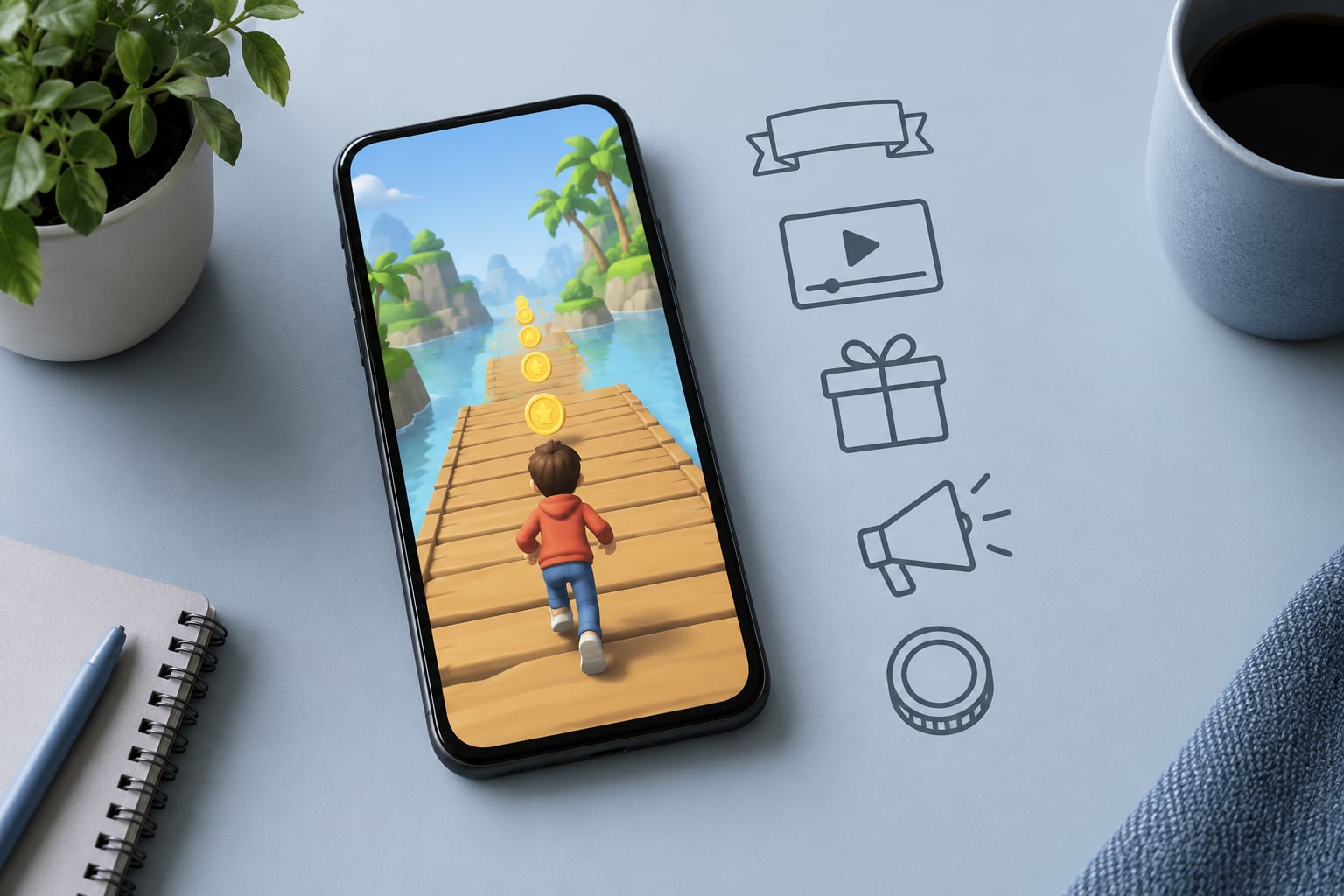
How advertising works in mobile games comes down to one trade: a developer gives away a game for free, and an ad company fills the empty space with adverts that other businesses pay to place there. You watch them, tap them, or skip them, and the money from the advertiser flows back to the studio through an ad network.
What most players never see is the machine behind it. A single 30-second video you played in a puzzle game might have been auctioned to five networks, bought by a brand you would recognise, and paid out at a rate the developer tracks in a figure called eCPM. This guide walks through that machine in plain terms, from who buys the ads to what the numbers on a publisher’s dashboard actually mean.
Table of Contents
- 1How Advertising Works in Mobile Games at a Glance
- 2The Three Parts of a Mobile Ad Sale
- 3What Happens When You Reach an Ad Break
- 4Who Gets Paid and for What
- 5Why Mobile Games Show Ads
- 6Common Mobile Game Ad Formats
- 7How Advertisers Choose Mobile Game Ads
- 8Contextual Targeting Compared With Behavioural Targeting
- 9How Mobile Game Advertising Is Paid For
- 10What Players Receive for Watching Ads
- 11How Publishers Measure Ad Performance
- 12Data, Privacy, and Targeted Mobile Ads
- 13Frequently Asked Questions
- 14How do ads on mobile games work?
- 15How much do ads in mobile games pay?
- 16How do mobile games get away with fake ads?
- 17How do I advertise my mobile game?
- 18What are the different types of mobile game ads?
- 19How does ad mediation work?
- 20Conclusion
How Advertising Works in Mobile Games at a Glance
Here is the whole process compressed into one table. Read it top to bottom and you have the answer to most questions people ask about ads in games.
| Piece | What it is | Who benefits |
|---|---|---|
| Publisher | The studio that made the game and owns the ad placements | Earns revenue from every impression and completed view |
| Mediation layer | Software that picks which network fills each ad slot | Raises fill rate and eCPM for the publisher |
| Ad network | The marketplace holding the ad inventory and the buyer demand | Takes a cut of every sale it brokers |
| Advertiser | The brand or app paying to reach players | Installs, sales or awareness for a few dollars per thousand views |
| Player | You, watching, tapping, skipping or opting in | Often receives a reward, a bonus or faster progress |
| Formats | Banner, interstitial, rewarded video, playable, offer wall, native | Each trades visibility against player goodwill |
Two directions run through this system and people often mix them up. Advertisers buying adverts outside the game, on social feeds and networks, is user acquisition. The adverts you meet inside the game are in-game ads, and they pay the developer.
The Three Parts of a Mobile Ad Sale
Every sale has the same four participants, whether it happens in a racing game or a word puzzle.
The publisher is whoever owns the game. They decide where an ad can appear, how often, and whether a skip button exists. Nothing loads without the publisher’s consent.
The mediation platform sits between the game and the networks. It holds several ad networks at once and decides, for each request, which one wins.
The ad network owns the actual creative. When you see a 15-second spot for a mobile game, that spot came from a network’s library of video, playable and banner ads.
The advertiser is the paying customer at the far end. They might be another game, a subscription app, a bank or an energy drink.
You sit inside that loop rather than outside it. Your impression is the event the whole chain is billing for.
What Happens When You Reach an Ad Break
Here is the sequence most players never see, and it runs the same way in almost every free game.
1. The game asks for an ad. The SDK built into the game sends a request to the mediation layer for a rewarded video, an interstitial or a banner.
2. Mediation runs an auction. Every connected network is asked what it will pay for this impression. In a waterfall the networks are tried in a fixed ranked order; in bidding they all answer at once and the highest bid takes the slot.
3. The winning network returns a creative. That is the video or playable you end up watching, chosen from inventory that matched the targeting you were assigned.
4. Your action is recorded. An impression, a completed view, a click or an install gets reported back through the network and the mediation layer.
5. Money moves. The network pays the publisher, minus its own share and any mediation fee, and the advertiser’s campaign is charged against the model agreed in step two.
The whole loop is designed to take milliseconds, which is why your game can load an ad between levels without you noticing a pause beyond the ad itself.
Who Gets Paid and for What
The publisher is paid per thousand impressions or per completed view. The network keeps a share and forwards the rest, sometimes minus a mediation fee. The advertiser pays on a different metric entirely, usually an install or a purchase, which is why the two sides negotiate different prices for the same slot.
On Android, Google AdMob and Unity Ads are the networks most players will recognise. On iOS, Apple runs its own discovery and measurement layer through SKAdNetwork, and SKOverlay lets an ad appear without leaving the app. Outside the game, Meta, TikTok and Google remain the largest sources of install volume.
Why Mobile Games Show Ads
Most free games cost nothing to download and almost everything to run. Servers, art, marketing and salaries all have to come from somewhere, and advertising is the answer for the large majority of releases.
A puzzle game with a few million monthly players might earn a modest, predictable stream from ads while a premium title earns a lump sum once. Ads let a studio ship at no cost to the player and keep updating for years.
Ads also fund growth. A developer who buys installs for 30 cents each has to recover that cost, and ad revenue from those same players is the usual way it happens. The advert you watch is partly paying for the advert that brought you to the game.
The cost lands on you in time. On r/AndroidGaming and r/MobileGames, players argue constantly about frequency, and the recurring complaint is simple: ads between every level, sometimes more than one inside a level, break the flow of play. Others note that one or two ads per session feels fine.
Rewarded ads are the exception most players accept. Forum discussion repeatedly frames them as a fair trade rather than an imposition, because the player chooses to watch and receives something in return.
Common Mobile Game Ad Formats
Formats differ mainly in how much screen they take and how much the player has to give up to see them.
| Format | Where it appears | Player experience | Typical revenue position |
|---|---|---|---|
| Banner | Top or bottom of the screen, often persistent | Least disruptive, easiest to ignore | Lowest per impression |
| Interstitial | Full screen at a natural break, between levels | Blocks play, usually skippable after a few seconds | Mid range |
| Rewarded video | Player taps a button to open it | Opt-in and gives something back | Highest |
| Playable | Opens on the store page or in a feed | Interactive mini demo of a game | Paid on install |
| Offer wall | A list of tasks, install this to earn that | Player chooses from many offers | Paid per completed install |
| Native | Blends into the interface, labelled as an ad | Hard to spot, can feel like a cheat | Varies widely |
| Sponsored placement | A named brand or item inside the game world | Part of the fiction | Usually a flat deal |
Playable ads deserve a note because they are where user acquisition and in-game advertising meet. A playable is a small interactive demo that usually lives outside the game, on an app store listing or a social feed. It is billed per install, not per view, so the creative has one job: convince someone to install.
That single goal explains most of the strange creatives you see. A puzzle game with no puzzles in the advert is not a lie the developer invented for fun. It is a bet that a promise will convert better than an accurate screenshot.
How Advertisers Choose Mobile Game Ads
Nobody buys a blanket list of games. Campaigns are narrowed by targeting, and the more specific the target, the less waste and the higher the price.
Genre is the first filter. A word game and a racing game attract different players, so campaigns are split by category rather than pooled.
Country and region matter enormously. A player in a high-income market generates more revenue per impression than one in a large emerging market, so bids differ by geography.
Device and OS narrow things further, since an iOS install behaves differently from an Android one.
Behaviour covers signals like a recent install, a purchase, or a session length. Campaigns target players who have already shown a pattern.
Time of day and app choice decide where the ad appears in the first place, since a commute-hour audience behaves differently from a late-night one.
Ultimately the campaign goal decides the payment model. Getting a first install and getting a paying customer are priced very differently, and the creative is built backwards from whichever one is being bought.
Contextual Targeting Compared With Behavioural Targeting
Contextual targeting matches the ad to the content around it. A cooking ad sits beside a recipe video, and neither the app nor the player has to be identified.
Behavioural targeting works from what a device is known or inferred to have done, which includes installs, purchases and app usage. It is more precise and far more valuable, which is exactly why it sits at the centre of the privacy debate.
On iOS since version 14.5, an app has to ask permission before it can track you across other apps. Many players decline, so a growing share of campaigns runs on aggregated, delayed data instead of a personal profile. SKAdNetwork records installs without handing over identity, and an aggregation layer such as App Attribution or SKAdNetwork Aggregated Event Measurement folds many conversions into one upload so the model has enough to work with.
How Mobile Game Advertising Is Paid For
Different buyers pay for different things, and the same impression can be worth several different numbers depending on who is asking.
| Model | Full name | Who pays | What is measured | Used for |
|---|---|---|---|---|
| CPM | Cost per thousand impressions | Advertiser | Ad loaded on screen | Brand awareness and reach |
| CPC | Cost per click | Advertiser | Tap on the ad | Traffic and app store visits |
| CPA | Cost per action | Advertiser | Any chosen action | Sign-ups, tutorial completions |
| CPI | Cost per install | Advertiser | First launch | The standard for user acquisition |
| CPA / CPI for publishers | Revenue per install | Network pays publisher | Install attributed to a campaign | Offer walls and cross-promotion |
| eCPM | Effective cost per thousand impressions | Network pays publisher | Actual fill, averaged over time | The publisher’s headline number |
| Revenue share | Split of the sale | Advertiser | Long-term value of acquired players | Publishers selling their own inventory |
| Hybrid | Several models in one deal | Advertiser | Installs plus revenue over time | Return on ad spend targets |
eCPM is the one publishers actually watch. It converts everything else into a single comparable figure: the money earned per thousand impressions, worked out from real fill rate rather than a flat contract. A developer sharing numbers on r/gamedev and r/Unity3D has described rewarded video in the range of a few dollars eCPM and interstitials in the region of one.
The other two figures that decide whether an ad shows at all are fill rate, meaning how often a request finds a paying ad, and how much the player is worth over their whole lifetime. A campaign that looks cheap on installs can be a loss if those players never spend.
Geography explains most of the spread between one game and another. A rewarded view in a high-income market can pay several times what the same view earns in a large emerging market, because advertisers there bid on a smaller slice of revenue. Studios that serve both often find the same game earns well in one country and barely covers server costs in another.
Small developers get a sobering version of this. Forums carry posts from people running a few thousand downloads a month and reporting ad revenue in the low hundreds of dollars or less, which is why so many small games bolt on an ad SDK without configuring anything. Switching a waterfall to real-time bidding is the usual fix: it lifts fill rate and eCPM, and the setup cost is a one-off rather than a per-request one.
What Players Receive for Watching Ads
Ads that give something back are the ones players accept, and the reward can be almost anything the game can grant.
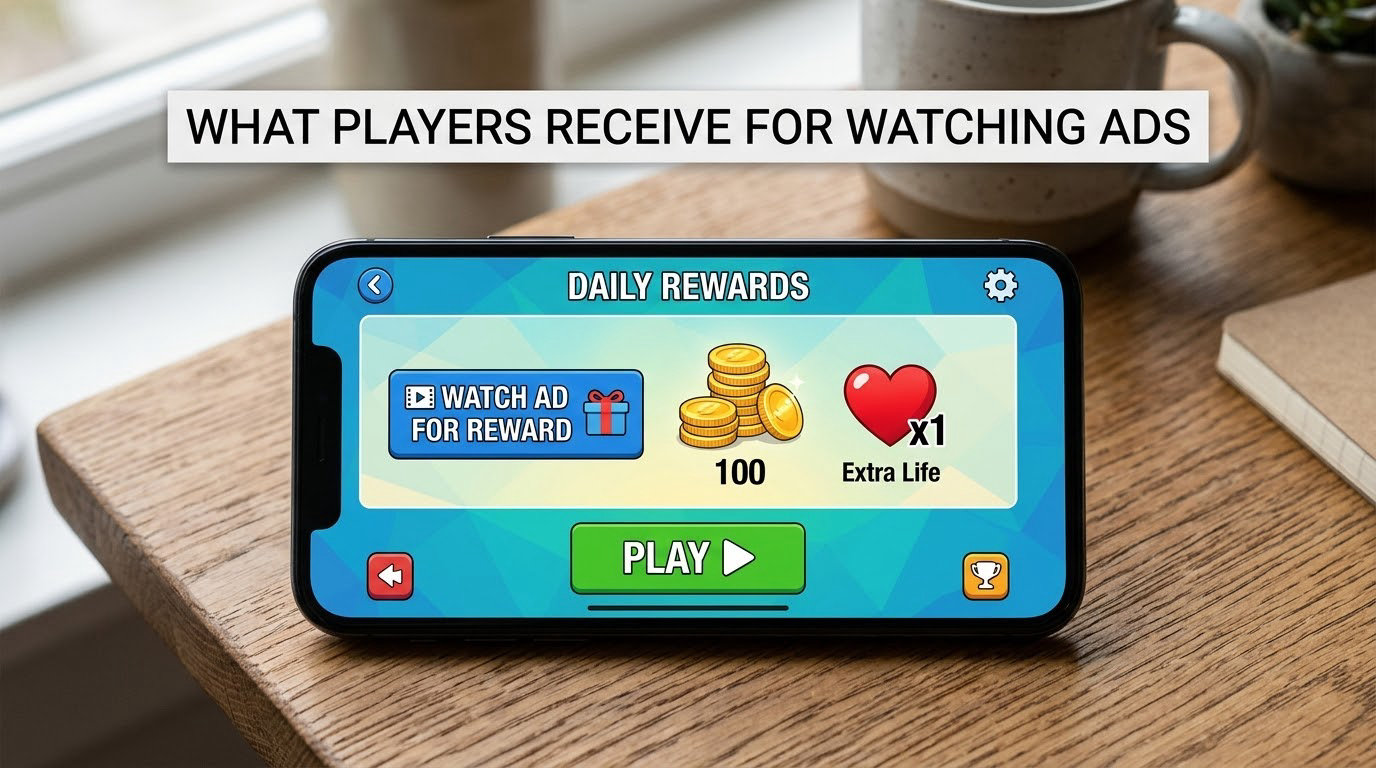
The classic list covers coins and premium currency, an extra life or a continue after a loss, a temporary boost such as double rewards for ten minutes, a trial of a locked item or character, and cosmetics that carry no gameplay advantage.
Revival after a loss is the one players notice most. Losing a run and watching an ad to keep going is a clean exchange: you spend 30 seconds of time for a second chance, and nobody is pretending the game was free to build.
Skippable ads work the same way in reverse. An interstitial you can dismiss after a few seconds leaves you with nothing, so a fast, visible skip button is what makes it tolerable at all.
Not every advert is worth your time, and it is fair to say so. A rewarded ad is optional and priced accordingly. A forced one is the publisher taking a cut of your session instead, which is a different deal entirely, and one that gets punished in the store ratings.
How Publishers Measure Ad Performance
Publishers count a handful of numbers, and each answers one question about whether the ads are working.
Impressions count how many times an ad was loaded and shown. Viewability checks whether a meaningful share of pixels actually appeared on screen, which stops invisible banner slots from counting. Fill rate is the percentage of ad requests that returned an ad rather than nothing.
Clicks and installs come next. On the buying side, the measure that matters is return on ad spend: revenue earned against what the campaign cost. Retention and purchase rate close the loop, because a player who stays for weeks is worth far more to an advertiser than one who uninstalls the same evening.
Attribution is the messy part, and it is messy for everyone. Something like an MMP, an AppsFlyer or Adjust instance, sits between the networks and the developer to decide which campaign caused which install, then passes that back so the advertiser can be billed.
For advertisers the tracking runs in the other direction, into the game rather than out of it. A conversion API sends events back to the ad platform, and campaigns optimise against a ladder of post-install milestones: install, then tutorial completion, then a deeper level, then a first purchase. The event a bid optimises for is the one it was taught to expect, which is why advertisers keep pushing developers to fire more of them.
Every layer of extra events has a cost, and creative volume is the other one. Teams ship new video concepts weekly because an ad that has run for a fortnight starts performing worse as players learn to recognise it, a pattern players themselves call ad fatigue and describe as ad blindness.
On iOS, SKAdNetwork handles this with delays and buckets rather than a single live event, so a developer sees grouped numbers instead of an exact trail. It is less precise and much harder to abuse.
One practical consequence shows up in the wrong place. When a game advertises a feature that does not exist, players notice and distrust the app, which shows up as worse retention. Creative teams argue for accuracy on those grounds alone.
Data, Privacy, and Targeted Mobile Ads
Personalising an advert means knowing something about you: your app habits, your approximate location, your device, and what you have already installed. On Android, an advertising ID is created with the device and an SDK inside the app can read it, pass it to a network and get a targeted creative back within milliseconds.
iOS tightened this. App tracking transparency now requires an explicit permission prompt before cross-app tracking, and most players tap deny, which leaves campaigns working from aggregated data such as SKAdNetwork rather than a personal profile.
A general audience estimate is something quite different from personal data. A campaign might be modelled to reach 25 to 44 year olds in a particular country without knowing who any individual is, which is contextual and aggregated targeting rather than surveillance.
What you control is limited but real. Denying the tracking prompt keeps you out of much of the personalised pool. Limiting ad personalisation in your device settings, clearing your ad identifier, and using an ad blocker all reduce how much of your behaviour is available. None of it stops rewarded ads inside games, because those are delivered inside the app rather than through your browser.
Frequently Asked Questions
How do ads on mobile games work?
When you reach an ad placement, the game sends a request to its mediation platform, which asks every ad network in its list to bid. The highest bid wins and its creative appears on screen. Your impression, view, click or install is recorded, and the network pays the developer on the agreed model. Rewarded ads are different only in that you tap to start them and the developer owes you a reward when it finishes.
How much do ads in mobile games pay?
Publishers measure it as eCPM, the money earned per thousand impressions. Developers reporting on developer forums cite a few dollars for rewarded video and around one for interstitials, though rates swing by country and time of year. Advertisers pay different rates again, commonly tens of cents per install for games, because they are buying a player rather than a view.
How do mobile games get away with fake ads?
Because the advert is judged on one number, usually the install rate, not on whether the promise is true. A puzzle game that advertises merging tiles may buy far more installs than an accurate creative, and the extra installs pay for themselves quickly. Players who arrive and leave do cost the studio, but slowly enough that the calculation still favours the misleading version.
How do I advertise my mobile game?
Set the goal first, whether that is installs, purchases or return on ad spend, because it fixes your cost model. Pick the networks your target players actually use, build a small set of video and playable creatives, and test them in short bursts rather than all at once. Track installs to post-install events such as tutorial completion so you optimise for players who stay, not downloads that churn.
What are the different types of mobile game ads?
Inside the game you will meet banner ads along the screen edge, interstitials that fill the screen between levels, rewarded video you opt into for a bonus, offer walls listing tasks such as install to earn, and native ads styled to blend in. Outside the game, on app store pages and social feeds, the dominant format is the playable ad, a small interactive demo billed per install.
How does ad mediation work?
Mediation is the layer that connects your game to many ad networks at once. In a waterfall, networks are ranked and tried in order, with each one often priced before the call. In bidding, every network is asked in parallel and the highest real-time bid wins, which usually lifts fill rate and eCPM at the cost of a little more setup work.
Conclusion
The short version: a developer gives the game away free, an ad network supplies paid adverts, a mediation layer decides which one wins each slot, and you decide how much of your attention to hand over in exchange. Formats that reward you for watching are usually worth your time, and forced full-screen breaks are the ones players resent.
So check three things when an ad appears. Was it optional, did it give something back, and did the game let you skip it quickly? Those three answers tell you what kind of business model you are playing, and the rest of the machinery stays hidden.