To know how to tell if a game is worth full price, divide what you will pay by the hours you expect to play, then judge how consistently good those hours feel. If that result matches what you would get from the same money spent on something else, the price is fair. That takes about twenty minutes of research, not a purchase.
Most of the difficulty is emotional rather than mathematical. A hyped launch trailer convinces you of things no trailer can prove, and the knowledge that the same game will be half price in a few months makes every full-price purchase feel slightly foolish. Waiting is a rational choice, and plenty of people on Reddit and the Steam forums treat it as one. This guide is about the opposite problem: how to buy with confidence when a game genuinely deserves your money, without guessing from hype alone.
I have gone back through my own library more than once with these steps, and the games I regret are almost never the expensive ones. They are the ones I bought on a friend’s enthusiasm and never opened.
Table of Contents
- 1What You Need
- 2Step-by-Step: How to Tell If a Game Is Worth Full Price
- 3How long should you play a demo before deciding?
- 4How to judge replay value beyond the review score
- 5Common Mistakes
- 6Frequently Asked Questions
- 7What is the 20 rule in gaming?
- 8What is the five dollar rule on Steam?
- 9Is sixty dollars a lot for a game?
- 10How do I see how many hours I have put into a game?
- 11Is it bad to wait for sales instead of buying at launch?
- 12Are short indie games worth full price?
- 13Conclusion
What You Need
Gather these before you judge anything. Without them you are guessing, and guessing is what produces a shelf of unopened games.
- The real price you would pay. Check the base edition, the console edition, and whether the game is already included in a subscription you pay for. Regional pricing means the number that reads as full price means different things in different places.
- The platform and system requirements. A game you cannot run at a steady frame rate is worth nothing to you, whatever the reviews say. Note the required storage, graphics card or processor, and whether it needs an expansion.
- A demo, prologue or free trial. Plenty of games ship one, and the free prologue bundled with a pre-order is often the honest part of the product.
- Review evidence from more than one place. The Metascore and OpenCritic numbers, a couple of written reviews, and a video playthrough that shows a full session rather than a highlight reel.
- Two length estimates. HowLongToBeat gives a main story figure and a completionist figure. You need both, because the gap between them is where most arguments about value live.
- The refund rules where you buy. Major PC storefronts generally allow refunds within fourteen days as long as you have played for under two hours. Console stores have their own windows and conditions.
- Your own limits. How much discretionary money this month, how many hours a week you actually game, and how large your unplayed pile already is. This part is the one people skip, and it decides more purchases than any review score.
Write your limits down before you look at scores. A game that scores brilliantly is a bad purchase if you will not open it for six months, and I have learned that the expensive way more than once.
Step-by-Step: How to Tell If a Game Is Worth Full Price
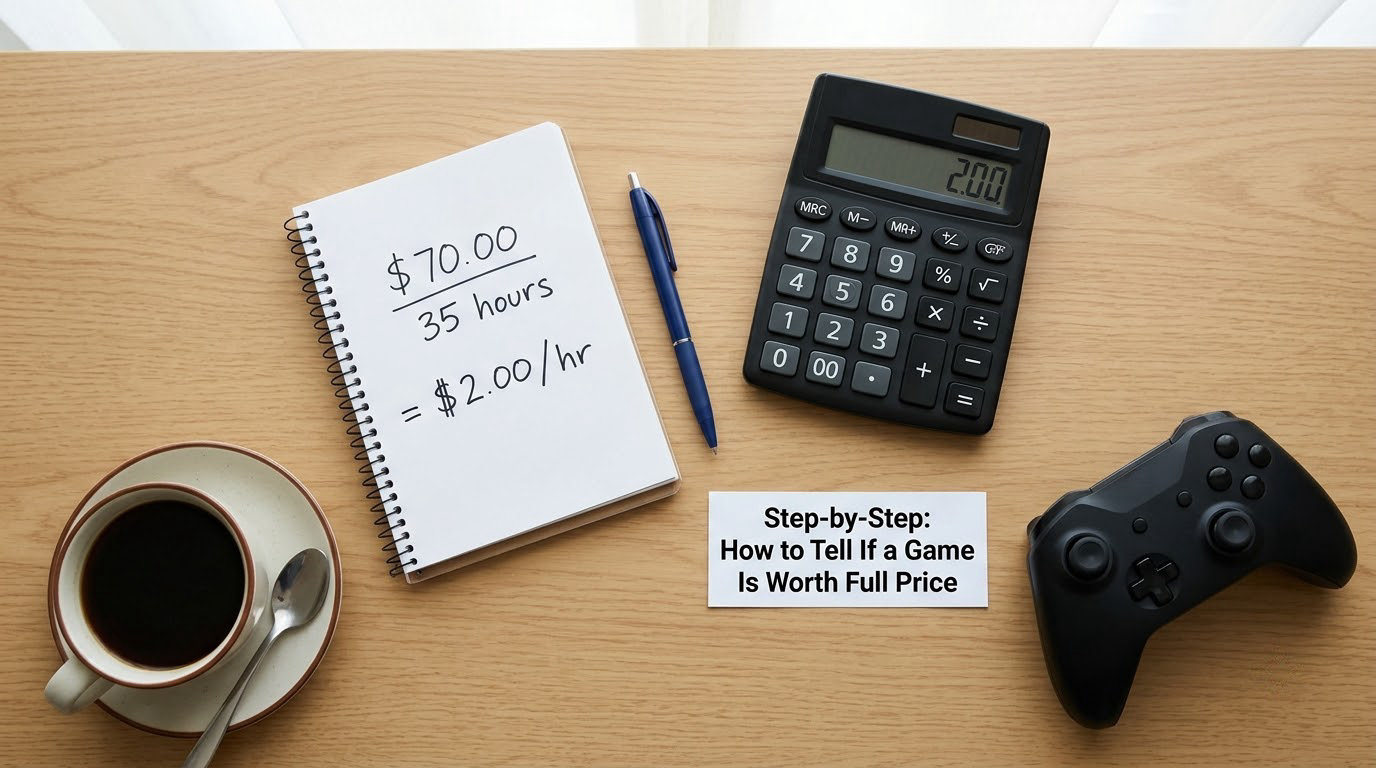
Run these seven steps in order. Each one depends on the answer to the last, which is why skipping ahead to the score tends to produce bad buys.
- Establish what you would actually pay. Not the launch price. Look at the base edition, the deluxe or complete edition, and the season pass separately, then add up what the extras cost on their own. If the complete edition bundles content you would never buy, its full price is not the number to compare against anything.
- Get a realistic hour estimate. Take the main story figure and add about a third of it for the natural stopping point most players reach, since completionist numbers assume optional side quests that most people skip.
- Divide price by those hours. A forty-hour game at the seventy-dollar price point lands near two dollars an hour. A twelve-hour game at the same price lands near six, and that number alone is a reason to investigate before you commit.
- Judge the quality curve, not the average. The average hides everything that matters. Find out how large the opening is, whether the difficulty keeps climbing, and how much of the back half is padding. A tight six-hour game beats a sluggish twenty-hour one far more often than the hour count suggests.
- Put your hands on it. Play the demo, trial or prologue and notice whether the first hour is representative or whether the developer has front-loaded everything interesting before the repetition sets in.
- Price the replay systems honestly. New Game Plus, branching endings, roguelike loops and multiplayer population all change the maths, but only if you will actually use them. Count them at zero by default and add them back when you are certain.
- Check whether waiting breaks the game. Online co-op, competitive population, seasonal content and the risk of delisting all argue for buying sooner. Single-player narrative with no online dependency argues for waiting. That single check resolves more arguments than the first six steps combined.
How long should you play a demo before deciding?
When you are working out how to tell if a game is worth full price, the demo is your cheapest test, so it is worth knowing how far into it you need to get. Two hours tells you whether the mechanics work and whether the art and performance hold up on your hardware. It tells you almost nothing about the back half, because most demos are cut from the opening and never touch the systems that decide whether a game stays interesting. Five to eight hours is the point where you can see progression curves, whether difficulty climbs or plateaus, and how quickly repetition sets in. A prologue behaves differently: it is a designed taste of the tone, so half an hour of it can be enough to rule a game out but rarely enough to rule one in.
My stopping rule: stop when you have reached a point where you would happily play another two hours without being asked to, or when you have hit the second mission that repeats the first with different numbers. Either result is a decision. If you cannot get past a single hour, the refund window is the safer test than a full purchase.
How to judge replay value beyond the review score
Reviews usually describe the first playthrough, so they are nearly silent on the thing you are buying when you buy at full price. Judge replay value on structure instead. Branching choices only count if the branches are mechanically different rather than a different final scene. New Game Plus counts more when it changes enemy behaviour or unlocks a new difficulty tier. Roguelike loops count a lot, because they are designed to be run many times. Multiplayer counts based on current population, which you can check before you buy rather than after. Mod support counts only if you have ever used mods. Difficulty modifiers and achievements count for almost nobody outside a small group of players, so treat them as zero.
The test I use is simple: after finishing the main path, can you name a specific second run you would start, and when? If the honest answer is never, the game is worth its first-run length only, and you should price it that way. On Reddit, users weighing in on this question converge on roughly fifty hours as the threshold where a game starts to feel like it delivered, even when they never finished the story. Treat that as a rough community marker rather than a law.
| Signal | How to read it | What it should change |
|---|---|---|
| Metascore and OpenCritic | A spread of more than ten points between them means reviewers disagree about what the game is | Watch a full playthrough before buying rather than trusting either number |
| Main story versus completionist hours | A huge gap means a thin core with a lot of optional work attached | Price the main story figure, not the completionist one |
| Hours-per-dollar result | Under one dollar an hour is cheap, one to two is normal, two to four is fine, over four needs a reason | Over four dollars an hour, wait unless replay systems are real to you |
| Demo or trial length | Long enough to show repetition tells you more than any score | A dull second hour outranks a high critic score |
| Developer track record | Studios with several shipped, respected games are a lower risk than a first attempt | For a debut project, wait for the first patch |
| Current player count and online features | Thin populations make co-op and competitive modes unplayable later | Buy sooner if the game needs other people to work |
That table is the short version of how to tell if a game is worth full price. Two of those rows change your answer more often than the rest: the hours-per-dollar result and the player population.
Common Mistakes
Buying on launch hype. Pre-release footage is chosen from months of work and cut to hide repetition. Reviews embargoed until launch day are written under pressure, and the first week of patches can change a game completely. If a game is not a live-service title with a community that needs day-one players, there is rarely a reason to be first.
Trusting a single review. One enthusiastic video can carry a game further than it deserves, and score bombing distorts aggregates in the other direction. Read two written reviews from outlets with different tastes, then check whether the Metascore and OpenCritic numbers agree. Disagreement tells you more than either number alone.
Judging from the first hour. Openings are the best part of a game, by design, and sometimes they are deliberately better than the game itself. Publishers know this too, which is why so many demos cover only the strongest ninety minutes. If you want an honest sample, look for a playthrough video that shows a mid-game session, not a launch trailer.
Ignoring system requirements. This is the most common pure waste. A game you cannot run smoothly is worth nothing at any price, and a discounted copy of an unplayable game is still a wasted purchase.
Treating length as quality. A long game is not a good game. Padding, fetch quests and repeated encounters inflate the hours without adding anything, and per-hour maths actively rewards padding. The stronger version of the calculation multiplies how good each hour feels by how many of them there are, so three excellent hours can equal thirty mediocre ones. That model comes from r/truegaming and it breaks the price-per-hour rule more often than not.
Forgetting editions and refunds. People frequently buy a deluxe edition that bundles DLC they would never have bought separately, which is how a seventy-dollar purchase becomes a wasted one. Read the bundle contents, and remember that the fourteen-day refund window with a two-hour playtime limit gives you a cheap way to test a game you were unsure about.
Waiting out of guilt, or buying out of it. Nobody owes a developer the first month of a game’s life. But do not use the discount as a reason to add a fourth game you will not finish to a pile of three you have not touched. Check the price history first, since the same price often appears three or four times a year on PC stores.
Frequently Asked Questions
What is the 20 rule in gaming?
The 20 rule is a community guideline, not an official policy: if you have twenty games you have not finished, stop buying new ones and clear the pile first. It exists because unplayed purchases compound faster than playtime does. Treat it as a spending brake rather than a judgement on your taste, and adjust the number to your own schedule. Someone with fifteen hours a week can hold a much larger backlog than someone with three.
What is the five dollar rule on Steam?
It is a personal spending rule that circulates on Steam forums: if a game costs more than five dollars at full price, wait for a sale rather than buying it now. The logic is that most PC games drop somewhere between twenty and eighty percent within six to eighteen months, and this rule makes you pay the sale price automatically. It works well for single-player games and fails completely for anything that needs an active player base or has a delisting risk.
Is sixty dollars a lot for a game?
It depends almost entirely on length and how consistently good those hours are. Sixty dollars across forty hours of consistently strong play is a fair deal by community standards. Sixty dollars across eight hours of a cinematic experience is steep, though not absurd if you enjoy that genre. The number that should worry you is the cost per hour of dull content, because that is the part you will not get back.
How do I see how many hours I have put into a game?
On PC, open your library, right-click a game and check the playtime shown on its page; the same data is on your profile and in Steam’s activity history. On PlayStation and Xbox, the store library shows hours played per title on the console itself. If you want an average across everything you own, add up the totals and divide by the number of games, which is a humbling exercise that tends to improve your buying habits.
Is it bad to wait for sales instead of buying at launch?
No. Waiting is the rational move for most single-player games, and treating it as a moral failing is what pushes people into impulse purchases they regret. Two things genuinely argue against waiting: online co-op or competitive modes that need an active population, and games at risk of being delisted or having features removed. Outside those cases, a six to eighteen month wait is the community default.
Are short indie games worth full price?
Very often yes. A focused game that delivers eight excellent hours can be worth more than a sprawling twenty-hour game that repeats itself, and plenty of acclaimed indies are priced well above what their length suggests because the production was small. Judge them on consistency of quality and on whether the design respects your time, not on the hour count. The one thing to check is whether a short length is a deliberate design choice or a sign of an unfinished release.
One more practical note, since subscription services change the maths entirely. If the game is already in a catalogue you pay for monthly, the price you are weighing is not the full price at all. Add up a year of your subscription against the three or four games you would have bought from it, and the correct answer is often to do nothing. Many players buy a game at full price while it sits in a service they already pay for, which is the most expensive mistake on this entire page.
Conclusion
Start with the demo, then confirm the system requirements, then divide the price by realistic hours and check whether the online features need you to buy now. That is how to tell if a game is worth full price, and it takes less time than the trailer you were about to watch for a fifth time. If the maths lands in the normal range and the hands-on sample holds up, buy it without apology. If it lands high, check the price history and wait, because most games are meaningfully cheaper within a year.