Gear score is a single number a game calculates from the equipment your character has equipped. It summarises how strong that set is supposed to be, and it is usually the thing standing between you and a locked door. Updated for October 2026.
Understanding how gear score systems work matters because the number is a proxy, not a promise. It can tell you roughly where you stand in ten seconds, and it can also lie to your face when you equip a clearly better item. This guide covers how the maths works, why scores drop, and how to raise yours without wasting a night on the wrong upgrade.
Game systems change with patches, so treat the numbers in any guide, including this one, as current-to-date rather than permanent. The underlying mechanics rarely change though.
Table of Contents
- 1What Is a Gear Score System?
- 2How Do Games Calculate Gear Score?
- 3Step 1: the base value of an item
- 4Step 2: modifiers on that item
- 5Step 3: combining the slots
- 6Where gear score systems work differently across games
- 7What Do the Main Gear Score Components Mean?
- 8Item level
- 9Rarity
- 10Substats and their weights
- 11Upgrades, sockets and enchantments
- 12Set bonuses
- 13Temporary and percentage bonuses
- 14Caps
- 15Does a Higher Gear Score Always Mean Better Gear?
- 16How gear score systems work when your build does not match the score
- 17How Can You Improve Your Gear Score?
- 18How Do Gear Scores Affect Matchmaking?
- 19How Do You Read Gear Score Before Upgrading an Item?
- 20Frequently Asked Questions
- 21What is a gear score system?
- 22How is gear score calculated?
- 23Is a higher gear score always better?
- 24What is the highest gear score in World of Warcraft?
- 25Does raising gear score in Ghost Recon Breakpoint improve your loot?
- 26What determines the gear score new drops arrive at?
- 27Conclusion
What Is a Gear Score System?
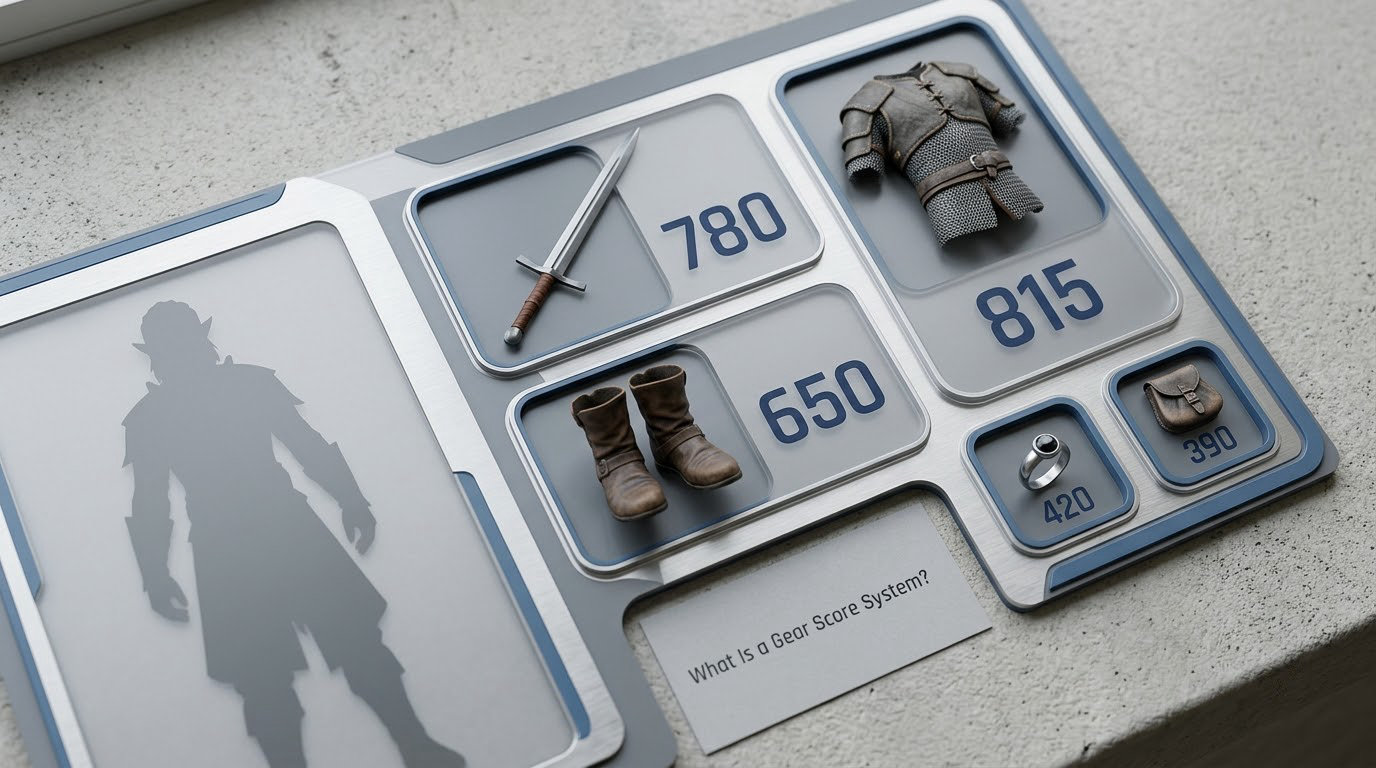
A gear score is one number that a game calculates from the gear your character currently has equipped, used to summarise how strong that gear set is supposed to be. It is often the value that decides which content you are allowed to enter.
That is different from your character level, which counts how much experience you have put in, and different again from rarity, which is a label on an item. Gear score sits above both of them and below actual combat performance.
You meet it in three places: the character panel where your total is printed, the item tooltip where each piece shows its own value, and the group finder where someone screens applicants by it. That last use is the one that shapes how people play.
The idea is simple. A player who cannot parse six stats and work out a weighted sum deserves one number that tells them whether they are ready for the next dungeon. The trouble is that developers then use that same number as a hard gate, a ranking, and a loot filter, and a proxy rarely survives all three jobs.
How Do Games Calculate Gear Score?
Every gear score system is a version of the same three-step recipe: assign a value to each item, adjust it for the upgrades on that item, then combine every slot into one character total. The steps are simple. The variation between games is where the confusion starts.
Step 1: the base value of an item
Most systems start from item level. Item level, often written ilvl, is a tier label the drop table assigns to a piece of gear. Item 200 in a mythic dungeon is worth more to the maths than item 160 in a starter zone, and that ordering is fixed by the game, not by how good the stats on it feel to you.
Step 2: modifiers on that item
The base value then gets adjusted by rarity colour, upgrade or enhancement level, socketed gems, enchantments and reforges. Hypixel SkyBlock is unusually explicit about this: its wiki lists reforges, enchantments, star upgrades and the Recombobulator among the modifiers that feed the number, and states that the score has no effect on the actual stats of an item and is capped at 5000.
Step 3: combining the slots
The game either adds the values together or averages them across the slots you have filled. Adding rewards equipping everything, averaging punishes empty slots instead. Which one a game uses changes what the number rewards, so the same total can mean very different builds.
Where gear score systems work differently across games
The table below compares what actually feeds the total in the systems players ask about most.
| Game | Main input | Modifiers counted | What the total is used for |
|---|---|---|---|
| World of Warcraft (Wrath era systems) | Item level and weighted substat rolls | Enchantments, reforging, gems, set pieces | Content gates and raid applicant screening |
| The Division | Roll quality on each item | Upgrade paths, recalibration, sets, brand and gear perks | Checking whether you are ready for a checkpoint |
| Hypixel SkyBlock | Dungeon armour and weapons | Reforges, enchantments, star upgrades, hot potato books, Master Stars | A pure comparison metric, capped at 5000, with no effect on item stats |
| Dark and Darker | Item tier and rarity | Upgrades and enchant-like rolls | Notoriously treated by players as a poor stand-in for power |
| Ghost Recon Breakpoint | Weapon and gear tier | Upgrades and level bonuses | Drop quality, since higher gear scores raise what you find |
| Ragnarok Landverse | Equipment stats and enhancements | Enchantment bonus, weapon refinement, card score | Server rankings, job class changes and map entry requirements |
| Pantheon | Item levels and gear scores, with HP and AC counted alongside | Upgrades and scaling as levelling continues | Player-versus-player matchmaking and progression |
That table is the honest answer to how gear score systems work across titles. Same idea, different weights. A number from one game means nothing in another, which is why arguments about thresholds usually end with someone quoting a wiki table at the other person.
What Do the Main Gear Score Components Mean?
Once you know what feeds the total, you can read any score instead of just staring at it. These are the components worth checking in almost every game.
Item level
The tier of the item and the backbone of most formulas. It is also the component most likely to mislead you, because a higher item level from the wrong source can score worse than what you are wearing.
Rarity
The colour of an item. Rarity feeds most systems as a multiplier or a flat bonus, and in loot shooters it often tracks how close the roll sits to the maximum value for that tier.
Substats and their weights
Substats are the numbers on a rolled item, such as crit chance or health. Games weight them differently by slot, and a stat that is excellent in a helmet can be nearly worthless in a ring. This is the part that makes gear score feel arbitrary until you see the weights.
Upgrades, sockets and enchantments
The upgrade path is often the cheapest score available. An item already in your slots that you push three more steps can move your total further than the drop you have been farming for a week.
Set bonuses
Wearing two or four pieces from one set can add a chunk of score in some systems and nothing in others. In World of Warcraft add-on communities, players have historically mixed and matched set pieces from different specs purely to chase a higher number, which tells you how much the metric drives behaviour.
Temporary and percentage bonuses
Food, potions, boosts and percentage contributions can move the score without changing a single item. Always note whether the number in front of you is a base score or a boosted one, because raid leaders screen on different ones.
Caps
Some statistics stop being useful at a certain point, and some scores stop rising entirely. Hypixel caps gear score at 5000, and World of Warcraft has soft caps on individual stats that make raw values misleading. A score that ignores caps is measuring roll quality, not performance.
Does a Higher Gear Score Always Mean Better Gear?
How gear score systems work when your build does not match the score
No, and the exceptions are where most of the interesting decisions live. A higher score means the average item in your bags is closer to the top of its roll range. It does not mean you are stronger, healthier, or better at the fight in front of you.
Players on r/thedivision put it plainly: gear score is just a gauge of how close to max your stats are, and it is up to you as a player to decide what is actually better or worse. Players on r/DarkAndDarker take the harsher line and call gear score a poor system that does not actually represent player power, and their experience is that geared veterans regularly beat high-score beginners.
Five things make a high score a weak signal:
- Diminishing returns. Once a stat passes its soft cap, more of it produces almost nothing in real fights.
- Side stats. Two items with identical scores can carry completely different crit, sustain or utility values.
- Class fit. Gear scored for another class can out-score your best option while doing nothing useful for you.
- Set requirements. A four-piece bonus can make a lower-scoring set the correct choice for the fight.
- Caps and PvP-only stats. Scores that ignore caps mean two players at the same number can have very different power.
Even the reference pages are careful here. The Warcraft Wiki describes gear score as a numerical value based on the statistics of a player’s gear and immediately qualifies it as supposedly the maximum potential of a player’s performance.
The best use of the number is comparative and narrow: two characters, same encounter, same patch. Anything broader and you are asking a proxy to answer a question it was never built for.
How Can You Improve Your Gear Score?
Work through these in order. Skipping to the last one is how people end up grinding for a week for a drop worth less than the upgrade sitting in their bags.
- Find your worst slot. Total score is built from every piece, so the cheapest points come from the weakest item, not the newest. One ring at 70 dragged a character’s total down more than every other slot combined in cases players have described on r/wotlk.
- Push existing items to their cap. Upgrades, enhancements and reforges usually convert straight into score without any RNG involved.
- Complete a set bonus. If two pieces are already worn, the matching piece often jumps more than its raw value suggests.
- Check the weighting for your slot. When you have a choice between two items of similar value, take the one whose substats your class weights heavily.
- Use boosts only for the check that needs them. A temporary buff is perfect for a ready check and pointless for a progression target.
- Then farm, with the drop rule understood. Several games scale new drops to your highest equipped item rather than your average, so leaving a big piece equipped can raise what you find. A GameFAQs notice about that rule has long advised players they do not have to equip their highest level gear.
Before you farm, open the score breakdown. Most add-ons and menus will show per-item values, and the cheapest improvement is almost always visible once the numbers are laid out side by side.
How Do Gear Scores Affect Matchmaking?
Matchmaking is where a proxy metric turns into a hard rule, and where players feel it most. Queue up in a looter shooter and the game pairs you with players inside a score band, so your team is as geared as you are whether you like it or not.
In MMO groups, the score shows up as a ready check. A raid leader reads the applicants, sorts by score, and invites upward. r/wotlk has players describing the other side of that coin: taking a break, coming back, and being told no to everything because an invisible number was too low.
Some communities have pushed back hard enough to matter. On r/newworldgame, players describe gear score as a cop-out and an easy way for developers to gate content behind artificial walls to prolong achievement. That criticism lands because the number is opaque by default. When a game publishes its weights and its caps, as Hypixel does, the complaints tend to quiet down.
The compromise most developers land on is to hide the power calculation. Your character sheet shows a friendly number, the matchmaking service ranks by real stats behind the scenes, and the score stays as a progress bar rather than a gate. When a score gate blocks you and the game offers no way to see why, treat the score as a symptom rather than a verdict, and look for a simulator or a damage parser instead.
How Do You Read Gear Score Before Upgrading an Item?
This is the five-minute routine that stops expensive mistakes. Run it before you commit upgrade materials, reforge stones or a salvaging decision.
- Compare the item values, not the colours. A legendary that scores below your equipped rare is a real outcome in most weighted systems.
- Look at the substat weights for that slot. If the new item wins on stats your class ignores, the score gain may be cosmetic.
- Check whether you are at a cap on anything that matters. Upgrading a capped stat wastes the resource.
- Test the set bonus. Compare the four-piece effect against the single-piece upgrade before you decide.
- Recalculate your total before committing. Many add-ons and menu previews show the new character total without equipping anything.
After that, apply one rule from the sections above: gear score does not measure damage, healing or survivability. If you have access to a simulator, a damage parser or a recording of your own play, those tell you more than the number does.
Frequently Asked Questions
What is a gear score system?
A gear score system turns the equipment your character has equipped into one number that summarises how strong that gear set is. Each item gets a value based on things like item level, rarity, upgrade level and weighted stat rolls, and those values are added or averaged into a character total. The game then uses that total for progress tracking, content gates, ready checks or matchmaking.
How is gear score calculated?
It is a three-step process. First each equipped item gets a base value, usually from its item level. Second that value is adjusted for rarity, upgrades, gems, enchantments and reforges. Third the game combines the slots into a single total, either by adding them together or averaging them. The exact stat weights differ per game and usually per slot, which is why scores are not comparable between games.
Is a higher gear score always better?
No. A higher score usually means your items sit closer to the top of their roll range, not that you perform better. It ignores stat soft caps, class fit, set bonus value and PvP-only stats, so two characters with the same total can have very different power. Players on r/DarkAndDarker and r/thedivision both argue the number is only a rough gauge, and their practical advice is to compare the stats your build actually uses.
What is the highest gear score in World of Warcraft?
It depends on the version, because World of Warcraft dropped gear score as a core system after Cataclysm in favour of item level, and add-ons such as PlayerScore have filled the gap since. In the Wrath era systems, which are the ones most players mean by this question, scores were in the low thousands for endgame gear and the community still argues about the ceiling. Check your expansion and patch before trusting any threshold you read.
Does raising gear score in Ghost Recon Breakpoint improve your loot?
Yes, that is the main practical reason to care about it in Breakpoint. Drop quality scales with the gear score your character is equipped at, so raising the score raises what you find. You can toggle the score display on or off, but it keeps doing the same job either way, which is why players recommend leaving it visible and focusing on the upgrades with the largest jump.
What determines the gear score new drops arrive at?
Usually a scaling rule tied to what you have equipped rather than what you have cleared. Several games scale drops to your highest equipped item instead of your average, which means a single oversized piece can raise the quality of everything you find afterwards. The scale is tied to the item level of your best gear, so once you push that number up, new drops start arriving in a higher band.
Conclusion
Start by opening the score breakdown rather than the total. Look at the per-item values, find your weakest slot, and check the stat weights for that slot before you commit an upgrade or a reforge.
Then remember what the number is for: a fast comparison between two characters in the same patch. It is a good proxy for how close your rolls sit to maximum and a poor proxy for damage, healing or survivability. When the choice is close, judge the stats your build uses.