A realistic gaming goal is one you can still hit in your worst week of the month, not your best. That usually means a single campaign finish, a rank climb with a fixed end date, or a set number of dungeon clears rather than a season of everything at once. Here is how to set realistic gaming goals in about fifteen minutes, then five minutes a month to keep them honest.
Most failed goal lists fail for boring reasons. They get written on an enthusiastic Sunday, sized for a week with no work stress, and then they meet a deadline, a bad patch and a surprise release in the same fortnight. Players who write their goals down tend to finish somewhere between half and two-thirds of them, which reads as failure unless you planned for it.
Table of Contents
- 1What You Need
- 2Step-by-Step: How to Set Realistic Gaming Goals
- 3How to Set Realistic Gaming Goals for One Play Cycle
- 4Check Your Starting Point and Available Time
- 5Break the Goal Into Playable Actions
- 6Define a Measurable Completion Rule
- 7Track Progress Without Obsessing
- 8Review, Adjust, and Reward the Result
- 9Examples of Realistic Gaming Goals
- 10Common Mistakes
- 11Frequently Asked Questions
- 12How long should a gaming goal take?
- 13What should I do after missing a gaming goal?
- 14Are daily gaming goals better than weekly goals?
- 15How can I set a realistic goal in a competitive multiplayer game?
- 16Can gaming goals improve motivation without causing burnout?
- 17Conclusion
What You Need
You need five things, and all of them are free. The first is a baseline: where you actually stand right now in the game you care about.
The second is a weekly time budget in hours, decided before you write any goal. Third is one meaningful outcome, not a wish list. Fourth is a short review date on the calendar. Fifth is a tracker, and a notes app or a plain spreadsheet does everything you need.
Paid goal apps, elaborate dashboards and productivity systems are a waste of money here. If the tracking takes longer than ten minutes a week, you will stop doing it, and a system you abandon tells you nothing.
Step-by-Step: How to Set Realistic Gaming Goals
The process runs in six steps: define the outcome, audit your starting point, break it into actions, write a completion rule, track it lightly, then review and adjust. Each step exists because skipping it is the most common reason a goal quietly dies.
How to Set Realistic Gaming Goals for One Play Cycle
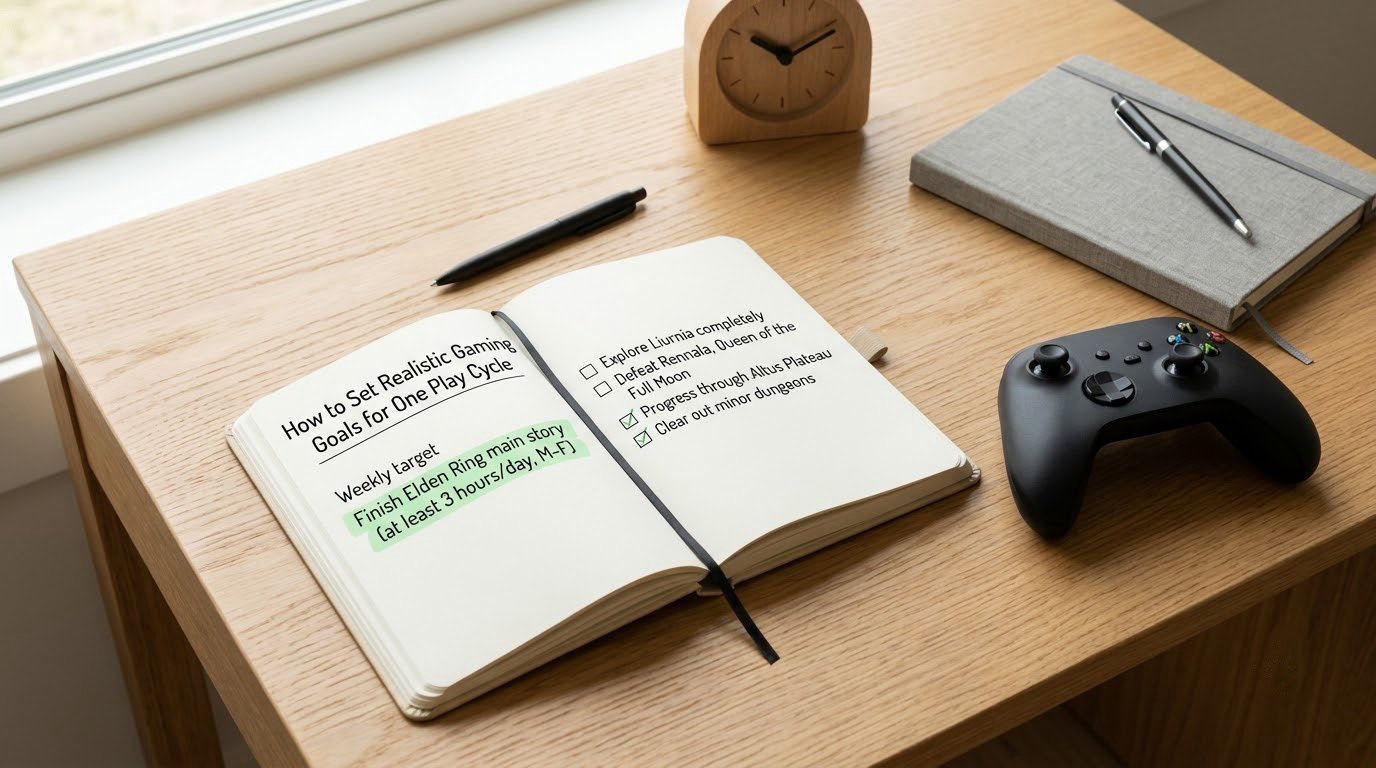
A realistic goal fits one play cycle, which for most people is a week or two. Write one primary outcome and one or two supporting ones, then stop. Anything past three starts competing with itself.
Keep it outcome-shaped, not perfection-shaped. “Finish three dungeon clears at difficulty eight” is a goal. “Finish the entire expansion without dying” is not, because dying is the game.
You know this step worked when you can say the goal out loud in one sentence and someone who plays the game would understand it.
Check Your Starting Point and Available Time
Record your current rank, win rate, quest completion, collection progress or hours cleared before you pick a target. Then write down how many hours a week you will realistically play, working around work, school, sleep and everything else already in the calendar.
Most people overestimate here, and they overestimate most badly after a good weekend. The honest number is your average over the last month, not your best week.
If your plan needs fifteen hours a week and your average is five, shrink the goal now rather than discovering it in week three. This step worked when your target is smaller than the time you have and you are not hoping for a quiet week.
Break the Goal Into Playable Actions
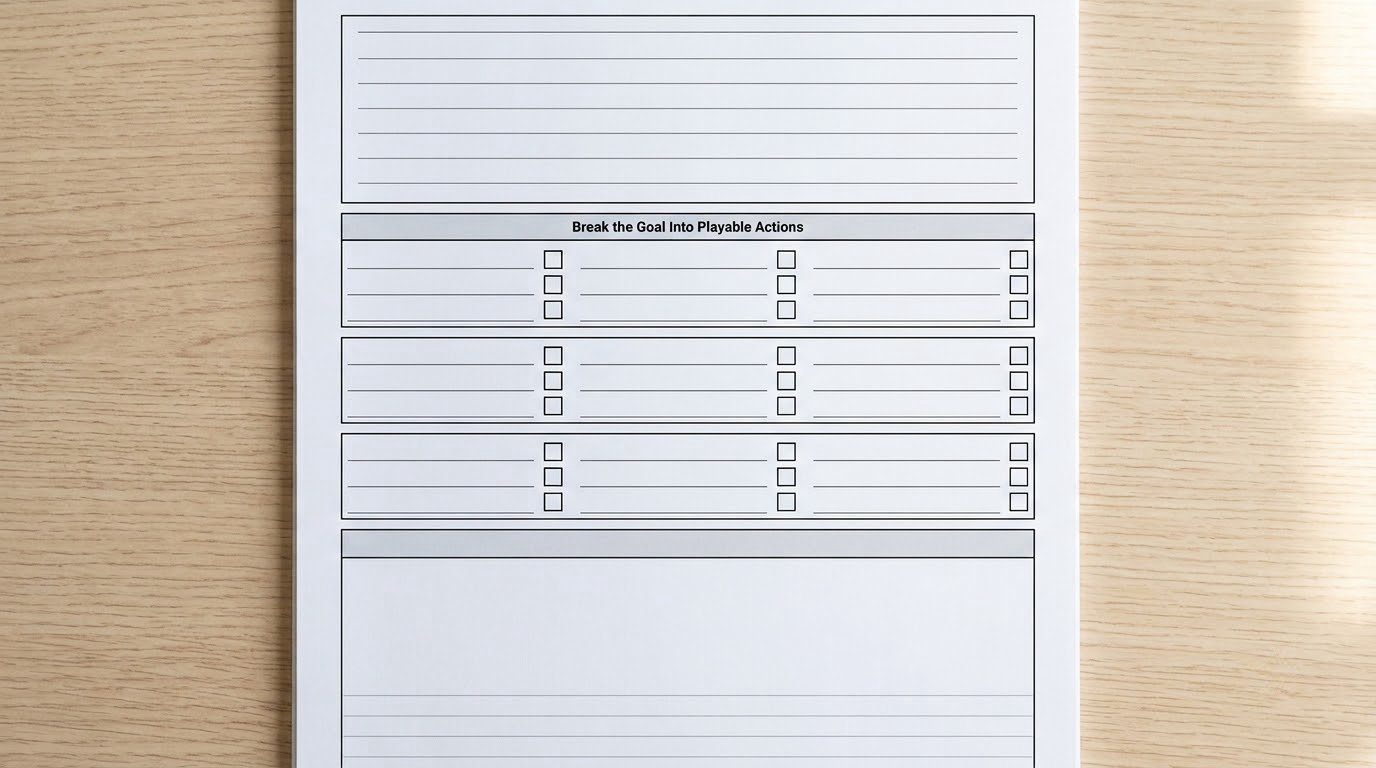
Turn the outcome into actions that can start in your next session. For MMO progression that might be two hours of story quests on three specific nights. For PvP it might be two ranked sessions plus one review of a loss. For a browser game or a completionist run, it might be a checklist of five side objectives.
Social goals count too: two clan nights, one night of playing with a friend you have not queued with in months.
Add a checkpoint that proves movement happened, such as a rank number, a quest count or a timestamped session log. It worked if your next session has a clear first action rather than a vague intention to play.
Define a Measurable Completion Rule
Write down what counts as complete, what does not, and what happens when a session gets cut short. “Complete” might be three ranked wins at or above your current rank, five sessions logged, or a campaign finished on normal difficulty.
Decide in advance that two of three wins on an interrupted evening still counts as a partial success, and that partial successes are data, not failure. Vague goals built on feelings cannot be reviewed, and that is why they collapse.
This step worked when someone who is not you could read your rule and agree on whether you hit it.
Track Progress Without Obsessing
A weekly check-in of four fields is enough: actions completed, notable results, blockers, and time actually played next to time planned. Ten lines in a notes app on a Sunday evening will do it.
Ignore the noise. A single bad session, a one-match win rate swing and a night of bad aim mean nothing on their own, and reading too closely into them is how a hobby turns into a second job.
The real signal is the gap between planned and actual hours. A growing gap is a scheduling problem, not a discipline problem, and once you know how to set realistic gaming goals it becomes the first number you check rather than the last.
Review, Adjust, and Reward the Result
Review on the date you picked, not whenever guilt reminds you. Write down one thing to keep, one thing to change, and one thing to drop.
If you hit the goal, carry the same actions into the next cycle rather than raising the target immediately. Partial success means the goal was slightly too large, so shrink the number by about a quarter. Missing it because of a new job, exams or illness is a scheduling failure, so keep the goal and cut the time it assumes.
Then use whatever time you saved on the game itself, not on the next goal. Once the checklist becomes the point, it replaces the thing you actually liked about playing, and that is how a hobby quietly stops being fun.
Examples of Realistic Gaming Goals
The pattern is the same everywhere: one game, one number, one date. These pairs show how vague goals become usable ones.
- Multiplayer progression: “Get through the current season” becomes “finish this season’s battle pass and hit rank 40 by the season end.”
- MMO progression: “Max my character” becomes “reach the next two levels and clear the weekly raid once a month for the next three months.”
- PvP improvement: “Get better at the game” becomes “play six ranked matches a week, review two losses, and climb one rank tier by the end of the month.”
- Browser or casual play: “Finish everything” becomes “clear the seasonal pass and the story chapters, about forty minutes on three evenings a week.”
- Backlog: “Beat my backlog” becomes “finish one game from the shelf this quarter, and pick two more for next quarter.”
- Completionist runs: “Get the platinum” becomes “finish the main story and the minimum required side content by a date, with optional trophies pushed to a later cycle.”
- Social play: “Play more with friends” becomes “two fixed group nights a week, protected in the calendar, with one new person invited monthly.”
- Time-limited balance: “Play less” becomes “cap sessions at two hours on weeknights and keep Sunday for a longer block.”
A player who set fifteen goals in a single year and finished eleven of them did not have a motivation problem. Work got heavier, two of the goals depended on a group that stopped queuing, and the review notes said so. Half to two-thirds is a normal year, and the review note is the part worth keeping.
Common Mistakes
Setting several major goals at once. Three goals is usually the ceiling. Beyond that, one bad week eats all of them, and you lose track of everything.
Copying another player’s schedule. A creator with eight free hours a week is not evidence that eight hours exist in your life. Build from your own average week.
Measuring progress by hours alone. Ten hours of aim training is not the same as ten hours of queueing. Measure the action you meant to improve.
Leaning on streaks. Missing one day and the streak is gone feels like evidence you failed at something. Weekly totals survive bad Tuesdays.
Treating one bad session as a verdict. A rough night is noise. Only the trend across the cycle counts.
Never lowering a target. Goals should shrink when hours shrink. The point is steady progress, not a personal best every month.
Motivation comes back after a rest day, not after a self-imposed penalty. Put one night a week in the plan where gaming is not allowed, and keep it there.
Frequently Asked Questions
How long should a gaming goal take?
Most goals work best on a two-week cycle, with a monthly review. Anything shorter than a week is hard to measure honestly because one bad session skews the numbers, and anything longer than a quarter stops being a target and becomes a vague direction. Seasonal goals like rank climbs work at twelve weeks, but they still need weekly checkpoints underneath.
What should I do after missing a gaming goal?
Decide why you missed it before changing anything. If your available hours dropped because of work, illness or study, keep the goal and cut the time it assumes. If the goal itself was too big, shrink the number by about a quarter. If you simply lost interest, that is data too, and dropping the goal counts as resolving it rather than failing it.
Are daily gaming goals better than weekly goals?
Weekly goals are better for almost everyone. Daily targets fail the first time work runs late or a friend needs you, and the broken day tends to end the whole attempt. Use daily actions inside a weekly goal instead, so a missed Tuesday costs you one action rather than the entire week. Reserve daily checkboxes for habits that genuinely take minutes.
How can I set a realistic goal in a competitive multiplayer game?
Start from a rank or win-rate baseline rather than a feeling, then pick one climbable target with a date. Budget hours for ranked play and review separately, because playing more is not the same as improving. Check progress every three weeks against your rank history, and pick a tier you can still hold at the end rather than one you spike into once.
Can gaming goals improve motivation without causing burnout?
Yes, when the goal is small enough to survive a bad week and you review it on a fixed date. Burnout usually comes from goals sized to your best week, combined with streak pressure and no rest day. Keep one night a week gaming-free, review monthly instead of daily, and treat a missed target as data to adjust rather than a verdict on yourself.
Conclusion
Do one thing tonight: write down your current baseline, choose a single measurable outcome for the next seven days, and put a fifteen-minute review in your calendar. That is the whole system, and it costs less time than one bad session.
Realistic gaming goals support steady progress rather than constant intensity. They still let you finish something, still give you a reason to log on, and still leave the game as the reason you play instead of a report card you dread. Review them on a fixed day each month, and let them shrink when your life does.