Knowing how to use replays to improve is mostly about asking one question before you press play: what do I want to see that I could not see live? Replay analysis means watching a saved recording of a match, pausing seconds before the moments that decided it, and writing down the one or two habits that keep costing you. One reviewed match for every five to ten played, at 15 to 30 minutes each, is enough to move a rank. Sitting through full games with no question in mind is what most players call reviewing, and it teaches nothing.
That last point is the whole problem. Watching replays feels productive, so it gets done while you are tired and a little tilted, and the session turns into a highlight reel with no notes attached. The method below is built to avoid that.
A note on scope first: replays, VODs and match recordings are the same idea in most communities. Native replay files give you speed controls and perspective switching; a screen recording gives you everything that happened on your monitor and nothing from the other nine players. Both work. What matters is the question, the pausing, and the written note.
Table of Contents
- 1What You Need
- 2A replay file or a recording of the full match
- 3A viewer with speed and perspective controls
- 4A note log that survives more than one match
- 5The patch version the match was played on
- 6Where to find replays, by game
- 7Step-by-Step: How to Use Replays to Improve
- 8Choose a Match That Exposes a Specific Problem
- 9Watch Once Without Pausing
- 10Mark Decision Points and Repeated Mistakes
- 11Compare Positioning, Timing, and Choices
- 12Turn Findings Into a Small Practice Plan
- 13Review Your Progress With a Follow-Up Replay
- 14Common Replay Mistakes and Better Alternatives
- 15Frequently Asked Questions
- 16What should I look for first when reviewing a game replay?
- 17Is it better to review a win or a loss?
- 18How long should I spend analyzing one replay?
- 19Can studying opponent replays improve my own gameplay?
- 20How do I know whether my replay analysis actually made me better?
- 21What if my game does not save replays automatically?
- 22Conclusion
What You Need
Four things, and three of them are free.
A replay file or a recording of the full match
If your game saves replays natively, check where they live and how long they last before you need them, because several titles expire them. If it does not, set up a screen recorder before your next session. A 1080p capture at 60 frames per second is more detail than almost anyone needs, and it is the difference between reviewing your own decision and reviewing a smear of pixels.
A viewer with speed and perspective controls
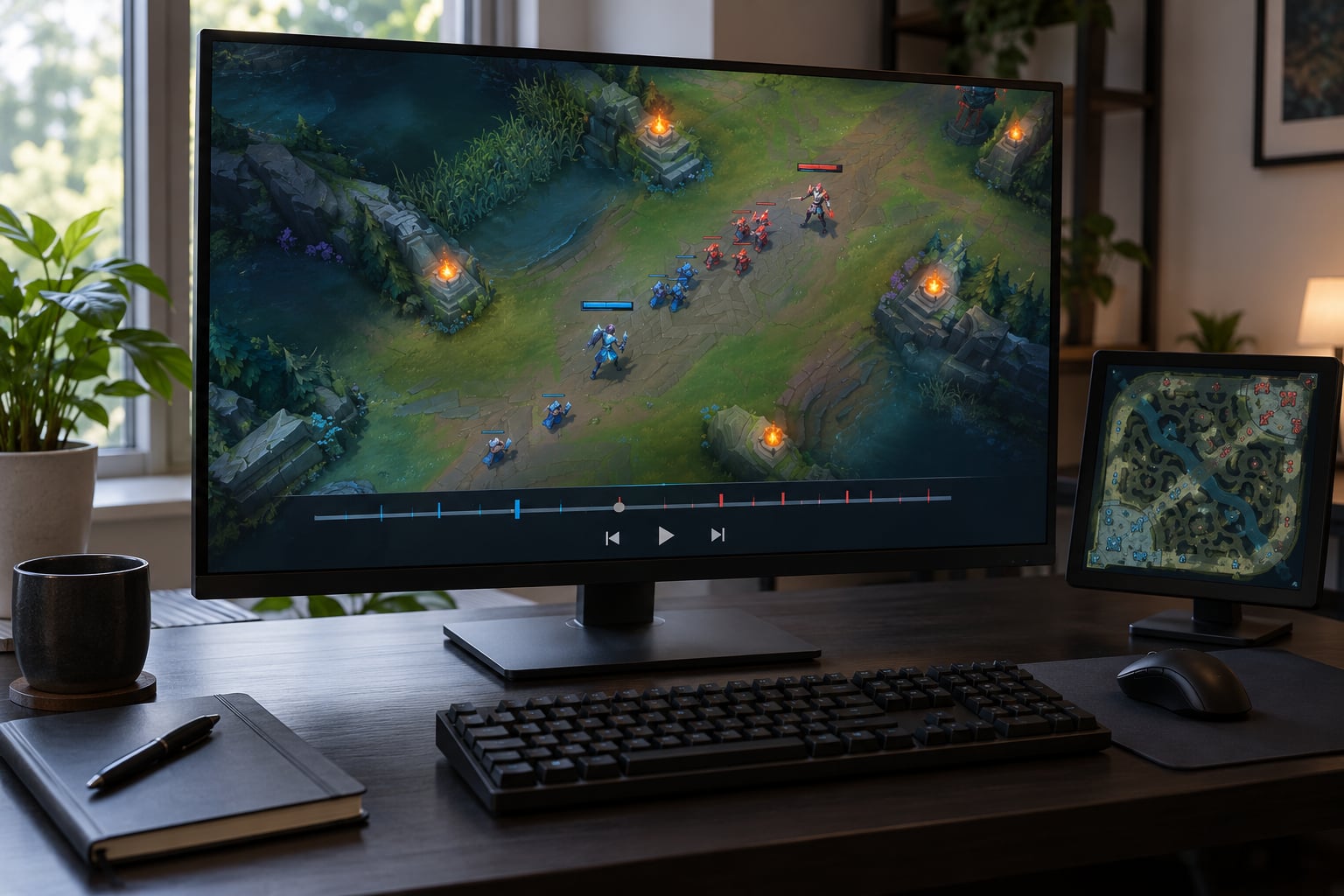
Native replay viewers give you slow motion, frame-by-frame stepping and the ability to jump into another player’s camera. That last feature is the one most players never touch, and it is also the one that fixes the biggest blind spot in review: you cannot see your own positioning error from inside your own eyes. Watching the same fight from a teammate’s view usually explains in ten seconds what an hour of scrubbing from your own perspective cannot.
A note log that survives more than one match
Use anything that keeps a running list. A phone note, a spreadsheet, a shared doc with your stack. The structure matters more than the tool, and five columns is enough:
| Time or objective | What I saw | What I should have done | Tag | Did I fix it later? |
|---|---|---|---|---|
| 8:20 first blood | Crossed the river alone to contest a warded lane | Hold jungle and let the wave arrive first | Positioning | No, repeated at 12:40 |
| 2v2 at 14:05 | Ability used second, after the opponent engaged | Trade first, then disengage | Timing | Yes, next match |
The last column is what turns a note into a habit check. Without it you are collecting observations, and observations do not change how you play.
The patch version the match was played on
Meta shifts fast enough that a two-month-old replay can be misleading. If you are about to copy positioning that a pro used eight patches ago, check that it still works today. Write the patch number in the note header and you will stop re-learning things that stopped existing.
Where to find replays, by game
| Game | Native replay | How to open it | Focus the review on |
|---|---|---|---|
| Dota 2 | Yes | Watch menu, or download the replay file from your match history | Item timings, farming patterns, where you were standing at each fight |
| League of Legends | Yes, expiring | Match history, then the replay button; older clips can expire | Wave control, roam timings, teamfight positioning |
| Counter-Strike 2 | Save as demo | Demos are not kept automatically, so download and store them | Utility usage, spacing, how you entered the site |
| VALORANT | No full system | Record your screen; use a stats site for the numeric side | Crosshair placement, timing, comms |
| Apex Legends | Limited | Short highlight clips, or a full screen recording | Zone damage taken, fight choice, rotations |
| Fortnite | No | Screen recording or post-match stats page | Build order, piece control, structure choice |
| Rocket League | Yes | Replays tab, pick a match and jump to the last goal | Boost spent at the moment of contact, defensive spacing |
| StarCraft II | Yes | Replay menu, then load the file | Production before the attack, supply, positioning on the map |
| Street Fighter 6 | Yes | Replay theatre, frame data visible in training mode | Frame disadvantage after blocked moves, anti-air priority |
| Overwatch 2 | No | Replay system has been unreliable, so record instead | Cooldown management, sound cue use, target priority |
If your game is not on this list, the fallback is the same: capture the screen, then work with what you captured.
Step-by-Step: How to Use Replays to Improve
Choose a Match That Exposes a Specific Problem
Pick the replay by the question you want answered, not by the result. A loss that tilted you is the worst possible choice for a first review, because you are already angry and you will go looking for someone to blame. The highest-signal replays are ordinary matches that went wrong in a way you have seen before.
A few questions that produce good review material:
- What did I lose the last three matches by? Pick the repeated pattern, not the scoreline.
- Which role or champion did I play badly twice this week?
- Is there a single tactical situation I keep mishandling, such as an objective fight or a rotation?
- What is the one thing opponents did to me that I did not do back to them?
Answering one of those before you open the file is the whole trick. Without it you will watch for twenty minutes and leave with a feeling instead of a note.
Watch Once Without Pausing
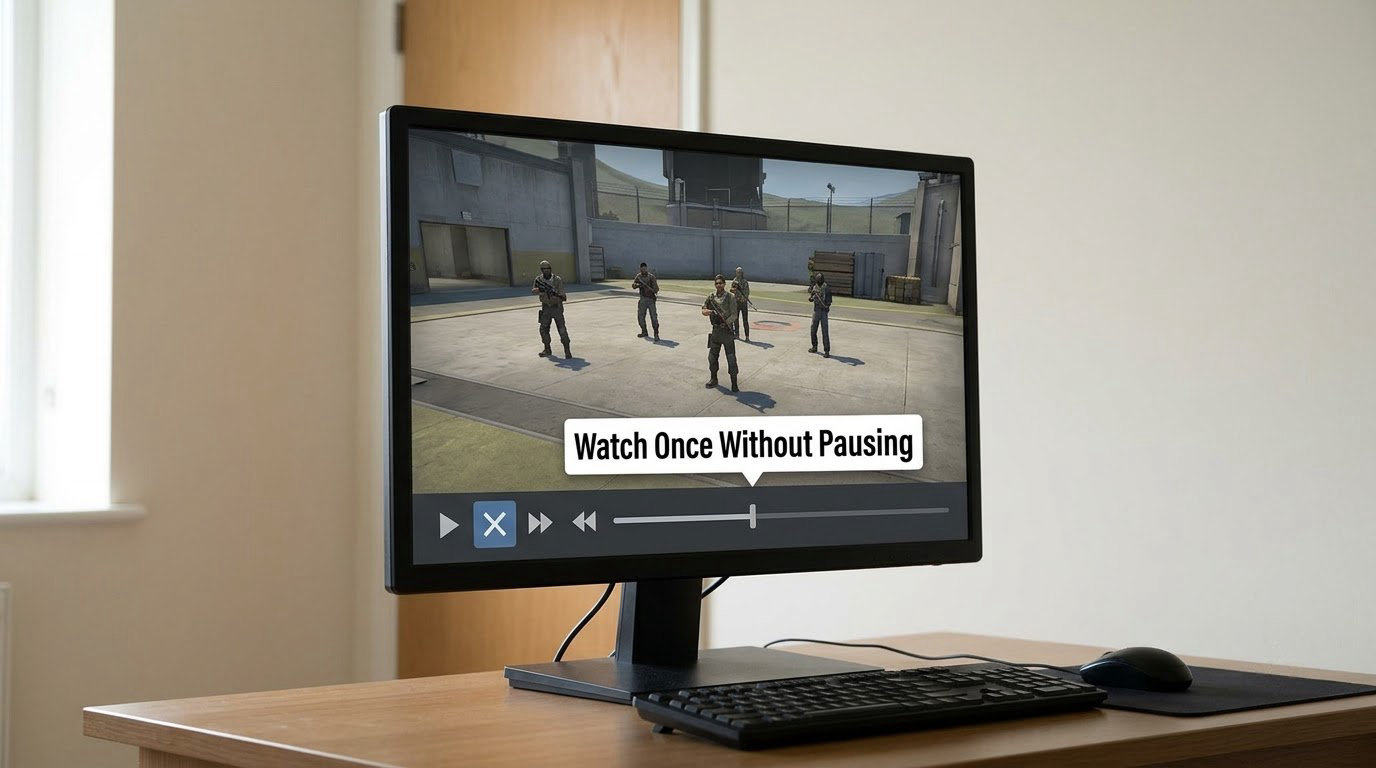
Run it once at full speed first, as if you were watching a teammate. Do not pause, do not scrub, do not defend your decisions out loud. Your job is to write down three turning points: the moment the match stopped going your way, the moment you thought you had won it, and the moment you most wanted to be somewhere else.
This pass exists because you need context before you judge details. A play that looks reckless in isolation is often correct once you know your teammate was missing and the wave was arriving in four seconds.
Mark Decision Points and Repeated Mistakes
Now go back and pause a few seconds before each turning point. Ask three questions at every stop: what were the best, worst and most likely outcomes of that choice, and was I even positioned to handle the likely one?
That three-outcome framing comes from Rocket League review communities, and it works in almost any genre. Once you have five or six marks, sort them by tag. One rotation error is an accident. The same error three times across two matches is the habit worth fixing, and it becomes the only thing you work on next session.
Watch from your teammate’s camera as well as your own during this pass. It is the fastest cure for self-deception, and plenty of players report that a single switch in perspective explained positioning problems they had argued with themselves about for weeks.
Compare Positioning, Timing, and Choices
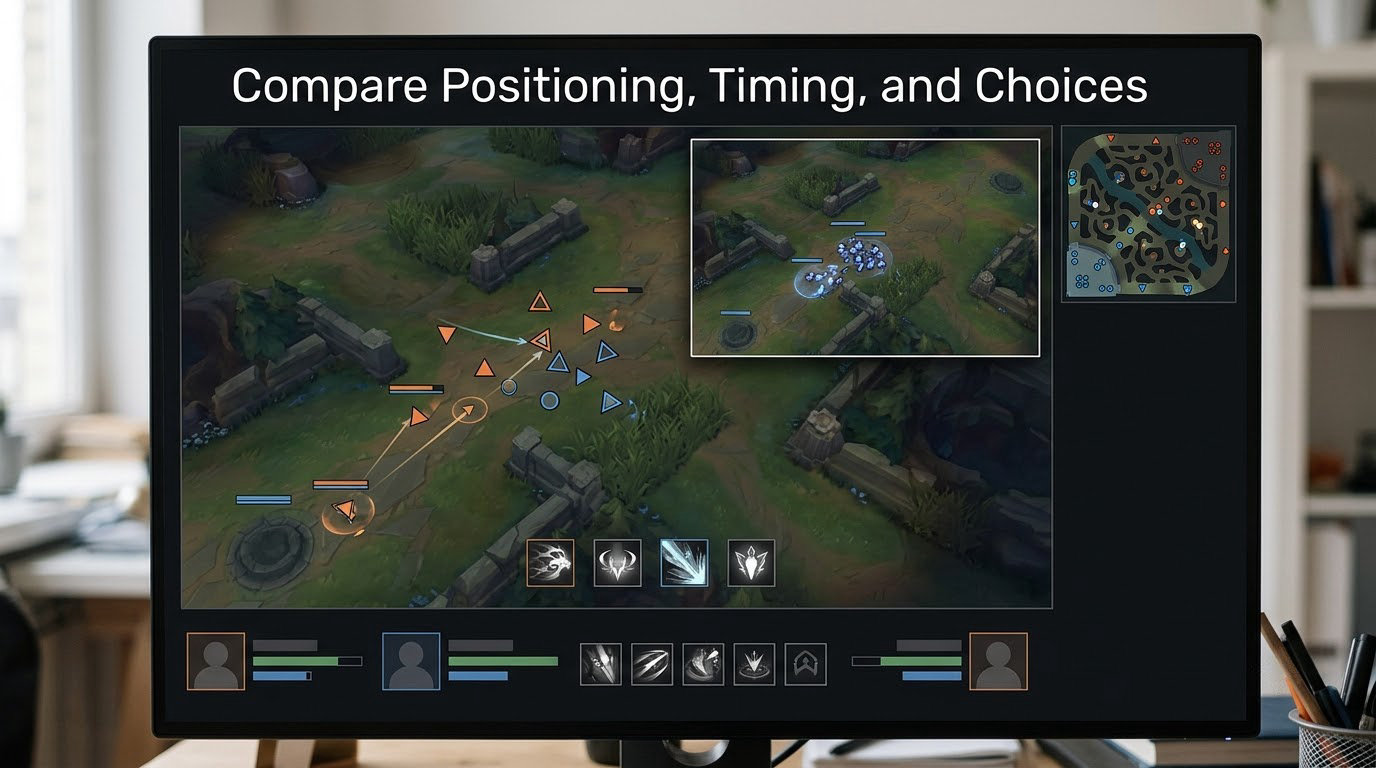
Break the review down into things you can actually observe, because “I played badly” is not an observation. Six of them cover most games.
- Positioning was I reachable by the threats that mattered, or was I somewhere I had no answer from?
- Timing did I act before or after the information arrived? Was the ability available or on cooldown?
- Resource use did I spend boost, health, mana, cooldowns and gold where it changed the outcome?
- Target selection who did I choose to fight, and was that the fight that mattered?
- Communication did I give the team the one piece of information it lacked?
- Risk when I forced something that did not work, was the payoff worth the loss?
The list changes shape per genre, but the categories hold. In a MOBA, timing and resource use carry most of the weight. In a shooter, spacing and crosshair placement dominate. In a fighting game, the single highest-value question is what your frame advantage was after each blocked move, so pull the frame data overlay into your review notes.
Compare yourself against a strong version of the same situation while you are in there. A pro replay or a top-elo VOD of the same champion, map or matchup is a reference point, not a mood board. Copying what they do without understanding the situation they were in produces confident, wrong calls. Take the reasoning, not the moves.
Turn Findings Into a Small Practice Plan
This is the step almost everyone skips, and it is the reason review sessions often produce nothing. A review that ends in twenty observations ends. A review that ends in one drill gets played next queue.
Write the goal in this shape: When [situation], I will [specific behaviour], and I will know it worked because [measurable thing].
So: “When the wave reaches my tower and my jungler is on the other side of the map, I will hold the wave outside the tower instead of trading all-in. I will know it worked because I stop dying before six and I have full control of the wave.”
Two goals is plenty. Trying to fix five habits at once means nothing changes, and you cannot tell which change produced the result. Reviewers in fighting game and coaching communities keep saying the same thing in different words: the habit works when you leave with one or two specific fixes and a note you can check in the next match.
Put the fix into the session immediately where you can. Reviewing at the halfway break of a ranked evening, then playing the fix for the rest of the session, is far more useful than reviewing three hours later when you have forgotten the feeling.
Review Your Progress With a Follow-Up Replay
The next match is data. After a few games, pull one replay that had the same situation and compare it against your note.
You are not checking whether you won. You are checking whether the behaviour changed. Did you hold the wave outside the tower, or did you all-in again out of habit? Did the spacing in the site fight match what you planned, or did the round end before you got there?
Players often report that the improvement after a review fades within a few sessions, which is a sign the loop stopped, not that the method failed. When the fix slips, that tag goes back to the top of your list and you drill it again. Most climbing over a few months looks less like one breakthrough and more like this loop running ten times.
Common Replay Mistakes and Better Alternatives
Every one of these feels productive while you are doing it.
Reviewing only the highlight moments. Clips show the kills, and the kills were rarely the problem. Watch the boring two minutes before the fight instead, since that is usually where the decision was made.
Reviewing the match that tilted you. Pick a neutral match next time. Your worst analysis happens while you are still angry about the last one.
Turning the review into a blame report. Notes about your own positioning are actionable. Notes about your teammate’s positioning are not, because you cannot change their habits. A review that lists four teammates and nothing about yourself is a waste of 30 minutes.
Watching with no notes. Memory keeps the good parts and drops the rest. A typed tag at the moment of the decision is the entire point of the exercise.
Judging yourself on kills alone. Kills are a noisy metric and in some modes a misleading one. Positioning, objective timing and damage dealt to the objective matter more, and any game with a stats screen or a free stats site will hand you those numbers faster than a replay will.
Changing five habits at once. You end the session with no idea which change helped. One goal, drilled until it is boring, then the next one.
Ignoring patches and map changes. A two-month-old replay is a snapshot of a game that no longer exists. Check the version before you copy anything from it.
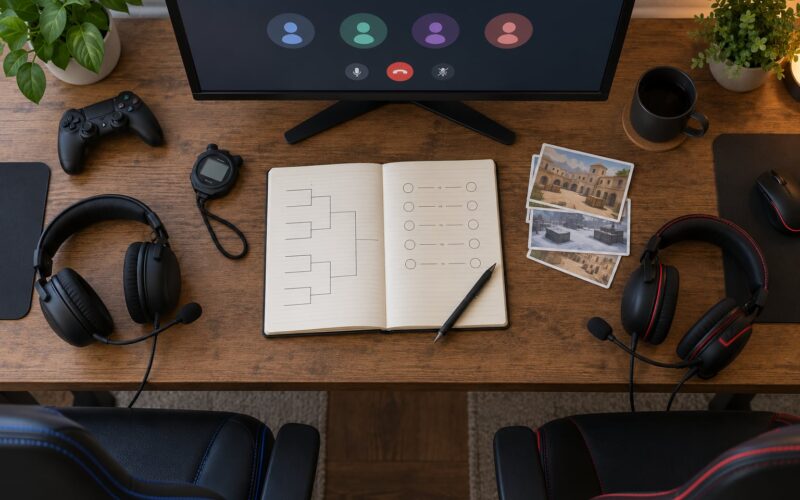
Doing the whole session alone, every time. Reviewing with a stack partner or a friend is reported as far less painful and much more actionable than solo review. One person watches, one person talks. Even a fifteen-minute shared session beats an hour of silent scrubbing.
Frequently Asked Questions
What should I look for first when reviewing a game replay?
Look for the turning points before the mechanics: the moment the match changed and what you decided two seconds earlier. Ask what the best, worst and most likely outcomes were and whether you were positioned to handle the likely one. Only after that does it help to look at aim, spacing or frame data. Most players find their real problem is a decision repeated across a whole match, not a mechanical slip in one fight.
Is it better to review a win or a loss?
Both, for different reasons. Losses show you what broke, which is usually easier to identify. Wins show you what you repeated by accident, which is far harder to see and worth catching. The one match to skip is the loss that made you angry, because emotional bias ruins the analysis. Pick a calm, ordinary match and review it for a question you actually care about.
How long should I spend analyzing one replay?
Fifteen to 30 minutes is the useful range. One unpaused pass at full speed, then a handful of stops at the turning points, then a short note with one or two goals. Longer sessions tend to drift into rewatching the same moment, which feels productive and adds nothing. If you are still watching after half an hour without a written goal, stop and review a different match instead.
Can studying opponent replays improve my own gameplay?
Yes, provided you copy the reasoning rather than the outcome. Watching a top-elo or pro VOD of your champion, map or matchup shows what good decisions look like before the pressure arrives. Watch a specific situation, write down what they did and why the situation allowed it, then test whether that reasoning fits your own games. Copying the play without the setup is how players end up confidently dead.
How do I know whether my replay analysis actually made me better?
Track one number and one behaviour across five to ten matches. The behaviour is the fix you wrote down, like holding the wave outside the tower instead of trading all-in. If you stop breaking the old habit but your rank stays the same, the problem is probably not your mechanics. Add a second goal from a different tag, since two small fixes compound much faster than five at once.
What if my game does not save replays automatically?
Record your screen instead. Capture at 1080p and 60 frames per second if your machine can hold it, check the audio so you can hear callouts and ult tracking, and learn the hotkeys before the match rather than during it. Write a title into the file as you stop recording so you can find the match later. Native replay files also expire in several games, so saving them is good practice regardless.
Conclusion
The method is a loop, not a one-time audit: pick a match with a question, watch it once straight through, mark the decisions, sort the tags, fix one thing, then check the next replay to see if it held. That loop is the difference between grinding a thousand matches and improving across the same thousand.
Start tonight, and keep it small. Replay your most recent match, write down the single mistake that showed up more than once, and test that one correction in your next queue. Everything else can wait for a second session.