If you came here looking for new-hire paperwork or how to activate a software trial, close the tab. This is the other kind: how onboarding works in free-to-play games, meaning the whole guided stretch between installing a game and becoming someone who plays it on purpose.
That stretch covers the tutorial, the core-mechanics lessons, the starter rewards, and the first hook back into the game tomorrow. In a free-to-play game it carries more weight than it does anywhere else, because nothing about the download proved the game was worth your time. Onboarding is what has to prove it, and it is still doing that job in 2026.
Table of Contents
- 1What Is Onboarding in a Free-to-Play Game?
- 2How Onboarding Works in Free-to-Play Games From First Launch
- 3What Are the Main Onboarding Stages?
- 4How Do Tutorials Teach Players Without Overloading Them?
- 5Why Do Free-to-Play Games Give Rewards During Onboarding?
- 6How Does Onboarding Connect to Progression and Retention?
- 7Why Player Onboarding in Free-to-Play Games Has to Prove the Loop
- 8What Makes Onboarding Feel Good or Bad?
- 9How Can Players Evaluate a Free-to-Play Game’s Onboarding?
- 10Frequently Asked Questions
- 11What is an onboarding game?
- 12What are the stages of the onboarding process in games?
- 13How are games free to play?
- 14What is the difference between a tutorial and onboarding?
- 15What is FTUE in game design?
- 16Why do free-to-play games make you register before playing?
- 17Conclusion
What Is Onboarding in a Free-to-Play Game?
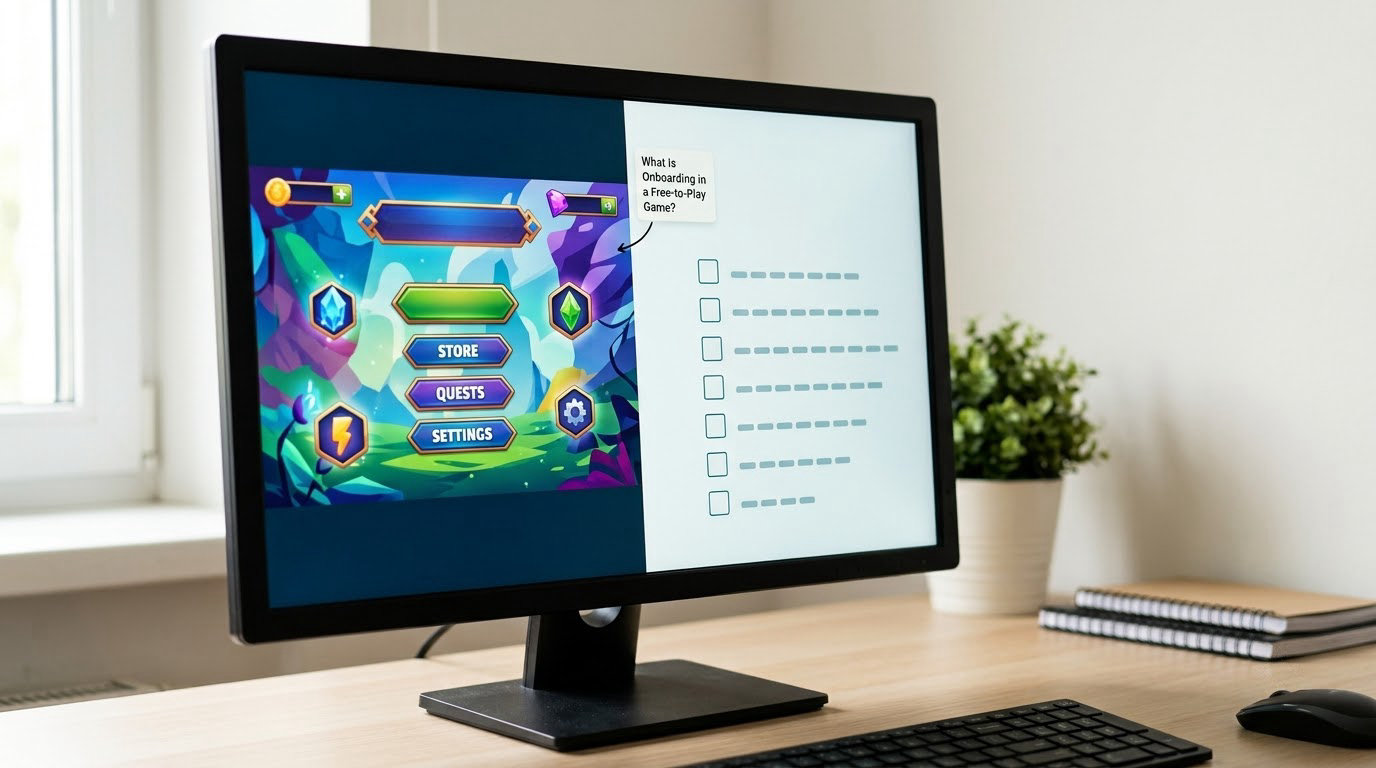
Player onboarding is the sequence between installing a game and the player’s first meaningful session: the tutorial, the core-mechanics lessons, the early rewards and the first progression hook. It teaches the core loop and proves the game is worth returning to before the game asks for an account, a payment or a wallet.
Designers often call the opening stretch the FTUE, short for first-time user experience. That term is worth knowing because it separates the whole onboarding arc from the tutorial, which is only one piece of it.
A tutorial answers one narrow question: how do I press the buttons? Onboarding answers the bigger one: what am I supposed to do here, why does it feel good, and why would I come back. The difference matters most at the edges, where the game is adding the parts it will not show you again for weeks.
Compare two openings. Super Mario Bros. puts a whole level in front of you and only ever shows one new move at a time, and World 1-1 still works decades later. Portal teaches its physics through test chambers, where each room is a small, contained problem with an obvious success state. Breath of the Wild hands you a physics-driven tablet with no tutorial at all and lets the Great Plateau do the teaching. Different methods, same goal: the player performs a mechanic and sees the world answer.
Free-to-play games have one extra constraint. A premium game sold you something already, so its opening can assume commitment. A free-to-play game has to earn that commitment inside the first session, which is why its onboarding is usually longer, busier and more generous with rewards than a comparable paid game’s.
How Onboarding Works in Free-to-Play Games From First Launch
The typical sequence runs in a fixed order, and once you see it once you will start recognising it everywhere.
Install and launch. The first screen after the splash is a choice, not a lesson: start as a guest with a device ID, or make an account. Mobile free-to-play games increasingly push the account step immediately, because an account is what carries purchases and progress across devices. Guest play usually means faster access and a warning that progress can vanish if you clear app data.
Permission requests. Notifications, storage, motion sensors, microphone, marketing email. These are not tutorial content, they are account plumbing, and they are the single most common place a player decides whether the game respects them. Denying everything should never break the core loop.
The tutorial introduction. Usually a short dialogue, a narrated splash or a text panel that establishes who you are and why you are here. This is the part many players skip and the part that quietly explains the fiction you will need later.
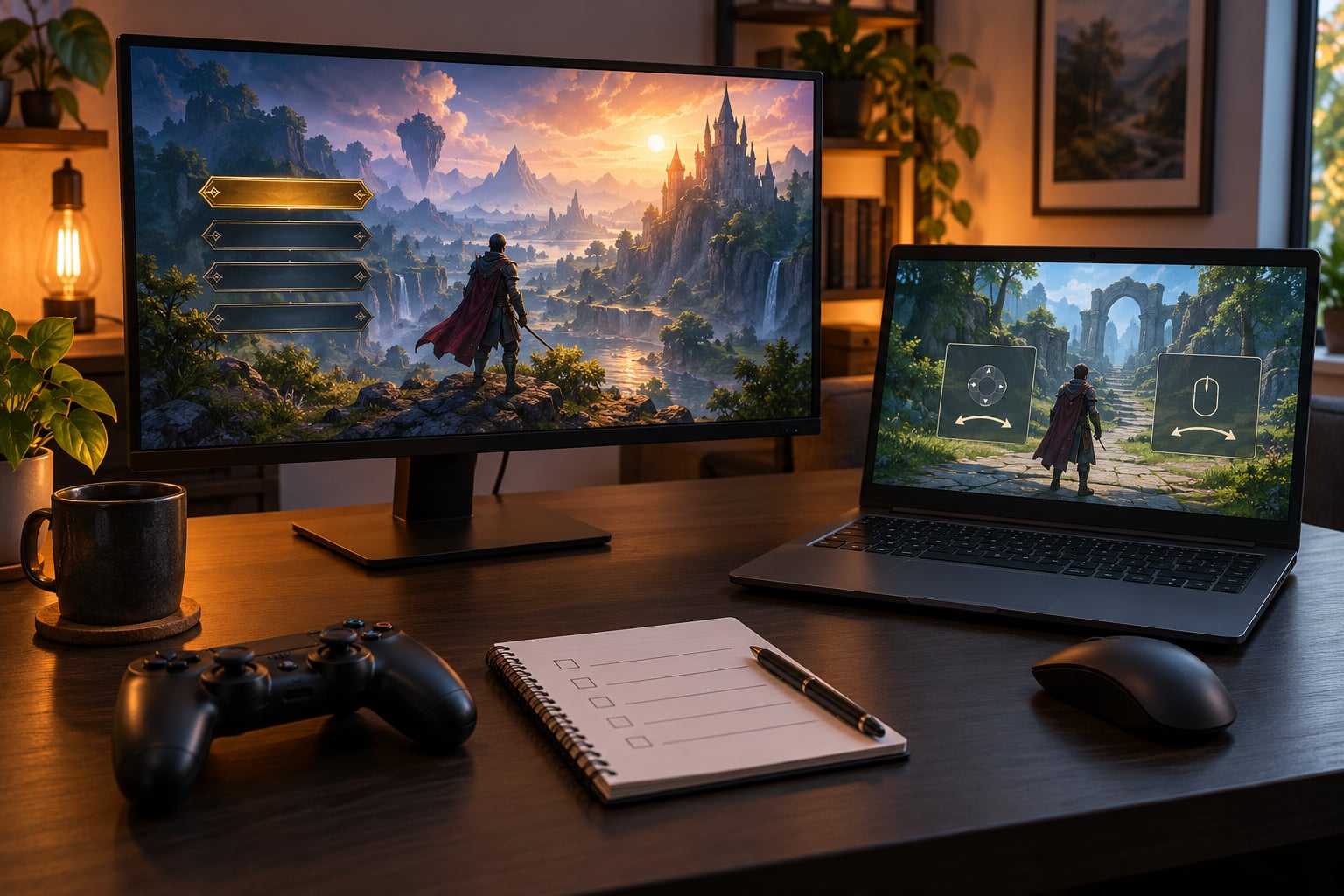
Controls and basic actions. Move, look, attack, interact. In games with more than one input scheme you may be asked to pick a layout and remap buttons here, which is the one genuinely useful setup step.
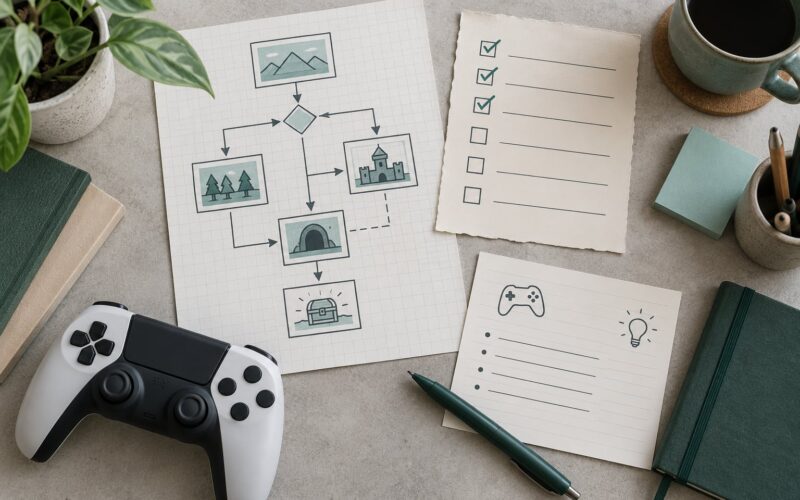
Early objectives. A quest chain, a checklist in the corner, a highlighted NPC with an exclamation mark. This is the spine of the tutorial, and it is what makes the next thirty seconds obvious.
The first reward. Almost always arrives within the first two or three minutes, before the player has done anything difficult. Its job is to prove that progress in this game produces something.
Customization and identity. Avatar, name, class or loadout choice. Even a simple pick-one-of-three choice matters, because it is the first moment the game treats the player as a decision-maker rather than a passenger.
The first meaningful choice. The first choice with a tradeoff, sometimes as small as which skill to upgrade first. This is the moment onboarding shifts from demonstration to ownership, and it is the last point before the game starts asking for something.
Which of those steps are required and which are optional is where good and bad onboarding separate. Account creation, control remapping and the core mechanics are required. Everything else should be skippable.
What Are the Main Onboarding Stages?
Free-to-play onboarding breaks into six stages, and each one answers a different question in the player’s head.
1. Attraction. Before the game runs at all: the store page, the ad, the creator video. The player’s question is “is this worth installing?” The game’s job is a promise, not instruction.
2. Activation. First launch, permissions, account or guest choice, device pairing. The question is “what does this thing want from me?” Failure here is silent and total, because a player who cannot get past a login screen never reaches anything that could hook them.
3. Instruction. The tutorial itself: teach one mechanic at a time, in context, with the game waiting for the input. The question is “what am I doing?” This is the stage most players think of when they say onboarding, and it is the smallest one.
4. The first real win. The moment the player uses a mechanic on purpose and the game rewards it clearly. This is the most important stage in the whole funnel. Reported figures in the mobile and indie scene put drop-off before the first level at roughly 40% of new players, and the cause is usually the onboarding wrapper rather than the game’s quality.
5. Progression and social hook. Long-term goals, a battle pass or season track, a quest chain that continues past the tutorial, a clan or friend prompt, sometimes the cosmetic shop. The question is “what would make me open this again?”
6. Habit. Daily login rewards, energy timers, weekly resets, events. The question is “what brings me back on a day when nothing is happening?” This is where a live-service game stops onboarding and starts retention work.
| Stage | What you experience | What the game is doing | Where players drop off | What good looks like |
|---|---|---|---|---|
| Attraction | Store page, ad, trailer | Making a promise in a few seconds | Install rate is the only metric that matters here | Honest screenshots and a real first-session clip |
| Activation | Account, permissions, device linking | Capturing an identity it can bill and save | Login walls and mandatory marketing opt-ins | Guest play first, account later |
| Instruction | One mechanic at a time | Getting the player to succeed while barely noticing | Text walls, long cutscenes, one-sided instructions | Every mechanic is demonstrated by doing it |
| First win | A clear, earned payoff | Proving the core loop is worth repeating | The most dangerous stage in the funnel | Fast, loud, unmistakable feedback |
| Progression hook | Quest chain, season track, clan invite | Creating a reason to come back tomorrow | Shop appearing before the game is fun | Goals visible, store quiet |
| Habit | Daily rewards, resets, events | Turning play into routine | Energy timers on day one | Rewards that add up without nagging |
How Do Tutorials Teach Players Without Overloading Them?
The answer is almost always progressive disclosure: show one idea at a time, right before the player needs it, and make every lesson a physical action rather than a paragraph.
Guided actions put the lesson inside the world. A prompt points at the object, the object glows, the player uses it. This is how Portal and Mario teach, and it survives contact with players who hate reading.
Contextual prompts wait for a trigger, such as the player reaching a locked door three times in a row, then open a short panel. Just-in-time help like this costs nothing when it is not needed and saves the tutorial from covering content the player will not meet for an hour.
Safe practice spaces let a mechanic be learned where the stakes are zero. Portal’s test chambers and a quest arena in an MMORPG both do this: no death, no penalty, no lost resources.
Progressive disclosure means the interface adds elements as they become relevant. Inventory appears after the first item, crafting appears after the first material, the map appears after the first area. The worst tutorials dump all of this in one screen, which is the difference between a tutorial and a manual with a Start button.
Checklists and persistent objectives keep the player oriented without interrupting. They also produce the cleanest telemetry a studio gets, because each line item is a measurable event.
Skippable layers matter more than most studios admit. Players who return to a game after a long break need a fast re-entry path, not a replay of week-one instructions.
Why Do Free-to-Play Games Give Rewards During Onboarding?
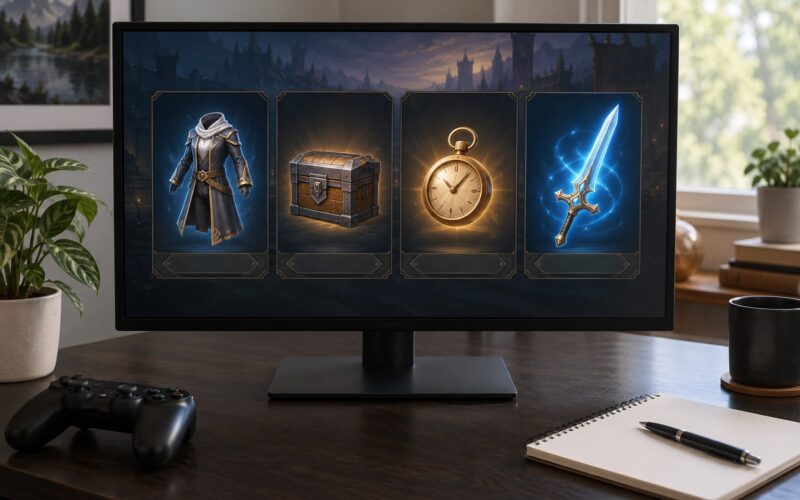
Rewards during onboarding demonstrate value, not generosity. The game hands out soft currency, starter gear, a welcome bundle or a timed multiplier in the first minutes so the player can see the shape of the reward system while it still costs the publisher nothing meaningful.
The currency is usually soft. Soft currency is earned in game and spent on in-game items. Premium currency is bought or earned rarely and is the one the store sells. Onboarding wants you to hold a stack of soft currency before the store ever appears, so that when you eventually see a premium price the number feels familiar instead of hostile.
Character progression plays the same role. A weapon, a character or a skill unlocked in the first ten minutes shows what the upgrade path looks like, which is the emotional core of most live-service economies. In collector games like Genshin Impact the pull sits early for exactly this reason: it is the most exciting thing the economy produces, and the tutorial is the cheapest possible place to demo it.
Useful rewards share a few traits. They arrive before you have earned them, they change how the game plays, they are not on a countdown clock, and nothing is being withheld behind them.
Pressure rewards share the opposite traits. Timed login streaks that punish a missed day, energy timers that pause progress, and a celebratory animation on every single tap all train the same response in the player: ignore the feedback. A well-known free-to-play veteran put it plainly on the Naavik podcast when discussing why studios abandoned play-to-earn: the players who came for fun were the ones the extra layer pushed away. Wallet creation was named there as the biggest adoption hurdle of all, which is why experienced teams let you play for thirty minutes or more before any account or payment screen appears.
How Does Onboarding Connect to Progression and Retention?
Onboarding ends where progression begins. The tutorial hands you a mechanic, progression turns that mechanic into a goal, and retention turns the goal into a reason to come back.
The bridge is usually the objective chain. A tutorial ends with “defeat six training dummies,” and the quest log quietly continues into “defeat six elites in the next zone.” The player never experiences a break. The early difficulty curve is tuned so that failure is cheap and frequent, because a player who fails twice with a full restart will try a third time, and a player who fails twice with a load screen will not.
Celeste handles this well: respawn is nearly instant, checkpoints are everywhere, and an Assist Mode lets anyone play the full game on their own terms without dressing it up as a charity. Warframe’s harder version of the same problem is skill rather than mechanics, and its forum threads show the result: new players arrive understanding the interface and still cannot enter ranked play, because ranking needs hours of practice that no tutorial can compress.
The social hook lands around the same time. Fortnite puts a squad, a party and a battle pass in front of you early, because playing alone is not the loop it wants. Clans and guilds do the same job in MMORPGs, and the good versions introduce them as “here are people who already play, join them” rather than a pop-up demanding a choice.
Why Player Onboarding in Free-to-Play Games Has to Prove the Loop
Free-to-play revenue comes from a small share of players, which means onboarding is a demonstration before it is a tutorial. If the player does not understand and enjoy the core loop in the first session, there is no second session to sell anything to. That is the whole argument for front-loading value: give away generously early, ask for money later, and only after the player has already decided the game is good.
There is a fair counter-argument worth stating plainly. Practitioners in the mobile and social-games scene argue that players leave because the first few minutes are not fun, not because of the onboarding wrapper. Both things can be true. A great tutorial in front of a dull game still loses the player, and a short tutorial in front of a good one still needs to explain the rules.
What Makes Onboarding Feel Good or Bad?
The dividing line is usually whether the game is teaching you or blocking you.
Good onboarding gets out of the way. It shows a mechanic once, then trusts you. It makes failure cheap with fast respawns. It answers every action with some feedback, however small, so you know the game heard you. It reveals systems gradually. And it respects the fact that you have a life, which means skip options, no unskippable cutscenes before you have ever moved, and a re-entry path for returning players.
The bad version has a recognisable set of failure modes, and players describe them in very specific language.
The invisible wall. You reach an object you cannot interact with and nothing tells you why. One player in r/CrimsonDesert climbed over a mountain rather than taking the intended pass, missed a required combat mechanic entirely, and only worked out what had happened roughly forty hours into the game. The cause was structural: a sandbox world that rewards exploration paired with a tutorial that assumes one fixed route.
The interrupt that arrives at the worst moment. Mobile free-to-play games routinely place an interstitial ad, an offer wall or a wallet prompt at the exact beat where the tutorial would otherwise click. Practitioners on the SERP for this topic put the usual advice plainly: long tutorials directly damage D1 retention, the share of players who come back the next day, and teams should not optimise tutorial completion at the expense of pacing.
The timer that starts before you understand the game. Energy and stamina systems that begin their first refill countdown during the tutorial turn the first win into a wait.
The feedback that lies. Confetti on every click, pop-ups for every minor action, and rewards for things you had no choice about. Players learn quickly that noise is not enthusiasm.
The checkbox. Studios that treat onboarding as tutorial_completed = true cannot see where players actually leave. A measured funnel, split by cohort and by acquisition channel, can. When teams finally break down retention by stage they tend to find the leak is somewhere other than where they assumed.
What can a player do about it? Spend ten free minutes before committing, which is the honest test of whether the first win lands. Skip tutorials you have already seen the shape of and come back later. Turn off notification and marketing permissions on day one and give them back if the game earns it. And treat any onboarding that hides monetization until after it has proven fun as the better behaved kind, because it clearly knows that the store works better on a player who already wants to come back.
How Can Players Evaluate a Free-to-Play Game’s Onboarding?
Run this list after your first session and you will know most of what you need to know about whether to stay.
| Check | Good sign | Warning sign |
|---|---|---|
| Time to first action | You move within a minute or two | Logins, permissions and carousels before anything else |
| Clarity of goals | Always one obvious next action | Several highlighted objects at once |
| Freedom to learn | Guided at the start, loose after | Skippable lessons hiding required mechanics |
| Failure cost | Fast respawn, small penalty | Long loads, lost resources, lost progress |
| Store timing | Quiet until the game is fun | Shop pop-up during the tutorial |
| Reward honesty | Gifts with no countdown | Login streaks, energy timers, expiring bundles |
| Accessibility | Assist options, remappable inputs, subtitles, colour modes | Settings buried after the third session |
| Explaining what is next | The quest log always has an entry | Nothing to do and no hint |
A player-facing shortcut: spend your first ten minutes on the actual core loop rather than on social features, cosmetics or the shop. Battles, extraction, building or whatever the game does when the pressure is on. If the shop gets more screen time than the core loop does, the game has told you what it values.
One more thing to check before you commit: can you get back in easily? Cross-platform account linking, a guest-to-account upgrade path and a re-entry that does not replay the whole tutorial are small signals that the studio expects you to still be playing in week three.
Frequently Asked Questions
What is an onboarding game?
An onboarding game is a short interactive sequence, usually called a tutorial or FTUE, that teaches a new player a free-to-play game’s core mechanics and gets them to a first win before asking for an account, a payment or a wallet. It works by demonstrating one idea at a time through action rather than text, then layering progression and social features on top.
What are the stages of the onboarding process in games?
The full arc has six stages: attraction before the game runs at all, then activation, instruction, the first real win, the progression and social hook, and finally habit. Some teams count only the five in-game stages and leave attraction out, since the player has not installed anything yet.
How are games free to play?
Free-to-play games are funded by a minority of players who spend real money, mostly on cosmetics, battle passes and currency bundles. Because most players never pay anything, onboarding has to prove the core loop is worth returning to before any payment prompt appears. The opening session is therefore a demonstration, not a transaction.
What is the difference between a tutorial and onboarding?
A tutorial answers one narrow question: which button do I press. Onboarding answers the bigger one: what am I supposed to do here, why does it feel good, and why would I come back. The tutorial is one stage inside onboarding, which also covers the account step, starter rewards, customization, the first real choice and the progression hook that comes after.
What is FTUE in game design?
FTUE stands for first-time user experience, the term studios use for a player’s entire first session, from the splash screen to the last reward of the tutorial. It is broader than the tutorial alone because it includes account setup, permissions, the early rewards and the moment the player understands the core loop. When D1 retention falls, teams usually go looking in the FTUE first.
Why do free-to-play games make you register before playing?
An account is what carries your purchases, progress and unlocks across devices and reinstalls, so free-to-play games push for it early. Good onboarding gives you a guest option or plays for thirty minutes or more before any account or wallet screen, because a login wall during the first minutes loses more players than it saves.
Conclusion
Onboarding in a free-to-play game runs from activation through instruction, the first real win, the progression hook and the first return session, and the whole arc exists to prove one thing before anyone is asked to spend money: the core loop is worth coming back to. For players, that means judging the game on how quickly it got you to that first win, not on how busy the opening screen looked. Try the core loop first and ignore the shop for ten minutes. If the game does not make that ten minutes interesting, the rest of the onboarding is decoration.