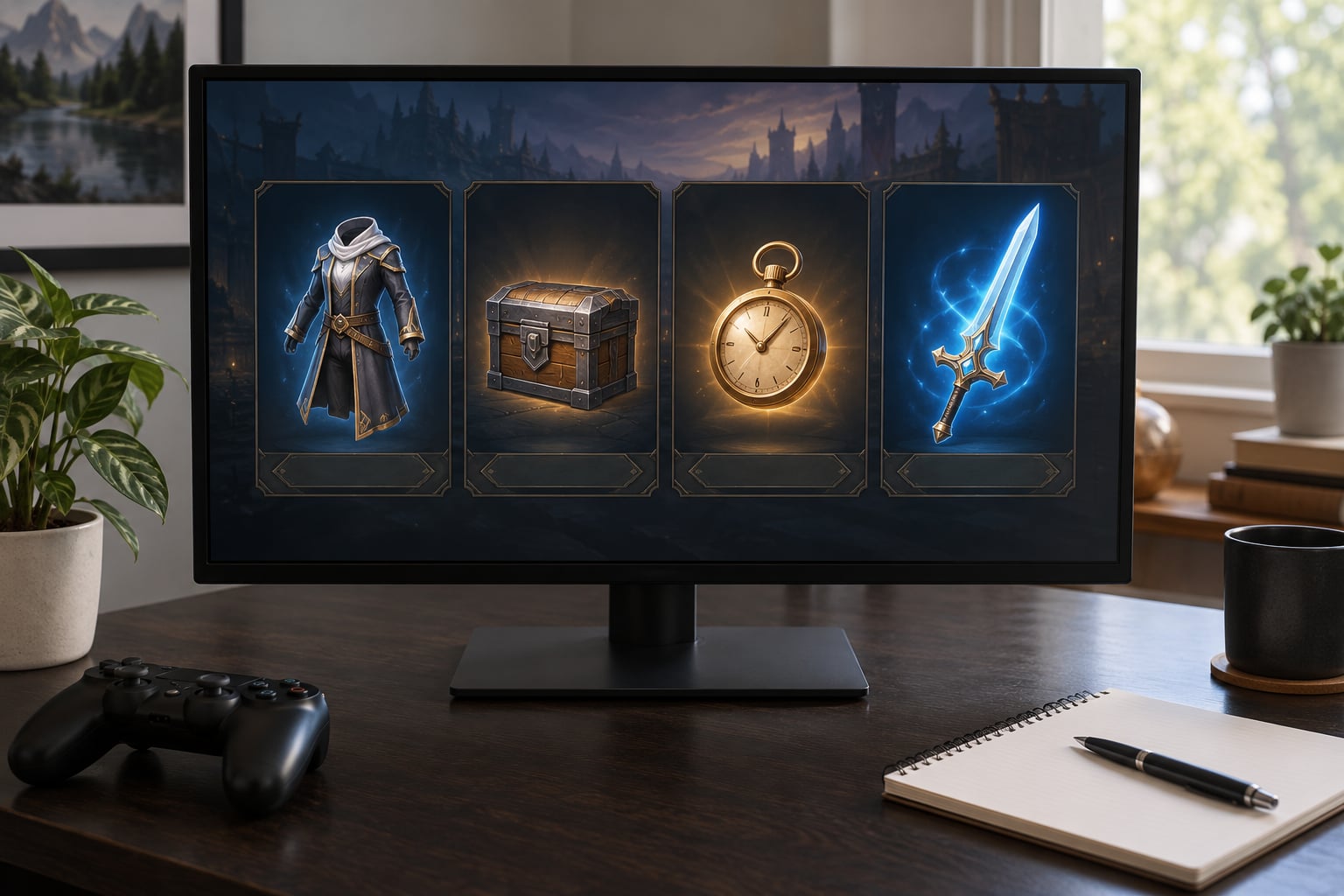
To know how to tell if a free to play game is pay to win, run three questions on every item in the store: does it change your stats, can you earn it by playing, and does it change your results against other players? Real money buys you something a free player never gets, and it matters in competition, the game is pay to win. Give it fifteen minutes with a fresh account, a second one for purchases, and about twenty minutes with the patch notes.
Most arguments about this topic go nowhere because people argue about the word instead of the item. A cosmetic weapon skin and a 15 percent damage upgrade live in the same menu, cost the same currency, and mean completely different things. Sort the menu into categories first, and the argument collapses into something you can actually check.
This guide gives you ten checks, in the order that produces answers fastest. It works for mobile gacha games, MMOs, shooters, extraction shooters and card games. Last reviewed for 2026.
Table of Contents
- What You Need
- How to Tell If a Free to Play Game Is Pay to Win: Step by Step
- 1. Identify What the Game Sells
- 2. Separate Cosmetics From Competitive Power
- 3. Compare Free and Paid Progression
- 4. Check Whether Purchases Affect Match Results
- 5. Look for Unavoidable Spending Pressure
- 6. Review Loot Boxes, Random Rewards, and Gacha Systems
- 7. Investigate Paywalling of Essential Content
- 8. Read Community and Expert Evidence
- 9. Test the Game Without Spending
- 10. Make a Fairness Decision
- Common Mistakes
- Frequently Asked Questions
- What does pay to win mean in a free-to-play game?
- Is a game pay to win if paid players can progress faster?
- Are paid character skins a sign of a pay-to-win game?
- How can I tell whether a paid item gives a real advantage?
- Does buying loot boxes automatically make a game pay to win?
- Can a free-to-play game be fair if it sells boosters and upgrades?
- The Short Verdict
What You Need
You cannot judge a game you have not looked at properly, so gather this before you spend anything.
- An in-game store. Open every tab, not just the featured one. Buried gear tabs hide the real numbers.
- Access to the competitive modes. Ranked PvP, the auction house, the raid ladder. A purchase that never touches another player is a different question from one that does.
- The patch notes for the last three updates. Monetization often arrives in seasonal updates, not at launch.
- A community source. A subreddit, official forum, or a wiki that lists drop rates and stat values.
- A second account or a fresh save. This is how you compare your own progress against a clean run.
- Your own purchase history. If you have already spent, you need to know whether you bought a sidegrade or a straight upgrade.
Also give yourself a stopwatch. If the whole audit takes more than half an hour, you are browsing, not auditing.
How to Tell If a Free to Play Game Is Pay to Win: Step by Step
Work through these ten checks in order. The first three usually settle it.
1. Identify What the Game Sells
List every purchase category the shop offers before you judge anything. Typical categories are cosmetics, character or class access, boosts and consumables, time skips, storage and interface slots, season passes, subscriptions, loot boxes and gacha pulls, and direct gear or stat purchases.
The category is the raw material of your verdict. Cosmetics and storage slots are the easiest to defend. Direct stat purchases are the hardest. Everything else lives in between, and the later checks decide where.
Note the currency too. A premium currency that converts into the same gold you earn by playing is a blurred line worth remembering, because it makes a purchase look optional while quietly funding your whole progression.
2. Separate Cosmetics From Competitive Power
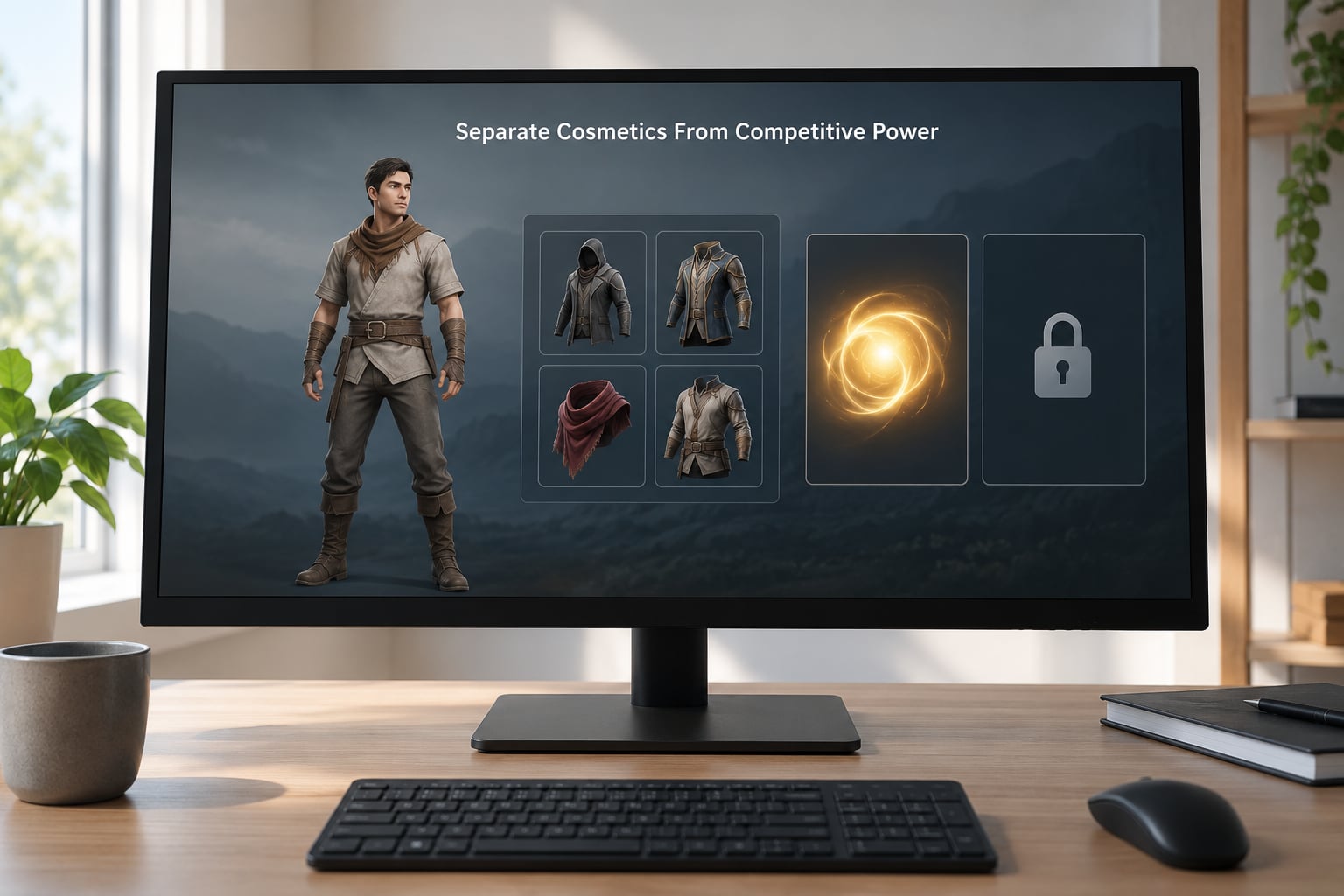
Appearance items change what you look like, nothing else. Competitive power changes numbers. Sort every store item into one of these columns: damage output, survivability, mobility or action speed, cooldown or ability access, matchup strength, progression speed, and access to content at all.
An item in any of those columns is not cosmetic, whatever the shop calls it. A costume that recolours a gun is cosmetic. A gun skin that comes with a handling change is not, even if the store never prints the number.
Watch for sidegrades too. If the paid weapon does 100 damage and the free equivalent does 95, that is a sidegrade and most players accept it. If the free version tops out at 60, that is vertical progression and it is power.
3. Compare Free and Paid Progression
Pick one concrete goal, such as reaching the second boss tier or hitting a gear breakpoint. Then time how long the free path takes, using repeatable content only.
Do the arithmetic honestly. If a store item costs the same currency you would earn in roughly fifteen hours of grinding, the developer has told you the answer in their own currency. Ask whether the free player can reach the same power eventually, and how long that is.
There is no universal cutoff, and community opinion swings hard on this. A short grind is a chore. A grind measured in weeks for the same result is the reason so many players call a game pay to progress, whether or not it is technically pay to win.
4. Check Whether Purchases Affect Match Results
This is the check that separates a serious problem from a marketing complaint. Ask whether a purchase changes how a match against another player ends.
Test it in the modes that exist. In PvP and ranked modes, buy nothing and record win rates over at least twenty matches. Compare those results with what players who spend report. In raids and endgame PvE, check whether the group you are struggling to beat is a gear check or a skill check.
In economies with player markets, ask whether the auction tax, listing fees or crafting costs differ by purchase. Reduced fees are a real economic advantage even though no gun gets stronger, and long-running MMOs have been argued over on exactly this point for years.
The community’s most repeated rule is blunt: competitive against other players online plus real-money boosts equals pay to win. That rule holds up well. Its blind spot is indirect competition, where your spend changes what you can farm, buy or build.
5. Look for Unavoidable Spending Pressure
Pressure is not the same as power, but pressure tells you where the developer wants your money, and it often sits next to the real problem.
Look for energy and stamina timers that cap daily actions, repeated failure rewards that only appear through a purchase, discounts that expire on a countdown, pop-ups on every failed attempt, storage caps that block progress, and free rewards set to expire while you are asleep.
Then test the one that matters most: can you decline the payment and still play the full game? If refusing means missing out on a mode, a system, or a large share of the content, the store is optional in name only.
6. Review Loot Boxes, Random Rewards, and Gacha Systems
Random purchases are not automatically pay to win. They become a problem when the pool contains competitive items and the odds are hidden or the duplicates are punishing.
Check four things. Are drop rates published, and are they published per item or only as a vague band? Is there duplicate protection, so a bad pull converts to something useful? Can you buy the item directly with in-game currency instead of gambling on it? And do the strongest items live in the pool, or only cosmetics and currency?
Also check whether the gacha system has pity protection, a hard rule that after a set number of pulls you are guaranteed the item. Without it, spending more is the only reliable path to the character you need, and that is power sold at a markup.
Gacha is common in single-player and co-op games where nothing is competitive, which is the strongest reason it is accepted there. The same system in a ranked ladder is a different design entirely.
7. Investigate Paywalling of Essential Content
Free-to-play means the entry point is free, not that the game is complete. Look at what sits behind a purchase that a reasonable player would treat as required.
Check whether replay or recording is blocked, whether storage or build slots are capped, whether essential crafting materials come only from the store, whether a social feature such as trading is locked behind a subscription, and whether the tutorial or onboarding path forces a purchase. Blocking free players from the full experience is not a stat advantage, but it is paywalling, and players punish it harder than they punish cosmetics.
8. Read Community and Expert Evidence
Forums are good for finding the specific mechanic, weak on deciding the verdict. Use them to locate evidence, then verify it.
Search the game’s subreddit or official forum for the mechanic you suspect, then check whether someone posted numbers, a patch note line, or a repeatable example. Drop-rate wikis and data-mining communities are the most reliable sources because they publish their figures. Creator videos that compare two accounts under identical conditions are useful; unedited clip compilations are not.
Discard evidence that only shows someone losing, or someone winning after a purchase. Sample size is what makes a claim checkable. And treat fan arguments with the same suspicion you would give a vendor page selling monetization tools: naming criteria before naming a game is the mark of a useful source.
9. Test the Game Without Spending
The most convincing proof anyone accepts is a free player finishing the content, so run your own test.
Pick a two-week window and spend nothing. Log what you unlocked, the tier you reached, the win rate in competitive modes, and every point where you hit a wall that only a purchase removed. Keep it simple: a note on your phone with the date and the blocker is enough.
At the end, look at the log rather than your mood. If the free run finished the content and enjoyed competitive play, you have your answer for this game. If it stalled repeatedly at gates tied to boosts or time skips, that is evidence, and it is evidence you gathered rather than read.
10. Make a Fairness Decision
Convert what you found into one of four verdicts based on competitive impact, not on how much a purchase costs.
- Harmless monetization. Cosmetics, emotes, storage, interface slots. Stats and outcomes are identical for every player.
- Questionable convenience. Time skips, extra inventory, faster crafting. Fine if a free player can reach everything, slower.
- Borderline pay-to-advantage. Free access is real but the free path is long, or fees and boosts shift economic outcomes. This is where honest disagreement lives.
- Clear pay-to-win. Purchases grant exclusive power, and that power decides results against other players. Most people mean this one when they use the phrase.
Write down which checks drove the verdict, and re-run the audit after every major update. Live-service games change their stores quietly, and a fair game at launch is not automatically fair in season three.
Common Mistakes
Most bad verdicts come from a handful of repeated errors.
- Assuming any paid item means pay to win. Cosmetics and extra bag space are normal in free-to-play games. Call every store pay to win and nobody will take your next point seriously.
- Judging from one match. A loss proves nothing. Twenty matches at the same skill level prove something.
- Confusing price with power. An expensive item that changes nothing mechanically is still cosmetic.
- Ignoring free-player limits. Ask whether the free player can finish, not whether they get everything quickly.
- Taking marketing claims as proof. A store calling boosts convenience does not make them convenience.
- Skipping the patch notes. The mechanic you are worried about may have shipped last week.
- Trusting one forum thread. Look for numbers, not consensus.
- Never re-checking. Audit once a season.
Two habits make this easier. Keep a small note of every purchase with the date and what it changed, so a seasonal patch never sneaks past you. And when the debate turns to whether something counts, argue about the mechanic rather than the label. The label is where most threads die.
Frequently Asked Questions
What does pay to win mean in a free-to-play game?
It means real money buys an advantage that free players cannot obtain by playing, such as higher stats, exclusive power items, or permanent progression boosts. The defining part is not the spending itself but the gap it creates between paying and non-paying players in the same match or the same endgame tier.
Is a game pay to win if paid players can progress faster?
Not automatically. Faster progress is usually called pay-to-progress, and the line most players draw is whether a free player can reach the same competitive power eventually. If the free path exists and takes a reasonable amount of play, many accept it. If the grind is measured in weeks or months for identical results, the label becomes fair criticism.
Are paid character skins a sign of a pay-to-win game?
No. A skin changes appearance only. The signal worth checking is whether the same item also changes handling, damage, recoil, cooldown, or grants an ability. Shops sometimes bundle a purely visual skin with a mechanical variant, so read the item description and the patch note rather than relying on the label in the menu.
How can I tell whether a paid item gives a real advantage?
Compare it against the free version of the same thing. Check the wiki or a data-mining source for stat values when the store does not show them, run the same content with and without the purchase, and look for a sidegrade versus a vertical upgrade. A paid item that competes closely with what you can earn is fine; one with no free equivalent is power.
Does buying loot boxes automatically make a game pay to win?
No. It depends on what is in the pool and how the odds are handled. Published drop rates, duplicate protection, pity guarantees, and a direct purchase option with in-game currency all reduce the problem. Hidden odds combined with competitive items in the pool and no way to buy them directly is where random monetization turns into pay-to-win.
Can a free-to-play game be fair if it sells boosters and upgrades?
It can, when the boosters only accelerate something a free player reaches anyway, and the upgrades are sidegrades or convenience purchases. What breaks fairness is when a boost shortens the gap in a ranked mode where power decides winners, or when the store is the only reasonable path to the items needed to finish the game at all.
The Short Verdict
Start with the store, not the forum. Sort every item into cosmetics, convenience, progression and direct power, then ask whether the power column decides anything against another player. If it does, that game is pay to win by the definition most players use, whatever the marketing page calls it.
Log the date, re-check after the next seasonal update, and keep your evidence next to the item description.