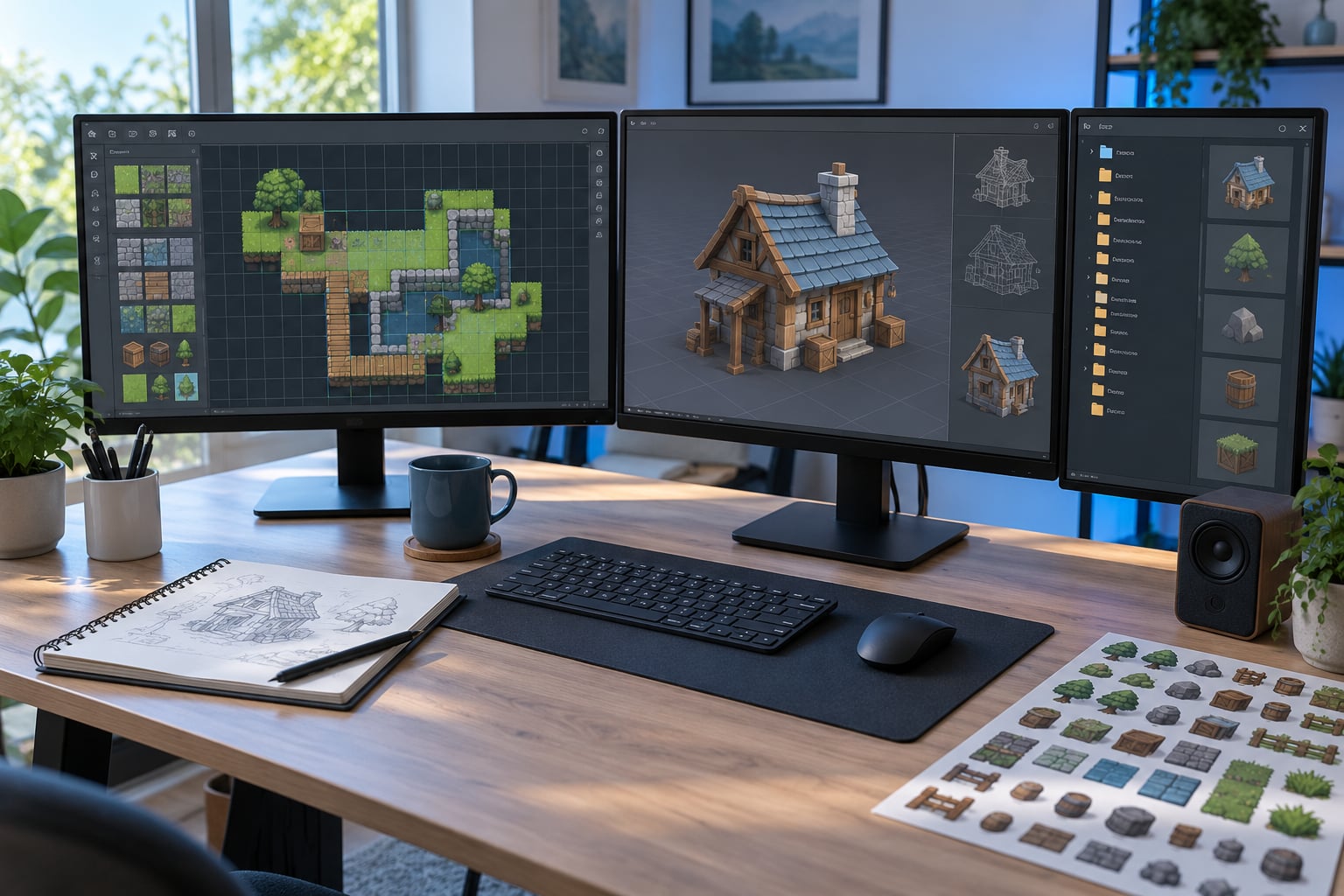
A total conversion mod replaces nearly everything a player sees and does in an existing game — art, levels, characters, weapons, story, rules and often the map — while reusing the original game engine and its mechanics to run it. The engine loads the vanilla game as normal, and a mod layer overrides the files it reads at runtime.
So how total conversion mods are made comes down to one repeatable pipeline: choose a game, check what you are allowed to change, audit its files, rebuild the content, wire it into the game’s systems, test, then publish. Most of that is learnable in a weekend. Finishing it is the hard part, and the honest answer to “how long does one take?” is months for a focused project and years for a big one.
This guide walks the whole pipeline and points out where each engine differs, because the process is universal even though the file formats are not.
What You Need
The word “total” does real work here. A total conversion is not a big mod; it is a mod that overrides essentially every replaceable file the engine reads, to the point where it conflicts with almost any other mod. An ordinary mod adds to the game or swaps one system and still coexists with everything else.
| Type | What it replaces | Typical effort | Plays with other mods |
|---|---|---|---|
| Total conversion | Art, levels, characters, weapons, story, rules, often the map | Months to years | Almost never |
| Large overhaul | Several systems, usually art plus balance, but core structure stays | Weeks to months | Sometimes |
| Ordinary mod | One system, one feature or a set of new assets | Hours to weeks | Usually |
| Mini-mod | A single weapon, enemy, quest or visual swap | An afternoon | Yes |
If players could install your mod next to another one without conflicts, it is not a total conversion. That test is worth applying early, because it changes the scope document you are about to write.
Beyond that you need four things: a game with documented modding support, art and audio production in some form, a scripting or data-editing skill, and version control. The tools are almost entirely free.
| Discipline | Tools | What they produce |
|---|---|---|
| Scripting and data | VS Code, Notepad++, the engine’s own script editor | Rules, events, definitions, localisation keys |
| 2D art | Aseprite, Krita, GIMP | Sprites, tilesets, icons, interface elements |
| 3D art | Blender | Models, textures, rigged animation |
| Audio | Audacity, LMMS, Bfxr | Sound effects, ambience, music |
| Level and map design | GZDoom Builder, Ultimate Doom Builder, Tiled, the engine’s map tool | Levels, province maps, heightmaps |
| Packing and version control | SLADE, 7-Zip, Git, GitHub | Packaged archives, history, safe rollbacks |
Old engines need a source port before any of that works. Doom conversions, for instance, run on GZDoom, which supplies both the runtime and the modern map-building tools. Beginners often ask whether they still need a specific old editor, and the honest answer is usually no — the source port replaced it years ago.
Step-by-Step
Here is the whole pipeline in order. Each stage has an output you can point at, which matters more than it sounds: a project with nothing demonstrable at stage four is a project that stalls at stage five.
| Stage | What you produce | Main skill | Solo-feasible | Rough time, solo |
|---|---|---|---|---|
| 1. Choose and check rights | Written scope, licence answer | Research | Yes | A few days |
| 2. Audit the files | Data map, replacement plan, design brief | Technical reading | Yes | 1 to 3 weeks |
| 3. Rebuild content | Sprites, textures, models, audio, levels | Art and audio | Partial | 2 to 9 months |
| 4. Wire the systems | Descriptor, scripts, data tables, hooks | Scripting | Yes | 1 to 6 months |
| 5. Test in stages | Crash-free build, known-issues list | Debugging | Yes | Ongoing |
| 6. Package and publish | Archive, readme, platform page | Documentation | Yes | Days |
1. Choose a Game and Check Its Rights
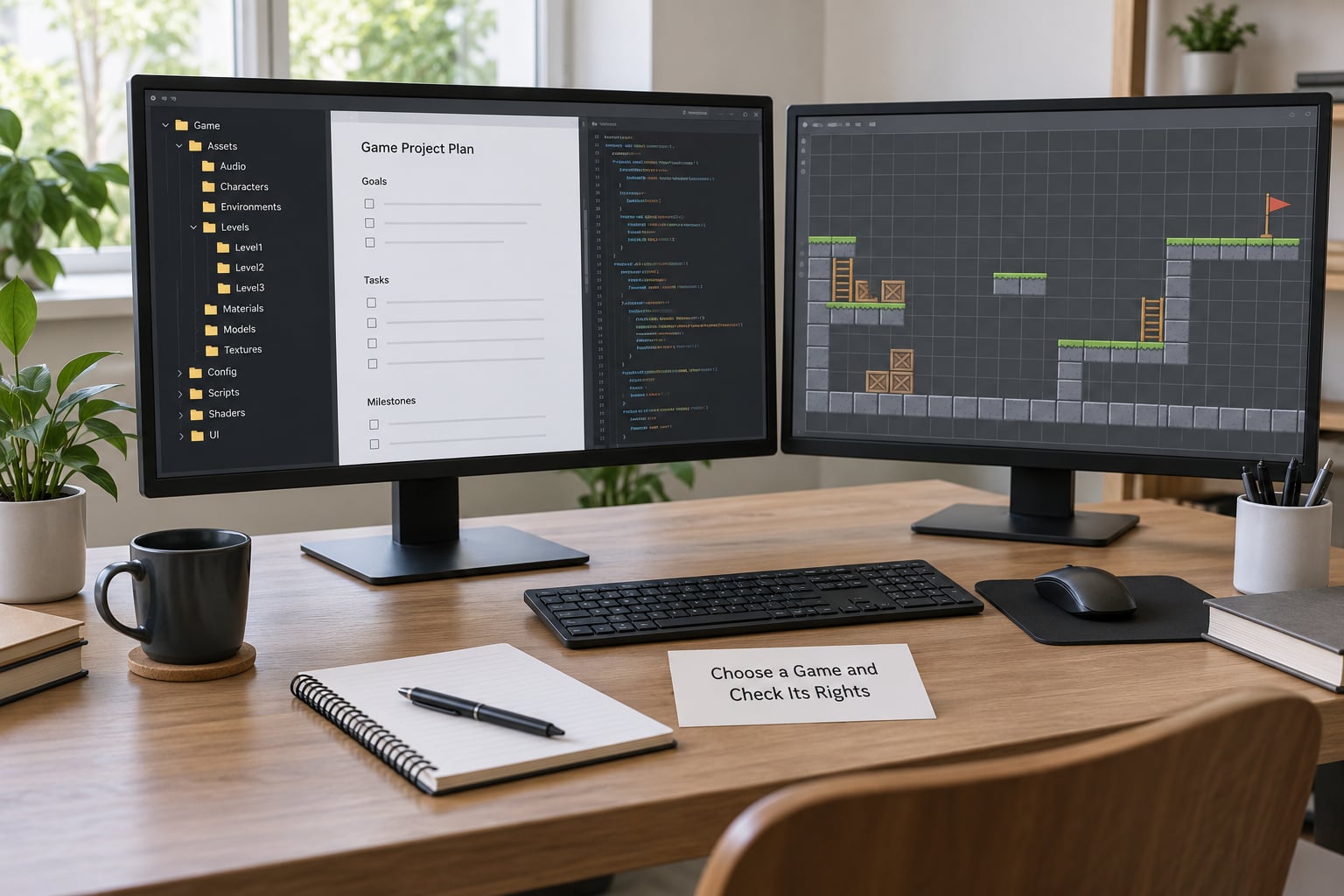
Pick a game whose modding support is documented rather than reverse-engineered. That single choice removes most of the pain later on. The Clausewitz engines behind Crusader Kings and Hearts of Iron read loose text files from a mod folder, which makes deep conversion straightforward. RimWorld is similar, with XML definitions. Bannerlord ships a real module system. Minecraft splits the difference between data packs and code mods.
Doom is the outlier worth knowing about, because it runs the oldest workflow still in daily use. A Doom total conversion ships as a WAD, an archive of assets and maps, loaded by a source port such as GZDoom. A modern conversion may package itself as a PK3, a zip-style archive, and may include its own standalone executable so players do not need the original game at all. That last route is what turned conversions like Brutal Doom into products in their own right.
Then check what you are legally allowed to do, and treat it as a factual question with an uncertain answer rather than something to assume. Free distribution of an uncompressed, non-commercial mod is widely tolerated and rarely litigated. Converting a licensed setting is different: reproducing someone else’s protected characters, logos or text is a copyright question, and the answer can change by country and change with time. Mods have been removed from platforms over exactly this. If your conversion needs a licence, get one, or pick a setting you own. Rules vary, so treat this as information rather than legal advice.
2. Inspect the Original Files and Plan the Conversion
Open the game’s data folder and read it like a stranger’s filing cabinet. For the Clausewitz games, the audit means reading the descriptor file where each mod declares replace_path entries, then finding the folders those paths point at. For Doom it means opening the game data in SLADE and listing lumps by type. For Minecraft it means reading the JSON data pack structure. The formats differ; the exercise does not.
The output of this stage is a list split into three columns. Replaceable: assets and data the engine reads at runtime, which is nearly everything visual and audible. Hard-referenced: elements the engine assumes exist and will crash without, even if your conversion never shows them. Shared: systems where several mods may write, which is where your load-order notes will live later.
That second column is the part nobody documents well. In the older Crusader Kings games, the executable reads a defines file and a block of static modifiers at startup, expects a specific range of minor titles, and expects two dummy event IDs reserved. Delete or repurpose them and the game fails before the main menu appears. The rule generalises: never remove something the engine loads at boot. Neutralise it instead, by pointing it at your own harmless content.
Now write the scope. One page is enough. State the setting in two sentences, list the systems you will touch, list the systems you will deliberately leave alone, and name the single experience you want players to have. That last line is what you fall back on when someone asks for a feature that would take six weeks.
The most reliable scope trick is the vertical slice: one level, one enemy, one faction, the full interface, playable from start to finish. It proves the concept, exposes every broken assumption early, and gives you something to show people. A TC released in that shape is a real release, and it is how a lot of good projects survive.
3. Replace or Rebuild the Game Content
This stage decides how long the project takes, and it is almost always art and audio rather than code. A convincing conversion has nothing of the original left on screen, and one recognisable original sprite is what makes a project read as a reskin.
For 2D work, the unit of production is a sprite or tile sheet with a fixed budget per frame, and the constraint is that everything must match a style you established early. Pick a small resolution and stay there. For 3D, the pipeline is model, texture, rig, animation, and the file must land in whatever format the engine imports. Audio splits into effects, ambience loops and music, and mixing matters as much as composition; a well-composed track with mismatched loudness ruins a level.
Keep the format decisions mechanical and written down: sprite sheet size, texture resolution, model format, sample rate, channel layout. Every artist on the project should be able to hand work over without asking you what the target is.
Levels and maps belong in this stage too. For Doom that means building maps in GZDoom Builder or Ultimate Doom Builder. For the strategy games it means a province map plus a heightmap and a texture set, which is a genuinely large piece of work on its own. Budget for it separately or it will eat the schedule.
4. Connect the New Assets to Game Systems
Assets on disk do nothing until the engine is told to load them. This stage is where files become features, and it is where the mod descriptor matters most: it declares your mod’s name, version, load order position and which vanilla paths it replaces.
Two patterns cover most of the work. The first is replacement: your mod supplies a file at the same path the engine reads, so the engine picks it up instead of the original. The second is addition: you add new entries to a data table, such as a weapon definition with its damage, cooldown and icon reference, or a faction entry with its colours and leader. Most conversions use both heavily.
Then there is the localisation layer, and it is worth understanding properly because it is the single biggest time saver in a strategy conversion. An event can ship with its original logic intact while every word the player reads comes from your files. Overriding localisation instead of rewriting script cuts weeks of work, and forces a real consequence: you have to decide what that event now means in your setting. If you cannot answer that, the vanilla logic will fight your story.
Where the base game hard-codes behaviour, you work around it rather than through it. Keep vanilla events registered but redirected, keep reserved IDs occupied, and let your own content sit in front of the original through ordering and priority. Then verify the systems your content touches actually respond: a new weapon that renders but does not damage, or a mission that triggers and never completes.
5. Test the Conversion in Small Stages
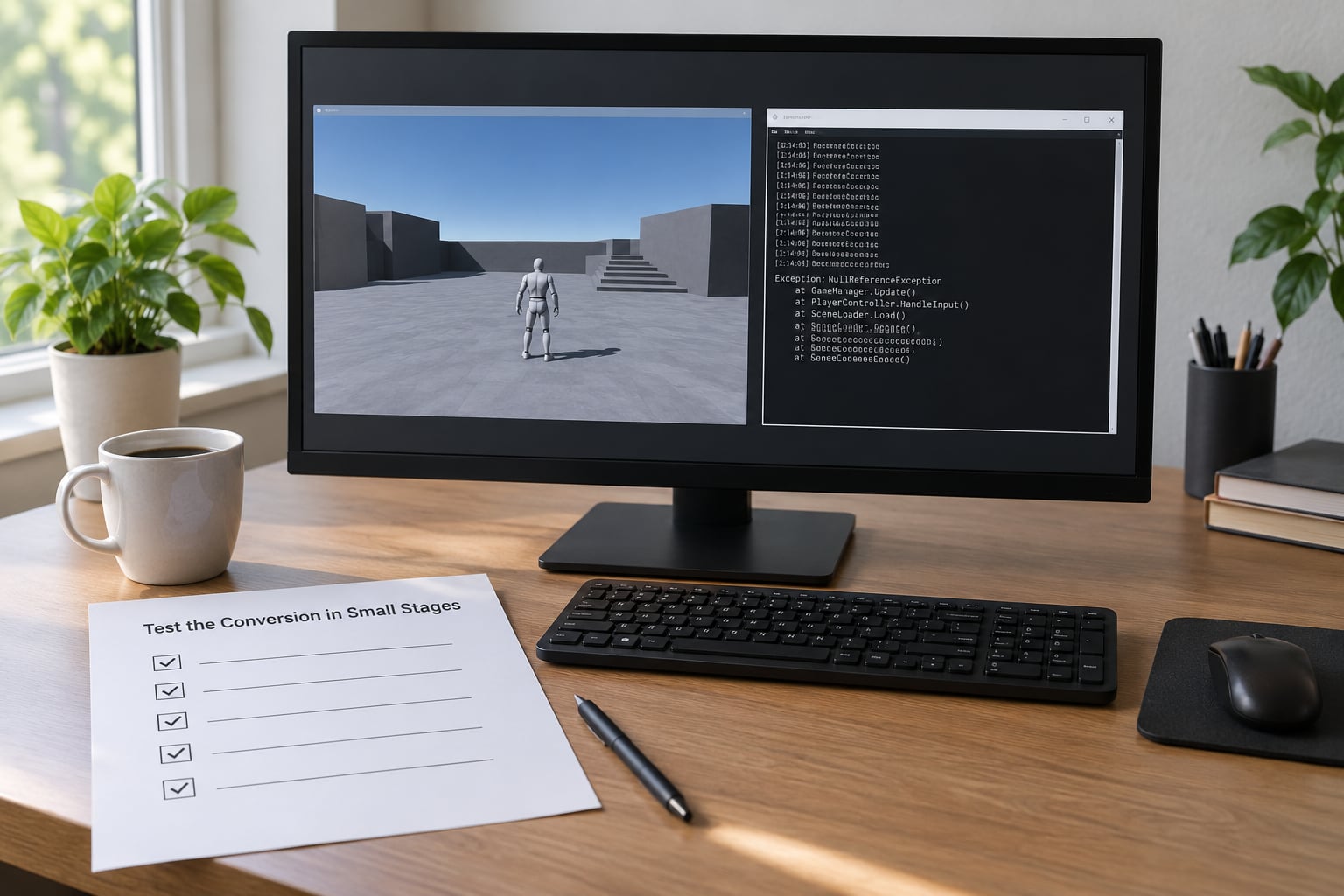
Test on a clean installation every time. If you have been running with fifty other mods active for months, a clean run is the only honest result, and it is the environment your players will actually have. The sequence that works: launch and reach the main menu without a crash, start a new game, load a save, play one level of each type, trigger one of each new system, quit and relaunch, then repeat on a second machine if you can borrow one.
When something breaks, read the log instead of guessing. Engines usually name the missing file, the failed key or the bad row in a data table. In Doom the console and the crash dialog give you the lump name that would not load. In the Clausewitz games the error log gives you the file path and often a line number. This one habit resolves most first-week bugs in minutes.
Then look for the failure modes that come from conversion work itself. Vanilla bleeding through means one of your replace declarations did not take, and the fix is usually a path typo or a load-order position problem. Crashes at startup almost always mean something the engine needed at boot is missing. Silent wrong behaviour, like an event that fires but does nothing, usually means a localisation key you never wrote.
Finally, write findings down as you go. A short known-issues list in your own notes becomes the most-read section of your release page later, because it saves every player from repeating your debugging session.
6. Package and Distribute the Mod
Package so that a stranger can install it: required files separate from optional ones, a readme listing every dependency with the exact version needed, a load-order note, and a one-paragraph description that says what the conversion is in a player’s words rather than the developer’s.
Pick the platform that matches the game. Nexus Mods and ModDB suit older and standalone-friendly projects. Steam Workshop works where the game supports it and reaches an audience already inside the game. The Paradox Mods portal and the in-game launcher cover the strategy titles, where installing through the launcher handles load order for you. For anything built on an open-source base, a public Git repository doubles as version history and a distribution point.
Version your releases properly. Bump the version, keep a changelog, and say which previous version broke. Players running a TC for six months will update on your schedule, not theirs, and a clear changelog is what makes updating painless instead of risky.
If your project has grown into something you could sell, be deliberate. Platforms generally prohibit commercial use of mod files, and several now require explicit permission from the publisher. Monetising a TC usually needs a separate arrangement with the rights holder, and it changes how the mod gets distributed. Decide this before you build, not after you have a hundred hours in it.
Common Mistakes
These are the errors that show up again and again, and each has a specific fix rather than general advice.
- Scoping the whole game at once. The result is a project with no playable milestone and no way to tell whether it is working. Fix: commit to a vertical slice and ship it before widening scope.
- Removing vanilla files instead of replacing them. The engine assumes some boot-time content exists and fails without it. Fix: keep every hard-referenced file, point it at your own content, and disable features only through their supported switches.
- Underestimating art and audio. Code is maybe a fifth of the work. Fix: budget stage three at half your total hours and get help early rather than late.
- Rewriting scripts when localisation would do. Event logic is expensive to fork and easy to break. Fix: override the text first, rewrite the script only where the mechanic itself must change.
- Declaring compatibility you do not have. A TC that overrides everything conflicts with nearly every other mod, and players are right to be annoyed. Fix: say so plainly on your page rather than letting them discover it.
- Testing only on your own machine. Your environment has every tool and fix you ever installed. Fix: test from a clean install, then on a second machine or a fresh user account.
- Skipping documentation. Without dependency and load-order notes, most of your downloads fail to launch and never come back. Fix: write the readme before the announcement, not after the support emails.
- Not using version control. One bad merge across a folder of thousands of files can cost a week. Fix: commit small, commit often, from the first day, even on a solo project.
- Holding the release for perfect. Perfect arrives after the audience has left. Fix: release the slice, take the feedback, and let the next version carry the fixes.
One last habit is worth adding: put the project in public early. A devlog, a monthly screenshot post or a public repository gives you testers, contributors and a record of progress. That visibility is also the main reason large conversions get the teams they need.
Frequently Asked Questions
What are total conversion mods?
A total conversion mod replaces nearly everything a player sees in an existing game, including art, levels, characters, weapons, story, rules and often the map, while reusing the original game engine and its mechanics to run it. The game loads normally and a mod layer overrides the data and asset files the engine reads, so the engine’s rules stay while the presentation and content are entirely new.
How long does it take to make a total conversion?
A focused single-player conversion built by one or two people usually runs several months. Large projects with custom art, new levels and a full art direction, like Ashes 2063 or Enderal, take years and teams. The single biggest variable is how much original content you replace, not how skilled the team is. A vertical slice of one level and one faction is shippable in weeks.
What tools do I need to make a total conversion?
A text editor, a 2D tool such as Aseprite or Krita, Blender for 3D, Audacity for audio, the target game’s own level editor, and Git for version control. Older engines also need a source port: Doom conversions are built and played with GZDoom, using tools like SLADE and GZDoom Builder. Nearly all of this is free, and you can start with a text editor and a version control system.
Is game modding illegal?
Most modding is legal because the publisher licenses the game for modification and the patch community depends on it. Boundaries exist, though. Redistributing original game files is not modding and is usually unlawful, and putting a licensed setting such as a television franchise into a conversion raises copyright questions that differ by country and change over time. Monetising a mod usually requires separate permission from the publisher.
Why does my total conversion mod crash on load?
Almost always because something the engine loads at boot is missing. Engines expect certain files, definitions or reserved IDs to exist even when your conversion never displays them, and deleting them causes a crash before the main menu. Declaring a replace path that points at a file which does not exist does the same thing. Keep every hard-referenced element in place and point it at harmless content instead of removing it.
Can I make a total conversion mod by myself?
Yes, but plan the scope around one or two people. Solo works best for a conversion that keeps the engine’s core mechanics and rebuilds art, levels and setting on top, rather than one that rewrites the mechanics themselves. You will wear every hat, so keep the vertical slice small, publish early and use version control from day one. Solo is realistic; solo and ambitious is where projects stall.
Conclusion
Every total conversion follows the same six stages: choose a game and check what you are allowed to do, audit its files to separate replaceable content from hard-referenced content, rebuild the art, audio and levels, wire them into the game’s systems through descriptors and scripts, test from a clean install, then package and publish. The engines differ in file format and none of them are close, but the order never changes.
Put simply, here is how total conversion mods are made: keep the engine, throw out the content, rebuild it in the right order. Your first action is small and concrete — pick one game with documented mod support, open its data folder, and list everything it loads at boot before you promise anything. That audit takes an afternoon and it will save the whole project.