
To pick a class in an MMO for beginners, work outward from how you actually like to play: pick a role first (tank, healer, damage dealer or support), then find the classes that fill that role with the combat style you enjoy, then test two of them for an hour or two before you commit. There is no gear, money or knowledge required to work through this, and the whole process takes about an evening.
The reason it feels so hard is that MMO players argue about classes like they are settling a score. Newcomers get buried under tier lists written by people with a thousand hours in a character they will never play again.
Community forums repeat the same reassurance in every MMO: almost any class is completely viable if you enjoy playing it. Your class does not decide whether you win. It decides what your buttons do for the next hundred hours.
Table of Contents
What You Need
Nothing physical. You need about an hour of free time and access to the game, plus a character slot or two if you want to test properly.
What you do need is honest information about five things before you start clicking buttons:
- Your preferred playstyle. Do you want to be in the middle of the fight or safely behind it?
- The role you want to fill in a group. Every MMO needs tanks, healers and damage dealers. Some add a fourth support slot.
- How much complexity you can hold in your head. Some classes run on a tight priority list. Others let you improvise.
- How much you care about playing alone. Solo play and group play reward very different things.
- How reversible your choice is in that specific game. Some games let you respec freely. Some make you start over.
That last one matters more than beginners expect.
Step-by-Step: How to Pick a Class in an MMO for Beginners
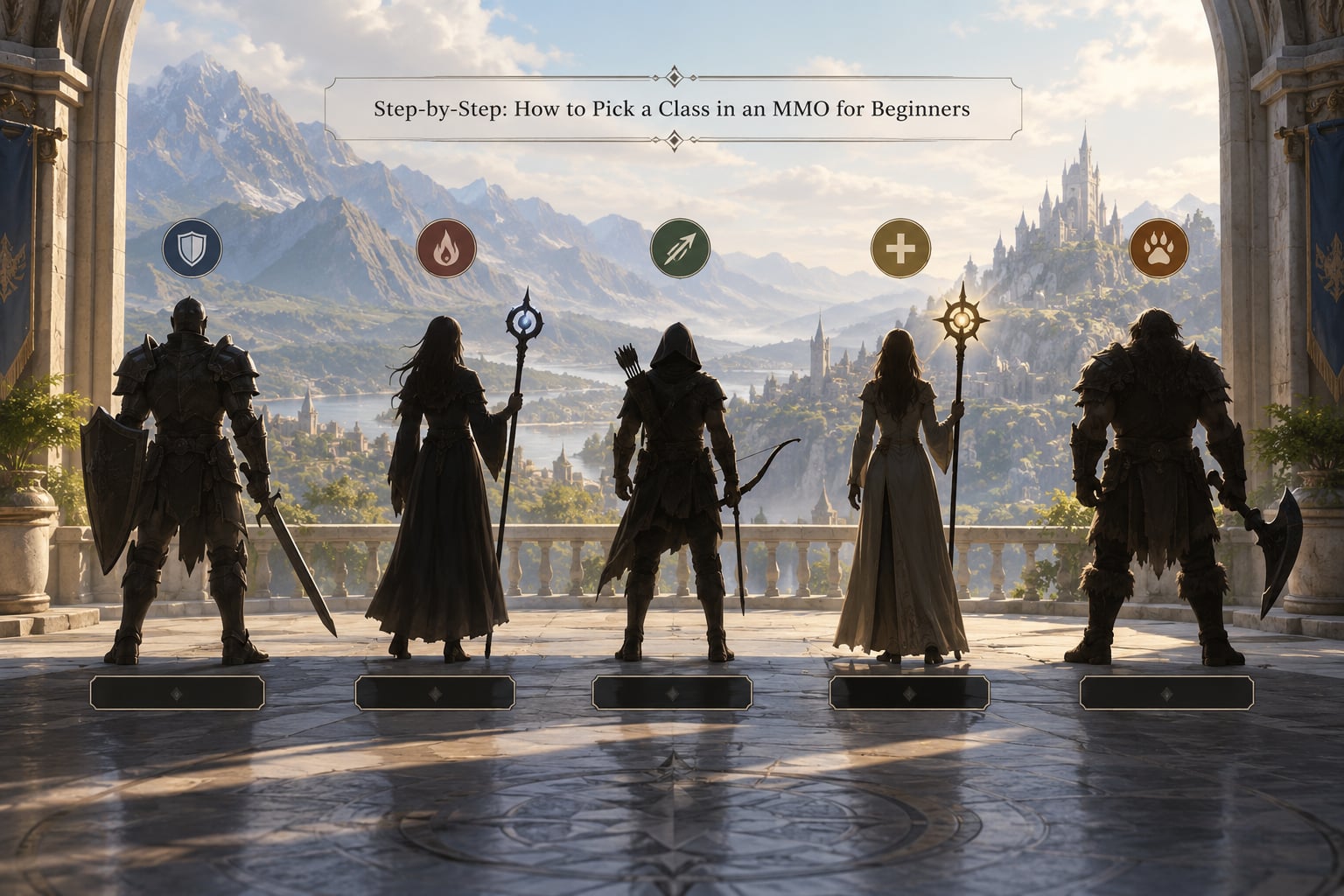
Six steps, in this order. Skipping ahead to step two is how people end up tanking at level 15 and quietly rolling a new character.
1. Decide What Kind of Player You Are
Start with the kind of moment you want to enjoy repeatedly, because combat is where all your time goes.
Some players want to be in melee range, swinging at something that is actively trying to kill them. Some want to hang at range and click. Some want to keep teammates alive and feel the tension of a healer trying to keep up with five moving people. Some want to summon creatures, place traps, or command a pet.
Be honest about which of those sounds good at hour 40, not hour 4. The dopamine hit of a new class fades fast; the actual moment-to-moment loop is what you are signing up for.
2. Choose a Role That Fits Your Preferred Group Contribution
Roles are the shared language every MMO group uses to organise itself. Pick the job you want to do for strangers, not the one that sounds coolest.
- Tank. Holds enemy attention so the rest of the group can attack without being hit. High responsibility, high positioning skill.
- Healer. Restores health as the group takes damage. Busy, reactive, and often the most mentally demanding role in the game.
- Damage dealer (DPS). Kills things. The broadest category, ranging from melee bruisers to ranged casters.
- Support. Buffs allies, controls enemies, or provides utility. Often folded into other roles in older games.
If your friends are already forming a group, check what is missing before you decide. Four damage dealers and no tank means nobody gets to run a dungeon.
3. Compare the Combat Style, Not Just the Numbers
Damage per second tells you almost nothing about whether a class will be fun. Attack range, ability complexity and movement tell you nearly everything.
Ask yourself how far you want to stand from a boss, how many buttons you can track, and how often you must move. A ranged caster might stand still to channel and then move constantly to survive. A melee fighter stays glued to the target and has to watch their back constantly.
Also check the cooldown pattern. Some classes have a few abilities on long cooldowns and a lot of downtime between them. Others give you ten short cooldowns that all want to be used right now. Neither is better. They feel completely different, and only one of them will suit you.
4. Check Whether the Class Stays Useful in Groups
Every class has group value, but not in the same currency. Beginners assume damage output is the only contribution, which is exactly why groups feel stuck.
Damage dealers shorten the fight. Healers make everyone else survive it. Tanks keep the enemy facing the right direction. Support classes and crowd control decide where the enemy is allowed to stand. A class with strong crowd control can be worth more to a group than a class that hits harder but brings nothing else.
Look at how your preferred class interacts with others. A class that slows, stuns or interrupts enemies pairs well with almost anything. A class that needs a lot of setup time is easier to play alongside a tank who can hold the enemy still.
5. Look at Solo and Beginner-Friendly Features
If you will spend your first fifty hours questing alone, some classes are simply easier to live with. You are your own tank, your own healer and your own damage dealer.
Check whether the class has self-healing, self-buffing abilities or a pet that holds attention while you attack. Check whether you can survive a mistake, because you will make mistakes. Check whether the abilities are explained as you unlock them, or whether you are expected to read a wiki before your first quest.
New players on the Elder Scrolls Online and Guild Wars 2 forums describe the same early experience: confusion about attributes, party roles and what the numbers on the character sheet are actually doing. A class with clear built-in guidance removes most of that friction.
6. Test One or Two Classes Before Committing
Play a short trial and ask specific questions afterwards. “Did I like it?” is too soft a question to act on.
Use the starter tutorial, a trial period, a practice area or a free alternate character. Most MMOs let you create several characters on one account, and many let you play a class for free until you commit.
After an hour or two, answer these: Did the combat hold my attention or did it feel like clicking waiting? Did I enjoy positioning, or did I want to stand still? Did I understand what my abilities did without researching them? Would I rather fight alone or wait for a group? Was there a moment where I thought I would enjoy doing this for two hundred more hours?
If the answer to that last one is no, try the second class on your shortlist. This is the step most people skip, and it is the one that would have saved them a wasted main.
Common Mistakes
Picking by popularity. The most-played class is the most-played because it launched first or has the most advertising behind it. Popularity says nothing about your experience. You will be spending your time in the class, not the player population.
Ignoring what your group already has. Everyone picks damage independently, then complains there is nothing to do. Decide the role your friend group needs before you decide your favourite role.
Writing off support classes. Support and crowd control are where a lot of beginners find their favourite role, because the work is subtle and the payoff is obvious to everyone else in the party.
Treating an endgame tier list as a beginner guide. Endgame rankings measure performance under organised, geared, coordinated play. You are not there yet, and the classes that rank well there are not automatically the ones that level well or feel good.
Dumping every attribute point into one stat. It is common advice and it is wrong in most games. Balanced spreads across two or three stats outperform the one-stat build unless a specific skill says otherwise. Read the tooltip on the skill before you commit the points.
Queueing for content you cannot do. If you skip the role that the activity needs, or queue without understanding your own gear score, you will spend your time being carried or getting rejected. Read the requirements on the queue before you enter it.
Committing without a play test. If you cannot level the class a little first, you are choosing from a character art splash instead of from a game. Let go of that choice. It costs one afternoon.
Frequently Asked Questions
What is the easiest class for a beginner in an MMO?
Most often a ranged damage dealer with strong self-buffing abilities, because it survives mistakes and does not rely on anyone else. Classes with pets or summons also suit beginners, since the pet holds enemy attention while you attack. The easiest class is the one whose kit you understand without a guide, not the one rated easiest by a video.
Is it better to choose a tank, healer, or damage dealer first?
For a first MMO, a damage dealer is usually the smoothest entry because you are responsible for one target instead of four teammates. Tanks and healers are more rewarding once you understand positioning and cooldown timing. If you plan to lead groups anyway, tanking teaches you how an encounter actually works.
Should I avoid support classes as a new MMO player?
No. Support classes tend to be forgiving, because buffs and crowd control have obvious effects that help the whole party. The trade-off is that their value is invisible to the group, so you may feel underappreciated early on. Pick them if positioning and crowd control sound more interesting than raw damage.
Can I change my MMO class later?
Most games let you switch specialisation or respec, usually for a small in-game cost that rises with each change. Switching between different classes is harder: some games charge gold, some require a quest chain, and some make you start a new character. Check your specific game’s rules before you invest hundreds of hours in one.
How do I know if an MMO class is beginner-friendly?
Look for self-healing, clear ability descriptions, forgiving cooldown timing and low movement requirements while learning. A class that survives a mistake without dying is beginner-friendly. A class that punishes every misstep needs more attention than most new players have. The easiest way to know is to play it for an hour before you commit.
Should I choose a class based on endgame guides?
Not as your first step. Endgame guides assume geared, coordinated play and measure performance, not fun. Read them later, when you understand which class you enjoy. A class that is excellent at endgame can be miserable to level, and a class that levels smoothly can have a strong endgame career once you learn it.
Conclusion
To pick a class in an MMO for beginners, start with the kind of fight you want to be in, match that to a role, shortlist two classes that fill the role with a combat style you like, and play both before you commit to a main.
That is the whole process. Everything else you read is somebody’s preference dressed up as advice.