A multiplayer game is dying when its active population falls faster than new players can replace them, until matchmaking breaks down and the studio can no longer cover the cost of running the servers. Learning why multiplayer games die, and how to spot it early, means reading the trend across activity, development and communication rather than any single number.
Most players notice a decline the same way they notice weather changing: something is off, and by the time they can name it, the shutdown notice is already up. That delay is the problem. A game can lose most of its population months before anything is announced, and the signals that gave it away were public the whole time.
The good news is that those signals are ordinary. Player counts, queue times, forum posts, patch notes and store page changes are all public, and most are free to check. The trick is knowing which ones carry weight for the genre you play and which ones are just noise.
Table of Contents
- 1Why Multiplayer Games Die and How to Spot It Early
- 2What makes a multiplayer game decline?
- 3The warning signs that a game is dying
- 4How to spot it early through community health signals
- 5What numbers should you track?
- 6Why multiplayer games die: the usual causes
- 7The difference between a rough patch and terminal decline
- 8Can players save a dying multiplayer game?
- 9What should you do before investing more time or money?
- 10Frequently Asked Questions
- 11Is a low player count always a sign that a multiplayer game is dying?
- 12How long should I wait before judging a new multiplayer game?
- 13Are frequent updates proof that a multiplayer game is healthy?
- 14Should I buy items or subscribe while a game is losing players?
- 15Do studios ever shut down a game that still has players?
- 16Conclusion
Why Multiplayer Games Die and How to Spot It Early
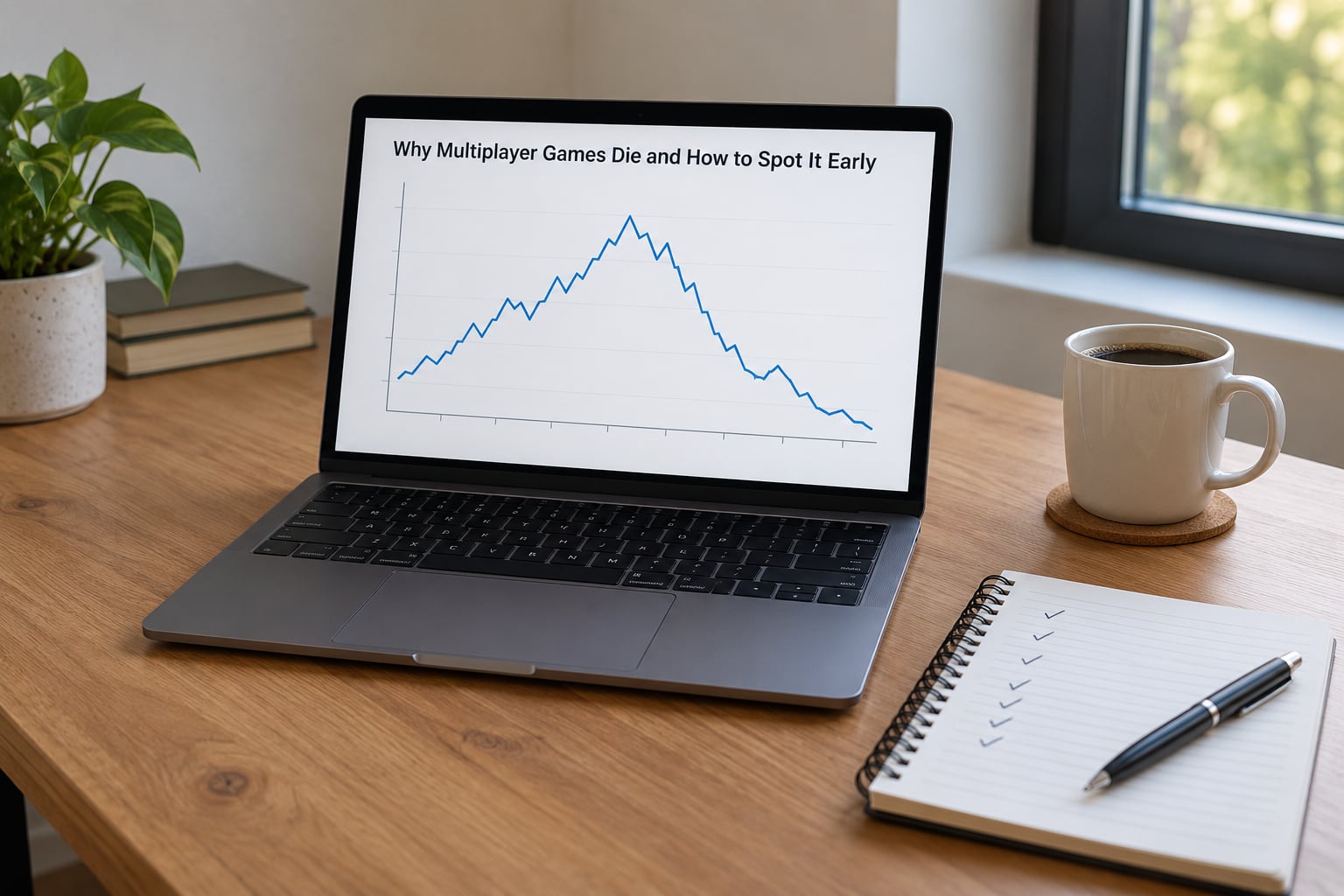
Multiplayer games die through a combination of falling participation, reduced development, weakening retention and lost trust. One of those four on its own is survivable. Together they form a loop where fewer players means less revenue, which means a smaller team, which means fewer fixes, which drives away more players.
What makes the loop hard to catch is that every step takes weeks or months, and the game usually looks fine at any single moment. A Tuesday night queue feels normal. A patch note about bug fixes feels like support. Nothing in isolation proves decline, which is exactly why people miss it.
Forum consensus tends to agree on one thing: the moment players call a game dead is usually about developer behavior rather than numbers. A popular thread on r/PCGamingDE put it as the point where developer interference degrades a previously healthy environment. That matches what players describe when they return after a month and find the ladder empty, the roadmap untouched and the matchmaking worse.
What makes a multiplayer game decline?
Four different things get called decline, and they have different meanings.
A content drought is a gap between updates. Nothing is broken, but the game feels unbuilt for. It usually clears, and it is the least serious of the four.
A seasonal slump is normal variance. Player counts dip between major events or over a quiet holiday and recover when the next update lands. Comparing a Tuesday in November with launch week is not a fair test.
A competitive population problem is narrower. The game is busy, but one role, faction, rank band or region is empty, so the people who care about that specific match lose first. Co-op shooters and MMO-lites hit this most often.
Permanent abandonment looks different again: the new-player intake stops, the parts of the community that organize things stop organizing them, and nothing recovers after a good patch. That is the pattern that ends in a server shutdown notice.
The warning signs that a game is dying
These ten signals are ranked roughly by how early they appear. The first four usually show up months before anything is announced.
- Peak concurrency drops and never comes back. Every game has a launch peak. When the number you hit on day one becomes a number you never reach again, and the recovery weeks that used to follow each update stop happening, the long-term trend has turned.
- Newcomers stop being visible. In a healthy game you regularly see unfamiliar names in matches and fresh handles in chat. When everyone has been around for a year and nobody new appears, intake has failed, and nothing else on this list matters yet.
- Matchmaking gets slower instead of faster. Queue times rising at peak hours, or empty matches that should be full, means the population is thinning exactly where it hurts most. This is the first signal players feel in their hands.
- The update cadence slows and the notes get thinner. A shift from maps, characters and mechanics to typo fixes and store banners tells you the team shrank. Content is the first thing cut when a live-service budget contracts.
- Support questions go unanswered. Bug reports, account help threads and Discord moderation requests that used to get a reply within a day now sit for a week. Support staffing scales with revenue, so silence is a financial signal.
- Features get quietly removed or locked down. Crews disband, modes retire, private servers disappear, replay tools vanish. Players read these removals as preparation for a smaller final version, and they are usually right.
- Event attendance collapses. If in-game events used to pull a crowd and now half the slots sit empty, the core audience has thinned even if the headline player number looks intact.
- Balance problems go unaddressed. One faction or weapon dominating for months, with no patch response, is a strong sign the team either cannot or will not fix the competitive layer. Players leave before they complain loudly.
- Monetization changes without explanation. Sudden price rises, a battle pass split into paid tiers, or a grind increase nobody announced reads as cashing out. Players forgive low numbers far more easily than they forgive extraction.
- Creator and streamer coverage dries up. A game without streamers has no marketing. New-player intake depends on visibility, so this is both a symptom and a cause, and it is one of the last things to disappear before a shutdown.
On r/videogames, players describing the end of a game they loved describe that gradual version rather than a sudden event: coming back after weeks, finding it unrecognizable or empty. That matches the list above, where signals one and two usually arrive long before the rest.
How to spot it early through community health signals
You can run a quick health check on any multiplayer game in about ten minutes. The routine is the same every time, which is what makes it useful.
Start with concurrency. Pull the public charts rather than trusting a screenshot someone posted, then look at the shape over three months rather than today against yesterday.
Next, check retention indirectly. Look at whether returning players appear in matches and whether new accounts show up at all. A game with churn but no intake is pumping through a shrinking population, which is the failure mode players cannot see from inside.
Then read the community surfaces. Forum threads, Discord activity and subreddit posting rate tell you whether the organizing layer is still there. Players across several threads credit organized community play with keeping low-population games alive, and that only works while people are still showing up.
Next, try to recruit. Find someone at your rank or skill level who is new to the game and see whether they can find matches and a group. If a new player struggles, the game will lose the next hundred too.
After that, read the update cadence and the substance of what lands. A useful update that fixes an old complaint does more for confidence than three cosmetic drops. Store page changes, discount events and a missing roadmap all count as communication data.
Finally, note creator coverage. If the game has not appeared in streaming or video for months outside of its own channels, treat that as a warning rather than a fact. Visibility feeds intake, and intake is what you are trying to protect.
What numbers should you track?
These are the metrics worth a place on your watchlist, and what each one actually tells you. There is no universal threshold, so read the direction and the slope rather than hunting for a magic line.
| Metric | Where to find it | Direction that matters | Why one data point misleads |
|---|---|---|---|
| Peak concurrent players | SteamDB, Steam Charts | Successive peaks falling | Launch week always sets an unreachable peak |
| Average concurrent players | Steam Charts, ActivePlayer.io | Slow downward slope | A single weekend or sale distorts it |
| Daily to monthly ratio | Studio reporting, tracker estimates | Rising ratio means fewer casual players | Cross-platform pools are usually missing from the count |
| Matchmaking queue times | In-game, community posts | Rising at peak hours | Regional servers and time of day distort it badly |
| Active population by faction or role | In-game pick rates, forum posts | One option collapsing | Pro players distort pick rates; try casual queues too |
| New account creation | Community observation, friend requests | Approaching zero | Hard to measure precisely, but the trend is obvious |
| Forum and Discord posters | Community hub stats, r/ game subs | Fewer unique posters, fewer replies | Platform migration moves the activity without reducing it |
| Update frequency and size | Patch notes, news archive | Fewer notes, smaller scope | A quiet month is normal after a content drop |
| Event participation | In-game results, community clips | Empty slots, thin coverage | One badly scheduled event means nothing |
| Store page and pricing changes | Steam store history | Deep discounts, removed features | Routine sales happen in healthy games too |
Two honesty notes on this table. Console and mobile populations usually sit outside Steam charts entirely, so a cross-platform game can look far smaller than it is. And no tracker tells you whether the remaining players are happy, which is why sentiment checks belong next to the numbers.
Why multiplayer games die: the usual causes
The reasons behind the symptoms are narrower than people expect. Usually it is one of these, or two compounding.
Development priorities moved. The team that built the game gets pulled onto a new project. Players on Blizzard and ResetEra forums describe this as a stronger signal than any single bad season, and they are usually right.
Server economics broke. Once a population falls, the money from it often no longer covers running the servers plus supporting the team. At that point a studio either funds a dead game from another title’s budget, or it sunsets it.
Post-launch support was never funded. Launch teams are large. Support teams stay small. Games that launch enormous and patch thinly tend to bleed players before anyone is assigned to fix the queue times that are losing them.
Monetization became extractive. Chasing short-term revenue in a game people already resent accelerates churn instead of slowing it, and the cycle PC Gamer criticism points at is exactly this: pressure applied to a modest population until the population leaves.
A faction, weapon or matchup is unbalanced. An unfixable competitive layer is a quiet killer, because the players who care most are the first to go looking elsewhere.
Cheating went unanswered. Unbanned cheaters change the meaning of every match. Players describe this as a leading cause of quitting, ahead of anything else, because it makes effort pointless rather than merely unrewarded.
Toxicity and lack of moderation. Small communities concentrate the worst behaviour. Unmoderated Discords are cited repeatedly as a top reason competitive multiplayer becomes unplayable, and unplayable games empty out fast.
Licensing or hosting instability. A studio losing rights to a league, a publisher ending a contract, or a host raising costs can end a game without any player-facing failure at all.
Your friends left first. Multiplayer is social infrastructure. When the group moves to something else, the game is effectively dead for you even if the population looks fine. This is the one cause that is entirely outside the developer’s control.
The difference between a rough patch and terminal decline
A rough patch has a recovery signal attached. Terminal decline does not.
After a rough patch, players you know come back. The good ones usually say so. Groups reform without anyone organising a revival, because the social structure survived the break.
After a rough patch, updates fix something people complained about. A known matchmaking problem gets addressed, or the ranked ladder gets a real pass. Fixes signal that someone is still building.
After a rough patch, queues behave normally at normal times. Empty matches show up in a bad region or a quiet hour, then fill later. Stable queues are hard to fake.
After a rough patch, new players are still welcomed. Groups invite, teach and keep playing with strangers. The absence of that is worse news than a small number.
Terminal decline has none of these. People do not describe returning. Fixes do not land. Queues stay broken. Nobody is organising anything, and the people who used to do it have stopped posting.
Here is the decision test I use: give any game eight weeks of consistent observation after a promising update. If the update produced a real fix, returning players and normal queues, it was a rough patch. If the update produced a discount and nothing else, it was the beginning of the end.
Can players save a dying multiplayer game?
Partly, and only within limits. Players cannot fix server costs, rewrite matchmaking or balance a faction, but they can affect two variables the developers watch closely: how good the game feels to be in, and how many people want to be in it.
Useful actions are unglamorous. Organise community sessions when the official ones are thin, welcome newcomers in your group because intake is the metric that matters most, and report problems clearly enough that a developer can reproduce them.
Reducing toxicity is also useful, and quieter than it sounds. A community that chases away half its players removes half its own population, which is a measurable loss rather than a moral failing.
Supporting the game when the price is reasonable and the design is reasonable is fair. Spending because you feel guilty about a game’s health, or because a shutdown warning was announced and you panicked, is the pattern that turns a bad situation into a worse one.
Worth saying plainly: most of the blame players assign themselves does not belong to them. A studio that cannot fund a game has made a business decision with information you do not have. Turning that into guilt helps nobody, including you.
What should you do before investing more time or money?
Run these seven checks before you commit to a new release, or keep grinding one you already play.
Community size in your region and skill band. Count real matches at your rank, at peak hours, for a week. Not the headline figure.
Faction and mode balance. If one option dominates and nobody is fixing it, expect your time to feel wasted.
Developer communication. A public roadmap, honest patch notes and a working support channel are worth more than any trailer.
Technical stability. Frame pacing, hit registration, crashes and queue reliability. This is what decides whether you still play in month three.
Support quality. Submit a real bug and see what happens. One answered report tells you more than a year of official community posts.
Progression and purchases. Check whether anything you buy is permanent, transferable or cosmetic. If unlocks depend on a live economy, assume you are renting progress.
Account portability. Ask what happens to your account if the service ends, whether character data is exportable, and whether anything plays offline.
Then choose. Join when all seven look solid and your group is already there. Observe cautiously when the community is healthy but numbers are soft. Switch communities when one region, faction or rank band is broken but the rest works. Leave when communication has gone silent and nothing has been fixed in months.
One last habit worth keeping: check the tracker before a big purchase rather than after. It takes under a minute and it is the cheapest information available to you.
Frequently Asked Questions
Is a low player count always a sign that a multiplayer game is dying?
No. A low count can reflect the time of day, your server region, unusually long match lengths or a quiet week between updates. Community consensus is that low population alone proves nothing, particularly in fighting games, where a small but dedicated ladder can stay healthy for years. Look for a sustained decline over several weeks alongside stalled new-player intake and rising queue times instead.
How long should I wait before judging a new multiplayer game?
Most meaningful judgment needs two or three weeks. Launch excitement, weekend spikes, updates and content drops all distort early numbers. During that window, watch whether players return, whether groups reform without being organised, and whether the first update fixes something people complained about. A game that recovers properly after each update is usually fine, whatever its headline count says.
Are frequent updates proof that a multiplayer game is healthy?
Not on their own. Frequent cosmetic updates can sit alongside unresolved matchmaking, cheating, balance or progression problems. Judge substance as well as frequency: does the patch address known complaints, does the store page still show features, and are support answers still coming back? A busy news archive means a marketing team is working, not necessarily that the game is being improved.
Should I buy items or subscribe while a game is losing players?
Treat spending as an investment with almost no protection once a service is involved. Avoid buying out of guilt, because your friends are leaving, or right after a shutdown warning you have been told to ignore. Check whether purchases unlock permanent progression or feed a live economy that may be wiped. Cosmetics you enjoy are a safer bet than anything tied to progression systems.
Do studios ever shut down a game that still has players?
Regularly, yes. Players remaining is not the same as players paying. Once a population stops covering server costs and ongoing support, a studio may fold the game into another title’s budget or close it entirely. Loss of a licence, a publisher ending a contract, or a host raising prices can end a game too, with no decline in population at all.
Conclusion
Decline is a trend, not a single metric. A low player count on a Tuesday means very little; a falling series of peaks, no new players, thinning forums and quiet patch notes over three months mean a great deal.
Start with the cheapest check: compare recent player activity, community activity and developer communication for any game you play. If all three are heading the same direction, you have your answer before the shutdown notice ever arrives.