Most player trading scams follow the same pattern: someone moves fast, gets you out of the protected channel, and takes something you cannot get back. To avoid scams in player trading, you slow the trade down, verify the person and the item before any value moves, and keep every exchange inside the official trade window with the payment method you can actually dispute.
That is the whole playbook, and it takes about ten minutes on a first trade. The problem is that most players never run those checks because the conversation feels normal. A friendly reply, a reasonable price, a profile with history — none of that is proof, and the accounts behind them are often weeks old.
This guide works across PC, console and mobile games, and it covers item trades, in-game currency, game keys and full account sales. I have pulled the advice from long-running trading communities and the patterns that keep showing up in dispute threads.
Table of Contents
- 1What You Need
- 2Step-by-Step: How to Avoid Scams in Player Trading
- 31. Verify the Player and Account
- 42. Confirm the Item and Transaction Details
- 53. Keep Trades Inside the Game
- 64. Test for Pressure and Urgency
- 75. Check Payment and Refund Claims
- 86. Review Trade Screens Before Confirming
- 97. Keep Evidence of Every Agreement
- 108. Use Official Support for Disputes
- 119. Walk Away When the Story Does Not Add Up
- 12Common Mistakes
- 13Sending your item or account details first
- 14Trusting proof screenshots
- 15Skipping the small print on the trade screen
- 16Using payments with no buyer protection
- 17Deleting the evidence
- 18Treating a friendly stranger like a friend
- 19Forgetting your own account security
- 20Buying an account without taking the email
- 21Frequently Asked Questions
- 22How do you know if a seller is scamming you?
- 23What is the safest way to trade?
- 24What is the safest way to receive money when selling online?
- 25Can you get your money back after getting scammed?
- 26Is selling a game account against terms of service?
- 27Why does a buyer ask me to verify my phone number?
- 28Conclusion: Make the First Trade Safely
What You Need

You do not need special software. You need a few habits ready before anyone sends you a message.
- Your own account, already secured. Recovery email attached, two-factor authentication on, and a mobile authenticator app rather than SMS where the game supports it.
- The official trade window. Know where it is in your game before you ever negotiate. If you cannot find it quickly, you are not ready for a high-value trade.
- A screenshot tool that works fast. Snipping a full trade screen should be a single key press, not a screenshot app launch.
- A place to record details. A note file with the exact username, account link, item names, agreed value and timestamps. Your memory is not evidence.
- Official support channels bookmarked. In-game help, the publisher’s support site, and the marketplace’s own ticket system. Save them before you need them.
- A second screen or a phone camera. Useful when you want to watch the other person’s trade window while you keep your own in view.
One more thing worth setting up: a public thread. Trading in a public forum post where other people can see the conversation gives you witnesses and a timestamp nobody controls. Private message chains are where pressure tactics live.
Step-by-Step: How to Avoid Scams in Player Trading
1. Verify the Player and Account
Account age is the first filter, and it is a rough one. Community traders sort new accounts into tiers: under 24 hours is extreme risk, under a week is very high, under a month is elevated, and older accounts with matching activity are the only ones most people will trade high-value items with.
Age alone is not enough. A six-month-old account with no playtime, no friends and no visible history was not built by a real player. Check that the account’s progress matches the story being told — a veteran account should have years of activity, a full friends list and consistent session history.
Then look outside the game. Search the exact username in quotes, the profile link, and the seller’s display name in a search engine. Look for prior scam reports on shared ban lists and reputation databases such as SteamRep where the platform applies. A reverse image search on their avatar catches reused or stolen profile pictures, which is common on throwaway accounts.
Do not trust a display name, an avatar, or a profile picture as identity. Verify the exact username you will trade with, character for character.
2. Confirm the Item and Transaction Details
Before any trade window opens, both sides should state in writing exactly what is changing hands: item names, quantities, condition, upgrades, binding status, and the delivery method. If the seller cannot list it precisely, that is information.
Ask for the item in an unstackable or single slot so you can see the exact count on screen. Level, rarity, wear, and any attached modifications need to be visible in the trade screen rather than described in chat. For in-game currency trades, settle on the number and the unit — millions are easy to misread when the trade window abbreviates.
Binding status deserves its own question. A tradeable item and an account-bound item are not the same transaction, and one of them cannot be reversed. Same with game keys: ask whether they are region-locked or already redeemed, and never accept a key the seller cannot show as unredeemed inside your platform.
3. Keep Trades Inside the Game
The official trade window, in-game mail, or a marketplace escrow service exist because they make both sides visible at once. Use them. Everything else adds risk for no gain.
Refuse any request to trade through a link, a remote-control session, screen-sharing, or a conversation that has moved entirely off-platform. Scammers use those to swap items after you confirm, or to harvest a login or two-factor code under the guise of a “verification” step.
The middleman rule matters here. A real middleman has a public, established record, is agreed on by both sides independently, and holds both the goods and the payment until each side confirms. A middleman who appears from inside the conversation, arrives by direct message, and rushes you is part of the scam.
4. Test for Pressure and Urgency
Pressure is the tell that shows up most reliably. Scammers manufacture a reason you must act before you think.
- “Limited offer, I have another buyer waiting right now.”
- “My account is being banned tonight, so this has to happen now.”
- “Just send your item first so I can check it’s genuine.”
- “I’ll add you as a friend, we can sort it out after the trade.”
- “Don’t tell anyone, you’ll get me in trouble with the mods.”
Veteran traders treat unexpected friendliness itself as a warning sign. Someone with no history offering you a favour, extra value or a discount is doing something unusual, and unusual is worth stepping back from.
Another tactic is asking you to pay first, or to hand over the item while they “verify” their side. Nothing good happens after that point. Refusing to go first is not rude — it is the default.
5. Check Payment and Refund Claims
Real money and virtual goods have very different protection levels, and the gap is where sellers lose everything.
A card or bank transfer can be reversed through a chargeback months after it cleared, and the seller usually loses that dispute even with evidence. PayPal Friends and Family is the worst case: it deliberately removes buyer protection, so a scammer can pay, receive the item, then file a claim through the card issuer instead.
Payments that are one-way by design — gift cards, cryptocurrency, wire transfers — offer no protection at all. If someone asks for any of those, the honest answer is that they are asking you to take the entire risk yourself.
Being paid can be a scam too. Instant bank transfer notifications can be reversed or funded with a stolen card, and that reversal lands on your account and can carry a fraud flag with it. If a buyer sends you money unexpectedly, do not release items until the payment has fully settled, and never send back an “overpayment” to a different account.
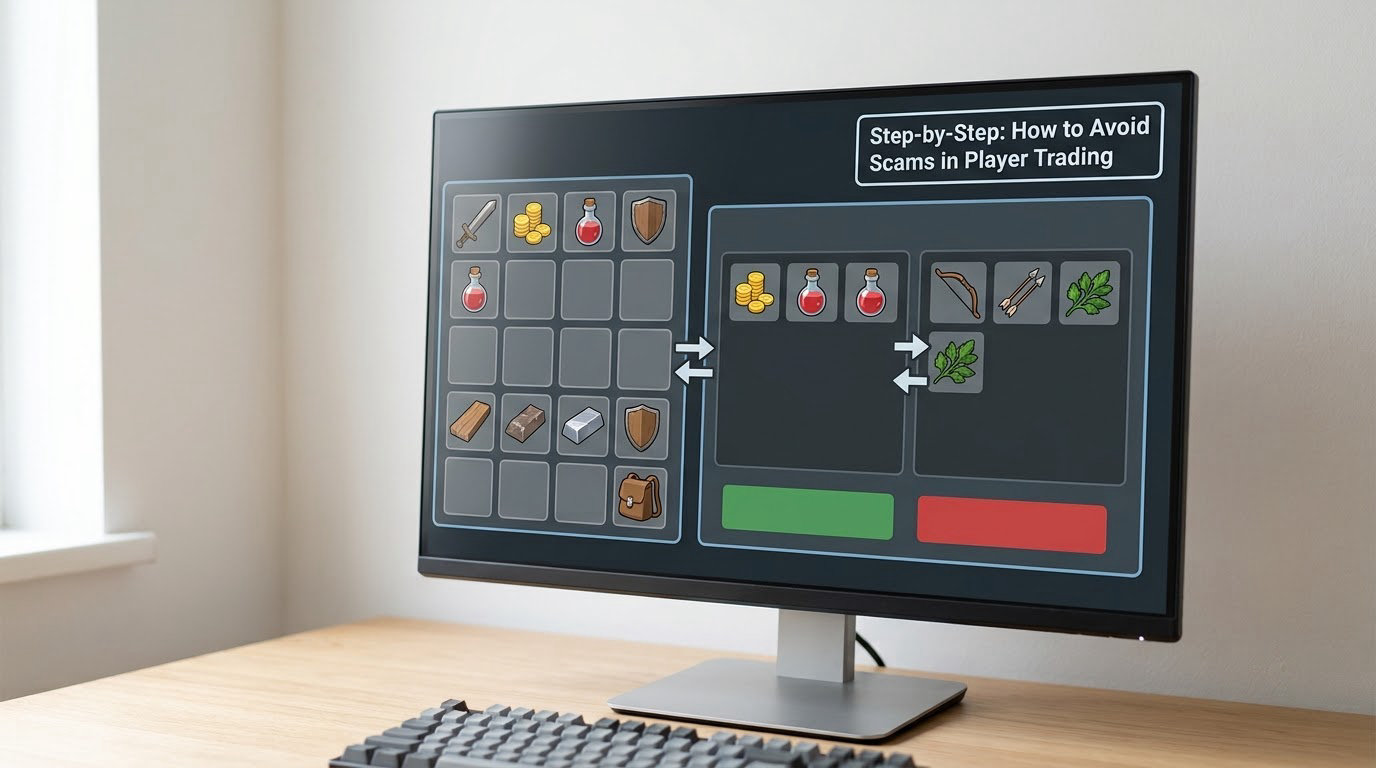
6. Review Trade Screens Before Confirming
This is the moment most item scams are built around. The trade screen shows both sides at once, and the trick is to get you to confirm while reading only your own column.
Run a fixed routine every time, in the same order. Match the usernames on both sides against the names you verified. Count items and confirm the quantity. Read each item’s description rather than recognising its icon. Check that both sides have accepted, and that nothing appeared after acceptance. Read every fee, tax or commission line in a currency trade.
If any detail changes at the last moment, close the trade. A genuine trade can be redone. Every trade-window swap scam depends on you feeling rude for checking twice.
Sellers should also know that buyers can be the one swapping. Scam reports show both directions, and the trade screen protects neither side on its own.
7. Keep Evidence of Every Agreement
Screenshot everything, and do it while it still exists. Capture the trade screen before confirming, the chat history with usernames and timestamps visible, the profile page, and any payment record or transaction reference.
Save it somewhere the other person cannot reach or delete. Local files plus a cloud copy works. A screenshot posted in a public thread with a permalink gives moderators and platform staff something verifiable rather than a claim.
Write down the agreed terms in your own words as soon as you agree them: who is trading what, the value, the date, and the channel. When a dispute comes down to what was promised versus what was delivered, that note is usually the difference between a refund and a loss.
8. Use Official Support for Disputes
If something goes wrong, go through official channels and do it early. File a dispute with the platform or payment service immediately, because the window for a chargeback is measured in days from the transaction date, not from when you noticed.
Give support the specifics: usernames, trade screenshots, chat logs, transaction IDs, dates and times. Vague reports get closed. So does a report that is a public accusation rather than a private ticket.
Escalate in order. Marketplace or platform ticket first, then publisher support for anything involving a compromised or wrongly transferred account. Reputation services and shared ban lists exist to flag the trader for the next person. Avoid public pile-ons and threats; they escalate the situation and can turn a straightforward refund into a fight.
Set expectations honestly. Users most value platform buyer protection and trust it least — it covers some situations and quietly does not cover others. A support ticket backed by clean evidence gets a better outcome than an angry one, but it is a safety net, not a guarantee.
9. Walk Away When the Story Does Not Add Up
You do not need to prove a scam before you end an interaction. You only need to be unsure.
Close the trade, block the account, keep your evidence, and secure what you already have: change your password, re-check your recovery email, confirm two-factor authentication is still on, and revoke any active sessions you do not recognise.
Ending a trade costs you a stranger’s item. Being wrong about a scammer costs you the item and the money. The maths is not close.
Common Mistakes
Most losses come down to a small number of repeated errors. Here are the ones I see most, with the fix attached.
Sending your item or account details first
The single worst move. If someone asks you to go first, the answer is no, and if they treat that as a dealbreaker, that was the deal. In a proper trade window, both sides commit together or not at all.
Trusting proof screenshots
An image of a payment confirmation proves nothing. Screenshots are the easiest thing in the world to fake. Verify payment in the payment app or your bank, not in a picture someone sent you.
Skipping the small print on the trade screen
Scammers rely on you recognising icons instead of reading lines. Read quantities, fees and item descriptions every single time, even on the fifth trade of the day.
Using payments with no buyer protection
Gift cards, cryptocurrency and bank wires are irreversible. So are payments labelled friends and family. If your protection is zero and the other side has none either, you have both removed the only lever you had.
Deleting the evidence
Blocking and reporting both, because blocking alone deletes nothing, but clearing chats out of spite does. Report through official channels with screenshots attached before you close the window.
Treating a friendly stranger like a friend
Guild members and friends are the same rule as strangers, plus awkwardness. Write the terms down even with people you know, because most guild disputes are misunderstandings about quantity, not theft.
Forgetting your own account security
Two-factor authentication, a current recovery email and revoked sessions. This is not a trading check, but account takeover is how many trading scams end, and it starts long before the trade window opens.
Buying an account without taking the email
Accounts get reclaimed by their original owner weeks or months later, even after the buyer changed the password. Buyers who had success re-linked their own email and two-factor authentication immediately, and kept the transfer details the seller used. Know that account sales break most publishers’ terms of service, and that a bad purchase can still get you banned.
Frequently Asked Questions
How do you know if a seller is scamming you?
Look at patterns, not promises. A brand-new account, a price well below market value, a push to move off-platform, pressure to go first, and a refusal to use the official trade window are the strongest signals. Check the profile, search the username for prior scam reports, and ask specific questions about the account or item. You do not need proof before you walk away from a stranger, only a reason to be unsure.
What is the safest way to trade?
The safest trade happens inside the official in-game trade window, in a public thread where possible, with both sides committing at the same moment. Verify the account first, agree every detail in writing, and read the final trade screen carefully before you confirm. Never trade through external links, remote-control requests, or conversations that have moved entirely off-platform.
What is the safest way to receive money when selling online?
Use a payment method with genuine dispute protection, and keep the transaction on a platform that can hold funds until delivery is confirmed. Avoid payments labelled friends and family, gift cards, cryptocurrency and bank wires, since all of them are effectively one-way. Never release the item on an overpayment notice, and wait until the payment has fully settled, not just shown as pending.
Can you get your money back after getting scammed?
Sometimes, and speed decides how often. File a dispute with the platform and your payment provider the same day, since chargeback windows are short. Then screenshot everything: trade screens, chat logs, usernames and transaction references. For compromised accounts, change your password, re-check your recovery email and two-factor authentication, and report through the publisher. Items and currency already delivered are usually gone.
Is selling a game account against terms of service?
Almost always, yes. Most publisher terms of service prohibit selling or transferring an account, and enforcement can reach both sides. That matters for buyers too: an account bought with a stolen card can carry a chargeback and a fraud flag into your hands, and a cheating ban can be applied retroactively. Even a legitimate sale carries unknown history, which is why many communities advise against buying accounts at all.
Why does a buyer ask me to verify my phone number?
It is a takeover precursor, not a friendly check. A phone number and account details together are enough for a skilled thief to attempt a SIM swap or an account recovery, and some verification requests are simply a way to collect a one-time code from you. Never read a code out loud, never click a link sent to verify anything, and confirm two-factor authentication on an app you already control. One-word messages asking to verify are a recurring pattern in trading scams.
Conclusion: Make the First Trade Safely
If you remember one thing about how to avoid scams in player trading, make it this: pause before value moves, verify inside the official interface, and never let anyone move the conversation off-platform.
Check the account age and its actual activity, agree the exact item and quantity in writing, and read the final trade screen before you confirm. Screenshot the whole exchange while it still exists, so a dispute has something to work with later. And if the story has any gap in it, you are allowed to end the trade without proving anything.
Most of that costs nothing. It is the trades you hurry that people end up posting about later.