Loot tables and drop rates work the same way in every game that uses them: the game generates a random number, compares it against the weights or percentages on each entry in a list of possible rewards, and grants whatever that roll lands on. That list is the loot table, those numbers are the drop rates, and almost everything else you have read about loot luck, party bonuses and tier lists is a modifier sitting on top of that basic roll.
Table of Contents
- 1How Loot Tables and Drop Rates Work in Games
- 2How Drop Chance Is Calculated
- 3Why a 10% chance does not mean every item has a 10% chance
- 4What 100 runs and 1,000 runs actually look like
- 5The Main Parts of a Loot Table
- 6Pity Systems, Bad Luck Protection, and Drop Scaling
- 7Guaranteed counters
- 8Soft pity and increasing odds
- 9Hidden pity
- 10Elite and boss bonuses
- 11Worked Examples of Loot Tables
- 12Example one: a fixed boss table
- 13Example two: a dungeon reward pool with two rolls
- 14Example three: an event reward with pity
- 15Why Drop Rates May Differ Between Players
- 16How Loot Tables and Drop Rates Work With Luck Bonuses
- 17How Players Can Estimate and Improve Their Chances
- 18Frequently Asked Questions
- 19Why did I not get a rare item after completing many runs?
- 20Does a 1% drop rate mean I am guaranteed the item after 100 tries?
- 21How do luck bonuses affect loot tables?
- 22What is the difference between item luck and loot-category luck?
- 23Are drop rates the same on every server and difficulty level?
- 24Conclusion
How Loot Tables and Drop Rates Work in Games
A loot table is a list of possible rewards attached to an action, such as killing a boss, opening a chest or clearing a dungeon. A drop rate is the probability attached to one entry on that list, and the game picks one (or several) entries at random each time you trigger the action.
Four words do most of the work in any discussion about loot, and they get mixed up constantly:
- Item pool — every entry the table is allowed to roll on at that moment. Different pools can apply at different difficulties, in a party, or out of combat versus in it.
- Weight — a number attached to an entry that decides its share of the roll. Weight 1 does not mean 1% unless the total weight of the table happens to be 100.
- Drop rate — the probability that one specific entry is selected on one specific attempt.
- Luck — a modifier, from a stat, an item or a buff, that adjusts a rate or a weight before the roll happens.
| Term | What it actually measures | Example |
|---|---|---|
| Drop rate | Probability one specific entry wins a single roll | 0.09% per chest for a legendary token |
| Drop chance | Probability the action produces any drop at all | A 30% chance the chest contains something |
| Expected value | Average result across many attempts | 1.5 tokens per 1,000 chests at 0.09% |
| Expected time | Attempts until a drop, averaged over many players | About 1,111 chests for that token |
A player on the Blizzard forums put the distinction neatly: roughly one in six or seven attempts gives you any drop at all, while the specific item you want is about one in 25 to 30. Same chest, same source, two very different numbers, and only one of them is the number you actually care about.
How Drop Chance Is Calculated
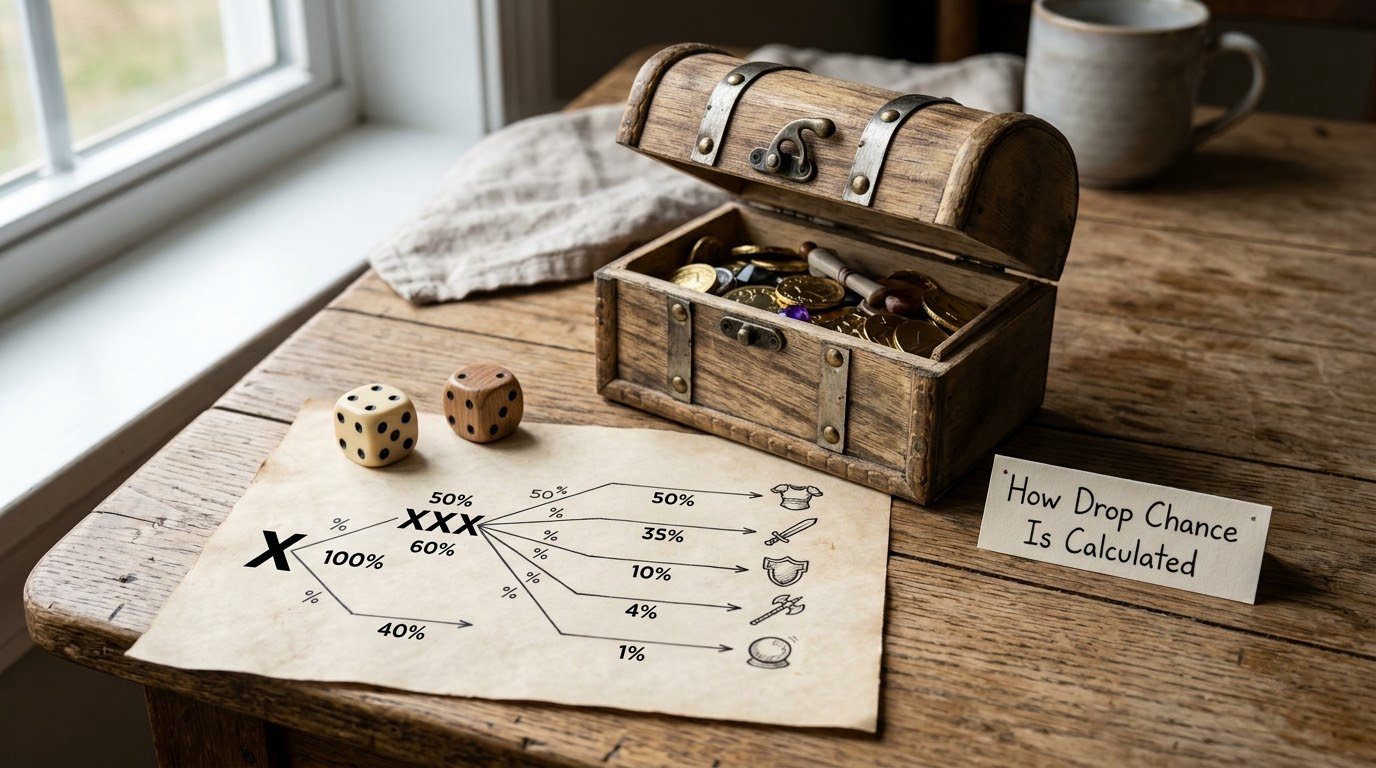
There are two ways a table is usually written, and they produce identical results. A table can list a flat percentage per entry, or it can list a weight per entry. With weights, the game adds up every weight in the active pool, generates a number in that range, then walks down the list until it finds the entry whose range contains that number.
That last step is why weights are the form developers prefer. Say a chest has four entries with weights of 1000, 100, 10 and 1. The total is 1111, and each share is its own weight divided by 1111.
| Rarity tier | Weight | Real percentage | Plain English |
|---|---|---|---|
| Common | 1000 | 90.009% | About 9 in 10 |
| Uncommon | 100 | 8.991% | Roughly 1 in 11 |
| Rare | 10 | 0.900% | About 1 in 111 |
| Legendary | 1 | 0.090% | About 1 in 1,111 |
This exact 1000/100/10/1 ladder is the one Microsoft’s PlayFab loot tutorial uses to demonstrate weighted selection, and it is worth internalising: the developer never typed 0.09% anywhere. They typed a 1 and let the maths do the rest.
Why a 10% chance does not mean every item has a 10% chance
Three different things get called 10%. A 10% chance for a single specific item means that exact item, once per trigger. A 10% chance for a category, such as weapons, means the table rolled the weapon category and then rolled again inside it. A 10% chance on a one-winner-takes-all table means the ten entries listed at 10% fill the entire roll and nothing else is reachable, which in practice only happens when the listed percentages add up to 100.
Published rates that add up to 87% are not a bug. The missing 13% is usually a no-drop outcome, and it is the single most misread number on most wiki pages.
What 100 runs and 1,000 runs actually look like
Picture that 0.09% legendary token again. After 100 chests, the expected count is 0.09, and the chance you have at least one is about 8.7%. That is roughly what most unlucky players experience, and it is why the community advice on r/thedivision is to average 200 to 300 runs before deciding anything is broken.
After 1,000 chests, the expected count is 0.9, and the chance of at least one climbs to about 59%. Two or more in the same sample happens roughly a quarter of the time. Nobody lands on exactly 0.9; the whole point is the spread. One player in a hundred gets three or more, and one player in a hundred gets nothing at all, and both of those players were playing the identical table.
This is the part that trips people up. If you have done 99 chests and missed, your chance on the next one is still 0.09%. The rolls do not know how close you are.
The Main Parts of a Loot Table
Any table worth reading closely is built from the same handful of pieces. When a wiki page looks confusing, it is usually because one of these is doing something unusual.
| Component | What it controls | Why it matters to you |
|---|---|---|
| Source | Which action opens the table | A chest, a boss kill and a repeatable dungeon can share names and differ completely |
| Eligible items | The active pool for your situation | Party, difficulty and level filters shrink the pool before any roll |
| Base weights | Each entry’s share of the roll | Convert them yourself, because devs rarely print the percentage |
| Conditions | When an entry can roll at all | First kill of the day, no party members nearby, boss below a health threshold |
| Random modifiers | Luck, boosts, event multipliers | Applied before the roll, so they change real odds rather than the label |
| Duplicate policy | Whether a repeat is allowed, converted or blocked | Often the difference between a progress item and a useless repeat |
| Caps | Per day, per week or per account limits | The rate on the wiki stops applying once you hit the cap |
| Server and region rules | Which pool your shard uses | Community servers and test realms frequently run their own tables |
The duplicate policy is worth reading twice. Some bosses, as one LurkerLounge guide notes, never drop duplicates of the same reward, which quietly means their effective legendary rate is higher than the raw number suggests and your 50th helm comes from a different table than your first.
Pity Systems, Bad Luck Protection, and Drop Scaling
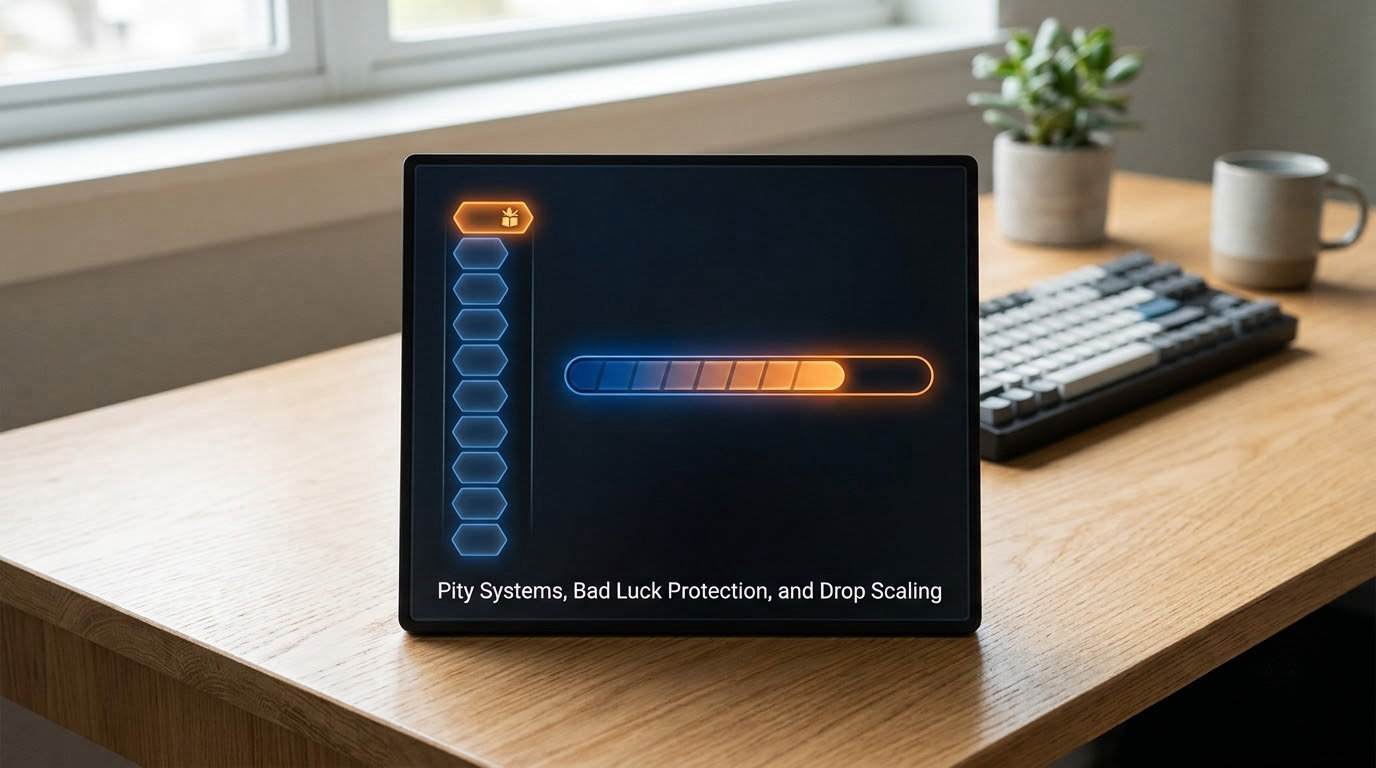
A pity system is any rule that changes your odds because of how long you have already gone without a drop. There are four flavours, and they are not equally strong.
Guaranteed counters
The clearest version: after 79 pulls with nothing, pull 80 is forced to give the item. This is a guarantee, and it is the only kind that ends a streak. If your game has one, the worst case is known and finite, and that number is worth more than any percentage on the wiki.
Soft pity and increasing odds
Here the rate climbs after a threshold but never reaches certainty. A common pattern is a flat 2% rate for the first 30 pulls, then 2 percentage points added per pull, hitting 100% around pull 80. Better than nothing, and still a real streak risk through the middle of the ramp.
Hidden pity
The same idea with the counter hidden from the player, so you cannot tell whether it exists. Players often detect these by logging thousands of results and looking for a distribution that has no long tail. Treat an unconfirmed hidden pity as if it does not exist.
Elite and boss bonuses
Some tables scale with difficulty rather than with your history. Harder tier, more damage, more players, bigger bonus. That is a different axis entirely from pity, and on many games it produces a far bigger improvement than any luck stat you can equip.
Players care a great deal about which of these a game ships. The Pirate101Central forum thread titled on drop rates being purely random is a good example of what happens when a game has no protection at all: the entire thread is people asking whether a streak is proof of anything. It is not.
Worked Examples of Loot Tables
Example one: a fixed boss table
A boss drops exactly one item per kill, from one pool of four entries.
| Entry | Weight | Real percentage | Expected kills |
|---|---|---|---|
| Ancient dust | 5000 | 87.72% | 1.1 |
| Runed blade | 600 | 10.53% | 9.5 |
| Wyrmbone | 90 | 1.58% | 63 |
| Crown of Ash | 10 | 0.18% | 570 |
The Crown sits at roughly one in 570. At 90 seconds a kill that is a bit over 14 hours of clearing in expectation, and the expectation says nothing about whether it lands on kill 12 or kill 2,000. What this table guarantees is a clean answer to “is 0.18% correct?”, which is yes.
Example two: a dungeon reward pool with two rolls
A dungeon grants two rewards per clear, drawn from weights of 500, 300, 150, 40 and 10, total 1000. That gives 50%, 30%, 15%, 4% and 1% per roll. With two independent rolls and no duplicates allowed inside one clear, the chance of getting the 1% item in a single dungeon is 1 minus 0.99 squared, or 1.99%.
So the same item is 1% per roll and 1.99% per dungeon. That is the difference between a per-attempt rate and a per-container rate, and it is the number most wiki pages do not print. Duplicate protection also matters: if repeats roll into duplicates, a dungeon with two rolls and five entries hands you the same item twice often enough to notice.
Example three: an event reward with pity
Consider a limited event with a 2% base rate, no duplicate protection, a soft pity starting at pull 30 and adding 2 points per pull, and a hard guarantee at pull 70. Over 100 pulls, the flat version would average 2 items and still leave a 13% chance of finishing with nothing. This version cannot finish with nothing at all, because pull 70 is forced.
That is what pity protection actually buys: it does not raise your average, it removes the worst case. If you care about the average, hunt for luck multipliers and difficulty tiers. If you cannot handle a 1-in-1,111 item with no floor, pity is the system you want.
Why Drop Rates May Differ Between Players
Two players can read the same wiki page, play the same content and get genuinely different odds. Usually the table is the same and the modifiers are not.
- Luck stats — a stat or item that raises a specific rate or a category of rates before the roll.
- Party composition — the EliteMobs wiki is explicit that rolls happen separately per damage contributor, so your personal rate in group content is not the table’s rate.
- Difficulty and level — many tables swap or filter their pool by tier rather than multiplying a single rate.
- Account and server rules — shards, test realms and community servers can publish their own tables.
- Version changes — a hotfix can quietly rewrite a pool, and old wiki pages keep the old numbers.
- Caps and first-drop rules — a guaranteed first drop, then a different rate, then a daily cap.
How Loot Tables and Drop Rates Work With Luck Bonuses
Luck is a multiplier or an additive boost applied to the rate before the roll, which means it changes the actual number rather than the label. A 1% base rate at double luck is a 2% roll, and a pity counter keeps counting either way. Games with visible luck systems, New World being the common example, tend to stack luck additively within a category and multiplicatively across categories, which is why players spend so much time on the stacking rules.
The practical warning: a luck bonus that only applies to one category does nothing for a drop outside that category. Read the tooltip rather than the marketing line.
How Players Can Estimate and Improve Their Chances
None of this makes a rare item more likely to come on your next run. What it does is stop you grinding the wrong content for the wrong reasons.
- Find the raw table first. Weights, roll count, quantity range, duplicate policy. If a page only says rare, it is not a source.
- Convert weights to percentages yourself. Divide each weight by the total weight of the pool that actually applies to you, not the whole table.
- Check the pool, not just the rate. Difficulty filters and party rules change which entries are reachable.
- Find the pity counter. The best-case number and the hard floor are the two figures worth memorising.
- Compare luck by category. Item luck and category luck are different multipliers and rarely both apply.
- Log your own results. Community trackers exist because wiki numbers are usually community-measured anyway. The Old School RuneScape wiki pulls its rare-drop figures from a loot tracker plugin, which is a good sign of how little of this data comes from the developer.
- Aim for a sample, not a streak. Two hundred to three hundred attempts is the number experienced players quote before judging a drop rate.
- Skip gambler’s-fallacy thinking. Missing on your ninetieth try does not make the ninetieth first more likely.
You cannot honestly promise yourself a drop schedule from any of this. You can only pick content whose rates match the reward you need, and know exactly how long the expected grind is before you start.
Frequently Asked Questions
Why did I not get a rare item after completing many runs?
Because a stated rate is an average, not a schedule. At a 0.09% drop rate, 100 runs gives you an expected count of 0.09 and roughly a 9% chance of having the item at all. Reaching 300 runs pushes the chance of at least one to about 24%, which is still an unlucky result but a normal one. Check the table first: a pool filter, a duplicate rule or a daily cap can all shrink your real odds below the headline number.
Does a 1% drop rate mean I am guaranteed the item after 100 tries?
No. One percent means one success per 100 tries on average, and 100 tries is the expected number, not a threshold. The chance of getting nothing in 100 attempts at a 1% rate is 0.99 to the power 100, which is about 37%. A guarantee only exists if the game ships a pity counter with a stated hard floor, and until you find that rule documented, plan as if there is no floor.
How do luck bonuses affect loot tables?
Luck bonuses are modifiers applied before the roll, so they change the probability rather than the reward. A 1% base rate at double item luck is a genuine 2% attempt. Most systems stack additively inside one category and multiplicatively across categories, so a category bonus rarely helps an item outside that category. Pity counters keep advancing on their own schedule regardless of your luck, because luck changes the odds of a roll and not the counter.
What is the difference between item luck and loot-category luck?
Item luck targets one named entry, such as a specific weapon or material, and does nothing for the rest of the table. Loot-category luck targets a whole group, such as all weapons or all crafting parts, and then the table picks inside that group using the normal weights. Category luck is usually the better buy for farming and item luck is usually the better buy for one specific target you are desperate to finish.
Are drop rates the same on every server and difficulty level?
Rarely. Difficulty tiers often swap the whole item pool rather than scaling a single rate, and group content can roll separately per damage contributor, which dilutes your personal share. Community and test servers frequently run their own tables, and patch notes can change weights without changing the headline percentage. Read the version the wiki page was last updated for, and treat any number older than the current patch as history.
Conclusion
Start with the raw table: weights, roll count, quantity range and duplicate policy, all of which you can find on a wiki or a community database in 2026 for almost any game with a live economy. Convert the weights yourself, check whether luck, party size or difficulty tier changes the pool before the roll, and find out whether a pity counter sets a hard floor.
Then do the expected-value maths and let it set your expectations. A 0.09% drop is about 1,111 attempts, which is a normal Tuesday if a run takes 90 seconds and a rough weekend if one takes ten minutes. Until a game ships a documented guarantee, a rare result stays uncertain, and no amount of counting makes the next roll more likely than the last one.