LFG stands for Looking For Group. In online games it means the tool a developer built so you can stop typing in world chat and get matched with other players for a dungeon, raid, fireteam or PvP match instead. That covers everything from the Dungeon Finder in World of Warcraft to the fireteam finder in Destiny 2 and the party builder in Final Fantasy XIV. If you have ever sat in a queue wondering why nobody joined you, this is the mechanics behind it.
Short version: here is how LFG systems work. You pick an activity, pick your role, and the system filters every other queued player down to the ones who fit, then assembles a group and teleports you into the instance. Most of the waiting comes from that filtering step, not from a lack of players.
Last updated for October 2026.
Table of Contents
- 1What Is an LFG System?
- 2How LFG Systems Work From Queue to Party
- 3The Main Parts of an LFG System
- 4How Matchmakers Choose Players
- 5Hard filters: pass or fail
- 6Soft preferences: who gets picked from the survivors
- 7Fairness rules that override your choice
- 8What Happens After a Match Is Found
- 9Different LFG Methods Used in Online Games
- 101. Instant matchmaking queues
- 112. Role-based queues
- 123. Party recruitment listings
- 134. Bulletin boards and add-ons
- 145. Guild and community finders
- 156. Player-created events
- 16Why LFG Searches Sometimes Fail
- 17How to Get Better Results from an LFG System
- 18Frequently Asked Questions
- 19What does LFG stand for in online games?
- 20Do LFG systems always create balanced teams?
- 21Why am I not finding an LFG party?
- 22Should I use an LFG queue or post my own party request?
- 23What information should I include in an LFG post?
- 24Can I use an LFG system with friends?
- 25What to Do First
What Is an LFG System?
An LFG system is any tool that assembles a group of players who did not know each other beforehand. Modern games ship three flavours of it, and the differences matter more than most players realise.
- Queue-based (automatic): you enter a queue with a role and a difficulty, and the system forms the group for you. World of Warcraft’s Dungeon Finder, the Lost Ark dungeon menu, and Overwatch 2’s quick play all work this way.
- Listing-based (manual bulletin board): you post what you want, other players post back, and a human being on both sides decides whether to group up. The MmoGah write-up of the Wrath classic group finder put it plainly: the point is to take the spam out of chat and move it into a panel.
- External platform: the group forms somewhere the game cannot see. Discord LFG channels, third-party squad-finding sites, and add-ons that scan the trade chat all sit in this bucket.
Developers built these because of two specific problems. The first was chat spam: hundreds of identical “dungeon run need healer” lines drowning everything else. The second was queue friction, where forming a group took ten minutes of messaging and half the group never showed up.
The side effect nobody advertised is social. When joining a group becomes effortless and the content is easy, nobody needs to talk to anybody. Players on r/classicwow still argue that dungeon finder removed the social fabric of the game, and it is a fair point.
How LFG Systems Work From Queue to Party
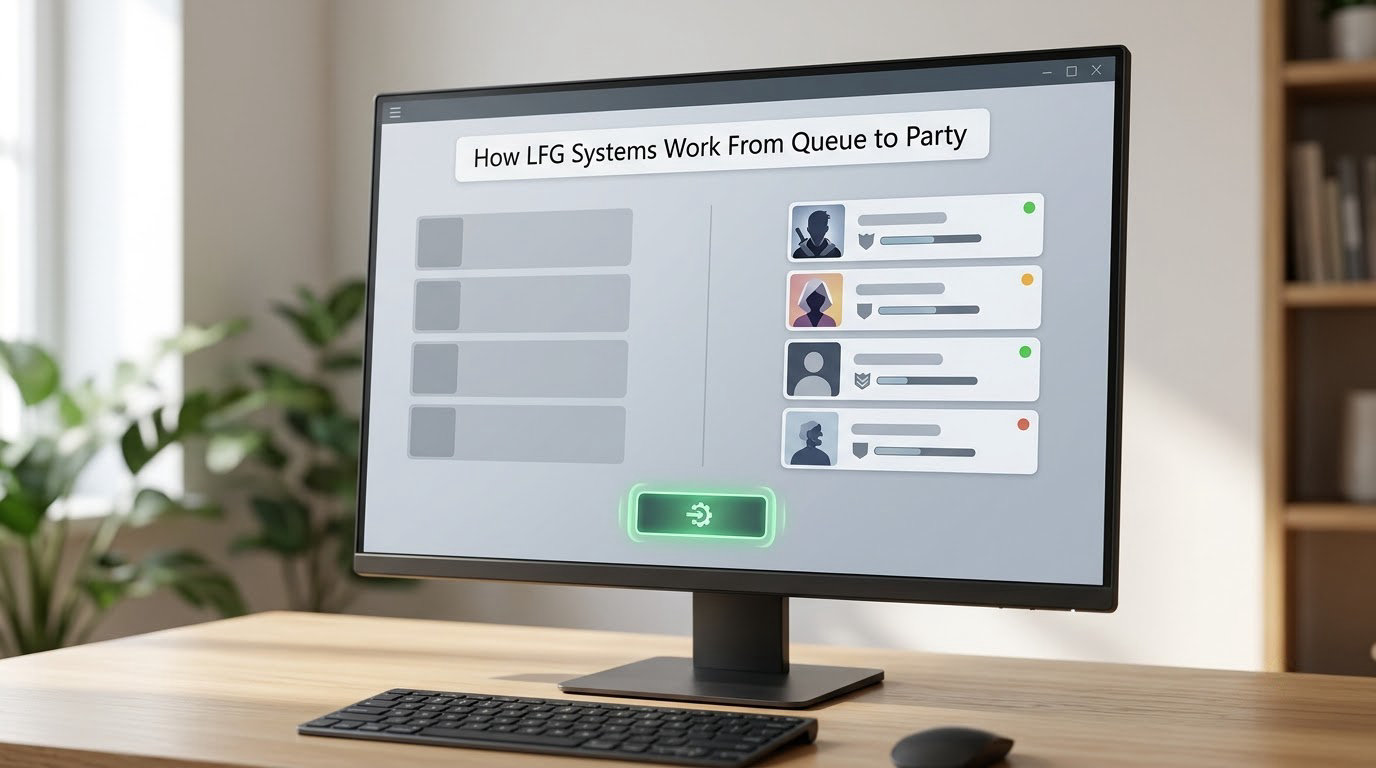
Every queue-based LFG system, whatever the studio called it, runs the same seven steps. World of Warcraft’s Dungeon Finder is the clearest example, but if you can follow that one you can follow any of them.
- Enter the queue. You choose the activity, the difficulty tier, and your role. Some games ask for a specific instance, others deal a random one and pay a bonus for it.
- Get sorted into a pool. Your entry joins a pool scoped to that activity, difficulty, region and language. Items outside those scopes never see each other.
- Pass the hard filters. Anyone who fails an item level check, a region or latency limit, or a role that is already filled gets removed from consideration. These are pass or fail, not scored.
- Get scored against preferences. Whatever survives is ranked on softer signals: your rating, recent clear times, voice chat opt-in, whether you are on a friend’s list, and how long you have been in the queue.
- Get assigned a role slot. The system needs a tank, a healer and a set number of damage dealers. If your class can do two jobs, the group builder picks the one that fills a hole.
- Form the group and run a ready check. You get a pop, a countdown, and the ability to decline. Everyone who accepts is teleported in together, or given a way to join the leader’s game.
- Complete, loot, and release. At the end you vote on loot or pass, everyone is teleported out, and the group is broken up unless you keep each other in a party.
That is the whole loop. Anything a game adds, like daily bonuses or guild permission, sits on top of step four.
The Main Parts of an LFG System
Six components show up in every real LFG system, no matter what the game calls them.
| Component | What it does | Where you see it |
|---|---|---|
| Player profile | Stores your roles, item level, rating, language and availability windows | Account settings, character sheet |
| Queue or listing entry | Your request, tagged with activity, difficulty and role | Dungeon Finder panel, LFG menu |
| Eligibility filters | Hard pass or fail gates like item level and language | The requirements checkbox list |
| Preference weighting | Soft ranking on rating, speed and voice preference | Role priorities and bonus options |
| Party slots | The fixed composition the group builder is trying to fill | Tank, healer, damage slots |
| Compatibility signals | Friend list, party history, prior kick or report flags | Silent, but it decides who you get |
The abbreviations confuse people constantly, so here is the cluster in one place.
| Abbreviation | Means |
|---|---|
| LFG | Looking For Group |
| LFM | Looking For More, meaning the group already exists and needs extra players |
| LFD | Looking For Dungeon, a specific instance or difficulty |
| LFR | Looking For Raid, a group for a raid boss |
| Party finder | The automated, in-game matchmaking queue, Destiny style |
| Group finder | A bulletin board where players post and message each other manually |
A player on r/turtlewow pointed out that vanilla servers have no system at all, so the community runs its own etiquette thread and has to keep reminding people that LFG and LFM are not the same thing. That confusion is not your fault.
How Matchmakers Choose Players
There is no single published algorithm, because every studio keeps its weighting secret. The mechanics are well understood though, and they fall into two groups.
Hard filters: pass or fail
Item level brackets are the big one. If you are queued below the dungeon minimum, you are invisible to that bracket. Region and language sit in the same category, and so does queue type: random dungeon and specific dungeon draw from different pools.
Soft preferences: who gets picked from the survivors
Once you pass the gates, systems rank you on estimated skill. World of Warcraft builds this from your clear times for the activity, Diablo IV leans on area difficulty and Paragon boards, and Overwatch and Valorant use competitive rating. On top of that sit preferences a player can set: voice chat on or off, prioritise roles you enjoy, and accept any difficulty.
Party leader relationships matter too. Some systems weight a friend of the leader higher. Blizzard and Riot both publish matchmaking design notes that confirm the pool gets widened over time, so a long queue is often the system widening its search rather than a bug.
Fairness rules that override your choice
Balance rules cap how many players of one role can join the same team, and in games with ranked ladders the win condition outranks personal preference entirely. In an MMO dungeon run, most of those rules do not exist, which is why the groups feel stranger than a ranked match does.
What Happens After a Match Is Found
Once the group is assembled, the run is short and slightly chaotic. A queue pop gives you a window, usually a countdown of a few seconds, to accept or decline without penalty. Miss it and you go back into the queue at the back of the line.
Accepting triggers the ready check, then a teleport into the instance. In listing-based systems you instead get an invite you have to accept while the leader waits, and the whole thing can fall apart if somebody does not answer.
Inside the run, failure states are the same everywhere. People leave mid-pull, disconnect, or get removed after a kick vote for latency, deaths, or running the wrong route. When the boss dies, you either roll loot or vote, then everyone is teleported out and the group is dismantled.
That dismantle is why repeat grouping needs a manual step. Unless you queue with friends or join the group finder listing together, you will probably never see those players again.
Different LFG Methods Used in Online Games
1. Instant matchmaking queues
The most common type. World of Warcraft’s Dungeon Finder, Diablo IV’s party finder, Lost Ark’s dungeon menu, and Helldivers 2’s quick play all drop you into a completed party. Fastest to use, hardest to control.
2. Role-based queues
Same idea, but you commit to tank, healer or damage. In Elder Scrolls Online the role assignment changes how the group builder fills the party, and healers routinely get near-instant pops while damage dealers wait. Choosing a role you can switch out of mid-run is the single biggest lever you have on queue time.
3. Party recruitment listings
You post the missing role and wait. Players reply, you read their profiles, you decide. Slower, but you control who ends up in the run, and it is the only way to build with specific people.
4. Bulletin boards and add-ons
An add-on reads the game’s channels and turns spam into a filterable list. It is still humans talking, just with less typing. Popular on realms with weak in-game tooling.
5. Guild and community finders
Recruitment tools inside a guild, or Discord servers organised by region and endgame goal. Slower to set up and far better for anything social, which is why players chasing a long progression roster almost always end up here.
6. Player-created events
Someone with the numbers hosts a scheduled run and posts a code. Nobody is matched automatically, so nothing is filtered, and the experience depends entirely on the organiser.
| Game | System type | Role check | Gear gate | Cross-server |
|---|---|---|---|---|
| World of Warcraft | Queue (Dungeon Finder) | Tank, healer, damage | Item level bracket | Yes, cross-server pools |
| Destiny 2 | Queue (fireteam) | Class and subclass slots | Power level band | Yes, by platform |
| Final Fantasy XIV | Queue (duty finder) | Role based | Item level sync | Data centre based |
| Lost Ark | Listing menu | Six party roles | Item level range | Yes, regional |
| Diablo IV | Queue (party finder) | No fixed roles | World tier | Yes, platform based |
| Overwatch 2 | Queue (quick play) | Damage, tank, support | Competitive rating | Yes |
Final Fantasy XIV is worth calling out because Duty Finder will also pull in registered players, not just queued ones, which changes how long you wait. Players on r/MMORPG keep the distinction clear: a party finder is automated matchmaking, a group finder is a bulletin board you post on yourself.
Why LFG Searches Sometimes Fail
Most stalled queues come down to one of seven things, and each has a fix you can apply tonight.
Your gear is outside the bracket. Below the minimum, you are not in the pool at all. Open the activity’s info panel and read the item level requirement before you queue.
Your role is oversupplied. Damage dealers outnumber healers nearly everywhere, so their queue is the one that stalls. Offer to flex, or queue as support if your build allows it.
Your filters are too narrow. Language, difficulty and comment filters all shrink your pool. Drop the comment filter first, because it is the most commonly overlooked one.
You are queuing at a dead hour. Queue depth scales with how many people are online. Mid-morning on a weekday is a different game from Friday evening, and low-population servers can be brutal.
Your region is separate. Latency limits hide whole countries from each other. If your region has a thin pool, that is the entire explanation.
Your profile is inaccurate. A wrong item level or a stale role preference means the ranking data is wrong. Guild leaders check character sheets before inviting, and automated systems do the same.
You were never really available. An unconfirmed character or a “away” status quietly removes you from consideration in several games.
One player on the Blizzard forums described four months of failed grouping and eventually found a real group in a small new guild where 30 of 500 members actually talked in chat. The reply in the same thread said dungeon finder works fine even as a damage dealer, because messaging people is too much work. Both are honest, and the difference between them is usually the bracket.
How to Get Better Results from an LFG System
Getting a better group is mostly a settings problem. Set your item level accurately, pick the role you actually enjoy, and decide before you queue whether you are willing to flex.
When you write a listing, five things get you replies: the activity and difficulty in the title, your item level, your role, your server or region, and your window. Add one line about what you want out of the run. Silence on all five and a listing sits unread.
Set a voice preference honestly. Players who want voice and join a silent group get frustrated, and that friction shows up in reports.
Queue when the pool is deepest, keep your queue time visible if the game shows it, and accept that a very fast pop is not automatically a good pop. The system is optimising for a completed group, not a good one.
Then do the boring part. Ready up before the pull, say hello in the first ten seconds, ask about mechanics you have not seen, and never loot before you have won. Players on r/wownoob make the first point constantly: LFG assumes you already know the content, so watch a guide before your first queue rather than learning on other people’s time.
Frequently Asked Questions
What does LFG stand for in online games?
LFG stands for Looking For Group. In a game it refers to the matchmaking system, whether a queue or a bulletin board, that assembles players for a dungeon, raid, fireteam or PvP match. Players type it in chat to mean the same thing, while LFM means Looking For More, which is a group that already exists and needs extra members.
Do LFG systems always create balanced teams?
No. In MMOs and co-op games, balance means the party has a tank, a healer and enough damage dealers to clear the content, not that the players are evenly skilled. Only competitive shooters apply skill and fairness rules, and even there the pool widens over time so long queues eventually pair mismatched ratings.
Why am I not finding an LFG party?
Check your item level against the activity requirement first, because falling below it removes you from the queue pool entirely. Then look at your role, since damage dealers almost always queue longer than healers. Language filters, difficulty choices, queue time of day and your region each shrink the pool further. Fix those before switching to manual posting.
Should I use an LFG queue or post my own party request?
Use the queue when you want content quickly and care about the activity more than the company, which is most daily runs and levelling dungeons. Post a listing when you need specific players, a clear schedule, or a group that keeps running afterward. Queues are faster but random, and listings take longer but let you vet who you are playing with.
What information should I include in an LFG post?
Put the activity and difficulty in the title, then list your item level, your role, your server or region and when you are online. Say whether you are levelling, farming or pushing, and whether you want a quick run or a regular group. Listings with all five basics filled in get replies far faster than a one line message.
Can I use an LFG system with friends?
Yes, and you should queue together rather than separately. Every major LFG system has a party or premade option that keeps your existing group intact and only fills empty slots, which is how most guilds clear content without breaking their roster. Queuing separately with friends in the pool can match you with each other and waste the run.
What to Do First
Open the LFG panel, read the item level requirement for the activity you want, and queue in a role you can swap out of. Set your preferences honestly so the ranking data is accurate, and queue when the pool is busiest.
Then look at your numbers honestly. If the queue stalls again, post a listing with your level, role, region and schedule, and pick your people by hand instead. That is how the mechanic works once you know where the filters sit.