Game prices drop after launch because publishers set the opening price high, capture full margin from early buyers, then chase volume once the launch window closes. A title that sells more copies at a lower price earns more total revenue than the same title sitting unsold. That is the whole mechanism, and everything else — editions, bundles, seasonal sales, subscription rotation — is a variation on it.
This guide walks through the typical price curve, why some games hold their value for years, and how to tell a real markdown from a fake one. Updated for October 2026.
Table of Contents
- 1How game prices usually change after launch
- 2Why game prices drop after launch: the usual sequence
- 3What makes the biggest difference after release?
- 4Why do editions and bundles affect the discount?
- 5Why do physical and digital copies price differently?
- 6How publishers create sales without changing list prices
- 7Why do some games stay expensive after launch?
- 8How to tell a real game price drop from a fake discount
- 9When is a game usually cheapest to buy?
- 10Frequently Asked Questions
- 11How long after launch do video games usually go on sale?
- 12Does a large launch discount mean a game is low quality?
- 13Why is a game cheaper on one console or storefront than another?
- 14Should I buy a game at launch or wait for a discount?
- 15Can a publisher lower a game’s price more than once?
- 16Conclusion
How game prices usually change after launch
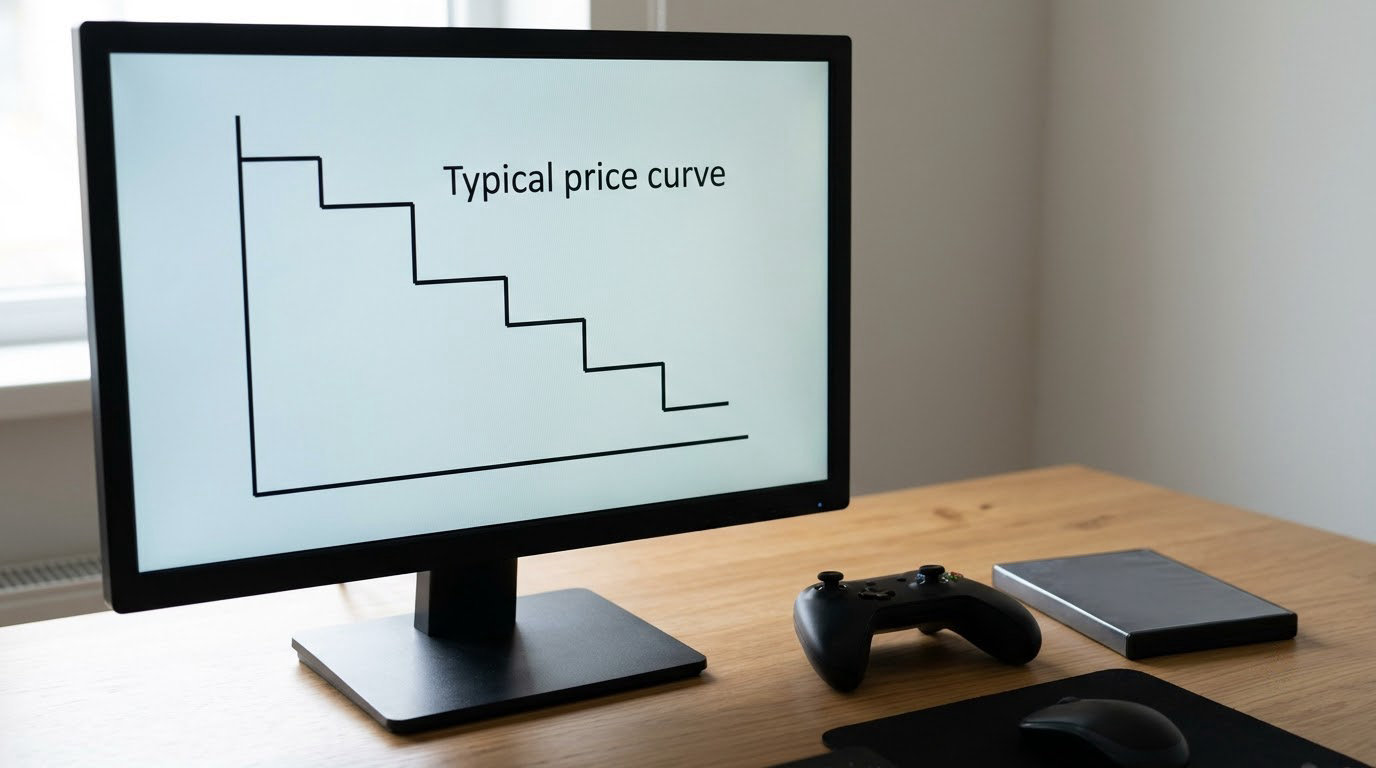
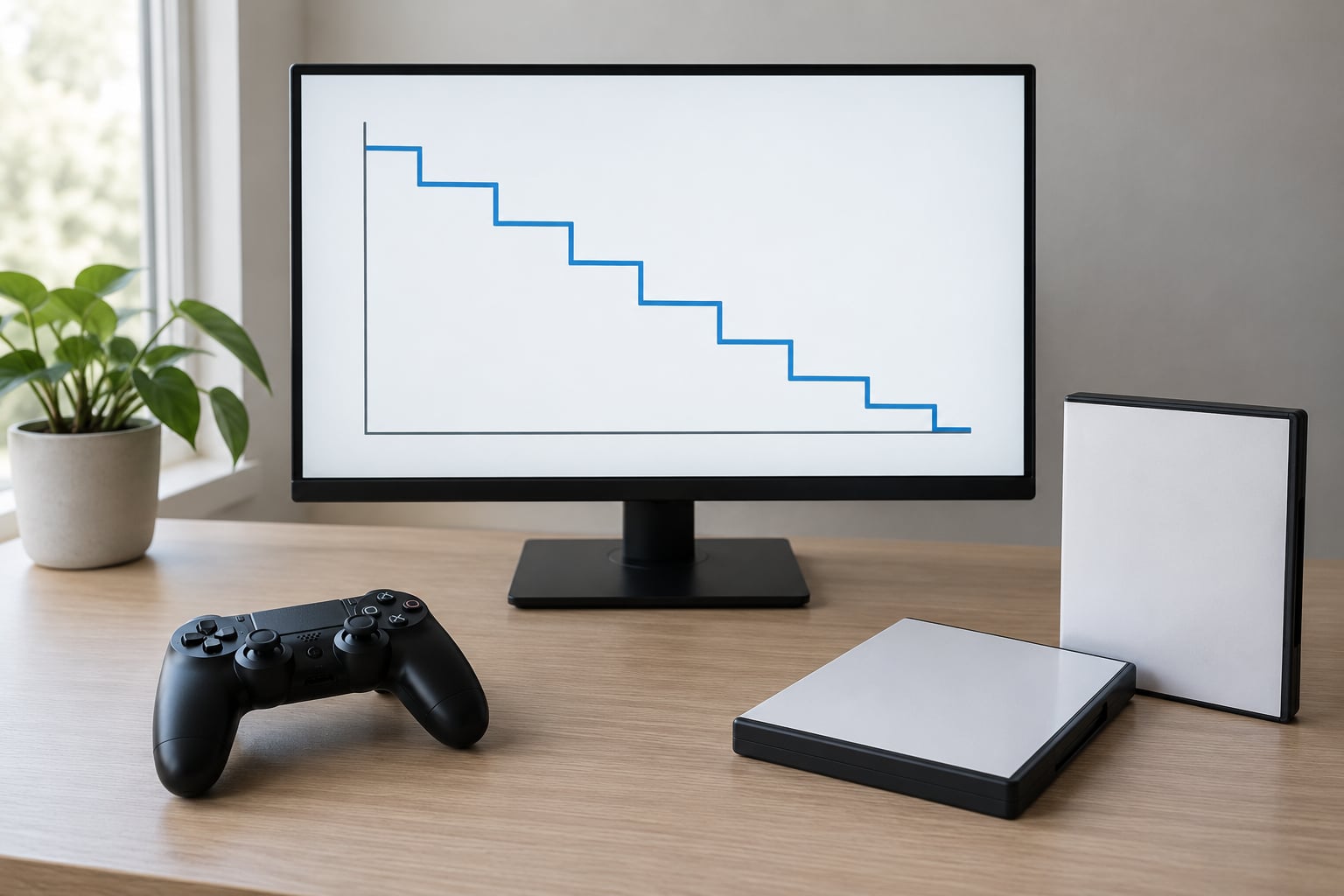
The table below shows a common shape for a mid-sized release. Treat it as a pattern, not a promise — the figures are illustrative and the timing varies a lot by title, platform and region.
| Point in the release | What usually happens | Price index (launch = 100) |
|---|---|---|
| Launch day | Full list price, sometimes with a small launch discount for early buyers | 100 |
| First few weeks | Price holds; platforms promote with themed features instead of markdowns | 95-100 |
| Two to three months | First real cut on most titles | 70-80 |
| Four to seven months | Deep promotional cuts and seasonal sale inclusion | 50-67 |
| One year plus | Heaviest cuts, often bundled with bonus content | 30-50 |
Why game prices drop after launch: the usual sequence
Game prices drop after launch because publishers test lower price points as the release hype fades. Early buyers validate demand, review scores settle, and the publisher learns how many people will pay full price. After that, each cut widens the audience, and the cheaper price usually sells more than enough extra copies to make up for the smaller margin per sale.
The launch period is deliberately short. Publishers use it to sell at full margin to the most committed audience, and they treat the first weeks almost as a measurement period rather than a revenue period.
Players on Steam forums have noticed the pattern for years: a large share of storefront users apply an only-buy-when-discounted rule to themselves. Publishers know that. When a list price is rarely paid in full anyway, the price acts as an anchor, and the real transaction happens months later.
What makes the biggest difference after release?
Several forces decide whether a game gets marked down in three months or three years. None of them is secret, but they combine differently every time.
Review reception. Strong scores give a publisher room to wait. A rough launch with mediocre reviews compresses the timeline, because the volume argument starts earlier.
How the first weeks actually sold. Publishers watch wishlist conversion and early sales pace closely. A launch that converts well sits high; one that stalls tends to be cut quickly.
Content updates. A major update, expansion or remake is an excellent moment to move older buyers to a cheaper edition, or to sell the upgraded version at a premium while the base version sits in a sale.
Competing releases. Big launches pull attention and spending elsewhere. Games in the same genre often get pushed into a promotion or a permanent cut shortly after a major rival arrives.
Publisher targets. Storefronts reward publishers for scheduling promotions and hitting volume thresholds. A publisher chasing a bonus tier has a direct financial reason to discount, and that reason has nothing to do with you.
Platform promotions. Storefronts run their own themed events and seasonal sales. A game can be deeply reduced inside an event without the publisher changing anything about its base price.
One more distinction matters more than any single force: list price versus sale price. The list price is the anchor the publisher set at release and rarely touches. The sale price is what you actually pay, and it moves constantly.
Why do editions and bundles affect the discount?
Editions have separate price histories, so two copies of the same game in different editions can sit at completely different points on their discount curve.
| Edition | Usually bundled | How its price tends to behave |
|---|---|---|
| Standard | Base game only | Cuts first and deepest; most store sales target this version |
| Deluxe | Base game plus extra digital items | Holds higher for longer, then cuts more gently |
| Complete or GOTY | All prior DLC and expansions | Smallest percentage reduction, but usually a bigger absolute saving |
| Collector | Physical extras, art, a physical copy | Limited runs; once sold out it often never returns |
| Platform or store variant | Nothing, or store-specific extras | Only one store discounts it, so its price can look stale |
This is also why the same game shows different savings in different places. A sale that takes the standard edition down by half might barely touch the complete edition, and the headline percentage you see is the one attached to the version being promoted.
Bundles muddy it further. A bundle of several older titles can undercut buying any one of them individually, which makes the individual markdown less obvious than it looks.
Why do physical and digital copies price differently?
Digital copies have no manufacturing, shipping or shelf costs, so they carry the highest margin and the least pressure to discount. Physical copies have retail costs that do not go away, and retail competition used to force prices down for everyone. With fewer physical stores selling games, that pressure largely disappeared.
Used physical copies are a separate market. Their price is driven by supply of used stock and how many people want the title right now, not by the publisher’s list price at all.
Pre-owned digital keys sit somewhere in between. Their price is set by resellers who buy keys in regions with lower prices and sell them into regions with higher ones, which is also one reason list prices differ across regions.
In practice you will regularly see the same digital game cheaper on one storefront than another, and occasionally cheaper from a physical retailer than from the console store itself. Comparing before you buy takes about thirty seconds and has saved me more than once.
How publishers create sales without changing list prices
Most discounts you will ever see fall into a handful of buckets. Keeping them apart makes the whole picture much easier to read.
Permanent list price cut. The publisher lowers the base price and it stays down. This is the one to watch for, because it means the original anchor was set for a short window and the game now costs less forever.
Launch discount. A small early-buyer reduction bundled into release week. It is a marketing lever, not a value signal.
Themed promotion. Storefronts run genre weeks, publisher spotlights and holiday events. The discount exists only inside that event window.
Weekend and seasonal sales. Fixed-date events with predictable calendars, which is why waiting for one is often smarter than buying at the first markdown.
Subscription rotation. Games enter and leave subscription catalogues on a schedule. That is not a price cut at all, but it feels like one to players who assume the game is being given away permanently.
Loyalty and bundle offers. Store credit, store-specific rewards and bundle pricing that never touches the individual game price.
One more thing confuses people: two accounts on the same storefront can show different prices. Store-specific credit, regional pricing settings and catalogue differences all change what a given account sees.
Why do some games stay expensive after launch?
Some titles hold full price indefinitely, and it is not always a sign of quality. Several forces protect the number.
Strong preorder and day-one demand give the publisher no reason to cut. If most buyers pay full price in week one, a markdown mostly loses money.
Premium positioning protects it too. A first-party title on a hardware platform carries value from the console itself, and cutting it cheaply would undercut every other game on that system.
Limited and collector editions can never be marked down because they are a fixed production run. Once they are gone, they are gone.
Weak early sales do not always produce a cut either. A publisher still supporting a title with expansions sometimes raises the price later or holds it steady, betting on a dedicated audience rather than the wider market.
And sometimes the choice is simply deliberate. Holding the number protects perceived value, and a publisher that has seen how quickly a franchise can be devalued by an early discount will wait a long time before doing it again.
How to tell a real game price drop from a fake discount
Some discounts are real savings and some are window dressing. Here is how to tell them apart.
Check the price history. A tracker that shows the last year of pricing tells you instantly whether the current deal is unusual or whether the game has been cheap for months.
Look at the reference price. Storefronts sometimes label a discount against a price the game has not actually held recently. If the reference number is higher than anything the game ever sold for, treat the saving as suspect.
Compare the percentage to the absolute number. A deep percentage on a complete edition may save more money than a modest cut on the standard edition.
Check that the edition is equivalent. A sale on the standard edition is not a discount on the deluxe version you were considering.
Read the conditions. Subscriber-only offers, credit requirements and bundle-only pricing mean the discount is not available to everyone, and comparing it to a plain purchase can be misleading.
Compare against what the game has cost you before. Your own history with the title is usually a better baseline than any advertised number.
A quick discount is not automatically a bargain. Players in Steam communities often read a steep early cut as a signal that the launch underperformed, and that reading is sometimes right.
When is a game usually cheapest to buy?
There is no fixed schedule, but certain windows reliably produce the best price.
- After the hype period. The first real cut usually arrives once the launch conversation dies down, often two to three months in.
- After a major update. Content drops and expansions are followed by promotions on the base version more often than not.
- During seasonal sales. Fixed-calendar events are the easiest points to predict, and games that were already cut beforehand often go deeper inside them.
- After a competing release lands. Same-genre rivals frequently trigger a cut within weeks.
- When editions change. Repackaging, a new complete edition or a price restructure resets the history and often makes the previous edition a bargain.
Who should wait and who should not:
- Wait if you are buying a single-player story game with no online dependency, if you have a backlog anyway, or if you are on a budget.
- Buy now if the game is multiplayer and you want to play with friends at launch, if the delisting risk is real, if you are spoiler-sensitive and the story leaks online, or if you are not the kind of person who will come back to it later.
- Use a tracker and forget about it if you want the discipline. Set an alert on the specific edition you want and let the notification come to you.
Frequently Asked Questions
How long after launch do video games usually go on sale?
For most titles the first genuine markdown lands two to three months after release, usually alongside the end of the launch marketing push. Smaller and older titles can be cut sooner, and platform seasonal sales add extra chances throughout the year. Single-player games follow this pattern most predictably, while new multiplayer and live service releases are an exception.
Does a large launch discount mean a game is low quality?
Not necessarily, but it is worth investigating. A steep cut shortly after release usually signals that the launch underperformed against expectations rather than that the game is broken. Check the review scores and player feedback before reading a discount as a bargain. A well-reviewed game that is cut early is more often a commercial decision than a quality one.
Why is a game cheaper on one console or storefront than another?
Each storefront sets its own base price, runs its own sales calendar, and can carry different regional pricing. Storefront credit and subscription status also change what a given account sees, which is why two players on the same platform can see different numbers. Physical retailers sometimes undercut console stores too. Comparing the specific edition across stores before buying is the simplest fix.
Should I buy a game at launch or wait for a discount?
Waiting is usually right for single-player games, especially if you already have plenty to play. Buy at launch when multiplayer matters, when the story spoils online, or when you know you will not return to a backlog. A price tracker with an alert set on the edition you want gives you the discount without needing to remember to check.
Can a publisher lower a game’s price more than once?
Yes. A publisher can cut the permanent list price, then include the game in themed promotions, seasonal sales and subscription catalogues on top of that. The more valuable of the two signals is the permanent cut, because it means the game now costs less as a matter of course. Temporary sales end without changing what the game normally costs.
Conclusion
The short version: the launch price is an anchor, not a fair price. Publishers set it high on purpose, then lower the effective price over the following months because volume makes up for thinner margin on every copy.
Before you click buy, check one thing: does the discount lower what the game actually costs right now, or does it just return it to its usual list price after a temporary promotion? That single check separates a real markdown from a sale that flatters the original number.