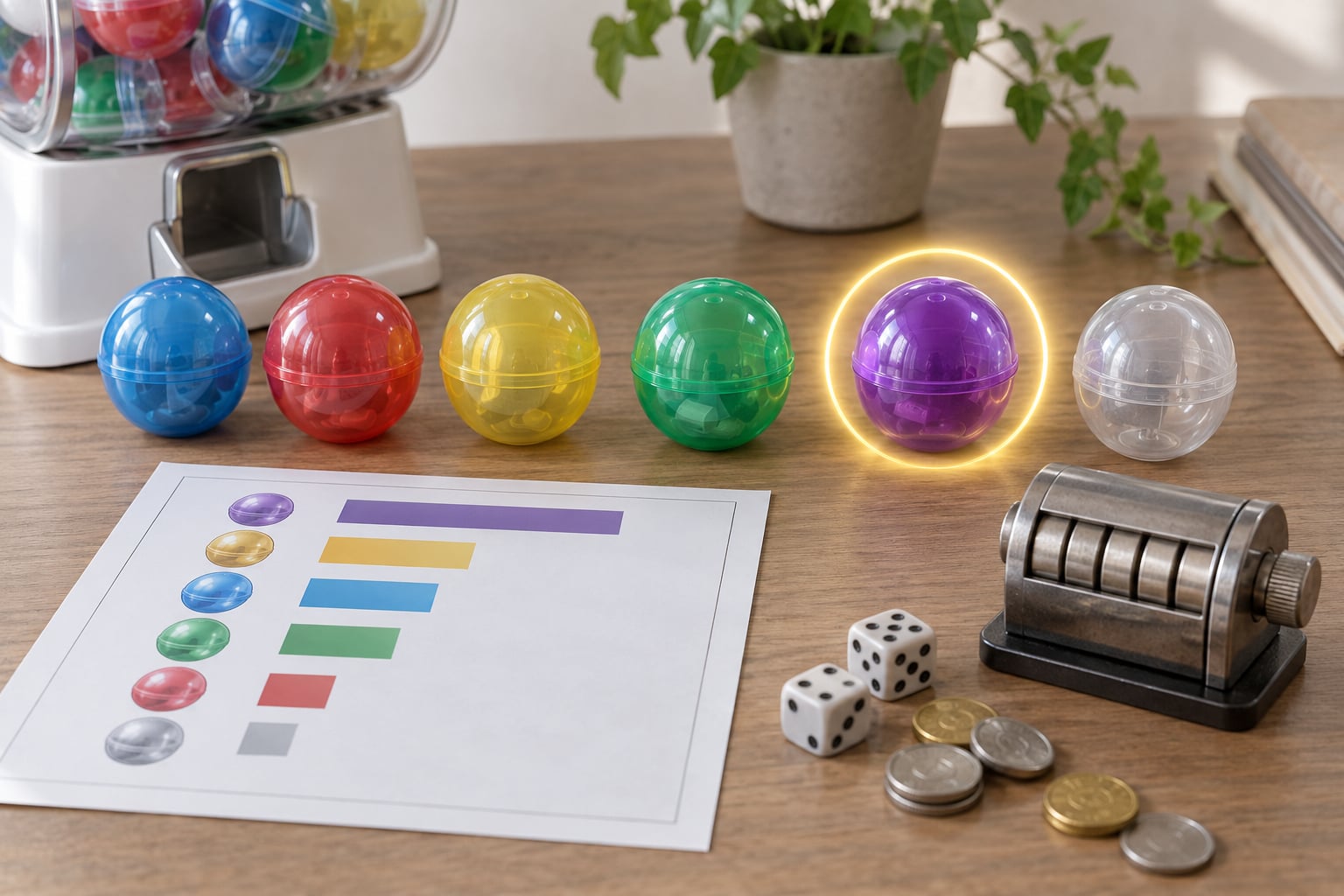
How pity systems work in gacha games is simpler than most guides make it sound: a pity system counts how many draws you have made since your last rare drop, quietly raises the odds as that count climbs, and forces a rare drop at a fixed ceiling. That ceiling is your worst case, and it is the whole reason pulling becomes a budget decision instead of an open-ended gamble.
Almost every gacha on the market, from Genshin Impact to Honkai: Star Rail to Arknights: Endfield, layers the same three pieces on top of each other: a base drop rate, a soft pity ramp, and a hard pity guarantee. Add a rate-up coin flip and you have the full picture. The details change from game to game, which is exactly where most confusion comes from, so check the numbers in your own client rather than trusting a guide’s table.
Table of Contents
- 1What Is a Pity System in a Gacha Game?
- 2How Do Gacha Probability and Pity Counters Work?
- 3Base rates and disclosed probabilities
- 4What the counter actually does
- 5Where pity thresholds differ by game
- 6What Is the Difference Between Hard Pity and Soft Pity?
- 7Soft pity, hard pity, the 50/50 and duplicate guarantees side by side
- 8Is 70 pity soft pity?
- 9Is 70 pulls hard pity?
- 10Why does hitting hard pity still not feel like a win?
- 11How Do Pity Systems Work in Gacha Games? A Worked Example
- 12Does a Pity System Guarantee the Best Item?
- 13Can Gacha Players Exploit or Reset Pity Counters?
- 14Counters are usually scoped to one banner type
- 15Any rare drop resets the counter
- 16Myths worth dropping
- 17How Do You Make Safer Decisions Around a Pity System?
- 18Work out the average, not just the ceiling
- 19Track the counter before you spend
- 20Budget in pulls, not currency
- 21Decide before the banner, not during it
- 22Accept that pity removes the worst case, not the variance
- 23Frequently Asked Questions
- 24What is the pity system in gacha and how does it work?
- 25Is 70 pity soft pity?
- 26Is HSR pity 80 or 90?
- 27Does pity carry over between banners?
- 28Do you lose your pity if you pull a 5-star you do not want?
- 29What gacha game has the worst pity system?
- 30Conclusion: Start With the Banner Rules
What Is a Pity System in a Gacha Game?
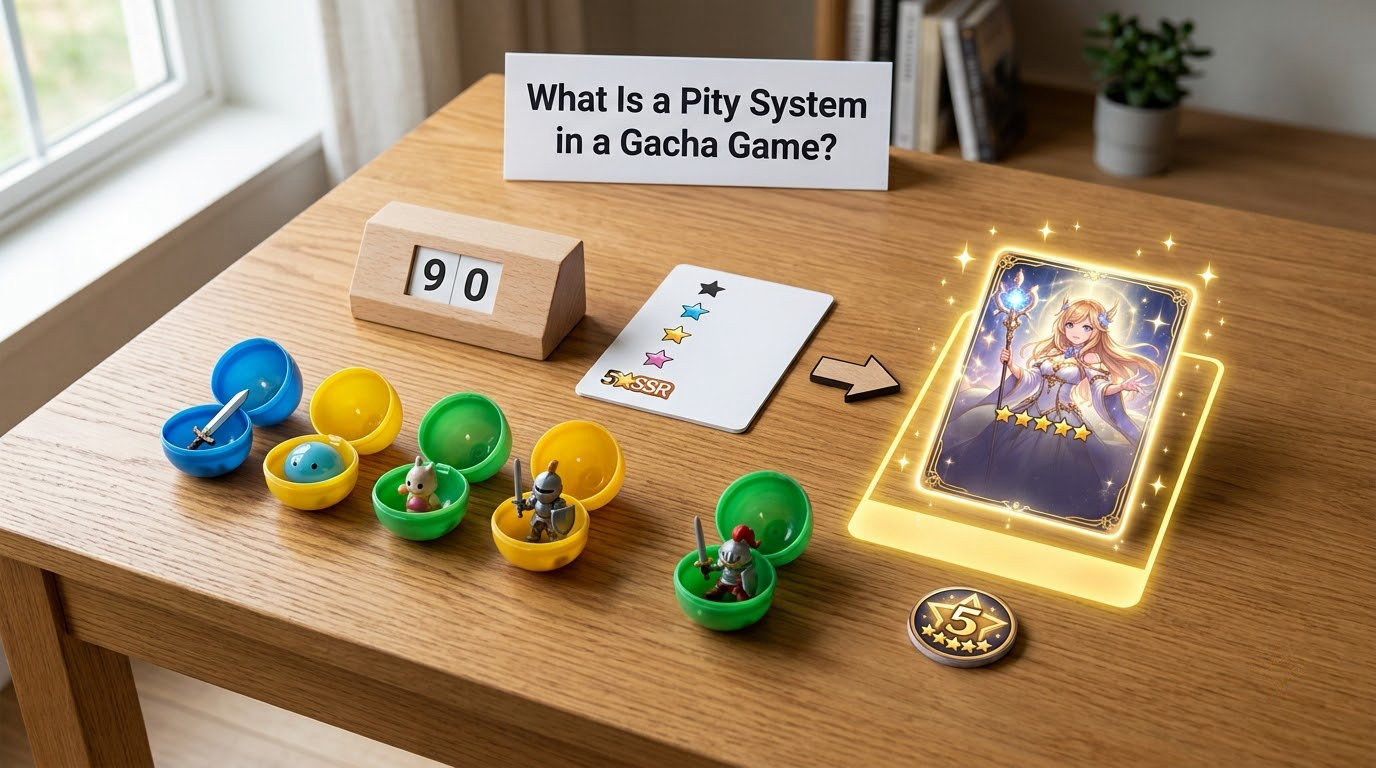
A pity system is a publisher’s safety net inside a random draw. Pull often enough without winning the rare item and the odds are forced upward, so a rare drop is guaranteed by a fixed number of attempts instead of never.
Without one, a rare item is a pure random event. On a banner with a 0.6% base rate and no safety net, the chance of going a hundred pulls without the item is not unusual at all, and the expected wait stretches past two hundred draws. You would have no way to plan for a character that requires the item.
Pity converts that open-ended risk into a bounded one. If the banner says 90, you know the rare drop lands by draw 90 whatever happens before that. That single fact is what makes saving currency for a specific unit a normal activity instead of a gamble with no floor.
It is worth separating two things people mix up constantly. A guaranteed drop is what pity delivers: a rare item appears by a set draw number. It is not the same as the guaranteed item you actually wanted, which is decided by a separate rule. Games hand you the first, and the second is still a coin flip.
How Do Gacha Probability and Pity Counters Work?
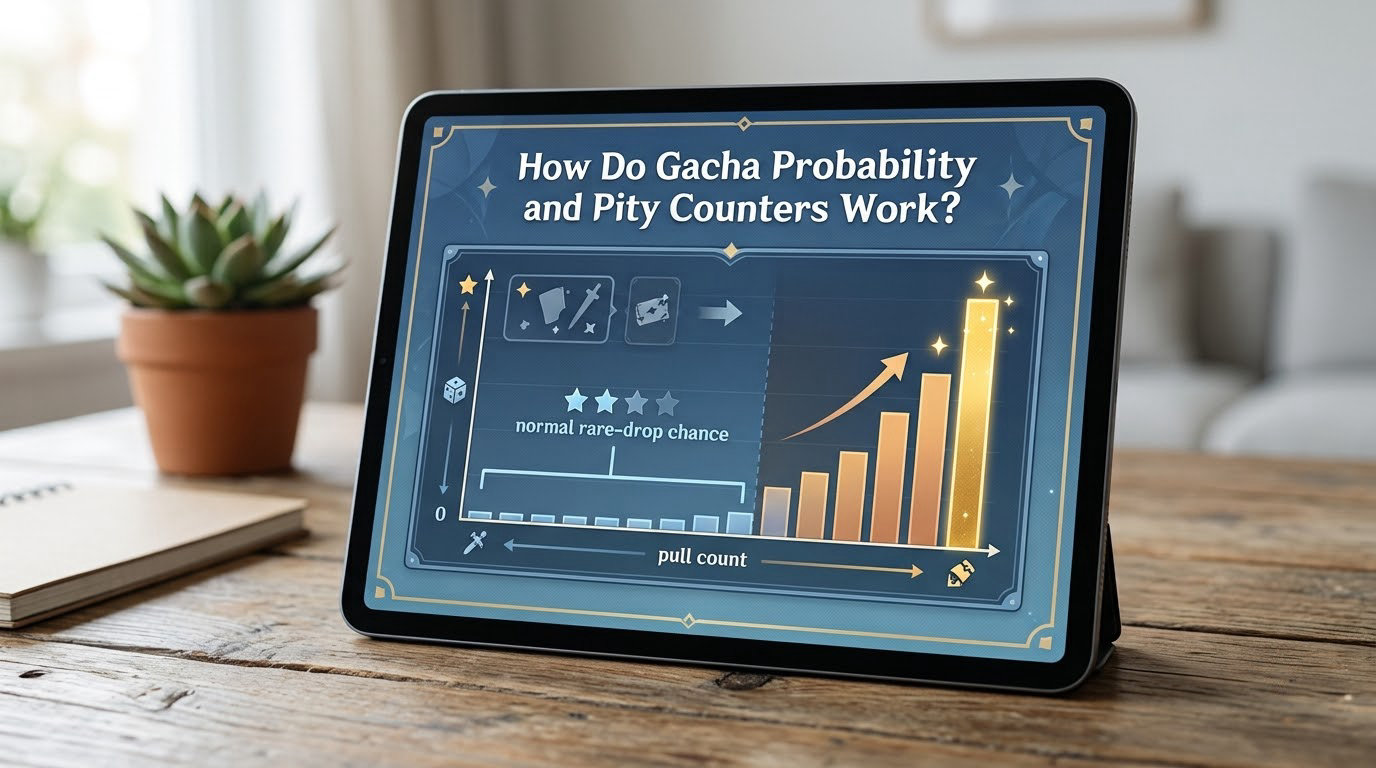
Three mechanics sit underneath every pity system: a base rate on each draw, a counter that increments once per draw and resets when you win, and a set of thresholds where the rate changes.
Base rates and disclosed probabilities
Rare characters usually sit near the bottom of the drop table. Genshin Impact lists a 0.6% base chance for a 5-star on its character banner, and Honkai: Star Rail publishes a 0.6% base chance for a 5-star warp. At that rate, roughly one draw in 167 wins on its own, which is why nobody expects a hit on pull ten.
Every mainstream gacha also publishes its drop rates in the client, usually inside the banner’s own info panel. Those screens are the authoritative source. Community trackers and spreadsheets are useful for second-guessing them, but the in-game disclosure is what the studio is held to.
What the counter actually does
The pity counter is a running tally of draws since your last rare drop of that tier. It ticks up on every draw, and any rare drop resets it to zero, whether or not the drop was one you wanted. That single rule explains most of the frustration players describe in forums: pulling a standard-banner character at pull 8 wipes a counter you had built to 70.
4-star pity usually runs on a separate, much shorter counter. Genshin Impact guarantees a 4-star or better every 10 wishes. Most titles keep a similar shorter guarantee for the mid-tier rarity so you are not truly starved of upgrades.
Where pity thresholds differ by game
These figures are the ones players and community trackers most commonly report. Patch notes change them, so verify in the banner info panel before you plan around a number.
| Game and banner type | Soft pity region | Hard pity | Rate-up split |
|---|---|---|---|
| Genshin Impact, character banner | Around draw 74 | 90 | 50/50, guaranteed after a loss |
| Genshin Impact, weapon banner | Around draw 74 | 80 | 75/25 toward the featured weapon |
| Honkai: Star Rail, character warp | Mid-70s into the 80s | 90 | 50/50, guaranteed after a loss |
| Honkai: Star Rail, light cone | Mid-70s | 80 | 75/25 toward the featured light cone |
| Zenless Zone Zero, standard channel | Reported around draw 73 | 90 | 50/50, guaranteed after a loss |
| Zenless Zone Zero, W-Engine channel | Reported around draw 65 | 80 | Split toward the featured W-Engine |
| Wuthering Waves | Reported around draw 73 | 80 | 50/50, guaranteed after a loss |
| Arknights: Endfield, 6-star | Not consistently reported | 80 for a first copy, 180 for a second | 25/75 on the weapon banner |
Arknights: Endfield is the useful outlier here. Players in r/Endfield document a 4% 6-star rate with an 80-draw guarantee for a first copy and 180 for a duplicate, and the weapon banner uses an unfavourable 25/75 split. That structure is why a general guide cannot answer these questions for you, and why the same question gets asked again every patch.
What Is the Difference Between Hard Pity and Soft Pity?
Soft pity is a rising rate that makes the rare drop more likely as your counter climbs. Hard pity is a hard ceiling where the rare drop is forced. Soft pity improves your odds; hard pity removes the possibility of going empty.
Soft pity, hard pity, the 50/50 and duplicate guarantees side by side
| Mechanic | When it kicks in | What it guarantees | Does it reset the counter |
|---|---|---|---|
| Soft pity | Late in the counter, commonly past draw 70 | Nothing. The rate rises, the drop is still random | No, it is a rate change, not an event |
| Hard pity | The stated ceiling, 80 or 90 in most titles | A rare drop of the banner’s top rarity | Yes, the guaranteed drop resets it |
| 50/50 rate-up | On every rare drop | Nothing on its own. Half the time the rare drop is the featured unit | Only the rare drop itself resets the counter |
| Guaranteed after a loss | The next rare drop after a lost 50/50 | The featured unit on the banner | Yes, like any rare drop |
| Duplicate or second-copy guarantee | Often 160 or 180 draws after the first copy | A duplicate of the featured unit instead of a standard one | Yes, when the duplicate lands |
Is 70 pity soft pity?
Pull 70 is the most commonly cited start of soft pity in Genshin Impact, not a guarantee. The rate begins climbing around there and keeps rising with every further draw, which is why the last twenty draws of a counter feel very different from the first fifty.
Is 70 pulls hard pity?
No, 70 is not a hard pity in any major gacha I know of. Hard pity is the fixed ceiling, 90 draws in Genshin Impact and Honkai: Star Rail, and 80 on most weapon and light cone banners. You always get something by that number, but never before it.
Why does hitting hard pity still not feel like a win?
Because hard pity guarantees the rarity, not the banner’s featured unit. The coin flip runs separately, and r/GenshinImpact threads are full of players who reached the ceiling and still lost the 50/50. It is the single most common misunderstanding in the search results, and the most painful one.
How Do Pity Systems Work in Gacha Games? A Worked Example
The following numbers are illustrative only. They are not taken from any specific game’s published rates, so use them to understand the shape of the mechanic rather than to budget real currency.
Say a banner has a 0.6% base chance per draw, soft pity beginning at draw 70, and hard pity at 90. Your counter starts at zero on the morning you decide to pull.
- Draws 1 to 10. A 4-star drops on roughly the tenth draw and your counter stays at zero. This is the most common new-player experience and it teaches nothing useful about the top tier.
- Draw 22. You win the featured character. The counter resets, the 50/50 resets, and you are done at a cost of 22 draws. Nobody feels bad about this outcome.
- Next banner, draws 1 to 40. Four-stars only. Your 5-star counter sits at 40, and at a 0.6% base rate that is entirely normal.
- Draw 55. A 5-star lands, but it is a standard-banner character you did not target. The counter resets to zero and your guaranteed-after-loss status is gone, because you won the coin flip and spent it on someone else.
- Third banner, draw 71. Soft pity has begun. Each draw from here is meaningfully more likely to produce a 5-star than the 55 draws before it, though nothing is certain.
- Draw 88. Still nothing. You are inside the region players call bad luck, but every remaining draw is more generous than the ones at the start.
- Draw 90. The guarantee fires and a 5-star appears. If you lost the 50/50 on an earlier banner, the coin flip decides whether it is the unit on the banner. It lands on the featured character here, which is the best realistic case at the ceiling.
Three lessons fall out of the walkthrough. The cost of an average character is lower than the ceiling, because most counters end well before 90. The ceiling is the worst case, not the expected case. And an unwanted 5-star is the most expensive event in the whole system, because it costs you a built counter and nothing in return.
Does a Pity System Guarantee the Best Item?
No. Pity guarantees a rarity tier, and on rate-up banners it guarantees the featured unit only when the separate coin flip or duplicate rule goes your way. Everything above the tier is still random.
Consider the layers of randomness a limited character sits behind in a typical 50/50 banner. You need the counter to reach its ceiling, the coin flip to land on the featured unit, and if you already own the unit, the duplicate guarantee to fire or to not fire depending on what you wanted. Each layer is separate, and pity only covers the first one.
Forced guarantees are the uncomfortable corner. GameFAQs threads about Genshin Impact contain players asking whether a guaranteed rate-up character can be banked for a future banner instead of being handed to them now. In the games as they currently work, it usually cannot, and the answer from players who reverse-engineered the systems is that the counter resets whether you wanted the unit or not. If you are close to a guaranteed pull and the banner’s featured unit is not a character you will ever use, that is a real cost and worth planning around.
Arknights: Endfield’s second-copy guarantee at 180 draws is the same idea with different numbers. Once you own the featured unit, the counter at that tier can deliver a duplicate instead of a standard drop, which players on r/Endfield describe as protection against an unwanted standard pull. Whether the post-duplicate counter resets to 180 or keeps climbing is exactly the kind of edge case the official documentation tends to skip.
Can Gacha Players Exploit or Reset Pity Counters?
There is no exploit, because publishers design counters to be unbreakable. What players can do is decide which counters they spend, and that is where most of the strategy lives.
Counters are usually scoped to one banner type
Character pity and weapon pity are typically separate pools with separate ceilings, which is why a weapon banner in Genshin Impact has a lower hard pity than a character banner. Spending a character counter on the character banner does not move the weapon counter, and pulling on the weapon banner does not advance the character counter.
Within one type, counters usually carry over between rotations. Players in r/Endfield and r/BlueArchive argue about whether that is a kindness or a trap, and both sides have a point: carrying over means a nearly built counter survives a banner you skip, while it also means a banner you skip can quietly convert into a guaranteed unit you have no use for.
Any rare drop resets the counter
This is the myth that costs people the most. Pulling a 5-star you do not want still resets the counter and consumes your guaranteed-after-loss status, because the game only knows that you won a rare drop. r/gachagaming threads about off-banner luck are full of people who learned this the expensive way.
Myths worth dropping
- A banner is due. Each banner is an independent sequence. A character being overdue in your opinion has no effect on the odds.
- Hitting hard pity means you lost. You got the rare drop you were owed. The coin flip is a separate system that ran earlier or ran on this draw, independently of the counter.
- Skipping a banner wastes everything. Usually it does not. Check whether your game separates counters by banner type and whether the counter carries over before assuming the worst.
How Do You Make Safer Decisions Around a Pity System?
Pity tells you the worst case. Turning that into a good decision takes a bit of arithmetic and a lot of restraint.
Work out the average, not just the ceiling
With a 0.6% base rate and a rising curve after draw 70, the expected cost of a 5-star lands somewhere around the low 70s, not 90. Add the 50/50 and the average cost of a specific featured character rises again, to roughly 115 draws, because half the time you win a unit you cannot use. Most players assume 90 for everything, which makes every banner look more expensive than it is.
How rare is hitting the ceiling, then? With a 0.6% base rate and a 90-draw cap, the odds of reaching 90 are a small fraction of a percent for most players, which sounds alarming until you remember the soft pity ramp is doing the work in the middle. Plenty of players describe most of their characters arriving somewhere in the 50s to 70s, with the ceiling as a genuine but uncommon outcome.
Track the counter before you spend
Genshin Impact shows a live pity tracker in the wish menu and keeps a detailed wish history you can page through. Honkai: Star Rail does not display a counter, so players count manually from warp history. Noticing this before you pull turns an anxious click into an informed one.
Budget in pulls, not currency
Free-to-play income in these games runs on a predictable weekly and per-patch cycle, so you can roughly predict your pulls before each reset. Community estimates for Star Rail put free-to-play income around 80 to 90 pulls per patch, which is a meaningful number when you are saving rather than chasing.
Decide before the banner, not during it
Write down the unit you are saving for, the pulls you will have when its banner runs, and what you do if the featured unit is not that character. Players who decide mid-banner tend to spend to relieve a feeling, which is how a 90-draw budget quietly becomes a 300-draw budget.
Accept that pity removes the worst case, not the variance
Even a perfect pity system leaves a 50/50 on the biggest reward in the game. It converts an unbounded loss into a bounded one. That is a real improvement and it is not the same thing as fairness, which is why players still argue about whether these systems are well designed even when they understand them perfectly.
Frequently Asked Questions
What is the pity system in gacha and how does it work?
A pity system counts your draws since your last rare drop. The chance of that drop starts at a low base rate, climbs as the counter rises (soft pity), and becomes certain at a fixed ceiling (hard pity). The counter resets whenever a rare drop lands, whether or not it was the unit you wanted. On rate-up banners, a separate coin flip decides if the drop is the featured unit.
Is 70 pity soft pity?
Pull 70 is usually where soft pity starts in Genshin Impact, not where a drop is guaranteed. The rate climbs from roughly draw 74 onward, and every draw past that point is more generous than the ones before it. Nothing is promised until the hard pity ceiling, which is 90 for character banners and 80 for weapon banners.
Is HSR pity 80 or 90?
Honkai: Star Rail has both, depending on the banner. Character warps guarantee a 5-star at 90 warps, while light cones guarantee at 80. Soft pity is commonly reported in the mid-70s on the character warp. Rates and thresholds can change with patches, so check the warp info screen in your client before planning around these numbers.
Does pity carry over between banners?
Usually yes within a banner type, and no across banner types. Character pity and weapon pity in Genshin Impact are separate pools with separate ceilings, and pulling on the weapon banner does not advance the character counter. A counter you built on a limited character banner generally carries into the next rotation of the same banner type, so skipping does not usually reset your progress.
Do you lose your pity if you pull a 5-star you do not want?
Yes, and this is the rule that catches the most players. Any 5-star resets the counter to zero and clears your guaranteed-after-loss status, even if the character is a standard-banner unit you have no plans for. If you are close to a ceiling and only want the featured character, check the standard pool before spending on a limited banner.
What gacha game has the worst pity system?
There is no clean answer, because pity structures differ in ways players argue about constantly. Lower ceilings and unfavourable rate-up splits are the usual complaints, which is why weapon banners in several games feel worse than character banners. Arknights: Endfield draws criticism for an 80-draw first-copy guarantee with a 25/75 weapon split, and for documenting its duplicate rules poorly.
Conclusion: Start With the Banner Rules
Pity turns an unbounded grind into a budget you can actually plan, which is the only reason most people play these games responsibly. It does not promise the character on the banner, and it does not care whether you wanted the rare drop that reset your counter.
So before your next pull, do one thing: open the banner’s own info panel and read four things. The soft pity region, the hard pity ceiling, the rate-up split, and whether your counter carries over from your last rotation. Those four lines tell you your worst case, your expected case, and roughly what a specific unit costs. Everything else you have read about pity systems, including this guide, is a useful explanation of those numbers rather than a substitute for them.