Matchmaking is the process a multiplayer game uses to group waiting players into a match, sorting them by shared criteria before choosing an opponent or team. Understanding how matchmaking systems work in online games starts with the handful of inputs behind that grouping: a hidden skill rating, connection latency, party size, how long you have waited, and which region you are queuing in.
That definition is the easy part. The harder question is why a match you queued for felt like a waste of fifteen minutes, and the answer almost always comes down to something mechanical: a search window that widened faster than you expected, or a skill estimate that was simply wrong.
Table of Contents
- 1What Is a Matchmaking System?
- 2How Matchmaking Systems Work in Online Games
- 3Step 1: your profile enters the queue
- 4Step 2: the candidate pool gets filtered
- 5Step 3: the search window widens as you wait
- 6Step 4: candidates get scored and ranked
- 7Step 5: teams and opponents are assembled
- 8Step 6: the server is allocated and the rating updates
- 9What Data Does Matchmaking Use?
- 10How Do Skill Ratings and Rankings Affect Matches?
- 11Elo: the system behind nearly every ladder
- 12K-factor: why new ratings move faster
- 13Why rating systems now track uncertainty
- 14Why Does the Game Search for a Match?
- 15How Does Matchmaking Build Balanced Teams?
- 16How Do Ping, Server Location, and Fairness Interact?
- 17What Is Match Quality and Why Does It Matter?
- 18Why Can Matchmaking Still Feel Unfair?
- 19Frequently Asked Questions
- 20Does matchmaking make every match perfectly equal?
- 21Why is my matchmaking rank different from the rank shown in the leaderboard?
- 22How do game developers prevent smurfs from ruining matchmaking?
- 23Can matchmaking put my party against stronger or weaker teams?
- 24Why does a match with lower-ranked players sometimes take longer to find?
- 25Can I improve the quality of my matches by changing a setting?
- 26Conclusion
What Is a Matchmaking System?
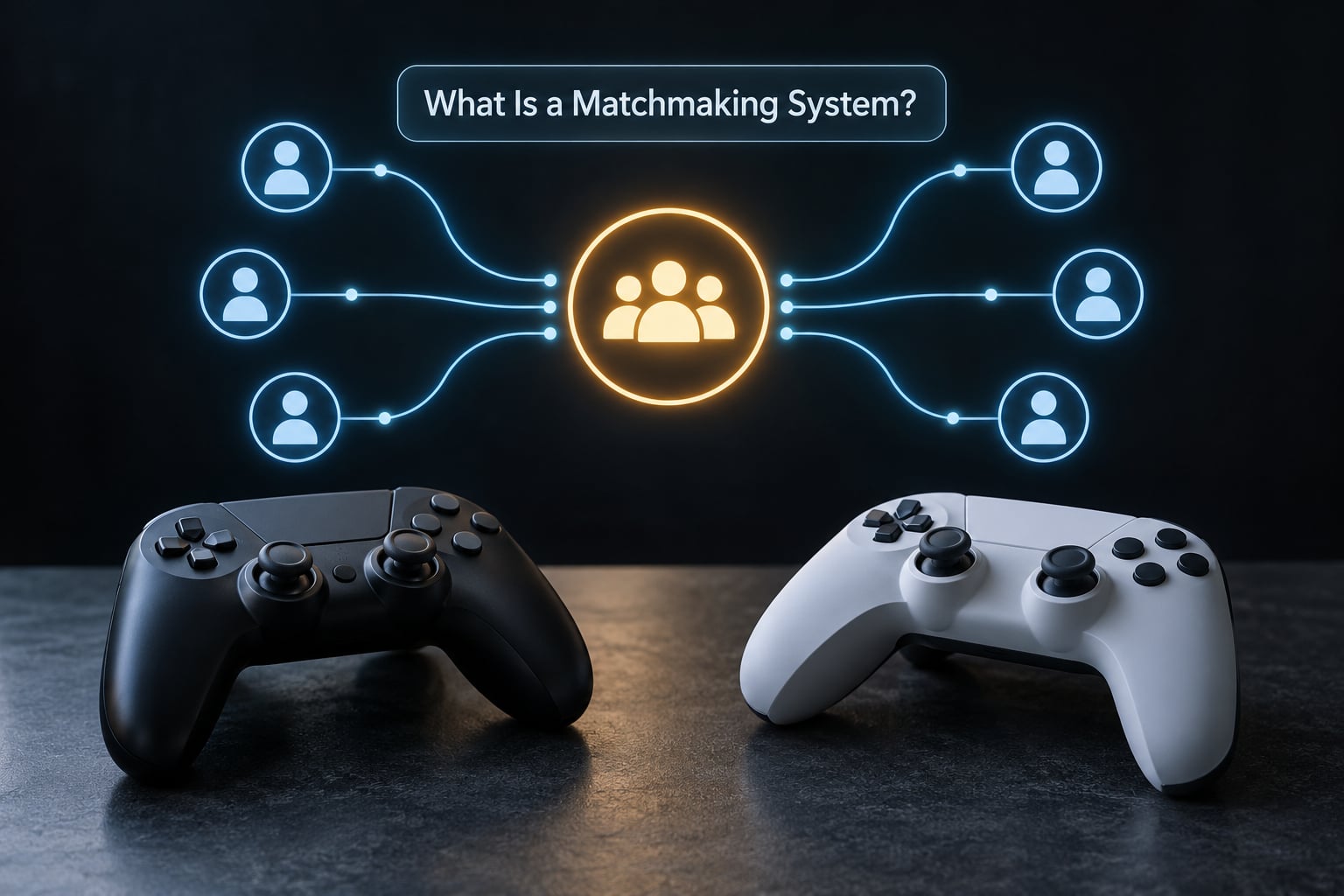
A matchmaking system is the layer between the queue button and the loading screen. It does four jobs, and most player complaints trace back to one of them doing something unexpected.
- Organisation. It sorts everyone currently waiting into playlists, regions and party groups.
- Selection. It decides which specific players or teams face each other.
- Enforcement. It applies the queue’s rules: how wide a skill gap is acceptable, how far from the server you can sit, whether your friends stay together.
- Adaptation. It reacts as the population shifts, widening or narrowing the rules to keep matches forming.
Skill is only one of those inputs, even when players use the term “skill-based matchmaking” as shorthand for the whole thing. A system that only sorted by ability would produce fair matches and ruinous ping, and a system that only sorted by ping would hand you constant blowouts.
How Matchmaking Systems Work in Online Games
How matchmaking systems work in online games comes down to one loop repeated for every match: read profiles, filter candidates, search, score, assemble, update. The order matters, because the reason your fourth match in eight minutes felt worse than your first is step three.
Step 1: your profile enters the queue
Pressing find match stamps your account into a playlist and sends a small bundle of data: your rating, your party, your recent results, your region, your connection quality and whatever behavioural flags the game keeps on you. Nothing is decided yet.
Step 2: the candidate pool gets filtered
The matchmaker first throws away almost everyone. Region and platform rules remove players on other continents or other input devices in games that separate them. Then a latency filter removes anyone whose ping to the available servers is too high. What survives is a pool small enough to search.
Step 3: the search window widens as you wait
Now the system looks for players whose ratings sit close to yours. Every few seconds it relaxes that rule, accepting a slightly wider skill gap. This widening is called backoff, and it is why the fourth match in your session feels noticeably worse than the first one. Players describe this exact behaviour on game forums as the pool “rapidly” expanding.
Step 4: candidates get scored and ranked
Every surviving combination is rated on how good a game it would produce: skill gap, latency spread, role coverage, party fit. The best-scoring set wins. This is also where pre-made groups get broken up or given compensation, because a party of friends is harder to place than five strangers.
Step 5: teams and opponents are assembled
In team games the chosen set is split into sides so both sides have similar total ability and can both fill the roles the map needs. In a duel game there is nothing to split, so the same scoring logic simply picks one opponent.
Step 6: the server is allocated and the rating updates
A server goes live, players connect, and when the match ends your rating moves by an amount determined by who you played and whether you won. Long-running games also run drift correction, quietly pulling ratings back toward their true value when too many of them inflate over time.
What Data Does Matchmaking Use?
Matchmakers read more than a skill number, and the more honest pages about this topic admit that skill is rarely the heaviest weight. Here is what a typical system looks at.
| Input | What it is | Why the system cares |
|---|---|---|
| Skill rating | A hidden number estimating your ability | The main driver of competitive balance, usually inside a widening band |
| Win probability | The rating system’s prediction for this specific pairing | Drives rating movement after the match |
| Recent form | Results and scores from the last several games | Catches a sharp climb or collapse that the long-term number misses |
| Party relationships | Who queued together and their combined rating | Decides whether friends stay intact or get split |
| Region | The data centre your client picked | Removes most of the planet before searching begins |
| Latency | Round-trip time to each candidate server | A hard filter in most competitive queues |
| Input device | Controller, mouse and keyboard, or mixed | Some games keep these in separate rating pools |
| Reported behaviour | Reports, penalties, leaver counts | Removes known problem accounts from your candidate set |
The order in that table is roughly the order of weight in a ranked queue, and it is not the order most players assume. In casual playlists the skill weight is often light enough that the rating is barely doing anything.
How Do Skill Ratings and Rankings Affect Matches?
Players use three different words for three different things. MMR is the hidden number the matchmaker reads. Rating is the algorithmic output, often still hidden. Rank is the cosmetic tier you see, like Gold or Diamond, which is just a labelled slice of the number. Conflating them is why a strong player insists their rank is wrong.
Elo: the system behind nearly every ladder
Elo rating predicts the score you should expect against an opponent, then rewards you for beating someone stronger than expected. In plain English: beat a player rated well above you and your rating jumps hard; lose to someone rated well below you and it drops hard; win or lose against an equal and it barely moves.
The expected-score idea is the part that trips people up. Your rating change is roughly the gap between what happened and what the system predicted. Beat the favourite and the system owes you a correction.
K-factor: why new ratings move faster
How far a rating moves is scaled by a multiplier called the K-factor, and it is usually large early on and smaller once you are established. New accounts need to travel a long way quickly; proven ones should not rocket after one lucky streak.
| K-factor | Effect | Typical use |
|---|---|---|
| 16 | Small, slow changes | Established players in a mature population |
| 32 | Moderate | General competitive ladders |
| 48 to 64 | Large, fast changes | New accounts, placement matches, small player pools |
Why rating systems now track uncertainty
Pure Elo has one weakness: it treats a player with one game played exactly like a player with ten thousand. Glicko-2 and TrueSkill, both Bayesian, attach a rating deviation to every account, a measure of how confident the system is. A big deviation means the system is still guessing, so it moves that rating faster and searches more widely for a real test. Once you settle, the deviation shrinks and the number stops wandering.
| System | Handles uncertainty | Team support | Where you meet it |
|---|---|---|---|
| Elo | No | Average team rating | Chess and most long-standing ladders |
| Glicko-2 | Yes, via rating deviation | Worked out by averaging | Many online competitive ladders |
| TrueSkill | Yes, with a skill and confidence pair | Built in, handles uneven team sizes | Microsoft’s Halo and Age of Empires matchmaking |
| MMR | Not an algorithm itself | Not applicable | A generic label players use for the hidden number |
Placement matches exist because of all this. A new account has no rating to speak of, so a handful of games are used to seed one, and the wide K-factor lets that seed move a long way quickly. Rating floors do the opposite job, stopping an account from sliding past a ladder’s lowest visible tier.
Why Does the Game Search for a Match?
Because a perfect match that arrives in twenty minutes is worth less than a close one that arrives in ninety seconds. Every rule the system holds is really a dial controlling how long you wait, and each time the game gives up on a rule, wait times fall and match quality falls with them.
| Rule relaxed | What you gain | What you lose |
|---|---|---|
| Time waited grows | A match within a couple of minutes | Widening skill range, more lopsided sides |
| Wider skill range | More candidates, faster fills | Even skill, less competitive accuracy |
| Wider region radius | A full lobby at any hour | Higher ping, more lag spikes |
| Party rules loosened | Your friends stay in one match | Less balanced teams, a skill penalty for you |
| Input device mixing | Everyone plays together | Possibly a shared rating pool with different aim curves |
This is why a queue feels fine on a busy Saturday night and miserable at 4am on a weeknight. The population is a third of the size, so widening starts sooner and goes further, and your match is assembled from a much thinner slice of players.
How Does Matchmaking Build Balanced Teams?
Team matchmaking solves a harder problem than picking opponents, because a bad match needs nine or ten people to have a bad time. Four approaches usually get combined.
Skill balance keeps the total rating on both sides close. For a 5v5 with a party of a 2.0, a 1.5 and a 1.0, the system measures the party average and fills around it, then balances total ability across the two sides.
Role balance stops both teams ending up with three damage dealers and no support. Role requirements are often hard constraints, which is why a queue asking for a specific role will move more slowly than a generic one.
Size balance handles the awkward numbers: a 3-stack against a duo, a solo against a full party. Some games simply refuse those pairings, others accept them and apply a compensation factor to the group’s rating.
Objective awareness is the newest layer. Modes with uneven sides or objective-based rounds get their weighting adjusted so a balanced rating spread still produces a fair fight.
How Do Ping, Server Location, and Fairness Interact?
Latency is usually a filter rather than a preference, and that is why a technically weaker player on a good connection often gets placed ahead of you. If the server is in Frankfurt and you are on 15ms while the other candidate is on 90ms, the system takes the weaker player, because a match with uneven skill and clean connections beats a fair match where someone is shooting around corners at a delay.
Some systems measure a delta, the gap between your best available ping and the ping to the server you actually got. The larger that delta, the more the game considers itself to have wronged you, and the more willingly it will move you later. Skill constraints usually loosen faster than latency constraints, because the player base forgives a wider skill gap sooner than a laggy one.
The trade-off is geographic fairness against competitive fairness. A regional server gives you good connections and leaves you playing the same small pool of people every night. A global pool gives you better matches and a 200ms round trip. Which one you get is usually a setting you chose once and forgot about.
What Is Match Quality and Why Does It Matter?
Match quality is the system naming the thing it was trying to maximise, and it is made of at least six components: how close the skill ratings were, whether both teams can fill the roles the map needs, the latency spread between players, how long you waited, how well the party composition fit, and whether anyone in the match has a recent report or abandonment record.
No single one predicts a good match. Perfect skill parity with a 150ms ping difference is a worse game than a slight skill gap between two players on the same server. That is why a queue can hold every individual component to an acceptable value and still hand you a bad night.
It is also why match quality is nearly always a trade-off rather than a target. Every component improved costs you somewhere else, usually queue time, and queue time is the component players notice most.
Why Can Matchmaking Still Feel Unfair?
Because most complaints are correct observations attached to the wrong explanation. Here is the honest list.
- Smurfs. An experienced player on a fresh account sits at the bottom of your rating pool, and a rating system has no way of knowing. Detection relies on behaviour patterns and anomaly checks, which catch some accounts and miss plenty.
- Rating error. Ratings are estimates. Ten matches produce a wide confidence band, so a new or inconsistent player gets matched on a number that is mostly guesswork.
- Leavers and throwers. A team that quits or deliberately loses destroys the match for nine people. No rating algorithm can prevent this; only reporting and penalties touch it.
- Uneven teams. Occasional imbalance survives because the alternative is a longer queue, and the system usually picks the shorter wait.
- Thin populations. Off-peak hours, low-population regions and new game modes all produce pools too small to search properly.
- Hidden rules. The biggest one. Most players cannot see the widening window, so they read a poor match as a personal verdict rather than a clock running out.
Two of those are worth separating out. The first is asymmetry: a bad match costs the strong player far more than it gains the weak one, because the strong player’s win condition usually depended on their own play. That is why good players burn out before bad players do.
The second is the 50% winrate idea that circulates in every game’s community. The goal of a rating system is to pair people the system believes are evenly matched, which in a stable population means roughly half of all games should be wins and half losses. That target says nothing about any individual player’s rate, and it cannot account for smurfs, throwers or a system whose estimates are simply wrong.
Frequently Asked Questions
Does matchmaking make every match perfectly equal?
No. Matchmakers aim for teams of roughly similar estimated ability, not identical ones. The rating is a statistical estimate built from a limited number of games, and a perfectly even match is not always the best available option once role coverage and latency are factored in. Widening the accepted skill gap over time is deliberate, so late matches in a session are often the least balanced ones you get.
Why is my matchmaking rank different from the rank shown in the leaderboard?
Because they are usually two separate numbers measuring two separate things. The rank you see is a labelled tier derived from your hidden rating, and a leaderboard may sort by a different metric entirely, such as peak rank, ranked wins or a seasonal score that decays. If your visible tier feels too low, compare recent results over a few weeks rather than a single session.
How do game developers prevent smurfs from ruining matchmaking?
Mostly with statistical detection rather than prevention. Because a rating system cannot see experience, only results, developers look for behaviour that does not fit the account’s rating: win rates far above the expected range, unusually fast rank climbs, and accounts that perform very differently across many games. Some games add manual restrictions on low-ranked accounts. Detection catches a meaningful share of smurfs and misses the rest.
Can matchmaking put my party against stronger or weaker teams?
Yes, and it is a deliberate choice with a trade-off attached. The system measures your group’s combined or average rating, then either splits the party to balance both sides or keeps you together and compensates with a rating adjustment. Keeping friends together usually costs you skill balance, which is why many competitive playlists warn you before accepting a stacked party.
Why does a match with lower-ranked players sometimes take longer to find?
Two reasons. The search window widens over time, so the longer you wait the wider the rating range the system will accept, and lower-rated players are a larger slice of any queue. The other is pool size: if there are not enough players at your rating and region nearby, the system keeps searching instead of filling the match quickly. Queue time and match quality move in opposite directions by design.
Can I improve the quality of my matches by changing a setting?
Sometimes, and the setting that matters most is your server region. Moving to a data centre closer to you usually tightens the latency filter, which means the skill window has to open less to find a match. Party settings, role selection and cross-play toggles matter too, but they mostly change who you wait for, not how good the resulting match is.
Conclusion
If you take one thing away from how matchmaking systems work in online games, make it this: when a match feels bad, check four things in order. Which region your client picked, whether your party changed the matchup rules, whether the mode asked for a specific role, and whether your rating has been moving sharply in the last ten games. That covers most of what is actually adjustable.
The rest is the design working as intended. Matchmaking systems are built to fill lobbies quickly and keep players playing, and fairness for you specifically is a smaller goal than that. Knowing which part is which is the difference between a bad night and a bad month.