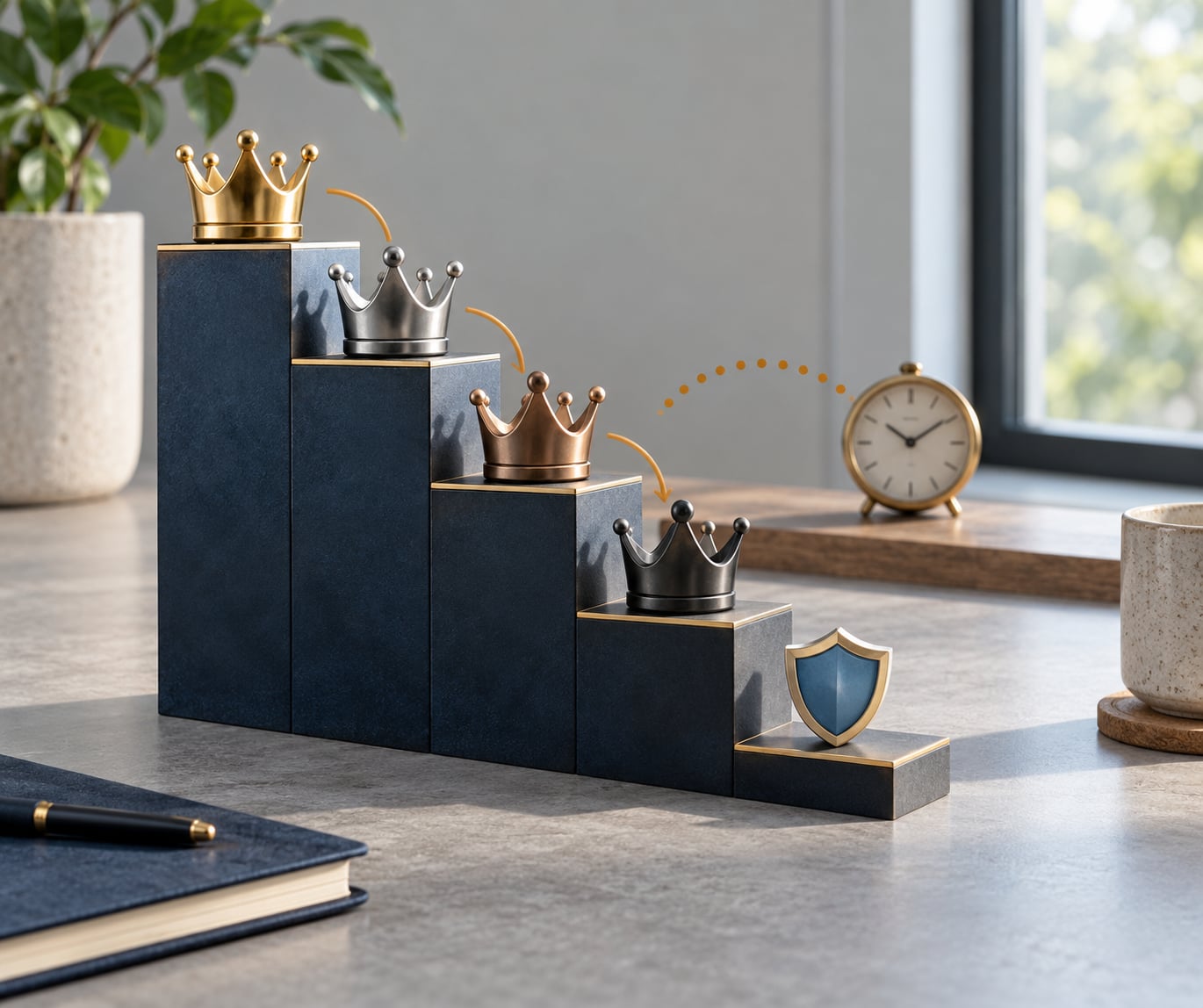
Ranked decay is a rule where your displayed rank drops automatically after you go too long without playing competitive matches, usually only above a certain rank tier. The point is to keep high ranks in the hands of players who are actually playing right now, rather than anyone who earned the badge once and logged off.
Understanding how ranked decay works in competitive games matters for one practical reason: almost every player who searches this is trying to work out whether it is safe to take a week off. The honest answer is that it depends entirely on which game you play and how high you are on its ladder, because the rules range from a very gentle timer to no inactivity decay at all.
Last verified: October 2026. Decay rules get patched every few seasons, so check your game’s own patch notes before planning a break.
The short version
- A timer runs from your last competitive match. Past that game’s idle threshold, your displayed rank starts bleeding away at a fixed rate per day.
- Decay is usually tier-gated. Most games exempt everything below a cutoff rank, so Bronze players rarely lose anything.
- One ranked match resets the clock. In several games unranked or quick play does not count, which is the single most misunderstood detail.
- A seasonal reset is a different system. It drops everyone’s rank at the start of a new season whether you played or not.
- Your hidden MMR usually does not decay. That is why your matches can stay just as hard after your badge drops.
Table of Contents
- 1What Is Ranked Decay?
- 2Why Do Competitive Games Use Ranked Decay?
- 3How Does Ranked Decay Actually Work?
- 4Ranked Decay Systems Compared
- 5Why Players Push Back on It
- 6How These Rules Have Changed Over Time
- 7Does Ranked Decay Change Your Hidden MMR?
- 8What Happens When You Return After a Break?
- 9How Much Can Your Rank Drop?
- 10Why Can Two Players with Different Activity Levels Be at the Same Rank?
- 11How Ranked Decay Differs from Other Ranking Changes
- 12Can You Stop or Reverse Ranked Decay?
- 13How to Protect Your Rank Without Overplaying
- 14Frequently Asked Questions
- 15How does rank decay work in League of Legends?
- 16Does VALORANT have rank decay?
- 17Do Overwatch 2 ranks decay?
- 18How much LP do you lose for decaying?
- 19Does playing unranked stop rank decay?
- 20Why is my rank lower than my matchmaking difficulty?
- 21What to Do First
What Is Ranked Decay?
Rank decay is a ranking system rule where a player’s displayed rank falls after a period of inactivity, so that a high tier reflects current skill rather than skill from two years ago. It applies to the badge on your profile, not to your account value, and almost every implementation of it is tied to a specific queue.
Five things move your rank down, and players mix them up constantly:
- Inactivity decay. A timer runs after your last competitive match. Once it expires, rank points drain at a daily rate.
- Seasonal reset. A scheduled event at the start of a new season that soft-resets everyone’s rank toward the bottom of the ladder.
- Demotion protection. A floor that stops you dropping out of a tier entirely after a bad losing streak.
- Skill rating movement. The hidden MMR number feeding your matchmaking, which changes when you win and lose, not when you stop playing.
- Penalties. Leaver busters, smurf sanctions and account sanctions, which can remove eligibility rather than move a number.
Only the first of those is decay in the strict sense. When someone on a gaming forum says “decay took my rank,” they usually mean the seasonal reset.
Why Do Competitive Games Use Ranked Decay?
The honest answer is that developers want their top ranks to be readable as a skill claim. A rank is only worth anything if the person holding it can still perform at that level today, and an inactive badge breaks that promise quietly.
There are five reasons that keeps coming up in developer notes and community discussion:
- Matchmaking accuracy. A player who earned a top rank and stopped playing two years ago is probably not playing at that level now. Keeping them in top lobbies produces the stomps that make a ladder miserable for everyone else in it.
- Rank camping and smurf population. If badges are permanent, high ranks fill with alternative accounts. Keeping the top of the ladder active limits the pool of smurfs, which is the argument CS and Valorant players have made in the game’s own discussions.
- Rating inflation. Over many seasons, a competitive rating drifts upward as stronger players accumulate. A periodic pull-back keeps the number tied to present-day performance.
- Population distribution. Ladders are shaped like a bell curve. Without some downward pressure, the top keeps thinning out and matches at the top get slower to fill.
- Retention. A rank you can lose is a reason to log in. A rank you earned for life is just a number in a profile.
None of this settles the argument. Players who take a holiday for work and come back to a demotion have a legitimate grievance, and the criticism that lands hardest is usually the accurate one: the loss feels arbitrary when nobody can tell you exactly which day it happened and by how much.
How Does Ranked Decay Actually Work?
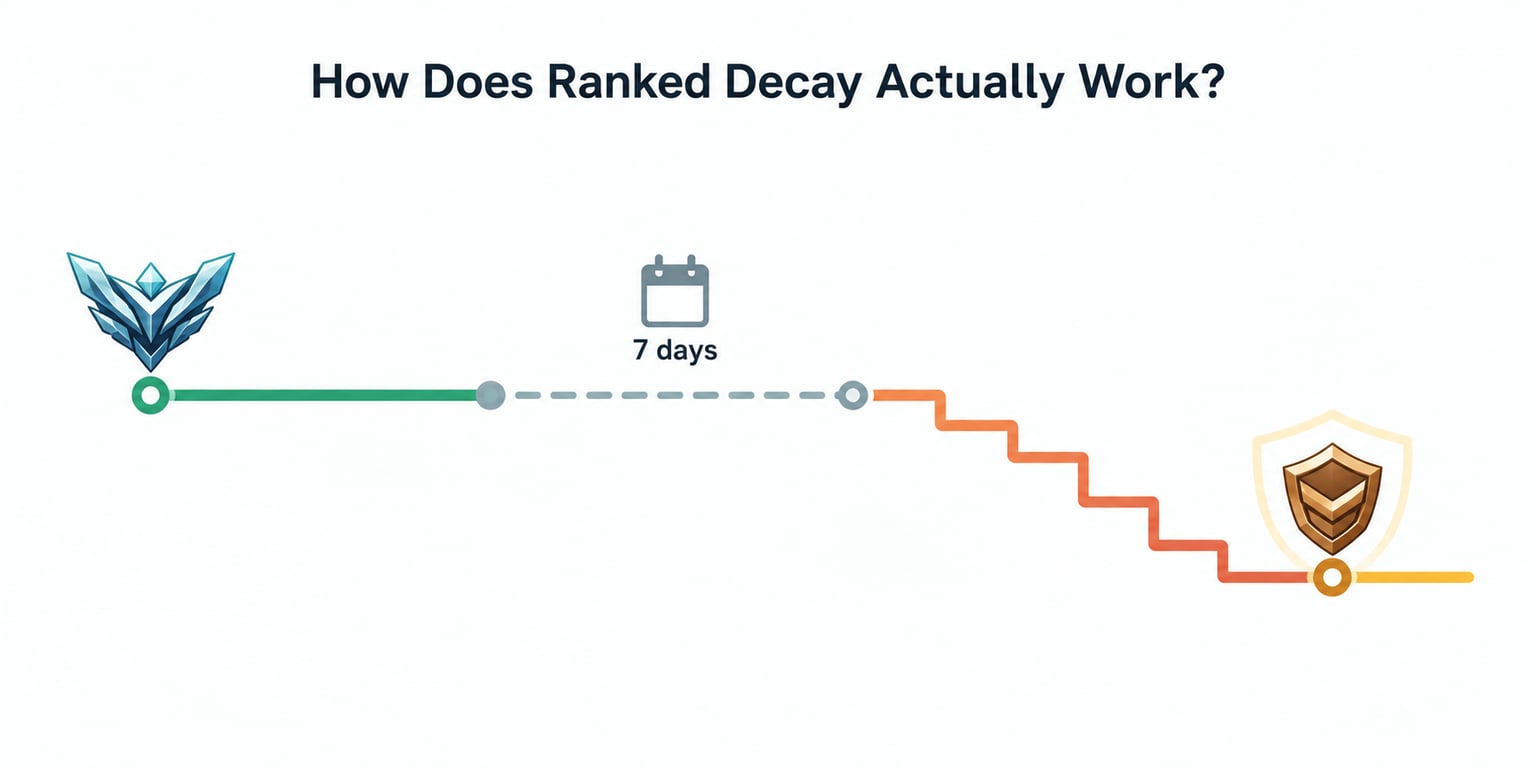
Every version of decay follows the same skeleton: a timer, a threshold, a rate and a floor. What changes between games is which of those four the developer chose to make harsh and which they made generous.
| Mechanism | Trigger | What the player sees | Can you avoid it |
|---|---|---|---|
| Inactivity decay | No competitive match for N days | Rank points fall daily above a cutoff tier | Yes, one ranked match resets the timer |
| Grace period | Crossing the idle threshold | A warning or a protected window before losses start | Yes, log in and queue |
| Decay ceiling | Rank above a cutoff tier | Nothing happens below the cutoff | Nothing to do, the rule simply excludes you |
| Hidden rating decay | Long inactivity, some modes | Match difficulty shifts instead of the badge | Not always, varies by mode |
| Seasonal soft reset | Start of a new season | Everyone drops toward the bottom of the ladder | No |
| Demotion protection | A long losing streak at a tier floor | You stop at the bottom of your division | No, but it limits the damage |
A few practical details matter more than most players expect.
The timer usually tracks one queue. In games where decay exists, it is almost always keyed to competitive or ranked matches specifically. Loading into unranked, quick play or a casual playlist keeps your account warm for bans and events, but it frequently does nothing for the decay clock.
Decay is tier-gated by design. Decay below a cutoff rank accomplishes nothing for matchmaking, because those lobbies are not the problem. Overwatch 1 used to run 25 SR per day for players at 3000 SR and above, explicitly to stop rank camping, and everyone below it untouched. The cutoff was the whole point: decay only helps if it hits the lobbies that are actually broken.
Some games have no inactivity decay at all. Marvel Rivals applies decay only at Eternity and above, and only after seven days without a competitive match. Overwatch 2 removed its Diamond-and-up decay rule, and players confirmed on Blizzard’s forums that they could idle for a year and keep the rank.
Hybrid systems are the norm. Most ladders today combine a seasonal reset with some form of inactivity handling, so a player on a long break can lose rank twice. Knowing which one did the damage saves a lot of pointless arguing.
Ranked Decay Systems Compared
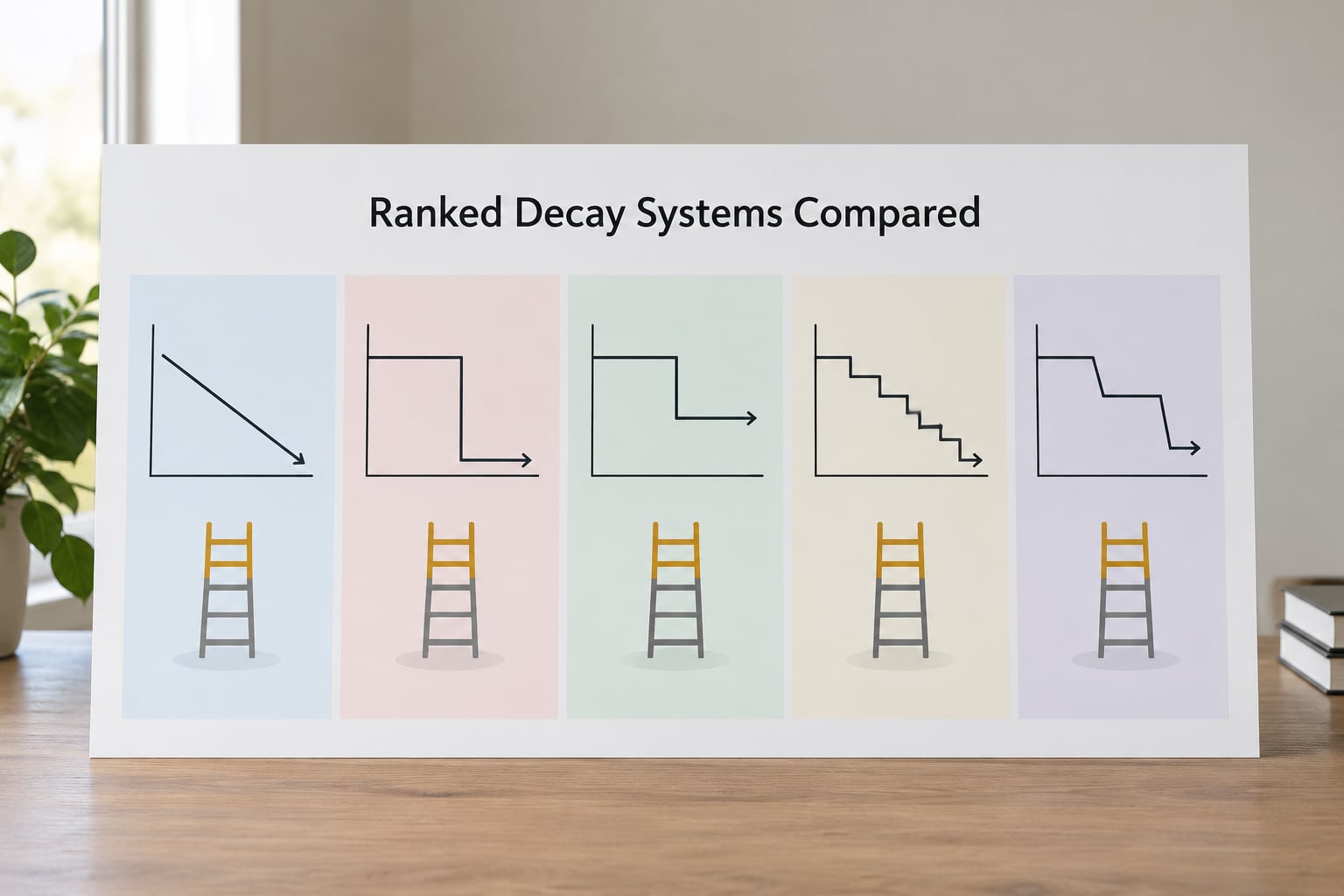
The table below compares the main decay systems used by competitive games right now, matched by trigger, visible effect and how much control you actually have.
| System | Trigger | Visible effect | Player impact | Common pattern |
|---|---|---|---|---|
| Gradual daily decay | Inactivity | Small daily loss | Slow bleed, easy to ignore until it is not | Rating systems above a threshold |
| Inactivity-only decay | Inactivity | Rank points drop, rating unchanged | Cosmetic loss, matches stay the same | Tiered ladders with a hard cutoff |
| Seasonal soft reset | New season | Everyone drops toward the bottom | A grind, not a punishment | Almost every modern ladder |
| Fixed-step decay | Inactivity | One or a few discrete drops | Sudden and easy to explain | Seasonal or holiday events |
| Hybrid | Both | Reset plus idle loss | Compounding, and the usual source of confusion | Riot and Blizzard titles |
Now the per-game picture. Rules here change, so treat each row as a starting point and confirm it before you plan around it.
| Game | Idle threshold | What drops | Ranks exempt | Seasonal reset |
|---|---|---|---|---|
| League of Legends | Idle period per tier | LP, harder above Masters | Below the top tiers | Yes, soft reset |
| Valorant | No standing idle decay | RR through normal play | All ranks | Yes, act-based reset |
| Counter-Strike 2 | No inactivity decay | Rank through match results | All ranks | Yes, seasonal |
| Overwatch 2 | No current idle decay | SR through match results | All ranks | Yes, seasonal |
| Marvel Rivals | 7 days without competitive | Rank, top rank only | Everything below Eternity | Yes, seasonal |
| Rocket League | No inactivity decay | RP through match results | All ranks | Yes, tier reset |
| Final Fantasy XIV | Not time-based | De-ranking after repeated low-tier losses | Not applicable | Seasonal, with its own crystals system |
| Guild Wars 2 | No standard idle decay | Rating through match results | All ranks | Yes, ladder reset |
Why Players Push Back on It
The complaint is not really about losing points. It is about the double penalty and the silence around it. A player who takes a work trip comes back to a lower badge and a seasonal reset landing in the same week, with no way to tell which system took what.
Second is the compounding problem with invested progress. Someone who spent months on one role or one hero and then took a break can end up demoted anyway, and that loss lands harder than a rating number would. Players on r/leagueoflegends have argued for years that the harshness should apply to top ranks only, since that is where the rule was designed to do work.
Third is the burnout effect. Grinds that feel compulsory push people toward alternate accounts, and r/VALORANT threads about season structure regularly describe players deciding to stop playing or start fresh rather than chase a leaderboard. A rule intended to keep the ladder honest can reduce the number of people playing it.
None of that makes decay wrong by itself. It makes the specific implementation worth arguing about, which is why patch notes matter more here than in most other games.
How These Rules Have Changed Over Time
Decay is not a settled design. It gets added, tuned and removed, and the version you read in an old guide may not exist anymore.
- Overwatch 1, the original rule. Players at 3000 SR and above lost 25 SR per day of inactivity, introduced specifically to discourage rank camping.
- Overwatch 1, 2018. The idle decay rule was removed entirely.
- Overwatch 2, Season 4. With no idle decay restored, players on Blizzard’s forums confirmed they could idle a year and keep their rank.
- League of Legends. Idle decay became the normal route for losing LP, with the top tiers treated more harshly than the rest of the ladder.
- Marvel Rivals. Scoped narrowly to seven days of inactivity and to Eternity rank and above.
- Counter-Strike 2. No inactivity decay, with the community arguing in Steam discussions that the ladder relies on active players at the top instead.
Read a decay guide that does not carry a date with suspicion.
Does Ranked Decay Change Your Hidden MMR?
Usually no, and this is the single biggest source of confusion in competitive communities. Matchmaking in most of these games runs on a hidden rating, often called MMR, Elo or skill rating, and your visible rank is a band that the hidden number gets mapped onto.
When a game applies inactivity decay to your displayed rank only, your hidden number stays where it was. The result is the complaint you will find on nearly every forum: the badge dropped but the games did not get easier. A player on r/GlobalOffensive put it plainly, describing matches where decayed players end up several skill groups below where they actually play and calling the result unrewarding.
A few games do move the hidden rating on long inactivity, which makes matchmaking change over time as well. That is why the useful habit is to check your rank page for both numbers rather than assuming one implies the other.
What Happens When You Return After a Break?
It depends on how the game measures inactivity. Common outcomes are a set of placement matches, a starting rating below your old one, extra rating volatility while the system re-estimates you, or full protection from further decay for a period.
Final Fantasy XIV takes the performance route rather than the timer route. A player at the lowest tier who loses a small run of matches can be de-ranked out of the division entirely, so the punishment there comes from results rather than from time away. It is worth knowing which kind your game uses before you assume a two-week break costs you nothing.
How Much Can Your Rank Drop?
The maximum loss is set by a handful of factors, and in most games at least one of them is a hard stop that keeps a bad week from becoming a disaster.
- Daily loss rate. A fixed amount per day is the simplest model. Overwatch 1 ran 25 SR per day for players at 3000 SR and above, which is the clearest historical example of a published rate.
- Weekly or monthly caps. Many games cap the total so a long break costs a bounded amount rather than everything.
- Minimum rank floor. Decay usually stops at a fixed rank so you cannot fall out of the ladder entirely.
- Decay ceiling. Below a cutoff tier nothing happens at all, which protects the overwhelming majority of players.
- Grace periods. A window after the idle threshold where you have not started losing yet. Missing it by a day is a common and painful experience.
- Pause and freeze items. A handful of games have sold or earned a temporary freeze that halts the clock.
- The seasonal reset. The largest single drop in the game, and the one that hits everyone.
The Guild Wars 2 community has argued for a gentler formula in its official forum threads: decay starting at 100 per day and reduced by 50 for each game played, so roughly two matches cancel 100 decay. Whether or not you think that is the right number, it shows the shape of the argument, which is that playing more should reduce the penalty proportionally rather than simply restarting it.
Why Can Two Players with Different Activity Levels Be at the Same Rank?
Because a visible rank is a band, not a number. Two players can sit in the same division while their hidden ratings, activity levels and season histories are very different, and the ladder shows you only the band.
Take a division that covers a hidden rating from 1,800 to 1,900. Player A plays most evenings and has settled at 1,870. Player B plays in bursts, wins a lot while active, and has the same 1,870 without playing nearly as much. Both show the same division.
Now let Player B stop playing for three weeks. If the game’s idle threshold is seven days and decay applies, Player B’s rating slides down toward the floor of the band, or out of it, while Player A drifts up as they keep winning. A month later the two are still on the same screen under the same label, because the band absorbed the difference, but the hidden numbers underneath are hundreds of points apart and the matches will feel different.
This is also why chasing a border rank is usually a mistake. The moment you sit one game above a promotion line, decay pace, hidden rating and variance all matter more than your visible division.
How Ranked Decay Differs from Other Ranking Changes
Several things lower your rank that are not decay, and mixing them up leads to bad decisions about when to play.
- Losing matches. This is ordinary skill rating movement. Your hidden number falls on its own, with no timer involved.
- Seasonal reset. A scheduled event that soft-resets the whole ladder, active players included.
- Skipped divisions. Some games skip a division when you are promoted a long way at once, which looks like a loss but is not one.
- Being outranked. Late in a season, other players climbing past you can push you into demotion without a single bad game.
- Queueing with a party. Party matchmaking can score the group on its strongest or weakest member depending on the game, which moves your effective rating.
- Smurf sanctions. Alt accounts in high queues get restricted or banned, which can affect the rating the main account inherits.
- Deliberate rating loss. Some players drop rating on purpose to queue with friends. It works until a system flags it.
One symptom separates them cleanly. If your rank fell without you losing matches and without a season starting, look at how long you have been away. That is decay, and the timer is the only thing that caused it.
Can You Stop or Reverse Ranked Decay?
You can stop it and you can win it back, but you cannot undo days that have already passed. Decay runs on elapsed time, not on a queue you can pay off later.
What actually works:
- Queue one ranked or competitive match before the grace period ends. This is the whole game. Most ladders reset the clock on a single competitive match.
- Use a decay freeze or pause item where the game sells one, usually available around holidays or through progression rewards.
- Climb back after you return. Rank points are recoverable, though the ladder is slower near the top because matches are less frequent.
- Wait for the seasonal reset when your real problem is that the season is stale and a fresh climb is cheaper than defending a decayed peak.
What does not work: playing unranked or a casual mode and expecting the clock to reset. In most games with a decay rule, the timer is tied to the competitive queue only. This is worth confirming in your own game’s support page, because it is the detail players get wrong most often.
How to Protect Your Rank Without Overplaying
The goal is not to never take a break. It is to know which break your game punishes and to spend your few weekly matches where they matter.
- Find your cutoff tier first. If your rank is below your game’s decay threshold, you have nothing to protect. Check the patch notes or support page before rearranging your schedule.
- Identify the qualifying queue. Competitive, ranked or tournament queue. Note whether the game’s casual modes also reset the clock, because some do and many do not.
- Count the days, not the games. Most idle thresholds are measured in days since your last qualifying match, so two matches a week is enough to hold a timer. One match every ten days is not, if the threshold is seven.
- Use small sessions instead of marathon ones. The purpose of a maintenance match is to reset the timer, not to climb. Losing that match is cheaper than losing a ranked game at the wrong time.
- Watch the top of the ladder, not the border rank. If decay is tier-gated, the promotion you are chasing matters less than staying under the threshold that triggers losses.
- Check the seasonal calendar. If a reset is two weeks away, holding a decayed peak is pointless. Let the reset take it and climb fresh.
- Play with a party when you need protection, alone when you need rating. Party rules differ by game and can inflate or deflate your effective rating, so pick deliberately.
- Save screenshots of your rank page. When a rule changes mid-season, which happens more often than players expect, an old screenshot settles the argument about what you lost.
If you take a real holiday, the safest plan is usually one competitive match every few days, or accepting the loss and treating the return as a fresh climb.
Frequently Asked Questions
How does rank decay work in League of Legends?
In League of Legends, idle decay is the main way players quietly lose league points. After a period without playing ranked, LP drains at a daily rate, and the drain gets faster and harsher above Masters because those tiers need active players in the top lobbies. There is no change to your hidden MMR, so your matchmaking does not soften. League also runs a separate seasonal soft reset at the start of every ranked season.
Does VALORANT have rank decay?
No standing idle decay. Valorant does not have a system that bleeds your rank rating down just because you stopped playing, so a two-month break costs you nothing on the ladder itself. What people often mean is the seasonal reset, where ranks compress at the start of a new act. Matchmaking there runs on a separate competitive MMR, which moves with your match results and is not affected by the season start.
Do Overwatch 2 ranks decay?
No, not currently. Overwatch 2 removed the Diamond-and-above idle decay that existed in Overwatch 1, and players confirmed on Blizzard’s forums that you can sit out a full year and keep your rank. Older guides still quote the old rule, which was 25 SR per day for players at 3000 SR or higher, specifically to prevent rank camping. That rule was dropped, then Overwatch 2 added its own seasonal rank change instead.
How much LP do you lose for decaying?
It depends on the tier and the game. League of Legends drains league points at a set daily rate once you have been idle past the threshold, with faster loss for Masters and above. Other games express the same idea in skill rating points or rank rating points instead of LP. The loss is normally capped per week and stops at a floor rank, so an absence costs a bounded amount rather than your whole ladder position.
Does playing unranked stop rank decay?
Usually not. In the games that have an idle decay rule, the timer is keyed to the competitive or ranked queue, so unranked, casual and quick play matches do not reset it. One competitive match usually is enough to reset the clock. Some titles do include casual modes in the qualifying queue, so check your own game’s rules rather than assuming either way before you plan a break.
Why is my rank lower than my matchmaking difficulty?
Because decay usually hits the displayed rank only, while your hidden MMR stays where it was. The badge drops, the rating that builds your matches does not, and the result is what forum players describe as losing the label without losing the lobbies. A handful of modes do move the hidden rating on long inactivity, which is why it is worth looking at both numbers on your rank page instead of assuming the badge tells the whole story.
What to Do First
Open your game’s official patch notes or support page and find one thing: the idle threshold for your current rank tier, and whether your queue resets it. That single check decides whether a break costs you nothing, a bounded amount, or a full climb back.
Then queue one competitive match. Not a full session, not a warm-up in casual, one qualifying match, which in most games is all it takes to reset the timer for another week.
If you are near a reset date anyway, let the season take the hit and climb fresh. Decaying a rank you were going to lose to the soft reset anyway is pure wasted effort.