Buying and subscribing are two different deals, and the whole difference comes down to one word: ownership. Buying a game moves a digital license onto your account, and that license stays there whether you cancel everything else or never touch the console again. Subscribing pays for access to a catalogue, and the access stops the moment the payments stop. That is the whole difference, and everything below is a consequence of it.
To decide between buying and subscribing, count the games you actually finish in a month, not the ones you browse. Two games a month or fewer usually makes buying the cheaper choice, and four or more usually makes a subscription pay for itself.
That rule sounds obvious, yet almost nobody applies it, because subscription catalogues are built to feel infinite. You open a menu with several hundred titles, tell yourself you have options now, and a month later you have played four hours of one of them. Meanwhile the monthly charge keeps coming. The result is the thing forum players complain about most: a subscription running in the background while you buy the same games separately.
This guide is about the decision, not about any particular service. Plan names, tiers, monthly fees and catalogue sizes change constantly, and anything written about specific plans is out of date within a season. What does not change is the arithmetic underneath, so that is what this article is built on.
Three short versions first. If you play one or two games a month, buy them. If you play four or more a month and want variety across genres, subscribe. If you are somewhere in between, run the break-even calculation below before you commit to anything.
Table of Contents
- 1How to Decide Between Buying and Subscribing at a Glance
- 2Buying a Game: When a One-Time Purchase Makes Sense
- 3What you own when you buy
- 4How to decide between buying and subscribing based on play habits
- 5What to do when a game is both for sale and in the catalogue
- 6Subscribing: When a Monthly or Annual Plan Makes Sense
- 7Cost Comparison: Upfront Price Versus Ongoing Payments
- 8One month at a time: using a subscription like a rental
- 9Game Library, Ownership, and Availability
- 10Choice overload: when a big catalogue works against you
- 11Multiplayer, Online Features, and Convenience
- 12Which Should You Choose?
- 13Frequently Asked Questions
- 14What is the difference between buying and subscribing?
- 15Is it better to use a game pass or buy games?
- 16How many games a month make a subscription worth it?
- 17Do you own games on a game subscription?
- 18What happens to my save if a game leaves the catalogue?
- 19Is a monthly plan better than paying for a year?
- 20Conclusion
How to Decide Between Buying and Subscribing at a Glance
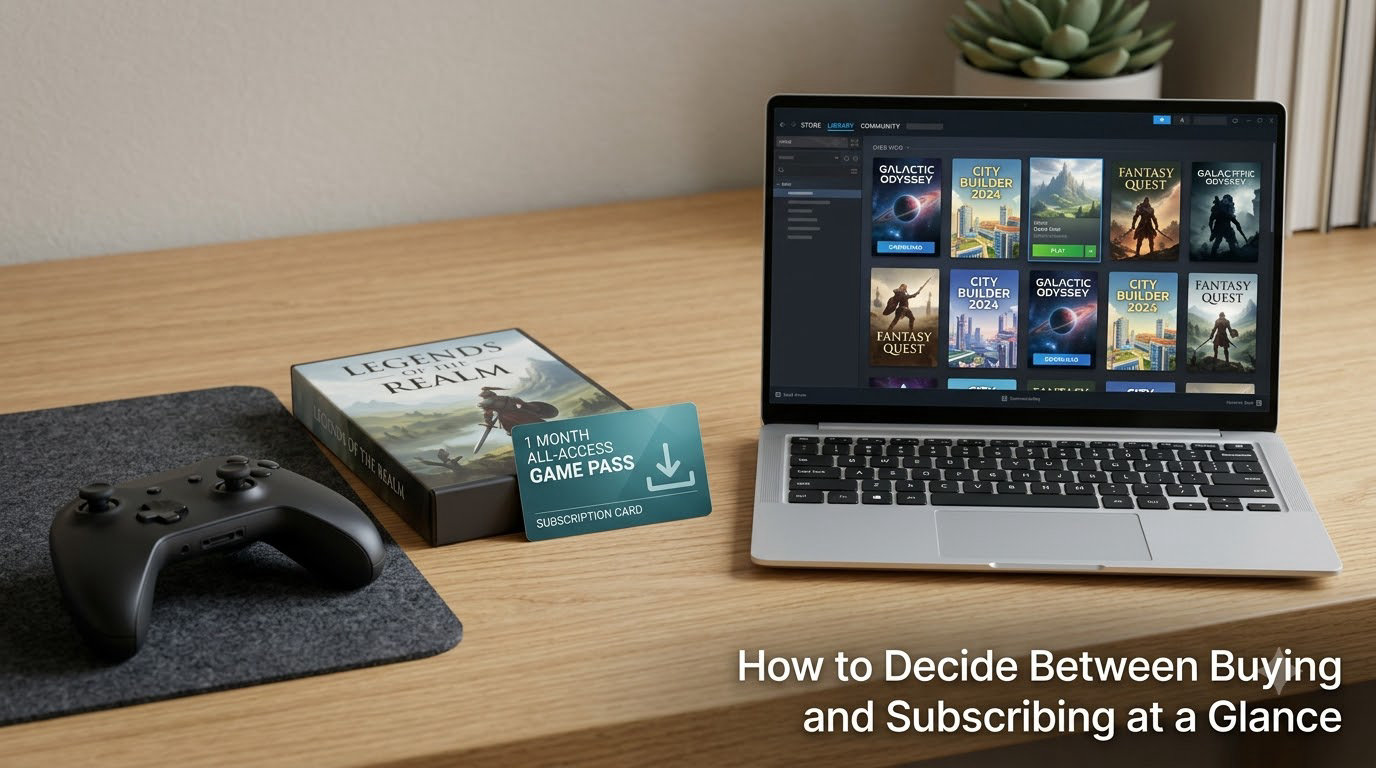
The quick comparison is ownership against access. Read down the right column and you can see the two models fail in opposite directions: buying is safe but narrow, subscribing is broad but revocable.
| Criterion | Buying a game | Subscribing to a catalogue |
|---|---|---|
| Upfront cost | One payment, per game, at whatever the current asking price is | Nothing until you sign up |
| Ongoing cost | None after the purchase | A recurring monthly or annual charge that continues until you cancel |
| What you get | One title, permanently, on the account you bought it on | Access to a large rotating catalogue while the plan is active |
| Catalogue size | Whatever your library holds, which grows slowly | Hundreds of titles, with new ones arriving and older ones rotating out |
| Day-one access | Available for nearly every new release | Only for the subset of releases the service carries on launch |
| Online multiplayer | Often still needs a separate recurring fee | Usually bundled into some tiers |
| Ownership | Yours, tied to your account on that platform | Rented. Access ends the day you stop paying |
| Resale or trade-in | Keeps some value, especially physical copies | Nothing to sell or trade |
| If you cancel | Nothing changes | The catalogue goes with you |
| Best for | Focused players, patient gamers, collectors, low monthly volume | Frequent players, genre explorers, players without a backlog problem |
Two rows carry most of the weight. Ownership decides what happens in three years, and ongoing cost decides what happens next month. Everything else is preference.
Buying a Game: When a One-Time Purchase Makes Sense
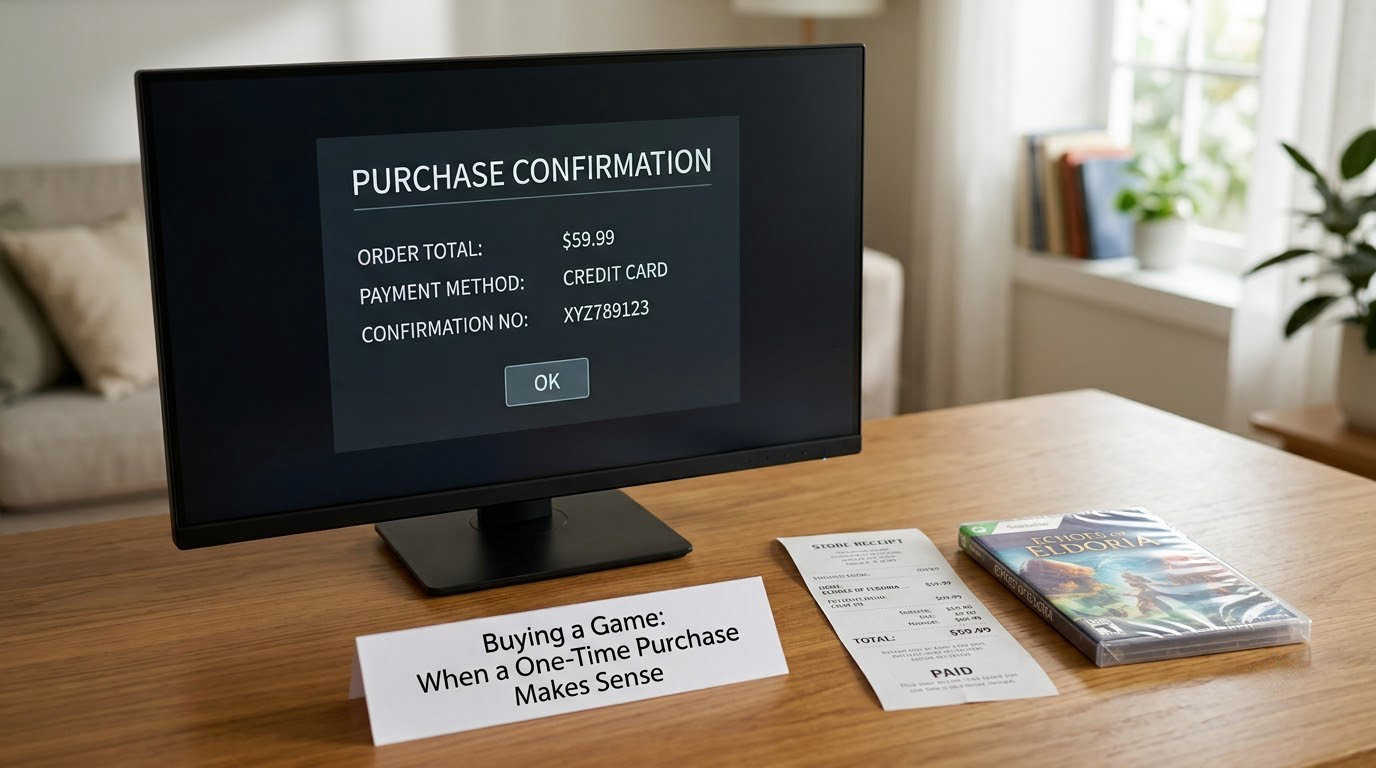
Buy the game when you already know it is the one. Not “it looks interesting” but the specific title you have been waiting for, especially one you will play for thirty hours and finish.
What you own when you buy
A purchase gives you a digital license tied to the account you bought it on. It survives subscription cancellations, platform store sales and the years in between. If you buy a physical copy instead, you get something extra that digital purchases cannot match: an object you can sell, lend or trade, which matters more than most buyers admit when they assume they will finish their backlog.
Buying also wins on day-one access. New releases almost always appear in the store first, so if you want to play a big launch with friends on release day, buying is the only way to guarantee it. Several players in a PureXbox forum thread made exactly this point, arguing that joining a game at launch lets you start with your friends instead of arriving months later as the person who has to learn the basics alone.
Buying wins on focus. A shelf of fifteen games you chose is a short list. A subscription catalogue is a to-do list that regenerates, and the backlog guilt that causes comes from the regeneration itself: the catalogue grows faster than you can clear it, so nothing ever feels finished.
How to decide between buying and subscribing based on play habits
Look at five things before you spend anything, and the answer usually writes itself.
How often you finish games. Some players buy forty titles and complete two. If that is you, a subscription is cheaper per hour than anything else available, because you are paying to have access rather than to own.
Whether you stay in one genre. A player who only wants one series can buy those games and never browse. A player who wants to try something unfamiliar benefits from access, since trying a genre you would never have purchased costs nothing extra.
How big your backlog already is. PlayStation Plus and Xbox Game Pass members in the r/XboxGamePass community repeatedly describe the same moment: opening the browse menu, scrolling for twenty minutes, and closing it without launching anything. If that happens to you, more catalogue makes the problem worse.
Whether your play is online. If your friends are on a specific title and you need to be there with them, you want the game itself, not a general catalogue.
Whether you are a patient gamer. This is the decisive one for a lot of people. Buyers who wait for discounts routinely pay a fraction of the full asking price, and one user on r/patientgamers did the maths on a year of subscription spend against an equivalent list of second-hand and discounted games and found the purchases came out ahead once the hit rate on actually finishing games was applied. If you are disciplined about waiting, buying cheaply beats subscribing monthly, every time.
What to do when a game is both for sale and in the catalogue
Buy it if you have any intention of returning to it, and ignore the subscription for that title entirely. This is the question that comes up constantly in forum threads, usually phrased as an accusation against the buyer for paying twice.
It is not paying twice. You are paying once for permanent access and once for temporary access to everything else, and the only wrong move is keeping the subscription running for a game you have already bought. Three cases cover nearly every situation:
- You will replay it or you have friends on it later. Buy. Access is gone when the plan ends, and this is the one category where a permanent licence is worth real money.
- You want to try it, and the genre is unfamiliar. Use the subscription first. If it lands, buy it afterwards and skip the last month you would have paid for it.
- It is rotating out of the catalogue and you are partway through. Buy today. This is the narrow window where buying is not about value at all, it is about keeping a save you can still use.
Set yourself a firm rule and the double-paying stops. The moment you own a title, it comes off the list of reasons to keep a plan alive.
Subscribing: When a Monthly or Annual Plan Makes Sense
Subscribe when volume is high and curiosity is the bottleneck. People who play four or more catalogue games a month, or who want to sample genres outside their habits, get far more out of access than out of ownership.
The strongest argument for subscribing is risk. Buying an unfamiliar game at full price and abandoning it in three hours feels expensive. Doing the same thing through access costs you nothing extra, and several players describe abandoning short games with no sense of waste as one of the quiet benefits of the model. That is the feeling the model is built to produce.
Subscriptions also bundle things buying does not. Online multiplayer access is the big one, since owning a game often does not include play against other people online. Cloud saves, discounts on titles outside the catalogue and streaming to devices you do not own can be folded into the same charge. Whether the specific tier you are looking at includes them changes regularly, so check what your current plan covers rather than trusting a plan name.
There is a version of value here that is easy to miss: games you would never have bought. Several subscribers describe playing a dozen-hour historical adventure or a small rhythm game they had no intention of purchasing, abandoning two without regret, and finding one they now love. Ownership would have required committing to each of those blind. Access turns a maybe into a free experiment, and the free experiment is the actual product being sold.
The underrated strategy is treating a subscription month by month. The forum consensus is closer to renting than owning: subscribe, pick your one target game, set a calendar reminder for the day before renewal, and cancel. You never have to hold a plan across a month you would not use. Microsoft leadership has said publicly that the service is not for everybody, and specifically not for people who play one or two games a year, which is close to the rule this guide arrives at from the other direction.
Value decays the longer you stay subscribed, and this is worth being honest about. Early on, a big catalogue feels like discovery. After roughly six months, most long-time members describe waiting for specific titles instead of browsing, which is exactly when a smaller shelf of owned games starts to look more attractive. If you are past that point and still paying monthly, the subscription is probably being kept out of habit.
Cost Comparison: Upfront Price Versus Ongoing Payments
Here is the break-even calculation in one sentence: divide the price of one new game by your monthly subscription price, and the result is the number of games you must complete in a year to make the subscription cheaper than buying them.
Worked example. Suppose one new release costs about as much as six months of your subscription. Six finished games over a year puts you at break-even, five finished games puts you ahead with buying, and eight finished games puts the subscription comfortably ahead. The same calculation on a discounted game is harder for the subscription to beat, because a game you buy on sale costs a fraction of its full price, which drags the buy side down while the monthly charge stays fixed.
This is why the honest break-even point is not a fixed number of games. It moves with what you would have paid anyway. Players who buy at full price on launch day have a high bar to clear, and players who wait for sales have a low one.
| What you do | Typical cost shape | What you end up owning |
|---|---|---|
| Buy one new release at full price | One large outlay, then nothing further | One permanent license |
| Buy the same game on sale | A fraction of the full price, on a good week | One permanent license |
| Keep a subscription for a month | One monthly charge, cancel any time | Access to the whole catalogue for thirty days |
| Keep a subscription for a year | Twelve monthly charges or an annual commitment | A year of access, none of it permanent |
Monthly billing is the safer default. Annual plans look cheaper on a per-month basis, but they lock you into a year’s worth of a price that the industry has repeatedly raised. One long-running service raised its monthly price several times over a few years, moving through a series of increases before landing at its current level, and the online reaction was mostly annoyance rather than shock. Nobody who had been paying monthly got that letter.
That history is the argument for treating any subscription as a rental you can end. It also explains why subscribers who regret their plans usually regret the commitment, not the concept.
One month at a time: using a subscription like a rental
The tactic that gets repeated most often in gaming forums is not about which tier to buy. It is about how long to hold any of them, and the answer is one month at a time.
The routine takes about a minute of setup:
- Check the game you actually want is in the catalogue today, not next month.
- Subscribe for a single month on the tier that includes it.
- Add a calendar reminder a few days before renewal, naming the game you are there for.
- Cancel before the charge hits, or let it renew if you found something better.
- Buy the game if you intend to keep playing it past the month.
The reminder matters more than it sounds. Without one, people keep paying out of momentum, and the month after a subscription lapses is when the honest reckoning happens. Several players describe that exact pattern: play hard for the first six months, then coast for a year while the charge continues, then cancel and immediately see that buying the three games they loved would have cost less.
This approach also sidesteps tier inflation. Tiers get restructured and features move between them constantly, so committing to an annual plan is a bet that the tier you picked in 2026 looks the same when the year ends. One month at a time means you can move up or down freely, and drop to the cheapest plan that still covers what you play.
Game Library, Ownership, and Availability
A bought game is yours until you delete it or close the account. A subscribed game is yours only while the plan is running, and its availability depends on decisions made by the publisher.
The practical risk is rotation. Catalogue services add and remove titles on their own schedules, and a game that leaves is not always replaced with anything similar. Forum members worry about this constantly, and the fear is not unreasonable. What you can do is check before you commit: is the game currently in the catalogue, and when did it last arrive? Games that rotate in late, or arrive and vanish inside a month, are not worth planning around.
Saves are the other soft spot. Your progress belongs to you on most titles, but a game you cannot launch is a save you cannot use, and any progress that syncs through the publisher’s own servers may depend on a service still existing. One belief makes this worse than it needs to be: that you can always buy a title later. That is true for most store games and false for the ones that get delisted entirely. If a game is leaving and you are halfway through, buy it. That one rule prevents most of the regret described in subscription threads.
Resale is the quiet cost nobody mentions. Owned games have value after you are bored with them, whether as a physical copy you list or a digital license you trade. Subscribed games are worth exactly nothing the moment you stop paying, so a year of subscribing builds a library you never owned and cannot convert into anything. That matters most to anyone who has ever turned a stack of unwanted games into credit.
Regional and platform limits sit on top of this. Some catalogues differ by country, some titles vanish by region, and PC-heavy catalogues are useless if your gaming happens on a console. All three are checkable before you subscribe, and all three are common reasons a plan disappoints.
Choice overload: when a big catalogue works against you
A large catalogue is only useful if you use it. Browsing several hundred titles can produce the opposite of discovery, and the pattern shows up over and over in the forums people use: open the menu, scroll through for twenty minutes, close it, launch the game you were already playing.
You can test whether this is happening to you without spending anything. Look at what you played in the last six months and count how many came from a catalogue you had unlimited access to. If the answer is two, access is not your bottleneck and a bigger catalogue will not fix it. A backlog problem solved by adding more options is just a longer backlog.
One practical habit helps. Pick your next game before you sit down, not while you are browsing. The catalogue is a warehouse, not a showroom, and it works best when you walk in knowing which shelf you need.
Multiplayer, Online Features, and Convenience
Owning a game and being able to play it with friends online are two separate things. Many multiplayer titles require a recurring fee on top of the purchase, so buying does not remove the ongoing cost. This is the item people misread most often in the whole comparison.
Three different recurring charges get lumped together in conversation, and they are worth naming apart. Game access subscriptions hand you a catalogue. Online multiplayer subscriptions unlock servers for games you already own. Premium bundles combine both with perks like cloud saves, streaming or discounts. When you are deciding between buying and subscribing, work out which of the three you are actually solving for, because paying a bundle to solve a one-title problem is a common overspend in this whole category.
Convenience tilts toward subscribing. Launch and play without installing anything, move between devices, and pick something up on a bad evening when you would rather not commit to a forty-hour campaign. Buying tilts toward control. Install it, patch it, play offline, and keep the whole thing forever.
Day-one access is worth more to some players than the cost implies. Playing a new release with friends at launch means shared progression and an easier time finding a group. Playing it two years later on a subscription means starting from zero among people who have moved on.
There is a version of this argument for people who do not have friends waiting at launch. Being new to a live game rarely feels good, and that discomfort is the real reason people pay full price on release day rather than waiting for a discount. If that applies to you, buying at launch is not impatience, it is paying to avoid the worst three hours of a game’s first month.
Which Should You Choose?
Match the option to the player, not to the platform. Six profiles cover almost everyone who reads this.
The two-games-a-month player. You play something on evenings and weekends and nothing else. Buy those games on sale. A subscription charges you twelve times a year for four to six uses.
The day-one buyer. You want new releases on launch, at full price, with your friends. Buy. Catalogue services carry only part of the launch lineup.
The backlog grinder. You own more than thirty unfinished games and want to finish something. Subscribe for a month at a time to sample, then stop. Browsing a huge catalogue will not fix a finishing problem.
The collector and trader. Resale value matters to you. Buy. Digital licences from a subscription cannot be sold, so your library never becomes anything.
The family or group player. Your play depends on friends being in the same title, often online. Look at which of the three charges you actually need, then buy the game and add only the multiplayer fee if it is missing.
The returning player. You are coming back after years and want to find what fits. Subscribe for a single month, play through several short games, then decide with real evidence instead of a marketing page.
The single-genre player. You want one series and nothing else. Buy the series. A catalogue makes you pay to browse thousands of titles you have no interest in, which is a strange trade when the thing you want has three entries.
The console-only player without a PC. A huge share of subscription value comes from PC catalogue depth. If your gaming all happens on one console, weigh the smaller console catalogue honestly before committing, because the plan is priced on the total library, not the part you can use.
If you are unsure where you sit, use the two axes that matter: how many games you finish in a month, and how much you care about playing new ones on release day.
| Low appetite for day-one releases | High appetite for day-one releases | |
|---|---|---|
| Low volume (a couple of games a month) | Buy on sale, one title at a time. | Buy. You will want the release, and you will want to keep it. |
| High volume (four or more a month) | Subscribe, but watch the value decay and cancel when browsing stops. | Subscribe for the months around launches, cancel in the gaps. |
One last practical step. Before committing to a year, run the calculation with your real numbers: games finished last year, times the average sale price you actually paid, compared with twelve months of the plan. Then write your answer down. Most people who do this end up choosing month to month, and that turns out to be the best value available in the category.
Frequently Asked Questions
What is the difference between buying and subscribing?
Buying a game gives you a permanent digital license tied to your account, and it keeps working whether or not you hold any subscription. Subscribing gives you access to a catalogue of games for as long as you keep paying, and the access ends the day your plan lapses. One is ownership, the other is time-limited access.
Is it better to use a game pass or buy games?
It depends on volume and patience. If you finish one or two games a month and buy them on sale, buying is cheaper and you keep everything. If you play four or more catalogue games a month or want to try genres you would not buy, subscribing wins. The test is simple: divide the price of one new game by your monthly fee to get the number of games you need to finish each year.
How many games a month make a subscription worth it?
For most people, four finished games a month is the point where the maths starts favouring a subscription, and two or fewer favours buying. The threshold moves depending on what you would have paid anyway, because a game bought on sale costs a fraction of full price. If you are unsure, subscribe for a single month, count what you finish, then decide.
Do you own games on a game subscription?
No. You have access, not ownership. The licence stays with the service, and when your plan ends you lose the ability to launch those games. Any progress you made may still exist on your account, but a save you cannot use is not much of a comfort, and subscribed titles cannot be sold or traded at any point.
What happens to my save if a game leaves the catalogue?
Your progress usually stays tied to your account, but if the publisher pulls support or the service cannot launch the game any more, you may lose the ability to play it at all. That is the case where buying is the right call. Check whether a title is still in the catalogue before you plan a long game around it, and buy it if it is scheduled to rotate out.
Is a monthly plan better than paying for a year?
Monthly is safer for most players. Annual plans cost less per month but commit you to a year’s worth of a price that has been raised repeatedly over the years, and annual plans usually do not let you cancel mid-term. Monthly billing lets you skip the months you would not use, which is the main reason forum regulars treat subscriptions as a rental.
Conclusion
Start with one list: the games you expect to finish in the next twelve months. Multiply that number by the average sale price you actually pay. Compare it with a year of the subscription, then run the month-to-month test on the games you are unsure about. Buy the ones you are certain about, subscribe for the months you want variety, and cancel the moment the catalogue stops being used.