Text-based MMOs still have players because the words are doing a job graphics used to do, and players have quietly gotten good at it. Add low hardware needs, screen reader access, play that fits in ten-minute gaps, and communities where some members have been logging in for fifteen years, and the genre makes sense in 2026 even though most people have never typed a single command into one.
I have played a lot of browser MMORPGs. I have also spent far too many evenings staring at a wall of green text, arguing with a guildmate about whether we should raid the goblin mine or farm the wolves first. Both are MMO experiences. Only one of them runs on a machine I found in a skip.
Here is what a text-based MMO actually is, the six reasons players keep coming back, how to judge whether a world is worth joining, and an honest look at the criticism that gets aimed at the genre.
Table of Contents
- 1What Makes a Text-Based MMO Different?
- 2Why Do Text-Based MMOs Still Attract Players?
- 3The writing carries the whole scene
- 4The systems underneath are genuinely deep
- 5They run on almost any device or connection
- 6Play fits around a real life instead of replacing it
- 7The community is half the game
- 8Your character becomes a record of years
- 9How Does Imagination Make Text Games More Immersive?
- 10What Kind of Strategy Can Players Build Without Graphics?
- 11Why Are Text MMOs Easier to Play on Almost Any Device?
- 12How Do Text MMO Communities Build Loyalty?
- 13Why Do Returning Players Care About Old Characters?
- 14How Can You Tell If a Text MMO Is Still Active?
- 15Frequently Asked Questions
- 16Are text-based MMOs still active?
- 17Do text MMOs have enough players to join a party?
- 18Is playing a text MMO difficult for beginners?
- 19Are browser-based text MMOs free to play?
- 20What makes a text MMO worth joining?
- 21Why do players return to older text-based MMOs?
- 22Conclusion
What Makes a Text-Based MMO Different?
A text-based MMO is a massively multiplayer online world rendered entirely in written words. Most of them descend from MUD, short for Multi-User Dungeon, a format that appeared in the early 1980s. Variants followed with different emphases: MOOs and MUSHes skewed social and roleplay-heavy, while later MUDs layered on combat, crafting and territory control.
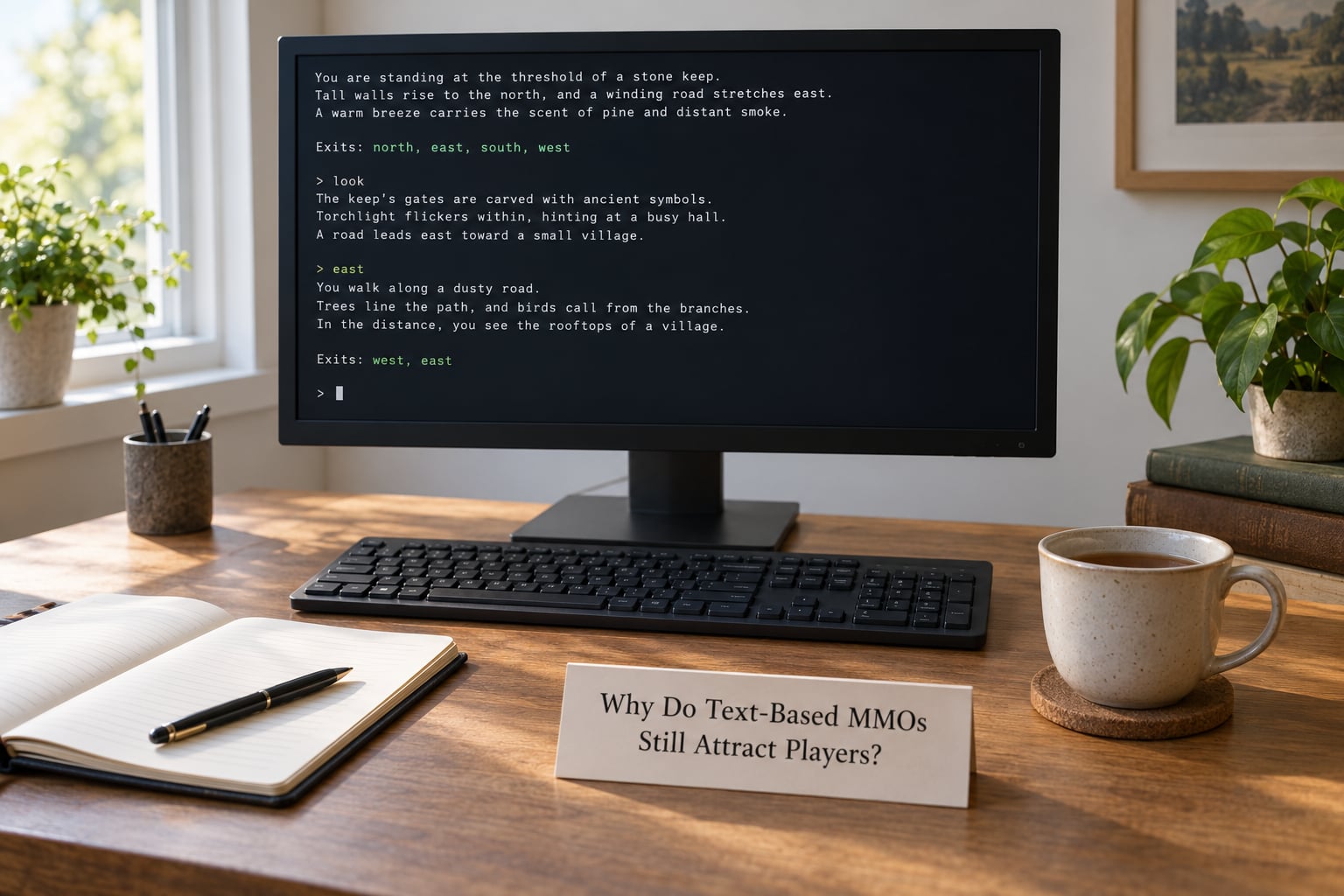
You connect through a text client and type commands. look describes the room. north moves you. say hello talks to whoever is standing there. The server replies with a fresh block of text describing exits, characters, loot and what just happened to you.
Three things set this apart from other games. The world persists after you log out, so the inn you left full of players is full again tomorrow. Thousands of people share it, often with no other players around you at all. And there are no images, so the renderer never limits what a room can contain or what an event can look like.
Single-player text adventures, sometimes called interactive fiction, share the writing but not the world. They are puzzle boxes with an author, designed to be finished once. A text MMO is a live place with other people in it, and it keeps going whether or not you show up.
Why Do Text-Based MMOs Still Attract Players?
That question comes up constantly in gaming forums, usually with an undertone of surprise. The answer is not nostalgia alone. Six things keep drawing people in, and they reinforce each other rather than standing apart.
The writing carries the whole scene
A graphical game spends time on a room’s lighting and clutter. A text game spends that budget on what the room means, who is in it and what they want. Well-run worlds give you weather, noise, smell and the mood of whoever wrote the description, and the writing is the production value.
The systems underneath are genuinely deep
The common assumption is that removing graphics means removing depth. That is backwards. Without animation budgets, developers invest in rules, economies, crafting chains, territory and simulation layers that a graphical MMO would struggle to render.
They run on almost any device or connection
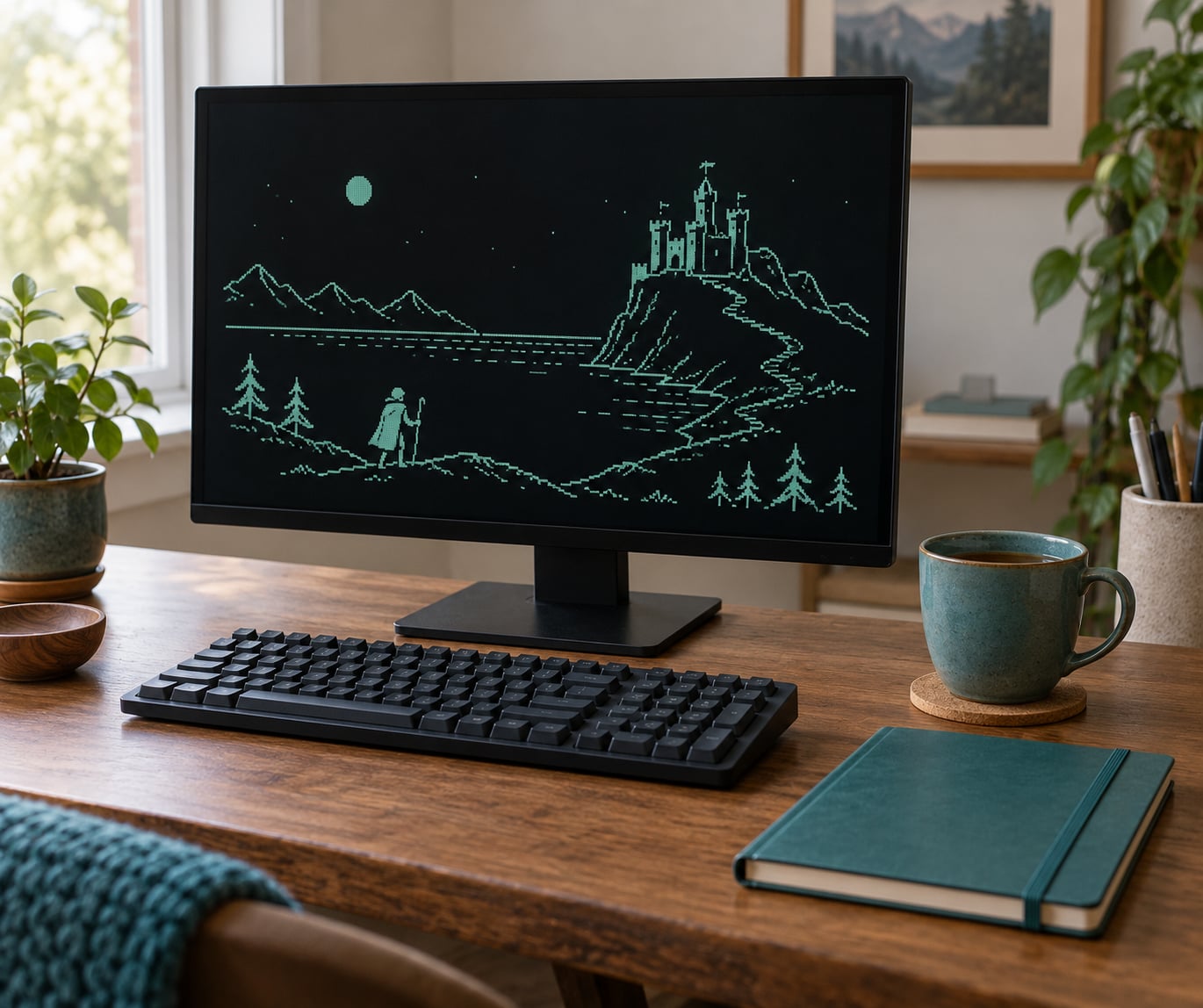
Many of these worlds are reached through a normal web browser with no install at all. A few kilobytes of text per action means a ten-year-old laptop, a phone or a patchy hotel connection can all work fine, and the format is unusually friendly to screen readers.
Play fits around a real life instead of replacing it
Typing a few commands between meetings is a complete session. There is no queue, no daily login streak that punishes you for one busy week, and no expectation that you are physically present for a raid night. The world keeps running while you are away, which is exactly what people who still have a job want.
The community is half the game
In a good world, the other players are the content. Running a tavern, escorting a stranger, arguing about a guild policy, or getting ambushed outside a mine are events no amount of production budget will script for you. Players describe these worlds as layered with depth, and the people are a large part of why.
Your character becomes a record of years
Skills, gear, reputation and a mapped route through dangerous territory accumulate into something a new character cannot buy or skip. Coming back after months away means picking up a life that was left running, not starting from zero.
How Does Imagination Make Text Games More Immersive?
It is not that text players imagine more vividly. It is that they are forced to fill gaps the game deliberately leaves open, and filling those gaps feels like authorship rather than a workaround.
Here is how it works in practice. You walk north and the room description reads something like a narrow stair going up, a lantern guttering on the landing, and wet footprints that stop halfway. No graphics version can decide what those footprints mean, and a good writer will not tell you either. You decide whether someone came down in a hurry, whether they were carrying something, whether they stopped because they were met.
That decision is the game. You walk in, look at what is actually there, and your expectation changes how you read the next line. Two people can run the same scene and remember different versions of it, and both are legitimate.
Players extend this further by writing scenes themselves. Roleplay-heavy worlds let a character declare an action, and other players answer in kind, so a tavern argument or a failed ambush can play out over a dozen exchanges with nobody typing a quest objective. Shared storytelling is not a side feature in those communities. It is the main event.
The most common objection to the genre is that it is a reading simulator that wrecks pacing, and the criticism is fair about some worlds. Bad description text, a quest buried in nine paragraphs of lore, or combat that is nothing but a dice roll five times over will read like a tax. What that objection misses is where the time goes when the writing is good: a graphical MMO spends its hours on animation, lighting and mocap that a text world simply does not have to buy.
That is also the argument made in the counter-thread of the usual gaming-forum complaint, and it holds up. Strip out the delivery layer and the only thing left to be good at is the writing itself, so a text game cannot hide a thin script behind a good actor.
The strongest writing in the genre is doing something specific: it describes enough to constrain you and leaves enough open to let you act. Too vague and the world feels empty, too exact and the game has scripted your imagination for you.
What Kind of Strategy Can Players Build Without Graphics?
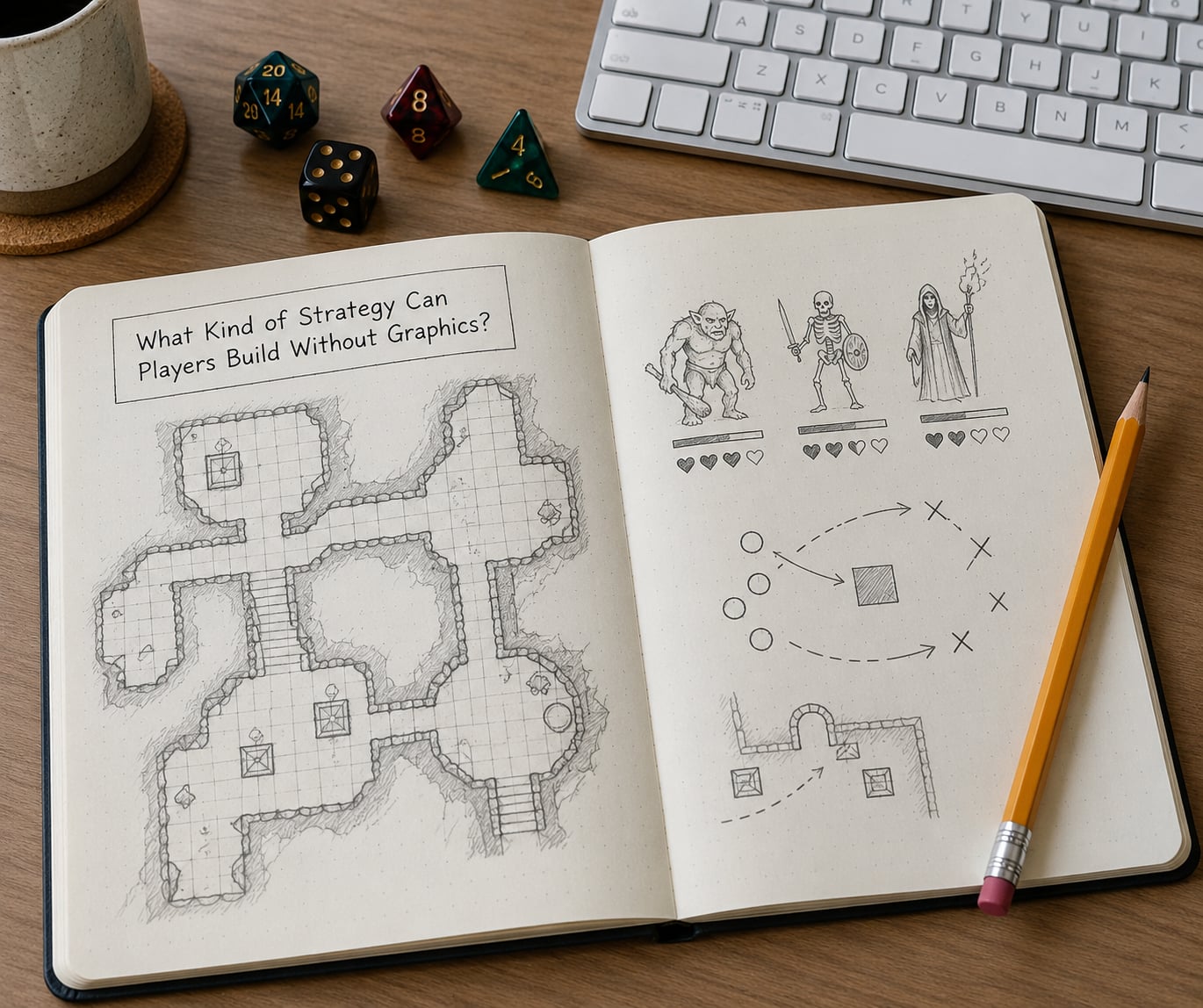
More than most people expect. Strategy in these worlds comes from systems and from other players, not from reflex timing or positioning, so it rewards planning and knowledge instead of reaction speed.
Take a party of six walking into a ruin. Four players favor fighting straight through, one wants to hold the entrance and let the monsters come to them, and one has spent an hour mapping the upper floor for a treasure cache nobody else knows about. In a graphical MMO that disagreement resolves itself in about a second, because the fight is decided by positioning and a rotation the interface will run for you.
In a text world it resolves slowly. Someone pulls up the room list, someone checks the experience ledger, someone asks the mapper what is upstairs. The party might spend twenty minutes deciding to bait a group of enemies through a narrow door one at a time, lose a member, retreat, come back with potions and take a different route entirely. Nothing stops that plan. The server simply reports what happens.
The systems feeding those decisions are real. Turn-based combat usually runs on formulas you can learn and outsmart. Crafting chains can be deep enough to support a whole economy. Several long-running worlds feature player-built territory, terraforming and town founding, where a settlement persists and grows over months. On the MUD community’s main discussion board, players list specific examples of that kind of depth: a MUD with an electric circuit building system, one with full space combat and station capture, one built around crafting and building towns and forts, and a turn-based survival game and a grand strategy simulator that routinely get compared to the biggest graphical sims.
That thread is the useful part. The recurring question there is whether text and ASCII games can match the complexity of mainstream management and survival sims, and the answer people give is that several already do, because depth is math and systems rather than rendering.
Why Are Text MMOs Easier to Play on Almost Any Device?
Because there is almost nothing to render. The hardware story is the least interesting part of the genre and still one of the most practical, so here it is in plain terms.
The classic route used to be awkward. You installed a telnet client, found a host and port, fiddled with terminal settings, and hoped the local operator was not blocking outbound connections. Modern access is much simpler. A growing number of worlds run a websocket client in an ordinary browser, so you open a page, type a character name and play. There are still free clients for people who want maps, triggers and highlighting, and they run on Windows, macOS and Linux.
Two practical benefits follow. Bandwidth use is tiny, so a weak connection or a data cap is not a real obstacle. And because a MUD is plain text, it can be read by a screen reader without a separate accessibility layer, which is why so many of these games have a genuine blind and low-vision player base.
One caveat worth stating: not every game runs everywhere. Some need a specific client, some are desktop-first, and a minority of worlds restrict which clients or scripts you may use. Check before you commit, but the general trend is toward opening a link and playing.
| Factor | Text-based MMO | Graphical MMORPG |
|---|---|---|
| Install size | Often zero, browser-based | Several gigabytes plus launchers |
| Hardware needed | Any laptop or phone with a keyboard | Modern GPU and a capable CPU |
| Bandwidth per action | A few kilobytes of text | Continuous asset streaming |
| Screen reader support | Native, since output is text | Depends entirely on the publisher |
| Session shape | Short and interruptible | Long, often scheduled around others |
| What drives depth | Rules, writing, other players | Content production, animation, art |
How Do Text MMO Communities Build Loyalty?
Retention in these games is mostly social. The world is a place, and a place only stays alive if people keep showing up, so the communities that work have habits you can actually observe.
Regular rhythm matters most. A world with a fixed weekly event, or a guild that logs in the same three evenings, gives people a reason to return that is not a progress bar. Shared lore comes next. Once a group of players has agreed on a backstory, a set of running jokes and a map of local trouble spots, leaving costs something socially, not just mechanically.
Mentoring is the underrated piece. Veterans teach new arrivals the command syntax, the unwritten rules and the political scene, and in small worlds that happens almost automatically because someone is always online. Player-run events fill the gaps the developers never planned: tournaments, story arcs, community celebrations, seasonal festivals that exist because a group of players decided to run them.
Long threads are a good sign. Discussions that started years ago and still get argued in are evidence that people believe their words will be read later. In one recurring MUD community thread, players describe groups that have been together for fifteen years or more, which is a stronger longevity signal than any patch note.
The failure modes are just as distinctive. Spam and griefing go unchecked for months. Newcomers get laughed at for typing slowly. A handful of veterans gatekeep knowledge to make themselves important, and the loudest voice in every channel ends up deciding policy. Watch for a community where the answer to a beginner question is a correction rather than a pointer, because that is how these worlds quietly lose a generation of players.
Why Do Returning Players Care About Old Characters?
Because the character is a record the game cannot give you fresh. In a persistent world, history accrues, and the value of that history is what pulls people back after months away.
Consider what a veteran actually owns. It is a skill set that took real play to earn, a reputation with the factions that determines whether guards attack on sight, rare equipment that may not drop again, and a mental map of routes, safe spots and shortcuts that took experimentation to build. None of that is purchasable in most of these worlds, and none of it transfers to a new character.
There is a social version too. Other players remember you, or remember your guild, or remember the run in the mines that everyone still brings up. A returning player walks back into a room where people already know the story, and that is a genuine social asset that a fresh account cannot buy.
Nostalgia plays a part too, particularly for people who first met these games on dial-up. But nostalgia alone does not explain someone logging in for an hour on a Tuesday. The more common reason is simple: the life they left is still going, and it will still be there tomorrow.
How Can You Tell If a Text MMO Is Still Active?
Player counts on these games are rarely published, so you check the signals instead. This matters, because a lot of well-documented worlds have run for over a decade and new arrivals struggle to catch up in a game that was never designed to last that long.
Look for recent forum or Discord posts from actual players, not from the administrators. Check whether other characters show up in the starting areas and whether they respond when you talk to them. An administrator who answers player questions within days is a good sign. A world with regular scheduled events is a stronger signal still. An update history covering the last few months, even small ones, tells you somebody is still maintaining the place.
Onboarding is the thing to ask about specifically. Some veteran communities run newbie nights, starter gear or a mentor list, and those exist because that world has decided new players are worth keeping. A community that has not thought about that in a decade is fine for roleplayers who enjoy figuring things out and miserable for everyone else.
The discovery problem is real. There is no dominant modern aggregator, so a lot of the work is done through recommendation threads, community directories and word of mouth. If you want a snapshot of what is out there and how to reach it, this is the kind of list worth scanning before you commit an evening to it.
The practical order is the same every time. Pick two or three candidates, spend twenty minutes in each, and choose the one where people answered you, the writing held up and the systems had something to offer. Community health is the single best predictor of whether you will still be playing in a month.
Frequently Asked Questions
Are text-based MMOs still active?
Yes, and not only as history. Many worlds have been running continuously since the 1990s, and a good share of them still update regularly. Forums and Discord channels carry active threads, scheduled events still run, and volunteer developers keep shipping small changes. The scale is a fraction of what graphical MMORPGs draw, but the communities are real and populated, especially in roleplay and strategy-focused worlds.
Do text MMOs have enough players to join a party?
It depends on the world, and you can check before joining. Busy communities run group content, guilds and scheduled dungeon nights. Smaller worlds lean on solo play, hunting and crafting, where you rarely need a group for progress. Look at how busy the starting areas are, how many characters show up in a session, and whether the world advertises party content. A twenty-minute trial run tells you more than any forum post.
Is playing a text MMO difficult for beginners?
The learning curve is real but front-loaded. Most of it is typing commands and learning a combat or crafting system, and a decent portion is unwritten social rules, which trips up almost everyone. Good worlds have newbie help, wikis and veteran mentors. Expect a few evenings of confused questions before it clicks, then a long stretch where the systems start to feel obvious.
Are browser-based text MMOs free to play?
Most are. There is no standard paid tier, no required monthly subscription and no pay-to-win store, which is one of the main things players like about the format. A minority of worlds charge a one-time purchase or run optional supporter tiers, and those are the exception rather than the rule. The economics come from volunteer developers, hosting costs and sometimes donations, so paying nothing is genuinely normal.
What makes a text MMO worth joining?
Judge four things in order: whether other players talk back, whether the writing holds your attention for ten minutes, whether the systems reward planning, and whether the world runs on a device you actually have. Depth can be enormous in a good world and absent in a bad one, and the same is true of community warmth. Check all four in a short trial before settling in.
Why do players return to older text-based MMOs?
Because accumulated progress cannot be skipped. A veteran holds skills, rare gear, faction standing and a mental map of dangerous routes, plus a social history other players remember. A game designed to run for twenty years also accumulates lore and inside jokes that no new release replicates. Nostalgia is part of it, but the deeper pull is returning to a world that kept going while you were away.
Conclusion
Text-based MMOs keep players because they substitute different things for graphics: writing that carries a scene, systems deep enough to plan around, an interface any machine can run, sessions that fit a commute, communities with real habits, and characters that record decades. None of that is nostalgia. It is design that aged well.
Start by picking two or three live worlds, spend twenty minutes in each, and go with the one where the people answered you. Everything else, from command syntax to faction politics, gets easier once you are actually talking to somebody.