To balance gaming and school, protect fixed study blocks first, give gaming a scheduled window you earn by finishing the work, and pick games you can pause so one session never swallows the whole evening. That is the whole method. Everything below is how to set those three pieces up.
Most students get one thing wrong here. They treat gaming as the enemy and try to win by quitting, then the stress lands somewhere else and the streak collapses inside a week. Gaming itself is not the problem. Unguided gaming is, because an open-ended session has no edge, and without an edge it eats the evening, then the sleep, then the next day’s attention.
So this is a scheduling plan, not a lecture. It takes about twenty minutes to set up and roughly fifteen minutes a week to keep it alive. Last updated October 2026.
Table of Contents
- 1What You Need
- 2Step-by-Step
- 31. List Every Fixed Commitment
- 42. Set a Weekly Gaming Limit
- 53. Schedule Playtime Instead of Waiting for Free Time
- 64. Protect Study Blocks With Simple Boundaries
- 75. Use Breaks and Rewards Without Falling Into a Slump
- 86. Adjust the Plan When Workload Changes
- 97. Review the Week Every Sunday
- 10Common Mistakes
- 11Frequently Asked Questions
- 12How many hours a day should I game while in school?
- 13What should I do if I want to play games but have homework?
- 14Is it better to study first or play games first?
- 15How can I stop gaming from taking over my weekends?
- 16What should I do when gaming makes it difficult to sleep?
- 17Can I balance gaming and school with a full-time job?
- 18Conclusion: Start With One Protected Study Block
What You Need
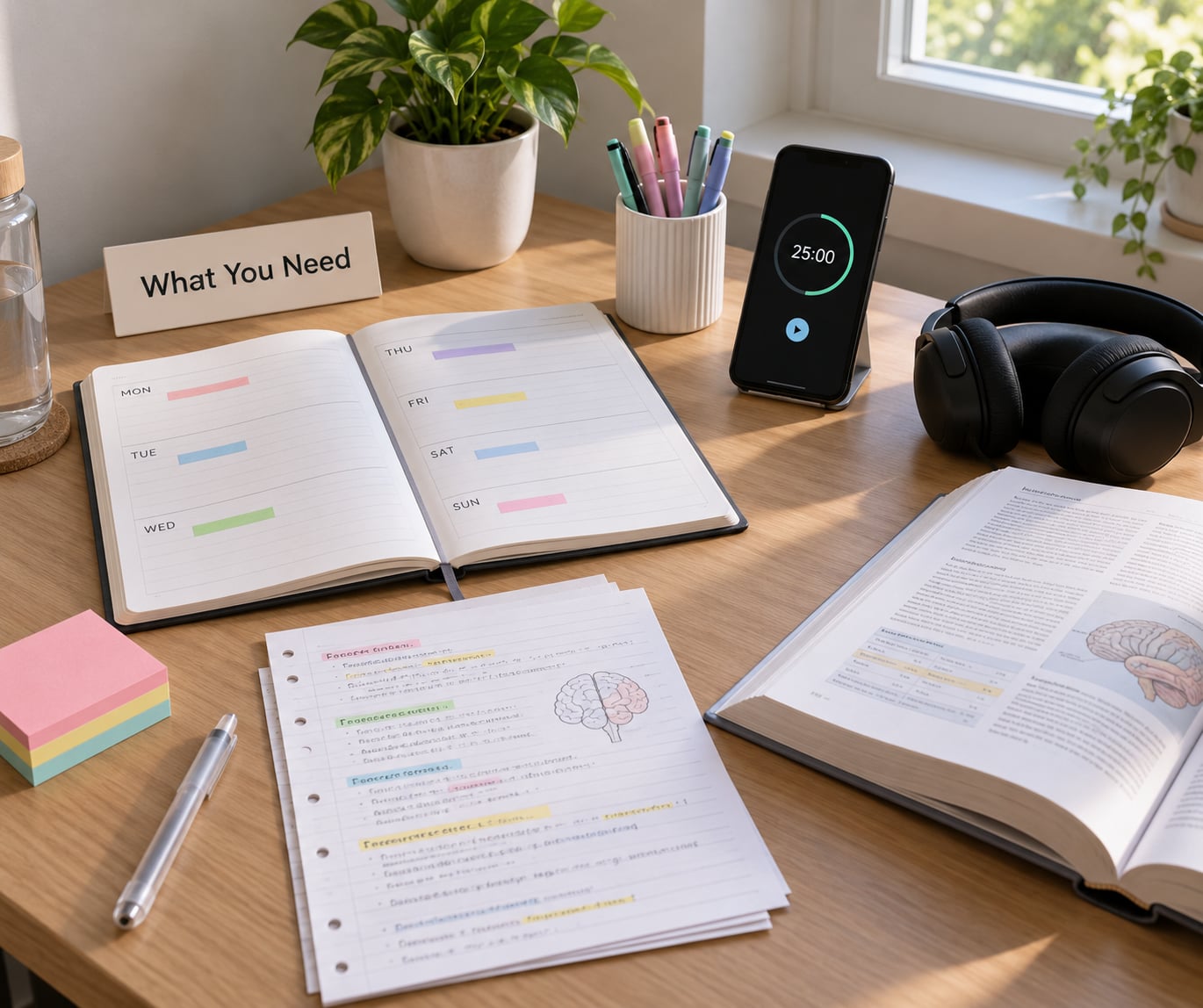
Five things, and you probably already own all of them. The plan fails without the first two, so gather those before you start.
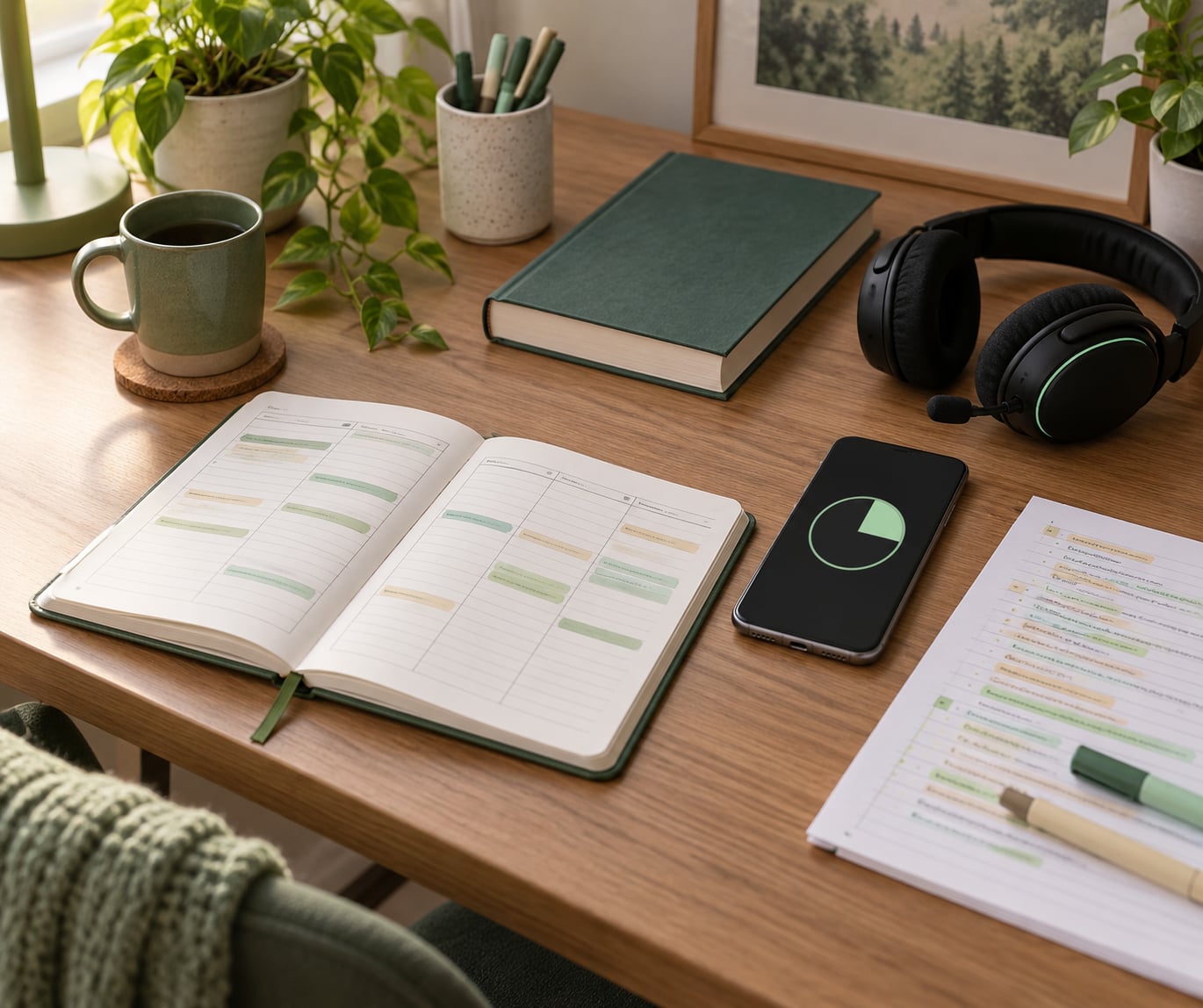
- A calendar you actually see. Phone, wall calendar, paper planner, whatever you check without hunting for it. Weekly view beats daily view for this.
- A full assignment list. Every due date, every exam, every reading list, in one place with the real deadlines, not the ones on the syllabus.
- Your fixed commitments. Classes, labs, a part-time shift, the gym, the commute, family obligations, sleep.
- Your honest current gaming hours. Check the console dashboard or the phone screen-time report. Most students guess low by a factor of two.
- A realistic focus estimate. Take your heaviest assignment and time one real study block. That number is your unit of planning, and it is usually lower than you hoped.
If you only do one thing before the steps below, subtract your true gaming hours from the hours actually left after sleep and classes. That leftover is the real budget, and it is the reason most “I will study more” plans fail.
Step-by-Step
1. List Every Fixed Commitment
Write down everything that does not move before you assign a single minute to gaming. Classes and commute, sleep at a fixed wake time, work shifts, practice, the evening meal your family eats together.
Sleep goes first on the list, at eight to nine hours, because every hour you take from it comes straight out of tomorrow’s focus. A student who games until 1 a.m. and studies at 6 a.m. is not managing time; they are borrowing from the next day and paying interest.
You know this worked when you can point at any hour on the calendar and say what it is for, with no blank stretches left.
2. Set a Weekly Gaming Limit
Decide your gaming budget in hours per week, not per day. Weekly numbers survive bad days; daily numbers get renegotiated every night, usually upward.
Most students who are actually managing their coursework land somewhere between seven and fourteen hours a week. If you are in high school with exams every month, the bottom of that range is kinder. If your grades are solid and you sleep properly, the top of it is fine. Anyone playing three-plus hours a day is not balancing; they are gaming with occasional school attached.
The test is simple: does the number still hold on the week you have three deadlines? If not, it was never a limit, it was a hope.
3. Schedule Playtime Instead of Waiting for Free Time
Free time never arrives. If gaming waits for a gap, the gap gets eaten by homework, chores, and the ability to start one more match at 9:40 p.m.
Block it instead. Pick specific windows, write them on the calendar the same way you write class times, and treat them as immovable. Two weekday evenings plus most of Saturday afternoon is a workable pattern for a full course load. Your friends are online at a certain time, so design around that rather than fighting it: make your queue times the scheduled windows and tell the group in advance.
A ready-to-fill version, if you want one now:
| Day | School block | Study block | Gaming window |
|---|---|---|---|
| Monday | Classes, commute | 6:00 to 7:30 p.m. hardest subject | 7:45 to 9:15 p.m. |
| Tuesday | Classes, shift | Two 30-minute blocks in the afternoon | None |
| Wednesday | Classes | 6:00 to 8:00 p.m. | 8:15 to 10:00 p.m. |
| Thursday | Classes, shift | Two 30-minute blocks in the afternoon | None |
| Friday | Classes | Short catch-up block only | 6:00 to 8:00 p.m. |
| Weekend | Chores, family | Three focused blocks, spread out | Remaining free hours |
Adjust the shape to your own week. A community college student with a full shift schedule runs this differently from a high schooler with a free third period, and that is fine. What matters is that the gaming hours are written down rather than leftovers.
4. Protect Study Blocks With Simple Boundaries
A study block only works if the game is harder to start than the assignment. That takes about four things.
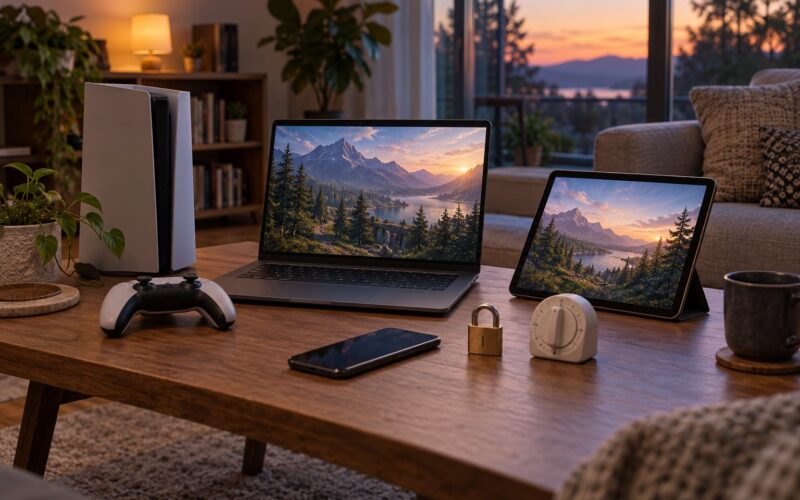
- Do Not Disturb on, notifications off. Includes the second device and the smartwatch.
- Console and gaming PC in another room, or at minimum logged out with the store closed.
- A blocker running on Steam, Discord, and streaming sites. Cold Turkey and Freedom exist for exactly this.
- A real timer, not the one in your head. Phone or kitchen timer, and you stop when it goes off.
Run study blocks in the Pomodoro Technique style: 50 minutes of focused work, 10 minutes off, four rounds, then a longer break. The 25-minute version works too when the material is heavy or your attention wanders.
You will know it worked if you look up after a block and cannot remember checking anything.
5. Use Breaks and Rewards Without Falling Into a Slump
Breaks are where most plans quietly die. A ten-minute break becomes “just one more match,” and the ten minutes is now ninety.
Keep breaks boring on purpose. Stand up, get water, look out a window, stretch your shoulders, eat something. Nothing with a scoreboard. When you genuinely finish a planned block, the gaming session that follows is not a break you sneak into, it is the scheduled window you already earned.
The most-cited routine on student forums is unglamorous: short bursts through the day, gaming in the evening. It works because the hard thing already happened by the time the fun part arrives.
6. Adjust the Plan When Workload Changes
A fixed weekly budget works until an exam week hits, then it stops being honest. Cut gaming to a floor rather than pretending it stays the same.
During heavy weeks: drop to a few short weekday sessions, move the big block to the weekend, and swap to games you can pause. Coming off a rough match in an open-ended survival game at 10 p.m. is a much worse way to lose an evening than closing a base you built in twenty minutes.
Two weeks after the deadlines clear, go back to your normal windows. Do not extend the cut into the next month just because it worked once. A temporary reduction is a tool; a permanent one turns into the quit attempt this plan exists to avoid.
7. Review the Week Every Sunday
Fifteen minutes, calendar open, five questions. What got finished? What slipped, and what caused it? How many hours did I actually game? How was my sleep? What is the one thing I move or drop next week?
Change one variable at a time. If you were short on sleep all week, do not also cut gaming and add more assignments, or you will have no way to tell what worked.
If you want a second opinion on playtime, check what your console dashboard or phone report says rather than your memory. It is usually a rougher number.
Common Mistakes
Treating sleep as the only flexible hour. The 11 p.m. to 1 a.m. block feels free because nobody scheduled it. It is the most expensive two hours in your week. Fix: set a hard stop time, decide it in advance, and finish gaming earlier on nights when you know you will want more.
Gaming in every break. Ten-minute breaks are not long enough to do anything in a session-hungry game, so you end up reloading for twenty minutes and never actually rest. Fix: breaks are for your body, not your controller.
Picking an unbreakable hour limit. “Ninety minutes, no exceptions” fails the first bad day, and then it fails the second. Fix: set a weekly total with a small buffer, and a daily window on the calendar.
Quitting entirely after one bad week. The most common line on r/StopGaming and r/GetStudying is that sudden, total abstinence does not survive contact with a stressful week. Fix: keep gaming, cut the hours, keep the scheduled windows.
Choosing a game you cannot put down. Match-based games like Fortnite and Valorant demand a full evening by design. That is fine as a weekend activity. It is a bad default for a Tuesday.
Letting the plan exist only in your head. Fix: write the gaming windows on the calendar beside your classes. A limit nobody can see is a wish.
Frequently Asked Questions
How many hours a day should I game while in school?
For most students with a normal course load, one to two hours on a weekday is realistic and stays inside a healthy seven-to-fourteen hour weekly total. The number matters far less than three tests: your sleep stays intact, your deadlines land on time, and you can stop when the timer goes off. Three-plus hours a day is not balancing, and if you cannot stop at the end of a session, lower the number before you start rather than after.
What should I do if I want to play games but have homework?
Finish a single timed block first, then play, and stop gaming for the day regardless of how the block went. A partial block still counts, because the point is to break the order, not to finish everything. If a deadline is tonight, gaming waits until it is submitted. That one rule removes most of the daily negotiation, and the queued session ends up feeling better because it was not taken out of panic.
Is it better to study first or play games first?
Study first, almost every time. Gaming first spends your best focus on the least demanding task of the day, and the rest of the schedule quietly inherits that low energy. The reverse order also keeps playtime from expanding into the whole evening, since it is bounded by the hour you finished rather than by when you get tired. If you need something in the morning, keep a twenty-minute game as a warm-up and move the real session to evening.
How can I stop gaming from taking over my weekends?
Give each weekend day one planned long session rather than open access for two full days. Start it at a set time, put an end time on the calendar next to it, and decide in advance what you do when it hits. Saturday afternoon and evening with Sunday morning for catch-up work works for a lot of students. Open-ended weekend time is where the slide actually happens, because there is no clock telling you the day ended.
What should I do when gaming makes it difficult to sleep?
Set a hard stop time at least one hour before bed, log out of the client and the console, and put the controller somewhere that is not next to your pillow. Late sessions do not just cost you that hour; the next morning’s attention drops and the cycle repeats. If you know one title pulls you in past midnight, drop it for weekdays entirely rather than relying on willpower at 1 a.m. Where a gaming pattern is seriously affecting sleep, study, or daily life, campus counselling services or an organisation like GameAware can help you work through it properly.
Can I balance gaming and school with a full-time job?
Yes, but the plan shifts from evening windows to smaller, more fixed blocks. Shift workers do best by attaching gaming to a consistent anchor, such as two or three sessions after a shift or a longer block on a day off. Protect sleep first, since irregular hours plus late gaming is where this collapses. Expect fewer gaming hours than a full-time student, and choose pausable games so a twenty-minute gap does not turn into ninety minutes.
Conclusion: Start With One Protected Study Block
The method is smaller than it sounds. List what is fixed, pick a gaming number you can keep on a bad week, write those hours on the calendar, put the console in another room during study blocks, and cut back instead of quitting when the workload spikes.
Do those five things today and run a fifteen-minute review every Sunday. That is how to balance gaming and school without giving up the part of gaming that actually keeps you going.