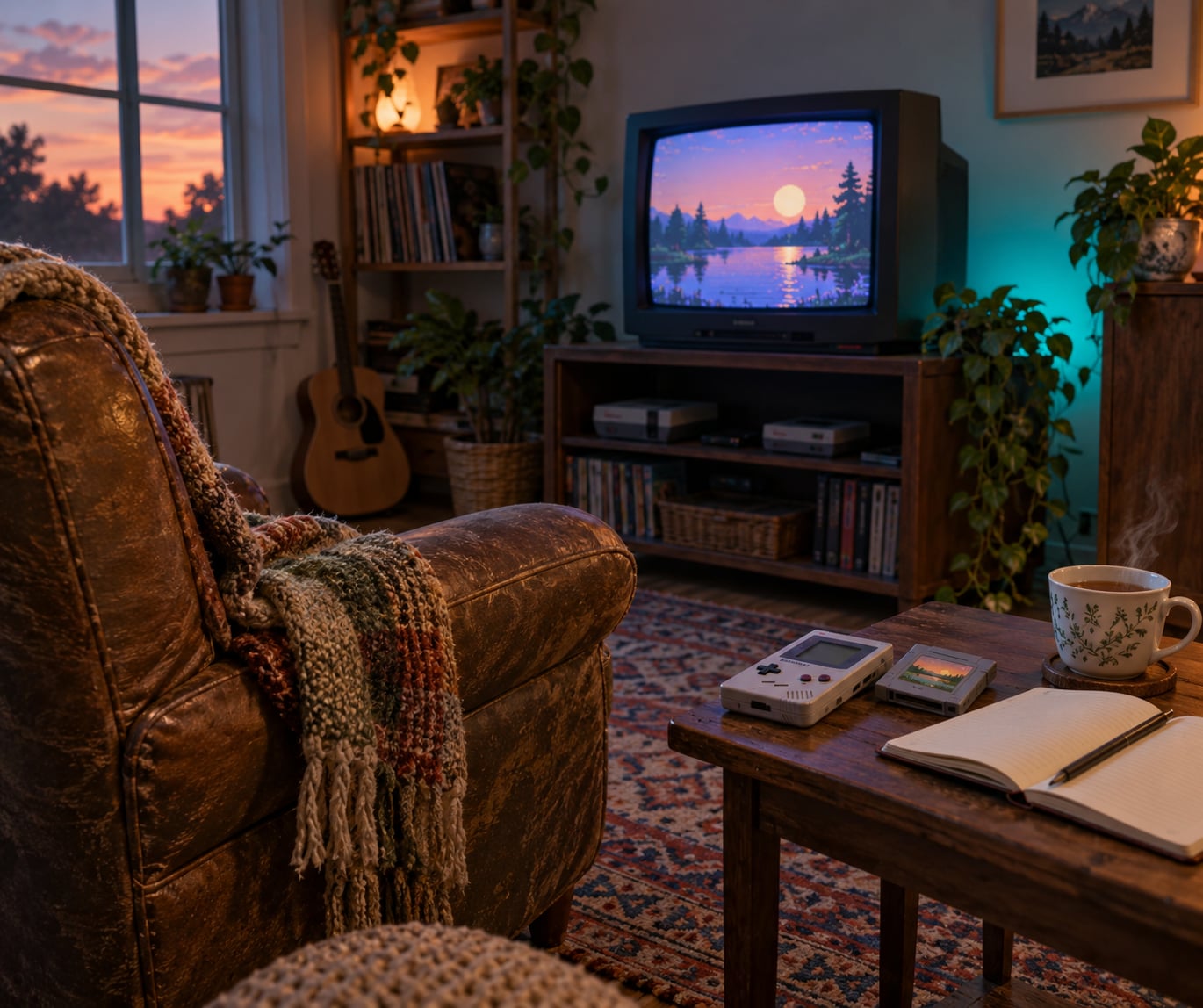
Gaming nostalgia is that bittersweet, mostly-warm feeling you get when you play a game from your past, especially one you first played on a CRT television with a cartridge half-pressed into the slot. It shapes your taste because the feeling attaches to the memory, and the memory then edits the game you think you remember. Understanding how nostalgia shapes gaming taste matters if you have ever rebuilt a favorite’s ending in your head, argued that an older game is better, or felt oddly flat replaying a childhood classic.
The honest answer is that nostalgia rarely makes old games good and new games bad. It changes what you remember, which changes what you rate highly, which changes what you buy and what you recommend.
Here is what the research and player experience actually point to.
Table of Contents
- 1What Is Gaming Nostalgia?
- 2How Nostalgia Shapes Gaming Taste
- 3Which Kinds of Gaming Nostalgia Are Most Powerful?
- 4Childhood Nostalgia
- 5Era Nostalgia
- 6Franchise Nostalgia
- 7Social Nostalgia
- 8Achievement Nostalgia
- 9Nostalgia and the Games We Play as Adults
- 10Why Older Games Can Feel Better Than They Did
- 11How Nostalgia Encourages Classic Franchises and Remasters
- 12Does Nostalgia Always Lead to Better Games?
- 13How to Keep Nostalgia from Limiting Your Gaming Taste
- 14Do you like this game, or the memory of this game?
- 15Getting unstuck from a nostalgia backlog
- 16How Nostalgia Shapes Multiplayer Communities
- 17Frequently Asked Questions
- 18Why do I love old games even when newer games have better graphics?
- 19Is feeling nostalgic about a game the same as genuinely believing it is still good?
- 20Why do some game soundtracks trigger stronger memories than gameplay?
- 21Can nostalgia make it harder to enjoy sequels or remakes?
- 22Is it bad if a player only wants to replay childhood games?
- 23How can game communities preserve older multiplayer experiences?
- 24Conclusion
What Is Gaming Nostalgia?
Gaming nostalgia is the bittersweet, mostly positive feeling that arises when you play or recall a game from your past. What triggers it is rarely the game alone. It is the hardware, the television you sat in front of, the house you lived in, and the people who were around while you played.
Nostalgia is not the same as familiarity. Familiarity means you know how a game works. Nostalgia means the game is tied to a time and place that meant something to you, and reloading that memory produces a physical response before you have done anything at all.
That difference matters because a game can be genuinely dated and still hit you hard. A PS1-era title with tank-style controls and fog you cannot see through was still the game that got you through a specific winter. Nobody is arguing the fog was good design. They are saying the memory outweighs the fog.
Wulf’s 2018 study in Media & Communication put numbers behind the idea that retro gaming succeeds partly because nostalgia works as a psychological resource, a buffer you can draw on when the present feels thin. That is different from saying old games are mechanically superior.
How Nostalgia Shapes Gaming Taste
Nostalgia shapes gaming taste by linking eras, genres, mechanics and presentation styles to rewarding memories, so the association does the work instead of the game’s current quality. Five mechanisms drive almost all of it.
- Memory reconsolidation. Every time you recall a memory, it becomes briefly malleable and gets rewritten. Recall a great session with a game, add three new good sessions, and the remembered feeling gets a little warmer each time.
- Affective forecasting error. People are bad at predicting how an experience will make them feel, so they over-weight peak moments. The boss you cleared at 2am, the soundtrack at full volume, the four-player couch session. Those minutes get stored as if they were the whole game.
- Identity continuity. The game tells you something about who you were at fifteen. Replaying it is a small way of confirming that person still exists. That matters more than graphics.
- Psychological resource. A known game is low-risk. No learning curve, no surprises, nothing to fail at. Under stress, familiar titles become comfort media, and comfort media gets overplayed.
- Collective nostalgia. Generational and cultural nostalgia adds layers. You can feel wistful about an era you did not personally live through, which is why a 2020s player can be genuinely moved by a PS1 game that released before they were born.
Stack those together and the pattern is fairly predictable. Your taste drifts toward whatever you have already felt good about. Eras you happened to play during a good year gain standing they have not earned. Genres that were easy to pick up during a stressful stretch get defended long after the stress is gone. Aesthetics you grew up with quietly become shorthand for quality, which is why people will defend pixel art and chiptune far more fiercely than the technical argument requires.
The research overview on nostalgia in games puts it plainly: researchers keep landing on nostalgia working as a coping mechanism, a route back to a more positive mental state.
Which Kinds of Gaming Nostalgia Are Most Powerful?
Social nostalgia hits hardest, followed by childhood nostalgia, because both carry other people inside the memory. Achievement nostalgia is the most durable on its own.
Childhood Nostalgia
This is nostalgia for a specific age rather than a specific game. It favors anything that was new when you were eleven, which is why the SNES and NES era keeps outperforming its actual quality in most retrospectives.
Era Nostalgia
Attached to a period rather than a title. Chiptune soundtracks, 2D sprites, fixed camera angles, a cartridge you had to blow on. Players describe this as loving how the hardware limitations forced developers to be clear and readable.
Franchise Nostalgia
Loyalty to a series, usually anchored by one entry. The rest of the catalogue gets a pass because the name alone carries positive weight. This is where the disappointment pattern usually appears, because the newest entry has to compete with a memory rather than a game.
Social Nostalgia
Four-player couch sessions, LAN nights, trading cartridges with a friend who lived on your street. One r/retrogaming poster described growing up on PlayStation 2 and being called a hipster for enjoying older games, arguing that liking a game for what it is should be enough. The social layer is the part people defend hardest and explain least.
Achievement Nostalgia
Finishing something you could not finish at twelve. This one survives longer because the memory holds a real accomplishment rather than a mood. Final Fantasy VI, Metroid, and anything you beat without a walkthrough sit here.
Nostalgia and the Games We Play as Adults
Age changes the equation more than taste does. At nineteen, nostalgia competes with new releases and mostly loses. At forty, it competes with a job, kids, and about ninety minutes of free time, and it starts winning.
That is when the same game you loved at fifteen becomes the one you reach for at 11pm on a Tuesday. It asks nothing of you. You finish a chapter, you close it, nothing is ruined. Designers call this comfort gaming, and plenty of players mix it with stress relief rather than pure sentiment.
Money plays a smaller role than people admit. A collection of classics you already own is cheaper than a new release, and cheaper feels good when you have less slack in the budget.
Genre drift follows from this. Competitive shooters often lose their appeal first, since they demand reaction time you no longer have and the people are gone. Comfort RPGs, city builders, and roguelites tend to gain, because they fit a forty-minute window and do not punish you for a slow week.
Why Older Games Can Feel Better Than They Did
Because you are remembering how the game felt, not how it played. Three things distort the comparison, and the third is the one nobody warns you about.
1. Peak moments get inflated. Affective forecasting error means the two hours you remember clearly outweigh the ten hours you played but did not enjoy. The famous soundtrack stays. The level design does not.
2. Your expectations moved. Control schemes, difficulty, UI clarity and onboarding all became better, and your standards rose with them. Ocarina of Time’s clunky camera reads as unpolished today, even though it was a technical marvel then and still shaped every third-person camera since.
3. The context vanished. The game was never reacting to a story you were part of. It was a Tuesday evening with three friends and a bad pizza. Replay the cartridge in an empty flat on a Sunday and you get the game, not the evening. One r/truegaming poster replayed several childhood all-time favorites and found them flat, noting the games felt very aged now, while newer titles stayed near the top of the list.
Nobody is saying those games were bad. They are saying the memory is carrying weight the software no longer supplies.
How Nostalgia Encourages Classic Franchises and Remasters
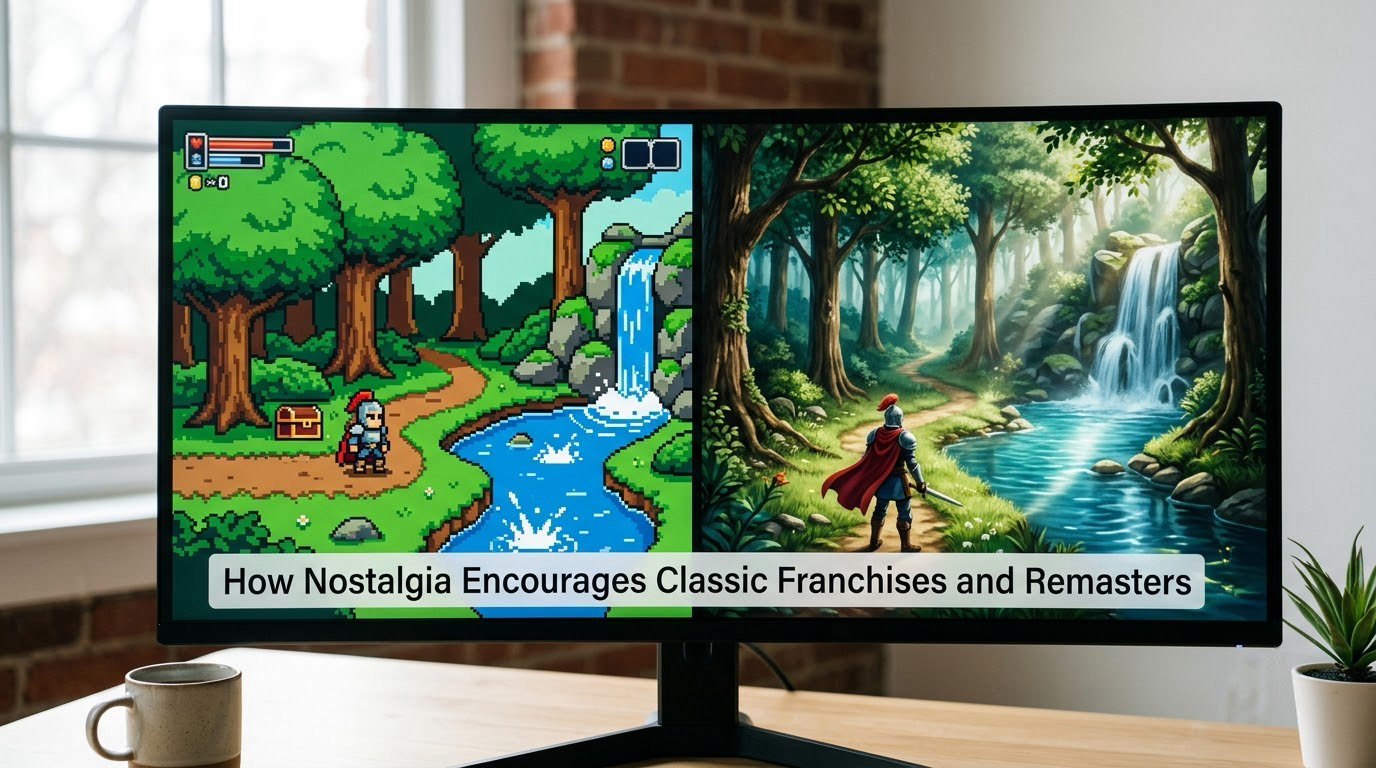
Nostalgia reduces uncertainty. A familiar character, a familiar score, a familiar world means you know roughly what you are getting, and publishers know that lowers the risk of a launch.
That is why remasters, collections and spiritual successors keep appearing. You recognize the name before you have seen a single screenshot. It is the same trick the film industry runs, and it works on the same psychology.
It also shapes new games. Retro-inspired indies use pixel art and chiptune partly because those aesthetics carry meaning without a lore dump, and partly because that market is understood. The look is doing half the marketing before a trailer finishes.
Some nostalgia borrowing is generous. A faithful remake lets someone who missed the original finally play it. Some is closer to nostalgia bait: the familiar silhouette, the recycled opening, the joke you have already seen a thousand times. A famous line from the AV Club’s long-running nostalgia argument puts the right test on it. Nostalgia can be a starting point to build from. It should not be the destination.
Does Nostalgia Always Lead to Better Games?
No, and it regularly leads to worse buying decisions. The bias is real in both directions: nostalgia inflates old games and can also make you cynical about anything new.
Four costs come with it.
- Blind spots. Difficulty that once felt fair may now be genuinely punishing, and you rate the game down for your own reaction time instead of its design.
- Commercial repetition. Remasters and sequels chase a feeling rather than an idea, and the result can be thinner than the original.
- Inaccessible classics. The games you re-rate most generously are often the ones you would not recommend to a newcomer today.
- Resistance to improvement. A sequel that fixes everything you complained about can feel worse because the version in your head never needed fixing.
Nostalgia works as a psychological resource, which means it does two jobs at once. It helps, and it distorts.
How to Keep Nostalgia from Limiting Your Gaming Taste
The fix is not to stop enjoying old games. It is to notice which part of the experience you are reacting to.
Do you like this game, or the memory of this game?
- Play something you loved, then describe its first hour out loud. Vague warm words point at memory; specific complaints and specific delights point at the game.
- Watch a friend play it without helping. If you cannot stop correcting them, you are in love with your version, not the software.
- Check whether you would choose the sequel. Players who like a game usually want more of it. Players who like a memory usually want the memory back.
- Ask whether you finished it. Unfinished classics stay ideal forever because the ending never had to be good.
- Give a new release the same courtesy you gave the old one. No discount for being unfamiliar, no penalty for being unfamiliar.
Getting unstuck from a nostalgia backlog
Pick a modern title that shares the old game’s design DNA rather than its skin. Loved the puzzles in a 16-bit dungeon crawler? Try one with modern difficulty tuning and the same problem design. Loved a PS1 survival horror? There is a whole modern lineage to sample.
Second, keep one slot in your rotation for something with no connection to your history. That is the cheapest test of whether your taste still has any say.
Third, let curiosity replace completion. Watching a retro retrospective or a speedrun of a game you never played is a fine way to feel nostalgic about something that was never yours, and it costs you nothing but an evening.
How Nostalgia Shapes Multiplayer Communities
Nostalgia does its heaviest work in multiplayer. A dead server with a dedicated team keeping it alive is the purest example of players paying to restore a shared memory rather than to play a game.
Reunions for retired titles have become a standard event on the community calendar. Old-player identities get established and defended, often by people who were fifteen when the game launched. Preservation communities archive maps, patches and forum threads so the exact version people remember still runs.
There is friction here too. People get defensive when newcomers misremember the thing that gave them status. Sharing old games with kids or friends carries its own awkwardness, since you are handing someone a memory that belongs to you.
Frequently Asked Questions
Why do I love old games even when newer games have better graphics?
Because graphics are only one input. Your memory of an old game is mostly feeling: the room, the people, the hour, the difficulty level that matched you at the time. Newer games ship better visuals and often worse friction, and your brain scores the older title on warmth rather than resolution. The comparison is rigged in the old game’s favour before you start.
Is feeling nostalgic about a game the same as genuinely believing it is still good?
No. Nostalgia explains why a game matters to you. It does not explain whether the game holds up. You can hold both: it shaped who you are, and its camera controls still frustrate you. The useful move is separating the two on purpose, by describing the game’s actual craft before you decide anything about it.
Why do some game soundtracks trigger stronger memories than gameplay?
Music is processed fast and attaches to context. A looping chiptune track from a cartridge era gets tagged with the room, the friends and the year, so it triggers on sight of an old menu or a startup jingle. Gameplay is slower and more analytical. You evaluate it. Music skips straight to feeling, which is why a four-note theme can undo you.
Can nostalgia make it harder to enjoy sequels or remakes?
Yes, and it is common. The new version competes with a memory that never had to deal with bugs, filler or a bad ending. If the remake fixes things you complained about, the fix can feel like a loss. Nostalgia can also block you cold on remakes you would otherwise enjoy, which is its own kind of waste.
Is it bad if a player only wants to replay childhood games?
It is not bad, but it is a narrower lane than you think. Replaying is a legitimate pleasure and a low-pressure way to decompress. The risk is only that the list stops moving and you rate games by memory rather than by design. Keep one unfamiliar slot in your rotation and the habit stays a comfort instead of a rut.
How can game communities preserve older multiplayer experiences?
Through volunteer-run servers, archived patches, version-locked clients, and event weekends that bring retired titles back. The motivation is rarely the graphics. It is that the game carries a shared memory nobody else owns, and the only way to be in that room again is to keep the doors open. It also makes great content, for viewers as much as players.
Conclusion
Nostalgia is not a flaw in your taste, it is part of how taste gets built. The problem only starts when you stop noticing it rewriting your memory.
So do something small this week. Replay the one game you would defend hardest, and write down what is actually good about it. Then pair it with one game it has nothing to do with. Comparing those two is the fastest way to find out how much of your taste is still yours.