Gaming can train parts of your visual attention and decision-making, but it does not stop your reflexes from slowing as you get older. In short: how gaming affects reaction time as you age is a story about what practice can sharpen, what age quietly takes away, and how much of the difference you actually notice in a match.
Most of the confusion around this topic comes from mixing up two very different things. The first is the general age-related drift in processing speed, which is real, gradual, and measurable. The second is performance inside a specific game, where familiarity, map knowledge, and how tired you are can swing results far more than a few dozen milliseconds.
This guide separates those two, gives you a repeatable way to measure your own numbers, and explains which day-to-day habits are worth the effort. It is general information about cognition and aging, not medical advice.
Table of Contents
- 1What Is Reaction Time and Why Does It Change With Age?
- 2How Gaming Affects Reaction Time as You Age
- 3How gaming affects reaction time as you age, by genre
- 4What Does the Research Say About Games and Processing Speed?
- 5Which Parts of Aging Most Often Affect Gaming Performance?
- 6How Can You Measure Your Reaction Time Accurately?
- 7What Simple Habits May Support Healthy Reaction Speed?
- 8How Do You Know Whether a Change Is Normal or Concerning?
- 9Frequently Asked Questions
- 10Does gaming make reaction time faster as you get older?
- 11Can action games prevent age-related slowing?
- 12How much improvement should I expect from reaction time training?
- 13Is a reaction time app accurate enough to track changes?
- 14What other factors besides age can affect gaming performance?
- 15When should a change in reaction time be discussed with a doctor?
- 16What to Do First
What Is Reaction Time and Why Does It Change With Age?
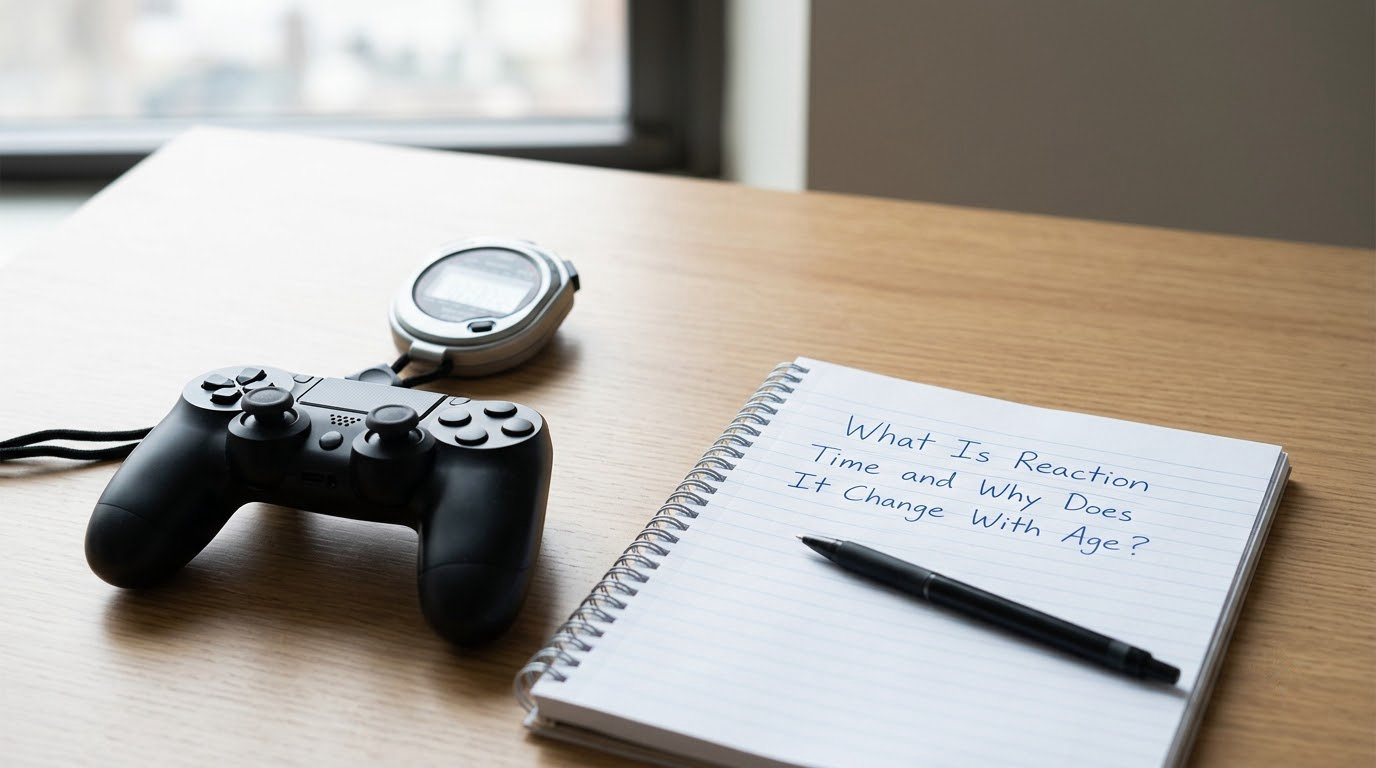
Reaction time is the gap between something happening and you responding to it. In a game that is usually measured in milliseconds: a cue appears, you register it, you decide, and your hand moves. Most adults land somewhere between 200 and 300 ms on a simple visual test.
Researchers sort reaction time into a few buckets. Simple reaction time means one cue, one response, nothing to choose between. Choice reaction time means several cues appear and you have to pick the right response, which is closer to what happens in a firefight or a raid.
Why does it drift with age? Processing speed is the big one. The brain simply handles information a little more slowly as the years go on, and that shows up everywhere at once rather than in one skill.
Then there are the things that speed the whole system up or slow it down: sleep quality, sustained attention, eyesight, cardiovascular health, medications, and how much mental fatigue you are carrying that day. Age rarely acts alone, which is why two 45-year-olds can post very different numbers.
How Gaming Affects Reaction Time as You Age
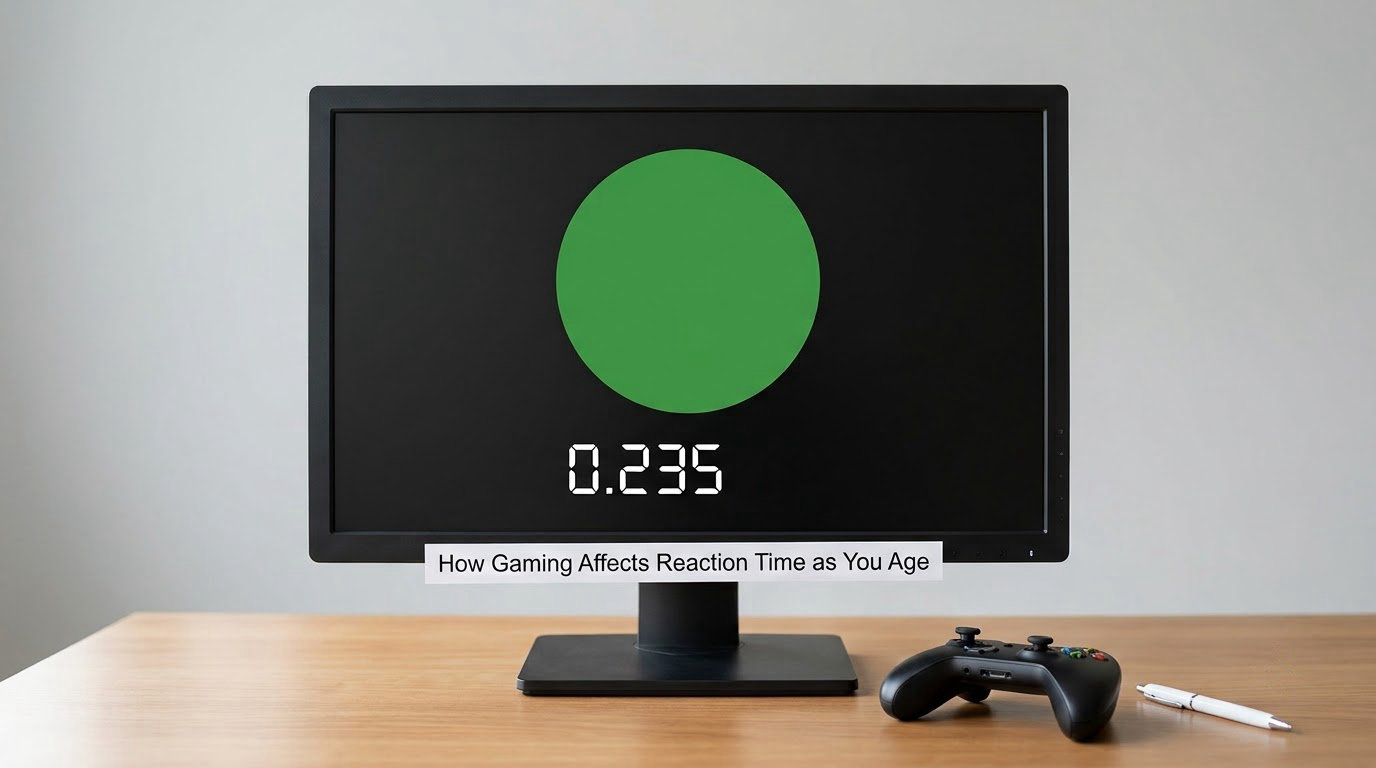
Gaming affects reaction time in four fairly specific ways, and none of them cancel out aging.
- Attention to visual detail. Fast genres force you to scan a wide area for small changes. That trains where you look, which is a separate skill from how quickly your nerve fires.
- Predictive reading of situations. Experienced players stop reacting to every cue and start anticipating what comes next, which is why veteran players often out-play younger ones.
- Time under pressure. Hours of timed decisions condition your arousal, so a stressful moment does not derail you the way it would off the clock.
- Raw speed in familiar patterns. This is where age shows up most. A shot you’ve seen a thousand times can still be a little slower at 45 than at 22.
So the honest answer to how gaming affects reaction time as you age is this: play gives you a larger, better-trained margin in the skills you use most, while the underlying processing speed still moves with age. Practicing offsets experience. It does not offset biology.
How gaming affects reaction time as you age, by genre
Different genres ask for different things. These figures are community ballparks for how fast a player usually has to read a situation, not official thresholds.
- Tactical shooters — roughly 150 to 200 ms to read and fire. Very unforgiving of raw slowness.
- Competitive arena and battle royale — roughly 180 to 250 ms, with a lot of that time spent tracking rather than reacting.
- MOBA — roughly 200 to 250 ms, but decision quality and cooldown tracking matter more than the raw number.
- Fighting games — the fastest window, often under 150 ms in a real match, where reading the opponent carries most of the weight.
- Strategy and simulation — far more forgiving, because the clock is yours.
What Does the Research Say About Games and Processing Speed?
The age side of the question is better measured than the gaming side. A large online study run by MindCrowd gathered reaction time data from more than 198,000 adults and reported that simple visual reaction time slows by roughly 3 to 6 ms per year of age.
That sounds tiny until you multiply it. Over three decades it adds up to somewhere near 90 to 180 ms, which is the difference between a fair fight and a stutter for anyone playing a genre where a duel lasts under a second.
The same study flagged factors that ride on top of age. Education was associated with faster processing speed. Smoking added around 7 ms plus a small extra penalty each year. Reported stroke and diabetes history were linked to noticeably slower responses. Group differences of that kind are averages across huge numbers of people, not predictions about you.
Now the harder half. Training studies on action video games have repeatedly shown that players improve on the tasks they practise. What remains contested is how much of that improvement shows up in tasks they did not practise.
Three caveats explain most of the noise. Cross-sectional studies compare different people at different ages instead of tracking the same people over decades, so they mix in education, health, and lifestyle differences. Practice effects mean a second test is faster because you know the test. Familiarity means a genre you have played for fifteen years produces faster responses than a genre you opened last week, regardless of your age.
That last one matters for how gaming affects reaction time as you age in practice. If you install a brand new competitive shooter at 50 and score worse than you did at 25, you have learned almost nothing about your reflexes.
Which Parts of Aging Most Often Affect Gaming Performance?
The useful way to think about it: age does not remove a single ability, it spreads a small tax across several of them at once.
- Visual processing speed. Finding a small enemy silhouette in a cluttered scene gets slower before you notice it in a menu screen.
- Sustained and divided attention. Tracking an objective while reading chat is harder at 50 than at 20, and errors creep in later into a session.
- Working memory. Cooldowns, item timers, and ultimate tracking are the first thing veteran players report losing.
- Hand coordination and fine motor control. Flick shots and fast inputs lose a little precision, which shows up as aim drift rather than delay.
- Hearing. Footstep cues in a shooter are genuinely harder to catch, and most players underestimate how much they rely on them.
- Fatigue and recovery. Tiredness arrives faster and lingers longer, and a bad night of sleep shows up in your next session.
None of this is a personal verdict. Individual variation is wide, and people in the same age bracket can sit 100 ms apart. If a change lands suddenly, comes with headaches, dizziness, weakness, vision changes, or trouble with speech, stop treating it as a gaming problem and speak to a doctor.
How Can You Measure Your Reaction Time Accurately?
Most people measure badly, then blame the result. A simple online test can be useful if you keep the conditions boring and identical.
- Pick one test and one device. A keyboard-based test on the same laptop gives you numbers that mean something. A phone on the couch gives you numbers that mean very little.
- Warm up first. Run 10 to 15 easy trials before you record anything, because the first attempts are mostly noise.
- Test at a consistent time. Morning versus 11pm can easily be a 20 ms difference on its own.
- Collect at least 30 recorded trials. Then look at the average, not your best run. The single best attempt is a highlight reel, not a measurement.
- Note the spread too. A fast average with a huge gap between trials and a steadier average both tell you something different about the same session.
- Log your condition. Hours of sleep, whether you ate, whether you are ill, how long you had been playing. Without this, a bad day reads as a trend.
Compare like for like or not at all. A 250 ms result on a rested Tuesday and a 230 ms result after a four-hour session tell you almost nothing about each other.
What Simple Habits May Support Healthy Reaction Speed?
Nothing here is a fix and none of it is a treatment. These are the low-effort habits that make your numbers steadier and your sessions less punishing.
- Protect sleep first. Forum players consistently call a bad night the single biggest factor they notice, and a lost night can affect your results more than any training routine.
- Move during the day. Regular physical activity supports cardiovascular health and alertness, both of which show up in how alert you feel at hour three of a session.
- Take real breaks. Every 45 to 60 minutes, stand up and look at something distant. Eye strain and static posture make the back half of a session worse for everyone.
- Build up practice volume slowly. Adding 30 minutes a week is easier on joints and attention than doubling your session length.
- Practise the specific skill, not the whole game. Short focused drills on a weakness beat another full match where you repeat your habits.
- Cut the obvious noise. A stable connection, a display matched to your frame rate, and a quiet room remove far more delay than any hardware upgrade.
- Keep sessions shorter when focus is gone. Pushing through mental fatigue mostly trains bad habits.
If fatigue, poor sleep, or difficulty concentrating is a persistent problem rather than a bad week, that is a conversation for a doctor, not a training plan.
How Do You Know Whether a Change Is Normal or Concerning?
Normal variation looks like a wobble. You are slower on a short, badly slept evening and back near your baseline within a few days. Your numbers drift a few milliseconds per year and you keep a written log to notice it slowly.
A concerning change looks different. It shows up over days rather than years, it keeps climbing, it hits one side of your body, or it comes with symptoms such as dizziness, blurred vision, headaches, numbness, or slurred speech. Those belong in a clinic, not in a self-diagnosis.
Bring your log. A simple record of dates, times, and numbers is genuinely useful to a clinician, and it takes you ten minutes a week to keep. Until a professional has assessed a sudden change, assume it is not a gaming problem.
Frequently Asked Questions
Does gaming make reaction time faster as you get older?
It can improve the parts of speed you practise: visual scanning, attention to detail, time pressure, and prediction of familiar situations. It does not reverse age-related slowing in processing speed, which a large study of more than 198,000 adults measured at roughly 3 to 6 ms per year. Practicing offsets experience, not biology.
Can action games prevent age-related slowing?
No study shows that any genre prevents it. Long-term brain health research points to cardiovascular fitness, education, social engagement, and sleep as the factors most consistently connected with a slower decline. Games can keep specific skills sharp while you play. Treat them as practice, not as a defence against aging.
How much improvement should I expect from reaction time training?
A realistic gain from focused drills is tens of milliseconds over several months, and results taper off once you are near your own ceiling. Players who report large jumps early on are often just learning the test. If a number moves by more than about 20 ms between sessions, check your sleep, your setup, or your testing conditions before you believe it.
Is a reaction time app accurate enough to track changes?
Good enough to catch a trend over months, not good enough to compare one afternoon against another. Use one test on one device, warm up, record at least 30 trials, compare averages rather than best attempts, and log your sleep and session length. Tools vary in rigour, so never switch tests mid-project.
What other factors besides age can affect gaming performance?
Sleep the night before is usually the biggest one, followed by session length, stress, eyesight, hearing, medications, alcohol, and whether you are ill. The large MindCrowd sample also linked education and smoking status to measurable differences in simple reaction time. Age is one variable in a list, and it is rarely the only one doing the work.
When should a change in reaction time be discussed with a doctor?
Mention it to a doctor or qualified healthcare professional if the change came on over days or weeks, keeps getting worse, is much worse in the morning, affects one side of your body, or comes with dizziness, headaches, blurred vision, numbness, or speech trouble. Those patterns point to something medical. A gradual drift you have tracked over years is a different conversation.
What to Do First
Measure your baseline this week on one device and write it down. Understanding how gaming affects reaction time as you age starts with your own numbers, not a comparison with someone else’s highlight reel.
If a change arrives fast, or with symptoms, take it to a doctor. If it arrives slowly, keep the habits that already work for you and stop chasing a number that belongs to a twenty-year-old.