Collectible hunting in games is the practice of placing items through a world and building clues, rewards and tracking around them, so that finding one feels like exploration instead of a checklist tick. In a browser MMO it is where most players first decide whether the world is worth logging back into for, or just a corridor they run through again.
The awkward part is that “hunting” pulls search results toward wildlife photography and trophy mounts, which is why nobody owns the phrase in game design yet. Below is how collectible hunting is designed in practice, end to end: what a hunt is, the seven-part loop, where the item goes, what the clue says, what you get back, and how you know it worked.
Table of Contents
- 1What Is Collectible Hunting in a Browser MMO?
- 2How Collectible Hunting Is Designed
- 3How the Core Hunting Loop Works
- 4Where Collectibles Should Be Placed
- 5How Clues and Tracking Systems Guide Players
- 6What Makes a Collectible Worth Finding
- 7How Designers Control Difficulty Without Removing Fun
- 8How Multiplayer Changes Collectible Hunting
- 9How Collectible Hunting Keeps Players Engaged
- 10How Collectibles Are Tested and Balanced
- 11Common Collectible Hunting Design Mistakes
- 12Frequently Asked Questions
- 13What is the difference between collectible hunting and ordinary item collection?
- 14How many collectibles should a browser MMO include?
- 15Should collectible hunting use random locations or fixed spawn points?
- 16How do hints help players without making the hunt too easy?
- 17Should collectible rewards be gameplay-related or cosmetic?
- 18How can designers prevent collectibles from becoming repetitive or grindy?
- 19Conclusion
What Is Collectible Hunting in a Browser MMO?
A collectible hunt is a set of items placed across a persistent world, usually with some form of list, counter or codex tracking what has been found. The player finds them through observation and deduction rather than through a quest marker on a minimap.
It is worth separating four things that get called “collecting” in the same breath, because mixing them up is where bad systems come from:
- Item collection is currency. Coins, herbs, ore. It exists to be spent and it paces the economy.
- Collectible hunting is discovery. One rare item per zone, no duplicates, and the interest is entirely in finding it.
- Achievement hunting is conditions. “Kill 50 bandits without being seen” is an achievement, and it can be missed entirely.
- Hidden-object search is a visual puzzle. A specific object is camouflaged in a scene and the challenge is noticing it.
Browser MMOs lean on collectible hunting specifically because persistent worlds need a reason to walk somewhere already cleared. A zone the player has done all its quests in still holds three things nobody has touched, and that is enough for a ten-minute login.
How Collectible Hunting Is Designed
Every collectible system I have looked at can be described with the same seven parts. Some teams plan them, most teams stumble into three of them and hope the rest sort themselves out.
- Pick the fantasy. What is the player actually hunting? Relics, creatures, recipes, lost journals, forgotten gods. The fantasy decides what the clue text sounds like and what the reward can plausibly be.
- Set the rules. How many exist, can they be found in any order, does the player need a tool or a key, is there a missable one? Write these down before you place anything.
- Distribute the targets. Spread them across zones, not clustered in one corner of the map. Uneven distribution is the number one reason a hunt feels thin in one area and exhausting in another.
- Build the discovery path. Every find needs a route in: something the player looks at, remembers, and can retrace. Clue density should rise as zones get older.
- Assign the reward. Decide whether the reward is flavour, cosmetic, power, or access to something else. Then decide how it escalates across the set.
- Design the tracking. How does the player know what is left? Empty slots, a counter, a regional breakdown, a codex entry with lore. This is the piece most teams ship last and it is the piece players actually look at.
- Test the completion curve. Watch where players stall. If most stall at the same item, that item is the problem, not the players.
How the Core Hunting Loop Works
Strip away the lore and every hunt runs the same seven stages: clue, hypothesis, search, discovery, verification, reward, next objective.
The clue gives the player something to think about. From it they form a hypothesis about where the item is, search the space on that basis, notice something, check whether it counts, and then get a reward that tells them whether the effort was worth it.
The final stage is the one teams forget. A hunt with no next objective is a list, not a loop. Good systems end a find by pointing at the next one, opening a follow-up, or rewarding the pattern of searching rather than the individual item.
Where Collectibles Should Be Placed
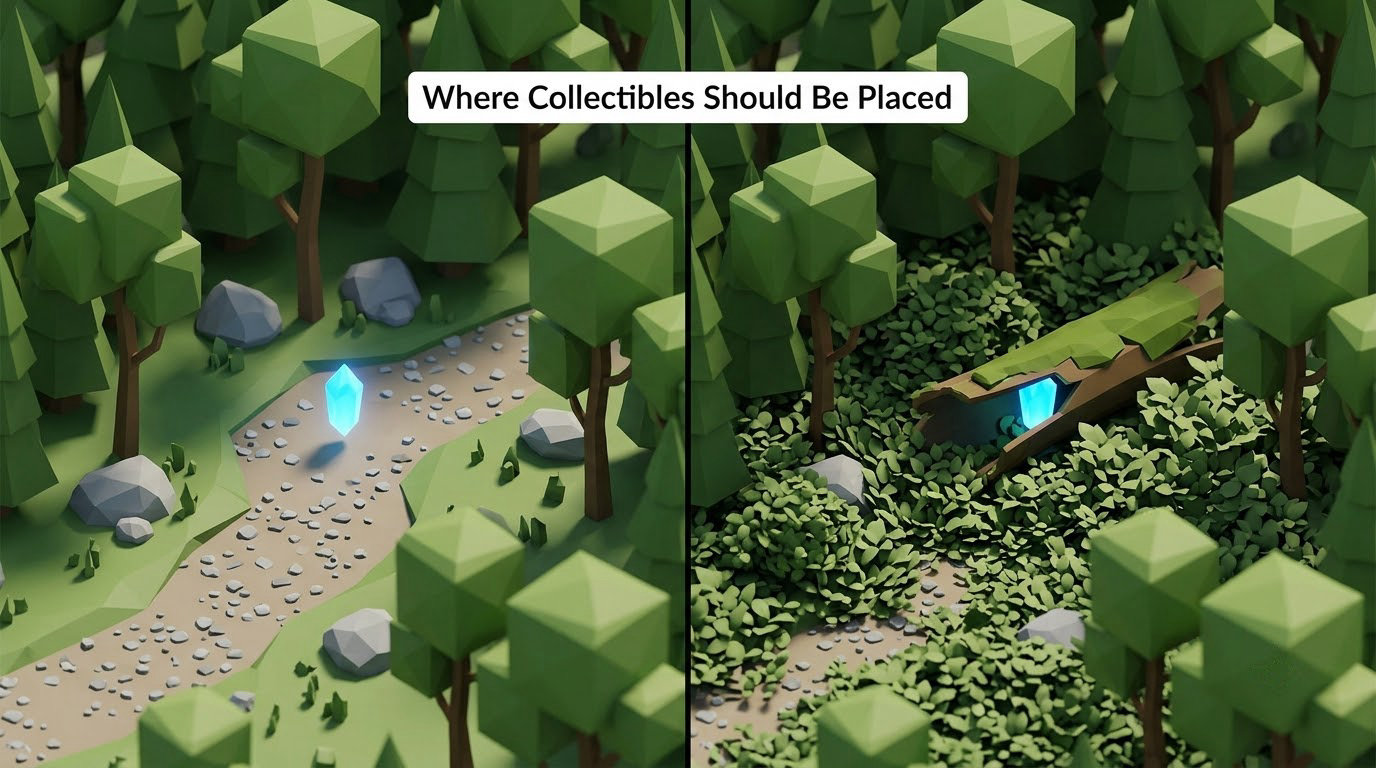
Placement is where a hunt is won or lost, and there is no single right answer. What matters is that every item sits somewhere the player has a reason to look, and that the reason is legible.
| Placement method | What the player experiences | Exploit risk | Best used for |
|---|---|---|---|
| Visible on the critical path | Finds it without effort, feels like a gift | Low, but players learn there is no need to look | First two or three items in a zone |
| Environmental storytelling | Notices the item because it fits a scene: a letter on a desk, a plate left on a table | Medium, players who break everything find it anyway | The lore-heavy tier of a set |
| Map landmark | Climbs or reaches a distinctive silhouette and gets rewarded for it | Low | Traversal collectibles, aerial or vertical zones |
| Randomised spawn | Checks the same spot nightly, keeps returning to an old zone | High, players map spawns and script farming | Repeatable daily sets, not one-time finds |
| Risk-reward location | Deliberately enters danger for something optional | Medium, and it punishes low-skill players | Late-game items and hard achievements |
| Hidden secret | Finds a false wall, an invisible walkway or a hidden chest | High, and it is the single most shared discovery moment | The capstone item of a zone |
On density, a useful starting rule is to place far fewer than feels comfortable. A zone that takes fifteen minutes to cross supports two or three collectibles, not ten. Over-placing does not make a hunt richer, it makes each item feel like clutter and gives players a reason to run past everything else.
One further habit pays off repeatedly: give every item a reason to be there in fiction. “Why is a lute leaning against this shed?” is a question players ask, and answering it turns scenery into a clue.
How Clues and Tracking Systems Guide Players
A clue only works if it narrows the search without ending it. The useful range runs from a theme (“where the drowned keep their things”) down to a single highlighted tile, and a good ladder lets the player choose where on that range to stand.
Three systems do most of the guiding. Category filters help when a zone holds twenty finds and the player remembers the shape but not the name. Regional breakdown helps more: “Forest 2 of 5” turns a vague memory into a destination. Rumour and hint chains help most of all, because a rumour can arrive in the middle of play from an NPC, a message or another player, and it costs the designer nothing to author.
On the tracking side, resist the urge to give exact coordinates. A map marker handed over for free converts a hunt into a commute, and the player learns to skip the clue text entirely. Partial clues, a counter, and a codex entry that fills in as items land keep the search intact while still telling the player their progress is real.
What Makes a Collectible Worth Finding
Rewards split into two families, and a hunt usually needs both. Intrinsic value is the item being good in itself: lore that changes how you read the zone, a passive that fits your build, a codex entry that opens a new story thread. Extrinsic value is everything else: cosmetics, titles, completion percentages.
Intrinsic rewards survive veteran players who already have every stat. Extrinsic rewards are cheap and scale, which is why live games lean on them, but they stop moving players once the wardrobe is full.
The Octalysis framework makes the same split from another angle. Scarcity from difficulty satisfies the drive for challenge, while scarcity from an incomplete set satisfies the drive to close an open loop. Mixing the two in one item usually blunts both.
Then there are collectibles as gates, which are more interesting than rewards. A set that unlocks a mount, a shortcut or a new zone is collectible hunting doing real work, because the hunt becomes the reason to explore rather than a bonus on top of exploring.
How Designers Control Difficulty Without Removing Fun
Difficulty in a hunt is mostly a clue problem, not a reflex problem. Six dials do most of the work.
Clue strength is the big one. A visual sign, then a regional hint, then a line of text, then an exact marker on the map. Ship the weaker tiers by default and unlock the stronger ones when a player has stalled or asked for help, rather than making everyone choose.
Search area decides whether the player roams or stares at a wall. A clue that narrows it to a district is satisfying. One that narrows it to a single crate removes the hunt.
Camouflage should be the exception. If the item is meant to be visually hidden, it should be a marked achievement, not a silent miss the player blames on themselves.
Difficulty tiers handle the spread. Everyone finds the obvious ones, a good minority finds the hard ones, and a handful never find the last one. That is a healthy distribution, not a defect.
Cooldowns and resets matter less for one-time finds than people expect, but they matter enormously the moment a hunt becomes a daily.
Assist options are the part most shipped systems skip. Accessibility assists, a reduced-camouflage mode, a longer hint window, colour-blind-safe silhouettes. Completionist pressure should never be the reason someone cannot play.
How Multiplayer Changes Collectible Hunting
A single-player hunt is a private notebook. The moment other players exist, the same system is a social object, and you have to choose what to share.
Cooperative clues are the strongest option. One player holds half a cipher, the zone fragments, the full set assembles from a group. The Project Horseshoe work on human-scale online design argues the same thing about small-group systems generally: scale relationship design to the size of the group you actually have.
Shared server progress works well for world-scale goals. A town that reaches one hundred total finds unlocks something for everyone. It gives a reason to tell strangers, which is worth more than it sounds.
Trading and trading routes add an economy, and an economy means value differences. Some players will hunt purely for the item they can sell.
Competition and spoilers are the two things to design around carefully. A leaderboard for fastest full completion turns discovery into a race, which kills the hunt for everyone slower. And a group chat where someone posts the coordinates turns a three-hour search into a three-second one.
The usual compromise is to gate the sharing, not the finding. The group bonus for a completed set rewards sharing, while the individual find stays individual.
How Collectible Hunting Keeps Players Engaged
Session length matters more than session count for this system. A collectible hunt is naturally a five to fifteen minute activity, which fits the way browser MMOs actually get played: a login, a few errands, a logout.
Over a long life the hunt runs through three phases, and each needs a different hook. Early on, curiosity does the work. In the middle, completion does: an unfinished regional set with a visible percentage is a low-effort reason to log in tomorrow.
Late on, novelty has to come from somewhere else. Rotating variants, seasonal sets, harder tiers with cosmetic-only rewards, and backtracking incentives that make old zones worth revisiting again. That last one is the real answer to the question developers keep asking about making backtracking interesting, because a hunt gives a cleared area a fresh reason to exist.
What breaks it is repetition without variation. The same five props in the same six corners is a chore, and it reads as filler the moment the player recognises it.
How Collectibles Are Tested and Balanced
You do not need a studio telemetry team to run this. A handful of numbers will tell you whether a hunt works, and a small browser game can collect all of them.
Time to find. The median matters more than the average. If most players find the first item in under two minutes and the last one in over forty, the set is fine. If the median is under a minute, there is no hunt.
Abandonment point. The specific item where players stop making progress. Nearly always a placement problem rather than a player problem.
Hint usage rate. What share of players bought a hint before finishing. High numbers mean the clues are not doing their job.
Completion distribution. If 80% of players get one particular item and 4% get another in the same set, that item is either badly placed or much harder than the rest.
Reward redemption. Especially for gates. A collectible set nobody used its reward for is a set you should cut.
Duplicate frequency and location popularity round it out. Popular locations mean you should place more nearby; never-placed items mean you should move or delete them.
For a small project, log item ID, timestamp, player, zone and hint purchases, then read the results as a list of sentences. “Nobody has found the lantern in Sunmarsh” is actionable in a way a dashboard is not.
Common Collectible Hunting Design Mistakes
These eight failure modes cover most of what goes wrong, and they tend to appear in pairs.
| Mistake | What the player feels | The fix |
|---|---|---|
| Unfair camouflage | “That was never findable” | Mark visually hidden items as achievements, never silent |
| Targets too small to notice | Nothing at all, no frustration, no memory | Anything findable should register within one glance or a 40-second window |
| Vague clues with no anchor | “Somewhere in this zone” is not a clue | Give every clue a district, a landmark or an object to search from |
| Dull backtracking | Ten minutes of walking through a cleared zone | Place the reason for the return next to something that changed since the last visit |
| Repetitive locations | “I know exactly where these are” | Vary placement logic per zone, and re-run clue tiers as zones age |
| Rewards unrelated to the hunt | Effort with no payoff shape | Make the reward escalate inside the set, not flat across it |
| Forced gating | Resentment toward the main story | Optional for power, opt-in for the hard tier, never required for the critical path |
| Systems rewarding map reveals and automation | The hunt becomes admin work | Reward the route and the finding, not the spoiler |
The Kingdom Hearts 3 lucky emblems are the standard example of the checkbox problem. Plenty of hidden things, constant prompts, guidance that is a counter rather than a clue, and no story attached to why any of it matters. God of War’s 2018 treasure maps are the standard example of the opposite: a finite set, a physical clue in the world, and a reward that escalates as the set fills.
Whatever the intent, a hunt that is chasing only completion percentage needs emergency level design.
Frequently Asked Questions
What is the difference between collectible hunting and ordinary item collection?
Item collection is an economy: coins, ore and herbs exist to be spent, and the interest is in how fast you gather them. Collectible hunting is a discovery system: a finite set of unique items with no duplicates, found through observation rather than a marker, and tracked with empty slots rather than a balance. One funds the game, the other gives the world a reason to be explored again.
How many collectibles should a browser MMO include?
Less than feels comfortable. A rough starting point is two or three per zone for a zone that takes about fifteen minutes to cross, scaled to how much varied sightline the zone has. What matters more than the count is the spread and the escalation. Ten items clustered in one corner reads as clutter, and a flat reward across all ten makes the fifth one worthless.
Should collectible hunting use random locations or fixed spawn points?
Fixed for one-time sets, random for repeatable daily ones. A one-time hunt needs to be solvable by a clue, because a clue has to point somewhere real. Random spawns make sense for a rotating set where the reward is a small daily or weekly currency, but players will map the spawn table and script it, so design the repeat set around repeatable effort rather than surprise.
How do hints help players without making the hunt too easy?
Make hints graduated and opt-in rather than on by default. Start with a visual sign or a regional hint that most players never need, then unlock a text clue, then an exact marker when a player stalls or asks. A hint the player chose themselves costs nothing in pride, which is why a paid or unlockable hint feels fine where an always-on one would not.
Should collectible rewards be gameplay-related or cosmetic?
Use cosmetics for breadth and gates for weight. A cosmetic per item gives you a long reward ladder at almost no balance cost, and it keeps working for players who already have every stat. Save gameplay rewards for set milestones, where unlocking a shortcut or a zone gives the whole hunt a purpose. Avoid making a single hard item a required power spike.
How can designers prevent collectibles from becoming repetitive or grindy?
Vary the placement logic between zones so two finds never feel like the same action, and let clue strength rise as a zone ages rather than repeating one difficulty. Cap how many incomplete sets a player can see at once, because completion fatigue is about unfinished things in view, not unfinished things existing. Then log find times and abandon points, and cut anything nobody reaches.
Conclusion
The strongest collectible hunt designs in games share one thing: every item is placed where a player has a reason to look, carries a clue that points at something real, and pays out more as the set fills. That is the pattern worth copying.
If you are building one, start smaller than feels right. Write the seven parts down, place three items in one representative zone, put your best clue next to the hardest item, and let a handful of players find them before you build the other eleven.
Then read the logs. Where people stalled, where they gave up, and which find they described to a friend the next day tells you more about how collectible hunting is designed than any amount of planning will.