
Here is how indie studios make multiplayer games in practice: they design the networked game loop first, lock down a netcode model and a backend early, and then spend most of their development time load-testing, provisioning for launch-day spikes, and running live operations on a service that has to stay up around the clock. On a team of roughly two to ten people, one role is almost always missing, and it is the one that causes the most pain — someone who owns the backend and picks up the phone when a queue collapses at midnight.
The rest of this guide walks the whole pipeline in order, from the first concept through launch and the first year of patches. No vendor gets a plug, because the right answer genuinely depends on the shape of your game.
Table of Contents
- 1How Indie Studios Make Multiplayer Games From Idea to Launch
- 2What actually happens when indie studios make multiplayer games
- 3What Makes Browser-Based Multiplayer Different?
- 4How Do Indie Studios Choose a Multiplayer Game Concept?
- 5How Do Teams Prototype and Test Multiplayer?
- 6How Do Servers, Netcode, and Cheat Prevention Work?
- 7How Do Small Teams Control Scope, Budget, and Burnout?
- 8How Do Studios Test Multiplayer Before Launch?
- 9How Do Studios Launch and Support a Multiplayer Community?
- 10Which Metrics Show a Multiplayer Game Is Working?
- 11What Can Small Studios Reuse on Their Next Game?
- 12Frequently Asked Questions
- 13Can one indie developer make a multiplayer game?
- 14What is the easiest multiplayer game genre for an indie studio?
- 15How much does it cost to make a multiplayer browser game?
- 16Do small studios need dedicated servers for multiplayer games?
- 17How many players are needed to test a multiplayer game?
- 18How long does it take to launch a small multiplayer game?
- 19Conclusion
How Indie Studios Make Multiplayer Games From Idea to Launch
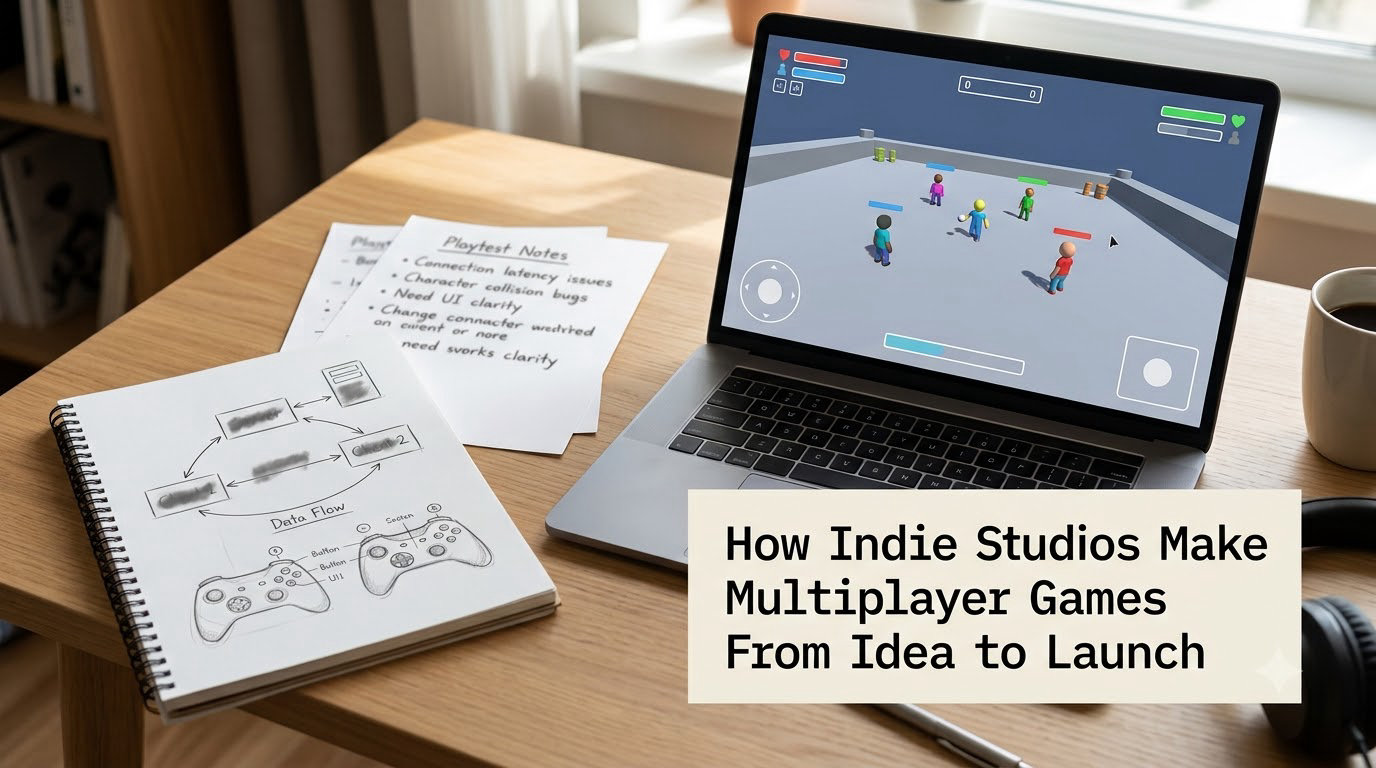
Multiplayer game development is the same shape as single-player development for about the first month, then diverges sharply. Every feature has to survive a second dimension: it only works if it works for several people at once, on different hardware, at different speeds, sometimes on different platforms.
The pipeline small teams actually follow has seven stages. Most projects that stall, stall because they try to jump from stage two to stage six.
- Decide the social activity. Not the theme, not the world — the thing two people do together. Racing, cooperating, trading, outlasting, guessing.
- Validate demand cheaply. A page, a Discord, a short playable build. People who sign up for a test are a stronger signal than likes on a trailer.
- Choose the netcode model and the backend. This decision constrains every design choice that comes after it, so it happens before features do.
- Build a networked prototype. Two players, one map, one round, no polish. If this is not fun, nothing later will save it.
- Test with real players. Colleagues are too polite. Friends will not tell you the queue is broken.
- Prepare the launch. Capacity, moderation, onboarding, patch process, and a written plan for the first bad day.
- Operate it. Patches, tuning, incident response, and the endless small work of keeping a live service healthy.
What actually happens when indie studios make multiplayer games
Feature work is the visible part and it is rarely the bottleneck. On most small online games, backend and operations work outweighs new gameplay in total hours, and it does so quietly — auth edge cases, matchmaking tuning that never stabilises, economy balance, leaderboard resets, keeping services in sync.
Developers in an r/gamedev thread on backend stacks described that maintenance tax almost word for word: the same handful of tasks reappearing forever, with no dedicated infrastructure people on the team to absorb them. It is the single most common reason a two-person studio ships a co-op game and then struggles through the following year.
Plan for that tax before you start. Budget for the backend the same way you budget for art, and decide in advance who answers alerts after release.
What Makes Browser-Based Multiplayer Different?
Browser-based multiplayer is cheaper to start and harder to run well, because you trade control for reach. A player can open a link and be in a match within seconds with no install, no store approval, and no version mismatch — and your updates ship the moment you push them.
The mechanism underneath is almost always a persistent WebSocket connection. The client opens it once, then receives state updates and sends input over the same channel, which is why a browser game can feel immediate in a way a page reload never does.
What you give up:
- Memory and CPU headroom. The browser tab shares a machine with twelve other tabs, video calls and a mail client.
- Tab throttling. Background tabs get throttled, so a player who alt-tabs may desync or stall the match for everyone.
- Anti-cheat surface. Client code is readable and modifiable, so authority has to live on the server or nowhere.
- Input and controller support. Gamepad APIs vary by browser, and a first-class console feel is much harder to hit.
- Distribution. No store page means no wishlists, no storefront discovery, and much harder word-of-mouth.
A native client is the better call when the game needs large asset downloads, platform features like achievement tracking and cloud saves, deep controller support, or a place on a console. A small, session-based, low-twitch game — a word puzzle, a card battler, a party game — can be entirely browser-based and never notice the difference.
How Do Indie Studios Choose a Multiplayer Game Concept?
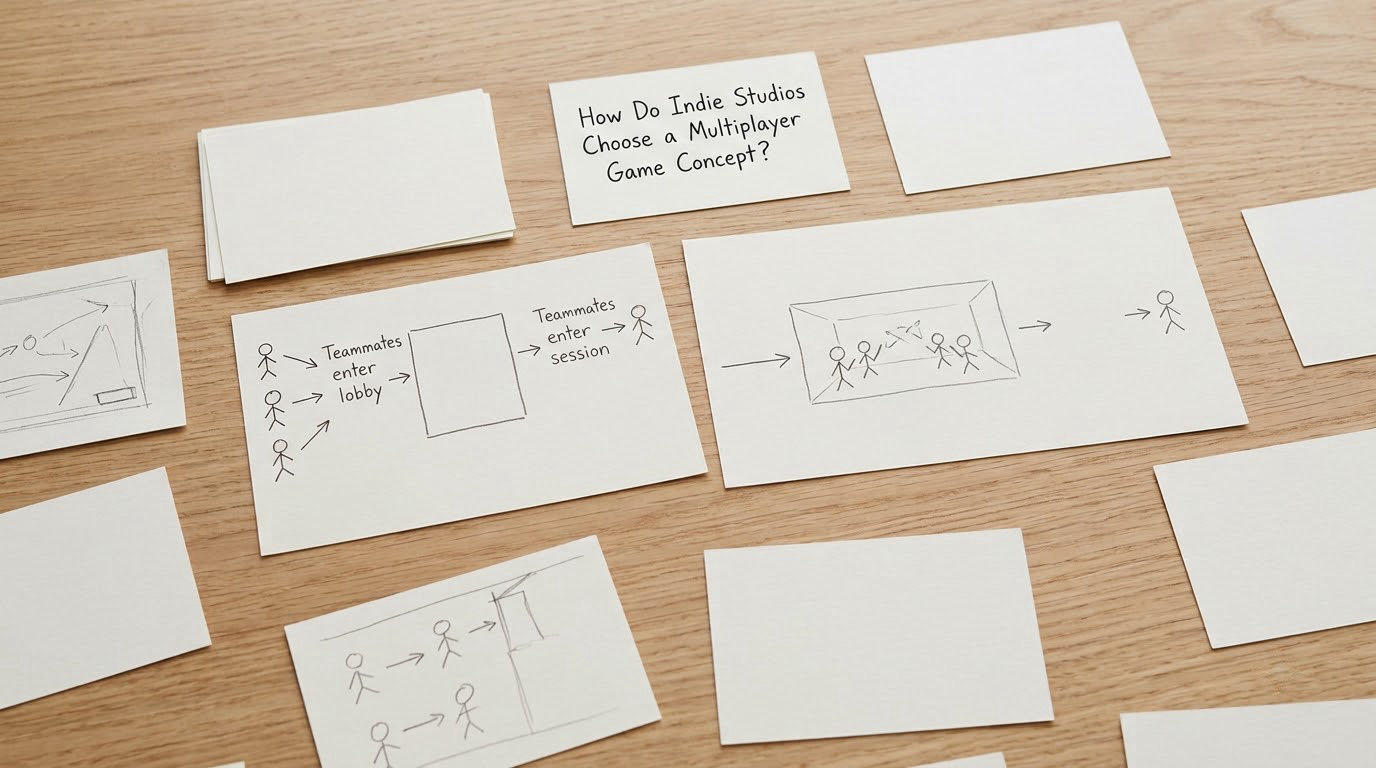
A good indie multiplayer concept is one social activity, stated in a single sentence, that a small team can build and support. Everything that does not serve that sentence is a candidate for postponement, not for a backlog.
Seven questions narrow almost any idea down:
- What is the core social activity? “Two players race” beats “a futuristic racing universe.” The second one sells tickets; the first one ships.
- Who is the audience? Solo players who queue, parties of friends, or both. Party games are friendlier to design and harder to balance, because your users bring their own skill range.
- How long is a session? Short sessions mean more server churn and a much bigger concurrency bill. Long sessions mean players who leave mid-match and a reconnect system you now need.
- Which platform? It follows from the audience. A party game on Steam Deck is a different design problem from a mobile game played in queues.
- What is the business model? Premium, free-to-play with cosmetics, or free with a battle pass. This determines whether the backend needs an economy, an inventory, and anti-fraud, or not.
- What is the differentiator? If the answer is a genre alone, keep looking. A specific hook — shared-screen chaos, a persistent world, a rule that only works online — is what gets a demo played.
- What can wait? Write the postponed list now. Ranked seasons, trading, guilds, tournaments: all plausible, all expensive, all fine to cut.
Before any of that, the honest question is whether multiplayer is right for this project at all. Multiplayer roughly triples the ongoing work and adds an operational obligation that never switches off. If the single-player version has no appeal, multiplayer will not rescue it.
How Do Teams Prototype and Test Multiplayer?
Prototyping multiplayer starts with a lie. Before there is a single real connection, you simulate the other player — a second instance of the game on the same machine, or a bot, feeding it inputs with a delay.
That trick lets designers tune feel in hours instead of weeks. You can add artificial latency of 80 milliseconds and 200 milliseconds, drop packets, and watch how the game holds up, all from a debug menu.
Once the loop is fun with a fake second player, move to real connections, in this order:
- Two machines on one network. Eliminates the variable that hides most bugs: the internet.
- Two machines on different networks. Real routing, real jitter, real NAT behaviour. This is where the first genuine disconnect bugs appear.
- Weak and unstable connections. Throttle bandwidth and add latency deliberately. If the game breaks at 300 milliseconds with packet loss, so will some players, permanently.
- Load tests. Point synthetic traffic at your own backend and watch where it falls over. Do this on infrastructure that mirrors production, or the result means nothing.
Alongside the technical tests, run usability sessions and watch behaviour, not opinions. Where do players wait? Which menu do they open three times? Do they understand what the queue is doing while they are in it? Write down the questions you asked so the next session asks the same ones.
Metrics worth watching before you add production: match completion rate, time from launch to first match, disconnect rate per match, and average queue wait. A drop in match completion is the earliest signal that netcode and design have drifted apart.
How Do Servers, Netcode, and Cheat Prevention Work?
Multiplayer runs on a server that owns the truth. Clients send input, the server simulates, and clients draw whatever the server says happened — with prediction and interpolation layered on top so it still feels responsive.
| Netcode model | How it works | Best fit | Complexity |
|---|---|---|---|
| Client-server (authoritative) | Server holds game state; clients send inputs and receive snapshots | Most online games, especially anything competitive or with progression | Moderate, and the honest default |
| Rollback | Clients simulate ahead, re-simulate when inputs arrive late | Fighting games, sports, fast 1v1s | High; very hard to retrofit later |
| Lockstep | Players exchange only inputs; all simulations stay in step | RTS, MOBA, card games with deterministic rules | High, and determinism is unforgiving |
| Peer-to-peer | One player’s machine is the host; no central server | Small co-op, prototypes, zero-cost tiers | Low to build, awkward to police |
The moving parts inside a client-server model matter more than they look:
- Client prediction and reconciliation. Your input applies instantly on your machine, then gets corrected when the server disagrees. Without it, controls feel like they are on a bad connection even when the connection is fine.
- Interpolation. The server sends a snapshot some milliseconds in the past, and the client smooths between them.
- Lag compensation. The server rewinds to what shooter A saw, validates the shot, then replays. This is the difference between a fair shooter and an infuriating one.
- Matchmaking and lobbies. Queueing, rating, party formation, and handing a full room a server address. This is where players lose interest, not in the combat.
- Persistence. Accounts, progression, inventory, and leaderboards that survive a session ending.
Cheat prevention at indie scale is simpler than it sounds: because the server is authoritative, most cheats become validation problems rather than detection problems. Ask on every request whether this action was physically possible for this player at this moment. Speed hacks, teleports, impossible aim and economy exploits all fall out of that one habit.
What you cannot do alone is moderation. Rage-quitting, verbal abuse and account selling are human problems, and they need a reporting flow, a review queue, and at least one person willing to look at them. Budget for it as a recurring task, not an occasional clean-up.
How Do Small Teams Control Scope, Budget, and Burnout?
Scope control on a multiplayer project is mostly about pretending the feature list is longer than it is. Every feature that touches the backend multiplies: it needs testing across clients, it needs migration logic for existing accounts, and it needs a rollback plan.
The reliable moves:
- Buy the boring parts. Authentication, matchmaking, lobbies, leaderboards and progression are solved problems. PlayFab, Unity Gaming Services, Nakama and Photon all exist so a six-person team does not spend a year on account edge cases.
- Pick one netcode model and do not change it. Backend choice paralysis is a real and expensive failure mode; teams start on one stack and migrate to another, losing months.
- Estimate infrastructure from concurrency, not from player count. A game with 20,000 registered players and 200 playing at once is a very different bill from 2,000 registered and 900 concurrent. Model peak concurrency and a spike buffer above it.
- Overprovision for launch. Publishing veterans are consistent on this: the launches that went well were the ones that were over-prepared. You can scale down afterwards, and optimising for density is a post-launch luxury.
- Freeze features at a fixed date. The scope that matters ends before launch, and everything after that goes into a patch plan with a priority order.
- Write the on-call plan now. Who wakes up, who is allowed to make the call, and what gets announced. A GDC panel on launch failures kept returning to the same theme: the successful teams decided in advance how they would respond.
Burnout in this work is mostly caused by unpredictability, not volume. On-call without a rotation turns into a game developer’s entire week becoming a series of 2am incidents. Even two people alternating a week is survivable; one person absorbing it alone is how a studio loses its lead engineer.
How Do Studios Test Multiplayer Before Launch?
Pre-launch testing is organised into six categories, and a test session that mixes them all usually finds nothing useful. Test one category at a time.
- Playability. Can a new player understand the loop, the controls and the win condition without being taught? Watch someone who has never seen it.
- Connection. Every failure state: lost connection mid-match, reconnect after a drop, host migration, full queue, server restart during play, client on an old build after a patch.
- Balance. Matchmaking rating, win rate spread, per-map and per-character pick rates. Do this with real cohort data, not with the opinions of your team.
- Progression. The economy, rewards, unlock pacing and, if you monetise, the purchase path from first session to second.
- Security. Attempt to cheat your own game. Client tampering, replayed requests, forged scores, inventory duplication. You will find at least one, and you want to find it first.
- Capacity. Sustained load at more than your expected peak. A well-known large-scale launch ran around six months of scale testing, and each major test exposed a different weakness in a different system.
Reproducibility is what separates useful bug reports from noise. Every report needs the build version, platform, match ID, and a log excerpt. Teams that skip that step end up chasing the same disconnect for weeks because nobody can reproduce it.
Run your closed test where your players already are. A Discord cohort of forty committed testers will find more backend problems than a weekend of internal play, and they will do it while you still have time to fix what they find.
How Do Studios Launch and Support a Multiplayer Community?
Launch is the end of development and the beginning of operations, and treating it that way saves a lot of pain. A reasonable sequence looks like this.
- Closed test first. Invite-only sessions with strangers rather than friends, sized to strain the backend without taking it down.
- Widen, then pause. Add players in stages, and fix between stages. Jumping straight from 100 to 10,000 concurrent players tells you very little.
- Pre-provision capacity. Have more server capacity ready than your estimates suggest you need, and know how fast you can add more.
- Write the onboarding. The first five minutes decide whether a player comes back. Keep it short, keep it in the game, and never make an account system a puzzle.
- Prepare moderation. Reporting in one tap, a review queue, a documented penalty ladder, and a named person responsible.
- Communicate before you patch. Scheduled maintenance, patch notes in plain language, and a single place players are told what is happening.
- Decide what is in the first update. Crashes and blocking bugs, balance, and anything you promised during the test. Resist everything else for two weeks.
Plan for graceful degradation too. When load exceeds capacity, the good version of this is shorter queues, reduced cosmetic effects, or pausing new logins — not a crash and not a five-day outage. Design the fallback before you need it.
One compliance item catches small studios out: player data is subject to GDPR, CCPA and similar laws from the first day you accept sign-ups, and deleting an account on request has to actually work across every service you use. It is much cheaper to build that in than to retrofit.
Which Metrics Show a Multiplayer Game Is Working?
A multiplayer game is working when players come back and finish matches, not when downloads are high. Here is the set worth tracking from the first public test, and what a healthy signal looks like.
- Activation. Share of new players who complete their first match. If most of them quit during onboarding, nothing else matters yet.
- First-session completion. How many matches a new player finishes in their first sitting.
- Return rate. Day-one and day-seven return are the two numbers that predict whether a community forms.
- Session length and frequency. Long sessions with few returns suggest a different game than the one you designed.
- Party formation. How many matches are played with friends rather than strangers. This drives word of mouth more than anything else you can measure.
- Match completion and queue wait. Completion dipping usually means netcode problems; queue wait creeping up usually means matchmaking or capacity.
- Peak and average concurrency. Average during the week, peak on launch day. Size your infrastructure on the peak.
- Latency, crash rate, and disconnect rate. Track these per platform, because mobile and desktop fail differently.
- Moderation burden. Reports per thousand matches. This grows with your audience and needs staffing before it needs policy.
- Revenue per active player, if you monetise. Conversion and ARPDAU, understood alongside retention rather than in place of it.
Pick a small set and review it on a schedule. Teams that watch everything end up watching nothing, and teams that only watch revenue end up optimizing the wrong thing.
What Can Small Studios Reuse on Their Next Game?
The quiet benefit of shipping an online game is that most of the backend is reusable. A studio’s second multiplayer title can be meaningfully faster than the first because the unglamorous layer is already there.
Typically portable to the next project:
- Authentication, account linking and identity handling, including the privacy and deletion tooling around it
- Matchmaking, lobby and party systems, and the rating maths behind them
- Progression, inventory and economy services, if you had them
- Analytics pipelines and the dashboards built on top
- Observability: logging, alerting, crash reporting, and a working on-call rotation
- Admin tooling, moderation queues and internal playtest harnesses
- Deployment pipelines and server orchestration, so a patch is a routine operation rather than a project
Reconsider instead of reusing: your netcode model (it should follow the new game’s genre, not your comfort), platform assumptions if the target hardware changed, anything hard-coupled to a backend contract you have outgrown, and any system one person understood completely. That last one is the real risk — reusable systems that depend on a single person’s memory are not reusable.
Frequently Asked Questions
Can one indie developer make a multiplayer game?
Yes, but pick the multiplayer type that needs the least server infrastructure. Asynchronous multiplayer, where players affect each other through stored data rather than live connections, is the most realistic solo project. Small co-op works next. Live competitive PvP is realistically out of reach for one person, because the operational burden alone is a part-time job on top of development.
What is the easiest multiplayer game genre for an indie studio?
Turn-based and card games, because the server only has to arbitrate a move rather than simulate a world at tick rate. Board games, tabletop-style games and asynchronous party games are the gentleest on-ramps. Fast real-time action is the hardest, since every millisecond of latency becomes visible. Whichever genre you pick, decide the core social activity before you build anything.
How much does it cost to make a multiplayer browser game?
The build itself is usually the cheapest part. Real cost comes from the ongoing service: hosting scaled to peak concurrent players, backend service tiers, moderation, and your own time on call. Costs track concurrency, not registered players, so model the peak and add a buffer. Vendors charge in very different units, so get quotes against the same concurrency assumption before comparing anything.
Do small studios need dedicated servers for multiplayer games?
For competitive or progression-based games, yes, an authoritative server is effectively mandatory, because it is what makes cheating hard and keeps everyone seeing the same game. For small co-op, a host-and-client model can work, though the host has an advantage and a host migration problem. Managed services let a small studio run authoritative servers without hiring infrastructure engineers.
How many players are needed to test a multiplayer game?
Around forty committed testers will find most design and backend problems before launch, and a public test of a few hundred will surface matchmaking and capacity problems that a closed group never triggers. What matters more than the count is the mix: strangers, not friends, and a mix of skill levels and hardware. Internal playtesting with colleagues reliably finds nothing.
How long does it take to launch a small multiplayer game?
Plan in years rather than months for a first online title, and assume the backend work runs in parallel with the game rather than after it. A narrow scope — one mode, one map set, one platform — can reach a public test in roughly a year for an experienced team, and a full release considerably longer. Add six months of capacity and load testing before you commit to a date, because that phase routinely surfaces new problems.
Conclusion
If you take one thing from this, make it the order of operations. How indie studios make multiplayer games well comes down to a narrow social experience, a playable networked prototype with real strangers in it, and honest metrics before any infrastructure scales.
Start by writing the one sentence describing what two players do together. Then build the ugliest version of that with a fake second player. Everything after — netcode, backend, servers, live ops — is in service of that sentence, and anything that does not serve it is a feature you have not agreed to build yet.