Learning how to tell real leaks from fake ones comes down to four questions: who is claiming it, what exactly are they claiming, when did it appear, and what do they gain from posting it. Anything built from a screenshot and an anonymous handle has failed at least the first question before you have read a single line of the post.
A game leak is any information about an unreleased game that reaches the public before the publisher intends it to, usually through someone with access to a pre-release build. That covers captured gameplay footage, internal asset files, datamined strings, artwork, release dates, and plain claims from supposed insiders. The pipeline that produces a leak and the pipeline that produces a hoax often look identical from the outside, which is why verification has to be a routine rather than a gut feeling.
Fake leaks spread faster than real ones for a simple reason: real information rarely argues. A fabricated trailer drop invites outrage, prediction threads, and clips, and that reaction is the whole point for an account trying to grow.
The rest of this guide is the process I use, updated for 2026: eight checks, roughly ten minutes of work for anything that would change your mind.
Table of Contents
- 1What You Need
- 2How to Tell Real Leaks From Fake Ones Step by Step
- 31. Trace the leak back to its original source
- 42. Check the account and its publication history
- 53. Look for independent corroboration
- 64. Examine screenshots, video, and audio for signs of a fake leak
- 75. Inspect file and image metadata
- 86. Compare details with the current public build
- 97. Separate accidental early access from promotion
- 108. Check for developer confirmation or contradiction
- 11What each signal implies
- 12Common Mistakes
- 13Frequently Asked Questions
- 14Does an anonymous source prove that a game leak is fake?
- 15Can AI-generated images make every game leak impossible to verify?
- 16Is one obvious error enough to label a leak fake?
- 17Should I share a game leak if no developer has denied it?
- 18How can communities moderate unverified leak posts?
- 19What is the fastest way to fact-check a gaming leak?
- 20Conclusion: Start With the Source
What You Need
Before you start, get five things lined up. Skipping the first one is how most people get fooled, because everything else depends on knowing what the original claim actually was.
- The original post and a link to it. Not a screenshot of a post. Find the earliest version you can reach and archive it, because the wording changes as the story travels.
- A browser with an image metadata viewer. Windows Explorer properties, macOS Finder Get Info, or any browser’s developer tools will show you capture times and dimensions.
- Reverse image search and a text search. Google Lens or TinEye for pictures, plus a plain search of any distinctive names or dialogue in quotation marks.
- The official developer and publisher channels. The studio site, the verified social accounts, patch notes, the store page, and the official wiki or patch notes for the current build.
- One independent second source. A separate community, a separate established outlet, or footage from a different person entirely. Not an account reposting the same image.
How to Tell Real Leaks From Fake Ones Step by Step
This is the workflow I run in order. Each step is cheap, and stopping early is fine — if step one fails badly there is no reason to keep investigating.
1. Trace the leak back to its original source
Follow the repost chain backwards until you hit the first upload. Quote posts, cropped screenshots, and “someone in the Discord said” framings each add a layer of distortion, and a detail that survives four layers is usually a detail that was already public knowledge before the “leak” appeared.
Ask one question: could I have found this text somewhere else this morning? If yes, it is not evidence of access.
2. Check the account and its publication history
Look at when the account was created and what it posted before this leak. An account opened days before a bombshell drop is the single loudest tell, and so is an account that has never posted about the game outside of leaks.
Then check the record rather than the reputation. Forum communities track hit rates obsessively because one enormous correct call creates a halo that forgives dozens of wrong ones. Judge the leaker’s overall percentage, not their best story, and remember that a reliable account will occasionally post a joke. Satire that gets screenshotted out of context looks exactly like a leak, which is why outrageous claims from an otherwise solid source deserve the same scrutiny as outrageous claims from a nobody.
3. Look for independent corroboration
This is where most amateur verification collapses. Ten accounts posting the same screenshot is one source, not ten. The only thing that counts is a genuinely separate line of evidence: a second leaker who has never linked to the first, a different community supplying footage of the same thing, or an established outlet that ran the story under embargo with its own material attached.
The “would a real outlet have run this first?” test is the fastest version of the same idea. If genuine pre-release footage existed, the outlets that cover that franchise would be sitting on it, and they have legal teams and audience incentives to publish it. If a piece is floating around forums while the trade press is quiet, that is worth asking about.
4. Examine screenshots, video, and audio for signs of a fake leak
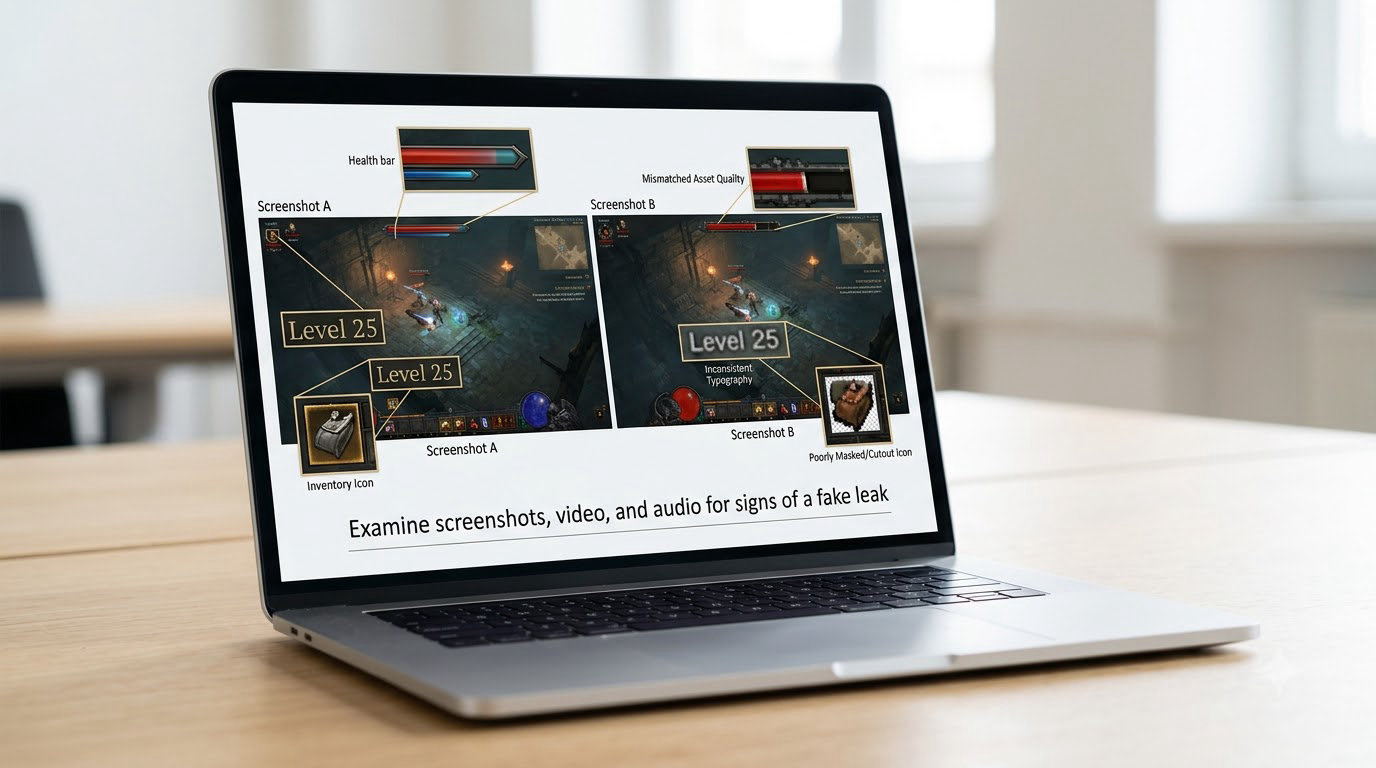
Open the image rather than trusting the post. Look at edges where a composite seam would sit: a horizon line that changes sharpness halfway across, a shadow that does not agree with the character’s feet, a hand that dissolves into a prop.
Then look inside the frame. Placeholder UI, debug menus, untextured surfaces, debug text overlays and temporary names are normal in internal builds and are a good sign rather than a bad one. Interface elements that contradict the known current build, a date in the corner that falls outside the game’s actual timeline, or duplicated assets repeated across supposedly different scenes are not normal at all.
For video, watch how the frame rate behaves. Real captured gameplay stutters, drops frames when a lot is on screen, and shows compression artifacts at the same moment. Smooth 60 frames with none of that cost is often rendered footage rather than a running build — which is not automatically fake, but it means the claims about it being captured need proof.
For audio, listen for lip-sync drift and for a soundtrack that loops cleanly. A fake often has the two halves assembled separately.
5. Inspect file and image metadata
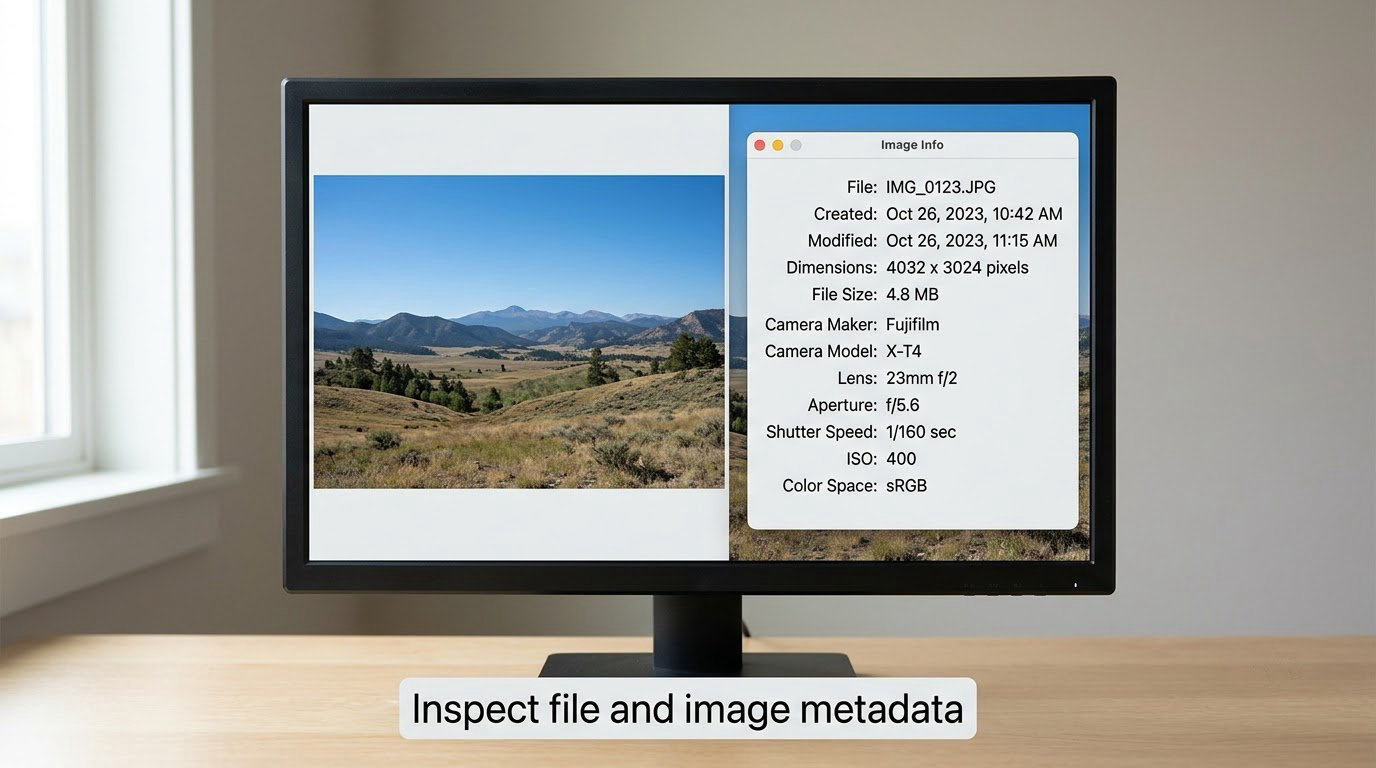
Right-click the file and open its details. Capture timestamps, image dimensions, the originating application and the source file name all tell a story. Several clues matter more than any single one: a capture date that predates the footage, an edit history listing half a dozen rounds of retouching, or a file name straight out of an art pipeline sitting on what was sold as console footage.
Do the same with the archive of the original post. Genuine early leaks often sit on private trackers, reposts, or dead file hosts that have vanished; that history is hard to fake and worth reading carefully.
One caveat worth stating plainly: absent or stripped metadata is not proof of fabrication. Screenshot uploads and messaging apps rewrite metadata constantly, and plenty of real leaks have been laundered through enough reposts to lose everything useful. Treat metadata as supporting evidence and nothing more.
6. Compare details with the current public build
Pull up current footage, recent trailers and the current build, then line up the specifics: menus, map layouts, character designs, HUD elements, terminology, platform features, release information and how far along the game visibly is.
Consistency across several independent details is meaningful. Contradiction with the current build is equally meaningful, though remember that pre-release builds look different on purpose. Menu layouts get rebuilt, quality settings change, and debug names come and go. What should never appear is a detail that the current team has publicly retired, or a release window that has already closed.
7. Separate accidental early access from promotion
Ask how this person got it, then check whether the answer holds up. Store visibility, preorder pages, press preview dates, review code emails, closed tests, licensing notices and early access programs all create legitimate windows where an outsider sees real material.
Timing that lines up neatly with one of those windows means access is plausible. Timing that lands the day before a major showcase, or the morning of a trailer drop, or right after a quiet patch, suggests the post is fishing for attention rather than reporting.
8. Check for developer confirmation or contradiction
Search the studio’s official accounts, the store page, patch notes and roadmap posts for any statement about the subject. A denial is genuinely informative: publishers deny things that are circulating, rarely things nobody has heard.
Silence proves nothing in either direction. Studios are legally constrained by NDAs and marketing plans, and a dev commenting on a leak is a last resort for most of them. Do not treat quiet as confirmation any more than you treat it as refutation.
Two more signals sit outside the leak itself. If a claim is sourced to “my cousin works there”, there is nothing to verify. And if the post is framed as viral marketing, a self-declared advert, or a “prediction for engagement”, read it as content rather than information.
What each signal implies
No single signal decides it. Here is how the ones above tend to point, and you should weight the leaning-real side far more heavily.
Source. Leaning fake: an account days old with no prior posts about the game. Leaning real: a long public history with a documented hit rate.
Corroboration. Leaning fake: many reposts of one image. Leaning real: a second, unrelated source bringing its own material.
Evidence. Leaning fake: everything in it is guessable from public information. Leaning real: specific artifacts such as build strings, file names, or internal names.
Proof of access. Leaning fake: nothing beyond “trust me”. Leaning real: able to demonstrate access without revealing it.
Behaviour. Leaning fake: asks for engagement, outrage bait, self-promotion. Leaning real: posts it and moves on.
Timing. Leaning fake: drops minutes before an announcement. Leaning real: fits a known preview, test, or press window.
Official response. Leaning fake: the publisher denied it directly. Leaning real: no denial, or confirmed in patch notes.
Visual quality. Leaning fake: seams, impossible lighting, mismatched assets. Leaning real: debug artifacts, placeholder names, capture artefacts.
Give the thing a score rather than a verdict. One point per signal that leans real, minus one per signal that leans fake, and treat anything under three as unverified. It is crude, but it stops one dramatic detail from outweighing seven quiet ones — and it takes about a minute.
Common Mistakes
Treating popularity as proof. A leak at the top of your feed has been amplified, not confirmed. Reach is a distribution fact, not an evidence fact.
Confusing fan art and AI imagery with leaked assets. Concept art, renders, trailers from other games and generated “gameplay” all circulate with real-looking UI. Look for the tells: lighting that does not move with the camera, text that changes shape between frames, hands and reflections that disagree, and asset details that shift when you compare two screenshots from the same scene.
Amplifying the original source. The single most useful thing you can do for a community is refuse to repost the primary post. Every share gives it an audience, an archive, and search visibility that makes it look more real over time. Quote it, link to it, judge it, and let the originator’s own reach carry the blame.
Ignoring which version the game is in. Judging internal footage against the current retail build produces false alarms and false clears in equal measure.
Counting one true detail as validation. Partly true leaks are the hardest case, and they are common. A post can nail the next region and the protagonist’s name while inventing everything else, and the two correct items get quoted forever. Score the claim as a whole, never the tidiest line in it.
Treating a denial as a finished verdict. Denials are strong evidence; they are not proof of fabrication, and confident refutations get corrected too.
Two practical notes before you close the tab. First, never download anything offered as a leaked build from a link in a DM or an unverified comment, and do not run an “early access” installer. That file is the actual product for a lot of fake leak bait, and it is far more dangerous than the misinformation. Second, if you already shared a fake, say so plainly, correct it in the same thread rather than quietly deleting it, and link the refutation. Modest communities forgive an honest correction quickly; they remember a quiet disappearance much longer.
Frequently Asked Questions
Does an anonymous source prove that a game leak is fake?
No. Plenty of genuine leaks come from anonymous accounts, because NDAs and employment contracts make anonymity a rational choice for insiders. What matters is consistency: an anonymous source with a long documented hit rate, specific artifacts, and no request for engagement is worth taking seriously. Anonymous plus no evidence, no history, and a post engineered to spark outrage is just unproven in both directions.
Can AI-generated images make every game leak impossible to verify?
Generated footage raises the bar, it does not remove the ability to verify. The practical checks survive: real builds show compression artefacts, frame drops, placeholder names and debug text, while generated clips tend toward suspiciously smooth motion, inconsistent geometry and text that shifts between frames. Trace the source, look for a second independent source, and treat any single clip as unverified no matter how clean it looks.
Is one obvious error enough to label a leak fake?
Rarely on its own. One glaring mistake can be a genuine internal build, an early concept, or a bad repost by someone who got a real image slightly wrong. Stronger cases are patterns: several contradictions with the current build, fake metadata, no independent corroboration, and a source with a motive for engagement. That is four signals pointing the same way, not one detail you found by zooming in.
Should I share a game leak if no developer has denied it?
Silence is not permission. Publishers stay quiet because of NDAs and marketing plans, so the absence of a denial tells you almost nothing. If you want to share, share it as unverified with the source named and your checks listed, and never attach a download link. If it turns out fabricated, a caveated share costs you very little; a confident share is what gives the fake its reach.
How can communities moderate unverified leak posts?
Require provenance rather than verdicts. Ask submitters to link the original post, name the source, and state which checks they ran. Set one visible flair for unverified material, ban reposts of the primary source so amplification happens in one place, and keep a running public record of sources that have been wrong before. Moderating leaks well means slowing the post down, not deciding what is true.
What is the fastest way to fact-check a gaming leak?
Run the four-question screen: who posted it, what exactly are they claiming, when did it appear, and what does the poster gain. Then add two quick checks, a reverse image search for the screenshot and a search of any distinctive name in quotes. If the claim is made of insider access but every detail is guessable from public information, treat it as fabricated and move on in about two minutes.
Conclusion: Start With the Source
Knowing how to tell real leaks from fake ones is less about spotting fakes than refusing to guess. Trace the material to where it first appeared, read the account’s whole history instead of its reputation, demand a second independent source, look at the actual file rather than the post about it, and check the details against the build that exists today.
Do that first one thing: find the original post and read the account behind it before you read a single comment section. Everything after that is confirmation, and most fake leaks die at step one.