Game balance patches are decided from evidence, not from the loudest thread. Studios collect player reports, sort them into a triage queue, check win rate, pick rate and matchup data to confirm the problem is real, pick the smallest lever that fixes it, test it internally and with competitive players, release it, then re-measure and adjust. When the numbers conflict, the team falls back on a written target for the meta and its read of the intended experience.
This guide walks through how game balance patches are decided, step by step, from the first report to the post-release measurement. Quick note before we start: search results for “balance patch” are polluted with weight-loss supplements, and nothing here has to do with that.
I’ve read enough patch notes and design write-ups to know the shape of the argument underneath them, and it is more deliberate than most players assume.
Table of Contents
- 1What Does Game Balance Mean?
- 2How Game Balance Patches Are Decided
- 3What Evidence Do Developers Use?
- 4How game balance patches are decided when the data disagrees
- 5How Do Player Feedback and Designer Goals Affect the Decision?
- 6How Is a Balance Change Tested Before Release?
- 7How do developers know whether a patch worked?
- 8Why Do Small Tweaks Sometimes Cause Large Reactions?
- 9How Are Patch Decisions Prioritized?
- 10How Do Developers Communicate the Reasoning Behind a Patch?
- 11Frequently Asked Questions
- 12Who decides how a game is balanced?
- 13Why is a 50% win rate not proof that a character is balanced?
- 14How long do developers test balance changes?
- 15Can player feedback change a planned game balance patch?
- 16What happens when a balance patch misses its target?
- 17Conclusion
What Does Game Balance Mean?
Game balance is the state where no single choice is correct every time. When one option wins regardless of skill, map, or opponent, the game is unbalanced, and players stop making decisions and start solving puzzles.
Balance is not the same as every option being equally strong. A heavy shotgun that hits hard at close range and does almost nothing across a parking lot is fine, because players can read the situation and respond. The problem starts when there is no situation in which the weaker option is right.
Designers worry about several kinds of balance at once. Internal balance is whether a character, weapon, or card performs as designed against the rest of the roster. External balance is whether the choices combine into a healthy meta rather than one dominant strategy. Then there is fairness, which is about matchups feeling honest, and economy, which covers progression costs and currencies in live-service games.
Perfect 50% symmetry is usually not the goal either. When every pick sits near 50% win rate, some options become boring, and the interesting decisions drain out of the game. Most teams aim for a band instead, something like 45% to 55% overall, with a wide spread of viable strategies inside it.
One more practical distinction: balance is not character power. A starter character can be weak and still be correctly tuned, because new-player experience is its job. If that character jumped to a 55% win rate, it would stop being a safe entry point, and the ladder under it would get harder for everyone.
How Game Balance Patches Are Decided
Balance changes come out of a pipeline, and a single strong opinion rarely moves one item to the front of it. Here is how the work usually flows inside a live-service studio.
- Report. Players file complaints through in-game reporting, forum threads, support tickets, and creator video. Most balance reports are duplicates of the same handful of issues, which is why volume alone decides nothing.
- Triage. A balance designer sorts reports into categories: genuine imbalance, working as intended, unclear, or needs investigation. Anything touching competitive integrity or an exploit jumps the queue.
- Data pull. The team pulls win rate, pick rate, ban rate, matchup-specific win rate, score or rating, playtime, and how those numbers split across skill brackets and regions.
- Diagnosis. The designer works out the cause, not just the symptom. A character at 56% might be overpowered, or it might simply be the best answer to a particular team composition problem, and those need opposite fixes.
- Target model. They write down what they expect the change to do. Bring the win rate into the target band, cut pick rate by a specific amount, or restore a rock-paper-scissors relationship. Without a written target there is nothing to judge the result against later.
- Pick a lever. Small numeric adjustments first, then mechanic changes, then a rework. The bigger the intervention, the more testing and communication it needs.
- Prototype and test. Internal playtests, simulation runs, sandbox builds for the player base, closed sessions with competitive players, and QA regression passes on anything the change might break.
- Release plan and measurement. The change lands in a hotfix, a scheduled patch, or a season reset depending on urgency and risk. After release, the same metrics are re-pulled and compared against the target.
That last step is where most players lose track. A patch that misses its target is not a failure to be hidden, it is the start of the next iteration.
What Evidence Do Developers Use?

The evidence comes in two very different flavors, and studios weight them differently. Quantitative signals are drawn from telemetry and aggregated at scale. Qualitative signals come from people watching games, reading forums, and arguing about feel.
| Quantitative signal | What it tells a designer | Where it misleads |
|---|---|---|
| Win rate | Raw outcome across matches played | Say nothing about why, and small samples swing wildly |
| Pick rate | How often players choose it voluntarily | High picks can mean popularity rather than power |
| Ban rate | How much players want it removed | Strong bans in draft modes can be about comfort, not strength |
| Matchup win rate | Where the advantage comes from | One strong matchup can hide a weak one |
| Rating or score data | How results differ by skill level | Rating systems lag and blend performance over time |
| Playtime and retention | Whether a change helped or hurt engagement | Popularity is not fun, and fun is hard to measure |
| Frame or damage calculations | Raw efficiency from a spreadsheet model | Real fights include positioning and prediction |
| Crash and bug reports | Whether a mechanic is exploitable | Players rarely file the ones that are subtle |
Qualitative evidence is just as real. Studio testers watch matches and take notes, designers read forum threads, community managers relay patterns from support, and pro players are invited into closed tests specifically because they play the game differently from the average person.
Each source has a ceiling. Telemetry is enormous and blind to why. Designer intuition sees why and is famously wrong about what most players enjoy. Player forums are loud, self-selecting, and terrible at representing anyone who stopped playing last month.
How game balance patches are decided when the data disagrees
Conflicts are the normal case, not an exception. A character can sit at a modest 51% win rate while holding a 40% pick rate, which usually means it is niche but correctly tuned, and many teams leave it alone. The same 51% with a 25% pick rate is a different story, because it suggests the character is strong but hard to use, and the fix is usually to remove the friction rather than cut the numbers.
When two metrics point in opposite directions, the designer decides which population the change is meant to serve, and that decision is written into the target before the numbers are touched.
How Do Player Feedback and Designer Goals Affect the Decision?
Player feedback matters, but it enters the process at a specific point: after the data confirms something real, and as a source of goals rather than solutions. People are usually excellent at reporting what feels wrong and unreliable at prescribing the fix.
The tension most players feel comes from that ordering. A loud thread about an unpopular character can be answered with data saying it is at 50% and rarely picked, and the response sounds like the studio dismissing the community. It is more often a disagreement about what the population should be optimizing for.
Several constraints sit behind almost every live-service balance decision:
- Competitive integrity. In ranked and tournament play, a single dominant option damages the whole ladder, so these fixes move first.
- New-player experience. Changes that make early content harder get held back, even when veterans are frustrated.
- Accessibility and hardware spread. Input-heavy options sometimes get adjusted so lower-end setups can compete, which confuses players who only check win rate.
- Monetization. Characters or items tied to spending or progression cannot move freely. A business approval step can delay or block a change that gameplay data alone would justify.
- Production cost. A cooldown adjustment is cheap. A character animation, voice lines, and new ability set can occupy a team for months.
- Release calendar. Fixes get batched to reduce disruption and testing load, which is why a known exploit can sit for weeks.
The designer goals part is the least visible. Every team has a statement of intent, and Riot’s has long been framed around many viable strategies rather than one correct answer. Whichever version a studio publishes, the practical test is the same: does this change open up choices or close them off.
How Is a Balance Change Tested Before Release?
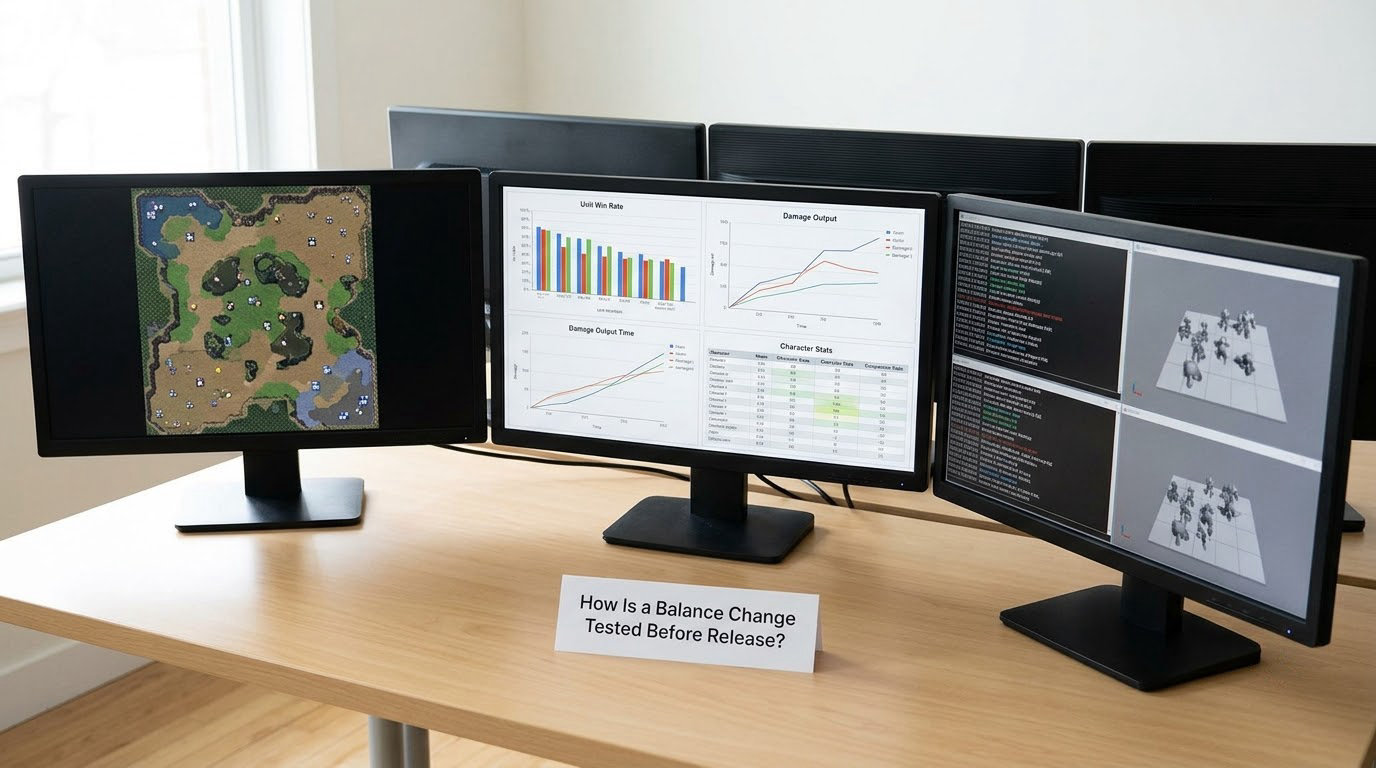
Numeric tweaks are tested in layers, and each layer catches something the previous one could not.
Internal playtesting. The design and QA teams run thousands of matches, often with scripted or simulated players, to check whether the change moves the numbers in the predicted direction. Simulations are cheap and fast, and they are bad at reproducing messy human play.
Model work first. Before anyone plays, designers calculate the theoretical effect in a spreadsheet. Cooldown, damage per hit, time to kill, resource cost per point of output. This catches the arithmetic mistakes that make a change useless or catastrophic.
Closed tests with competitive players. High-skill players stress the extremes of a character, and small groups of them can surface a broken interaction in an afternoon that random internal testing never finds.
Open sandbox or public test builds. Wider sampling, including from less experienced players, which is how a change that helps experts but hurts beginners gets caught.
Regression and QA passes. Anything the change touches indirectly gets re-tested, including combo interactions, cinematics, and any mode where the same character behaves differently.
Staged rollout. For high-risk changes, the update goes to a slice of players first, then widens. Rollback is a real option only when the blast radius is small, which is one reason studios hesitate on changes they cannot undo quickly.
How do developers know whether a patch worked?
They compare against the criteria they wrote before the change, not against how the patch felt on release day. Usually that means the target metric moved into the intended band, the secondary metrics did not move badly, no new exploit appeared, and matchups across the roster still behave the way the design intends. If a metric moves past the band, the next patch adjusts again, and sometimes the team reverts to the previous numbers entirely.
Why Do Small Tweaks Sometimes Cause Large Reactions?
A 5% cooldown change can read as a disaster, and the gap between the number and the reaction is usually about interaction and identity rather than math.
Cascading effects. Power does not live in one character. A small buff to a healer or a tank shifts every fight it takes part in, so the loudest reaction often comes from a character that was not touched at all.
Role identity. Players pick characters for fantasy as much as function. Change the fantasy and the win rate becomes irrelevant to how the change feels.
Counter chains. Weaken a counter and everything it countered gets stronger on paper, sometimes in the same patch. That is why a nerf to one option usually arrives with a buff somewhere else.
Hidden interactions. Skills, items, map features, and modes combine in ways nobody modeled, and the combination surfaces weeks later.
Different goals per segment. A change tuned for competitive play can feel like a disaster in casual play, and the reverse happens too. Studios pick a target audience and accept the complaints from the other one.
The framing gap. Patch notes often express changes in relative terms. “Damage reduced by 10%” against a base of 300 is a real nerf, but it is not a tenth of what many players assume. Forums frequently read this as a catastrophic cut when it was a nudge.
Popularity and success are different things too. A heavily picked character is not automatically broken, and a rarely picked one is not automatically weak, which is the single most misread fact in patch discussions.
How Are Patch Decisions Prioritized?
Live teams do not ship everything in the triage queue. They score items against each other, usually with something close to this rubric.
| Factor | Question the team asks | Effect on priority |
|---|---|---|
| Severity | Does it break the game for a large share of matches? | Highest weight |
| Competitive risk | Does it damage ranked or tournament play? | High, can override roadmap |
| Exploit potential | Is it being abused for farming or unfair advantage? | High, often moves straight to a hotfix |
| Player impact | How many players hit it, at what skill level? | High |
| Frequency | How often does it happen in a typical session? | Medium to high |
| Ease of reversal | Can we undo it quickly if it overshoots? | Medium, widens what is attempted |
| Production cost | How much art, code, and QA does it need? | Medium, decides timing more than merit |
| Roadmap fit | Does it collide with a reworked version already in production? | Often delays a fix indefinitely |
A worked example: a support character holds a 57% win rate and a 3% pick rate, and the excess is caused by a single exploitable terrain interaction rather than raw numbers. Severity is moderate because few players touch it, exploit potential is high because it is being farmed, and the fix is a small interaction change with low production cost. That combination usually outranks a 56% main character with a 30% pick rate, because the second case needs a full re-evaluation of a popular option and carries far more regression risk.
How Do Developers Communicate the Reasoning Behind a Patch?
Most patch notes tell you what changed and almost never why, and that silence is the root of most distrust. Good balance communication covers seven things, and a weak announcement usually has one or two of them.
- The problem, stated plainly. Not “we are improving balance” but “this option was winning far too often and was picked in nearly every match.”
- The evidence. Which metrics triggered the change, ideally with the before numbers.
- The goal. The target band the team expects the change to hit.
- The trade-offs. What the team chose to sacrifice, and what other option was considered and rejected.
- Known risks. Which interactions the team expects to shift and does not have a plan for yet.
- Testing limits. An honest note that closed testing covered a fraction of the player base.
- The follow-up plan. When the team will re-measure and what would trigger a revert.
Be skeptical of three patterns instead. Vague promises such as “we will keep an eye on it” usually mean nobody has written a target. Blaming unnamed factors, like matchmaking or a hidden exploit, shifts scrutiny without evidence. And unsupported claims that a change is purely for variety can be checked against the numbers: if the change also touches something with business value, that is worth knowing.
The honest comparison is the community manager who posts the team’s actual reasoning, including the parts that are still uncertain. It is rarer than it should be, and players notice when it happens.
Frequently Asked Questions
Who decides how a game is balanced?
A dedicated balance designer usually owns the decision, working from telemetry and a written target. Larger studios run a whole team with a producer, analysts, and a QA lead. Publicly, you will see a designer, lead systems designer, or game director named in the notes. Final sign-off often sits with a producer or director, because business and production constraints count as much as gameplay ones.
Why is a 50% win rate not proof that a character is balanced?
Win rate only shows outcomes, never causes. A 50% average can hide a character that crushes one matchup and gets destroyed in another, which players experience as genuinely unbalanced. Context matters too: opponent strength, map, game mode, and skill bracket all shift the number. Win rate is one input among several, and teams read it alongside pick rate, ban rate, and matchup splits.
How long do developers test balance changes?
A simple numeric tweak can move from idea to release in days. Anything touching mechanics, animations, or multiple characters takes weeks of internal playtesting, closed sessions, and QA regression work. Bigger reworks run for months because they need new art, voice, and animation alongside the design. Release calendars stretch it further, since many fixes wait for the next scheduled patch or season reset.
Can player feedback change a planned game balance patch?
Yes, often indirectly. Feedback shapes what gets investigated and which goals the team sets, and it regularly reveals problems telemetry missed, like an interaction that punishes a whole skill bracket. It is far less likely to dictate a specific number, because players are reliable at reporting symptoms and unreliable at prescribing solutions. Teams that read forums carefully usually catch real issues early.
What happens when a balance patch misses its target?
The team re-pulls the same metrics and compares them to the target they wrote beforehand. A small miss usually gets a follow-up tweak in the next patch. An overshoot or a new exploit can trigger a full revert to the previous numbers. Some patches get rewritten entirely, which is why you often see a nerf reversed a month later and the original version quietly restored.
Conclusion
Balance work is a pipeline: reports get triaged, data confirms or kills the problem, a target gets written, the smallest available lever gets tested in layers, and the result gets measured against the target afterward. Judging a patch is a similar exercise. Before deciding whether a change was good, look at what the studio said it was trying to fix, which evidence supported that, what outcome they expected, and when they planned to check again. The announcement alone will rarely tell you whether they hit it.