
Daily login rewards lift the number of players who come back tomorrow, but they rarely lift the number who still care a month later. In one published simulator case study, a seven-day escalating streak raised daily returning-player rates by 35% in week one, while a broader set of features that included onboarding work and social systems moved Day 7 retention further and held it. That gap is the whole story: streaks buy attendance, and only good content turns attendance into retention.
Below is how daily login rewards affect player retention in practice: what the available evidence actually shows, which designs move which retention metric, and how live-operations teams can tell the difference between a real retention gain and a queue of players logging in to collect a coin and leaving.
Table of Contents
- 1How Daily Login Rewards Affect Player Retention
- 2What Player Retention Does a Login Reward System Improve?
- 3Why Do Daily Rewards Encourage Players to Return?
- 4Which Daily Reward Designs Work Best?
- 5How Can Rewards Prevent Player Burnout?
- 6How Do You Measure Whether Daily Rewards Improve Retention?
- 7How to measure how daily login rewards affect player retention
- 8When Are Daily Login Rewards a Bad Idea?
- 9Frequently Asked Questions
- 10What is the best streak length for a daily login reward?
- 11How should a game handle missed login days?
- 12Do daily login rewards increase spending or only login frequency?
- 13Should daily rewards replace weekly events or regular progression?
- 14Why can a daily login reward increase D1 retention but reduce D30 retention?
- 15How do developers calculate the incremental retention from login rewards?
- 16Conclusion
How Daily Login Rewards Affect Player Retention
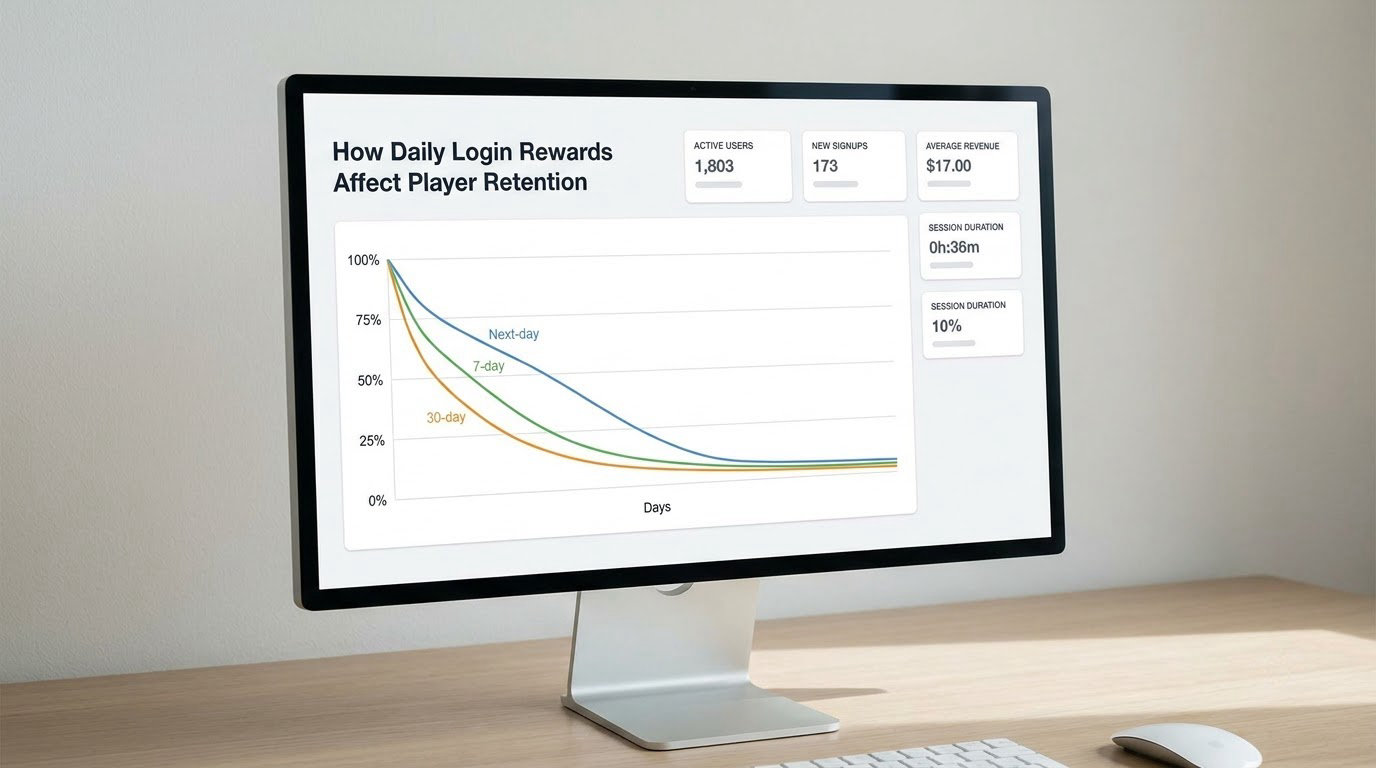
Daily login rewards raise short-term return rates because they attach an escalating, scheduled reward to one specific action: opening the game today. The honest summary is that they reliably improve next-day return, help modestly at seven days, and produce little measurable lift at thirty days unless the reward hands the player straight into something worth playing.
The effects worth naming:
- Next-day return goes up and falls again once the streak ends, which is a scheduling effect rather than a change in how much the player enjoys the game.
- Seven-day retention improves slightly when the calendar holds something back, so the player has a reason to come back on day six.
- Day 30 rarely moves unless the reward leads somewhere. A reward with no destination is a task, not content.
- Login count can rise while engagement falls, because claiming a reward is fast and playing is not.
- Momentum effects reach the back end of the funnel, since more week-one survivors means more players exposed to events, social systems and updates that do the real retaining.
So when someone asks how daily login rewards affect player retention, the useful answer is that they affect attendance far more than attachment.
What Player Retention Does a Login Reward System Improve?
Retention is not one number, and a login program touches some parts of it harder than others. Teams that treat Day 1 and Day 30 as interchangeable end up celebrating the wrong result.
| Metric | What it measures | Does a login streak move it? |
|---|---|---|
| Next-day return | Share of new players who open the game the following day | Yes, strongly. This is the metric the mechanic was built for. |
| Day 1 retention | Classic next-day cohort retention for a signup cohort | Partly. Onboarding quality usually moves this more. |
| Day 7 retention | Share still active a week after signup | Modestly, and only when the reward hands off into play. |
| Day 30 retention | Share still active a month after signup | Rarely on its own. Benchmarks for top mobile games sit around 25-40% at Day 1 and drop sharply by Day 7. |
| Rolling retention | Unbounded: share of a cohort active in any given week, no age cutoff | Yes, for a few weeks, then flattens. |
| Sessions per player | How much the game is played, not just opened | Often no. Sometimes slightly negative. |
| DAU/MAU stickiness | Share of monthly users playing on any given day | Yes in the short run, which is exactly why it flatters the program. |
The gap between the two retention families matters. Classic N-day cohort retention asks what happened to one signup group on one specific day. Rolling retention asks how much of a group is playing this week at all. A streak inflates rolling numbers and Day 1, so a dashboard full of blue DAU lines can hide a cohort curve that is falling apart after day three.
Contextual push and notification timing often get named in the same breath, but they act on a different lever. A streak reward creates the motive; the notification decides whether the player hears about it.
Why Do Daily Rewards Encourage Players to Return?
Every effective login mechanic leans on a handful of well-documented behaviours, and each one has a downside that shows up later. Understanding both halves is how you design the first without shipping the second.
Streaks and sunk value. Once a player has banked five days, day six is worth more because of what is already at stake. The design works, and it also means the first vacation of the year can cost a player their month.
Loss aversion. People weigh a lost reward roughly twice as heavily as an equivalent gain. That asymmetry is exactly what makes the deadline feel urgent.
Anticipation of the big day. The rare item sits visibly on day seven, and that visible destination pulls the player through the boring middle of the week.
Routine. A login alert at a fixed time is a habit cue in the ordinary sense. Once the association forms, the player often opens the app without deciding to play.
Visible progress. A row of ticked days is a progress bar most games never have to build, and it costs nothing to display.
Variable rewards. Randomized login drops add unpredictability on top of the schedule, which is the same psychological structure that makes loot boxes work.
The resentment side is just the mirror image. Pressure builds when a reward is trivial, when a reset wipes out accumulated value with no recourse, or when a friend who joined later receives a better schedule than the player who has been there since launch. Players describe exactly that last one as unfair in forum threads on r/PredecessorGame, where a day-six reward had visibly underperformed what a newer account received.
Which Daily Reward Designs Work Best?
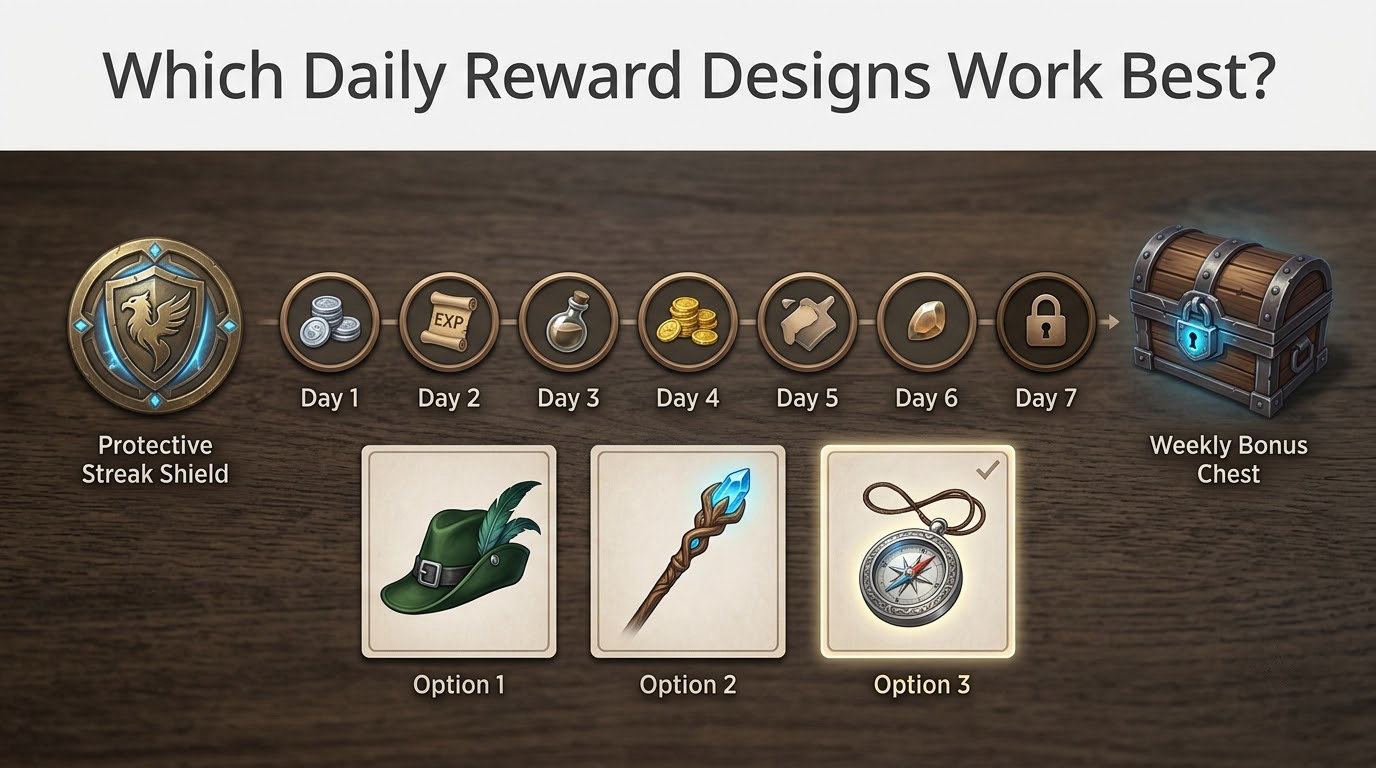
Design patterns differ less in the currency they hand out than in whether they punish absence. The patterns below are ordered roughly by how forgiving they are.
| Design | Player appeal | Retention strength | Build effort | Common failure |
|---|---|---|---|---|
| Choice-based rewards | High, players feel authorship | Moderate, sustained | Medium | Every option is bad and the pick feels meaningless |
| Capped streak with a milestone | High, reachable finish line | Moderate, sustainable | Medium | Nothing after the milestone, so Day 8 onward is flat |
| Progressive calendar, 7-day cycle | High, clear escalation | Strong in week one, decays | Low | Reset punishment ends the player’s participation entirely |
| Progressive calendar, 30-day cycle | Moderate, long runway | Strong in month one, harder to reason about | Medium | Too many steps, and the later rewards are never reached |
| Streak freeze or grace token | Very high, removes the panic | Strong, extends the habit window | Medium | Every freeze token is sold to players who earned them free |
| Randomized daily drop | High for the first months | Moderate, habit-based | Low | Reads as predatory once players expect a floor |
| Weekly challenge tied to play | High, has a gameplay reason behind it | Strongest long-term of the group | High | Unwinnable for a casual player, so it excludes exactly the people a daily login was meant to catch |
The weekly challenge row matters most. It is the only pattern on this list where the reward cannot be collected without playing, which is why it survives past the first week.
How Can Rewards Prevent Player Burnout?
Most streak abandonment is not a decision against your game. It is a player who missed Tuesday, lost eleven days of progress, calculated that rebuilding costs more than returning costs, and quietly never opened the game again. The fix is design, not messaging.
Catch-up systems. Let a returning player collect everything they would have earned since their last visit, capped at some limit. This converts a broken streak into a happy return.
Forgiving resets. A soft reset that starts the player partway through the calendar does less damage than a hard reset to day one.
Accumulated storage. Unexclaimed days that bank toward a later reward turn absence into progress instead of loss.
Randomized rewards. Random drops lower the emotional cost of missing a specific item, because there is no single prize to forfeit.
Rotating themes and capped streaks. A streak that ends at day seven with a clear finish line is easier to restart than one that runs indefinitely and always feels behind.
A real reason to log in. A reward that lands directly inside a session with something to do takes ten seconds longer to claim, and those ten seconds are where play begins.
None of this requires a bigger reward budget. It requires deciding in advance which failure you would rather have: a player who returns empty-handed, or a player who does not return.
How Do You Measure Whether Daily Rewards Improve Retention?
You cannot read causation off a DAU chart, because almost everything else you ship moves DAU too. The only clean answer comes from holding part of your player base out of the program and comparing.
How to measure how daily login rewards affect player retention
Run a randomized holdout. Before the program launches, split new signups into two groups with identical onboarding and store presentation, show one group the login calendar and keep it hidden from the other, then compare the two cohorts at Day 1, Day 7 and Day 30. Incremental retention is simply the difference between the exposed cohort and the holdout, expressed as a percentage of the holdout rather than as a raw gap.
Five things to check alongside that number:
Session quality. Median session length, sessions per day and the share of sessions under two minutes. A reward program that raises logins while pushing session length down is producing phantom retention, and the dashboards most teams rely on will not show it unless they look at sessions per daily user rather than daily active users.
Downstream behaviour. Did the extra week-one survivors reach the trading, social or event systems that do the actual retaining?
Monetization. Purchases, rewarded ad views and payer conversion for exposed versus holdout. In AFK Arena’s case, medal rewards were reported as lifting revenue 41% in the first month with about 30% of that sustained, which is the kind of follow-through a login grant should show.
Guardrails. Support tickets about rewards, notification opt-outs, session count collapsing among your most engaged players, and complaints in places like the EA forums where delivery bugs surface within hours.
Decay. Re-measure at Day 30, not Day 7. If the gap between cohorts narrows toward zero, the streak changed scheduling rather than attachment, and that is a useful thing to know before you spend another quarter on it.
When Are Daily Login Rewards a Bad Idea?
Login rewards stop paying off in predictable situations, and the warning signs show up in data long before anyone complains publicly.
Day 30 is flat. If the holdout and the exposed cohort converge by the second week, you have a scheduling tool, not a retention tool. That is fine to keep, as long as nobody claims it as a growth lever.
Players claim and leave. Sessions under two minutes climbing while sessions per player falls means the reward has become the entire activity.
It replaced something better. A login grant that pays out the same value as a weekly event discourages the weekly event. One published simulator case study moved Day 7 retention from 12% to 22% through a social and trading system, a far larger gain than the streak’s 35% bump in week-one returns, and the two rewards were live at the same time.
Delivery fails. Broken reward delivery is the loudest complaint players raise about these systems. A thread on r/Battlefield described a player logging in daily through a launch-to-October streak who never received the reward and had no path to compensation. One silent bug costs more trust than the entire program earned.
It punishes the wrong people. A system that only works if you check in every single day excludes players with irregular hours, students, shift workers, parents and anyone playing for fifteen minutes at a time.
Nobody remembers it. If a reward would not be missed by anyone, the honest fix is to delete it and spend the margin on content. r/androiddev threads show the other side of this too, where a developer reports 100k downloads and only 13 daily players and cannot tell whether a login bonus would fix it.
Frequently Asked Questions
What is the best streak length for a daily login reward?
Seven days is the most common choice because it fits a week, ends on a visible milestone and is short enough to restart without drama. Thirty-day calendars hold attention longer but are harder for players to reason about and slower to reward. Capped cycles with a clear finish line outperform open-ended streaks, because a streak with an end can be restarted casually while an endless one feels permanently behind.
How should a game handle missed login days?
Offer a grace window or freeze token, bank unclaimed days toward a later reward, and let returning players collect everything they missed up to a cap. The goal is to make a week away cheap instead of expensive. A hard reset to day one punishes exactly the players a re-engagement program is trying to win back, and many simply stop opening the game.
Do daily login rewards increase spending or only login frequency?
Both, but not equally reliably. A login grant raises login frequency directly, and more logins mean more chances to see a store, take an ad or reach a purchase prompt. The measurable version of this is monetization per retained player rather than total revenue, since a program can lift revenue without making anyone spend more per session. AFK Arena’s medal rewards were reported as lifting revenue 41% in month one with roughly 30% sustained.
Should daily rewards replace weekly events or regular progression?
No. Daily rewards work best as a small top-up layered on top of real progression and events, not as a substitute for them. When the daily grant pays out roughly what a weekly event pays out, players rationally skip the event, and the more interesting content stops earning its keep. Give the daily reward a small, reliable value and let events carry the exciting rewards.
Why can a daily login reward increase D1 retention but reduce D30 retention?
Because next-day return can be a scheduling effect while 30-day retention measures attachment. A player who only opens the game to collect a reward still appears in Day 1 numbers, then leaves permanently once the calendar ends, pulling the long-term curve down. It can also cannibalise better content, so players spend their limited session on a claim instead of the gameplay that would have kept them.
How do developers calculate the incremental retention from login rewards?
Split new players into an exposed group that sees the login calendar and a holdout that does not, keeping onboarding and store presentation identical. Then measure each cohort at Day 1, Day 7 and Day 30, subtract the holdout rate from the exposed rate, and express the result as a share of the holdout baseline. That percentage, tracked over a month, is the program’s real return.
Conclusion
Daily login rewards are a scheduling tool disguised as a retention tool. They reliably move next-day return, help a little at seven days, and rarely change Day 30 on their own, so treat any claim that a streak will hold players for a month as a hypothesis until a holdout group says otherwise.
Start with a baseline retention cohort before you ship anything. Then test a forgiving structure built around grace windows, catch-up and a reward that leads directly into play, and scale only when it produces incremental long-term retention rather than a rising count of players who collect a coin and close the app.