To be direct about how idle games keep you playing: they turn progress into a visible number that grows while you do nothing, so each short visit ends with a reward you can see and spend. Add offline earnings that reward returning rather than staying, upgrades that make the next hour faster, and a prestige reset that turns an hour of progress into a permanent multiplier, and the loop runs itself.
That loop is the genre’s whole trick, and once you can name its parts you get better at deciding whether you’re playing it or it’s playing you. This guide walks through the mechanics one at a time, in the order they appear in play, then names the places where the design turns sour.
Table of Contents
- 1What Makes Idle Games So Easy to Play?
- 2How Do Idle Games Keep You Playing?
- 3Seven mechanics behind how idle games keep you playing
- 4How Does Progression Create a Reason to Return?
- 5Why Are Rewards and Feedback So Important?
- 6How Do Collections and Tiered Goals Encourage Long-Term Play?
- 7Prestige, and why throwing progress away feels like a win
- 8What Role Do Short Sessions and Notifications Play?
- 9How Can Idle Games Create Suspense Without Feeling Manipulative?
- 10How Do Players Balance Autonomy and New Goals?
- 11Guardrails that keep the loop yours
- 12What Makes an Idle Game’s Reward Loop Work?
- 13Frequently Asked Questions
- 14Why do idle games make me want to keep playing?
- 15Do idle games really make progress while I am away?
- 16What is the main difference between an idle game and an incremental game?
- 17How do idle games create goals without constant active play?
- 18Are daily rewards in idle games manipulative?
- 19What is the best way to design a satisfying idle-game loop?
- 20Conclusion: Start With the Core Reward Loop
What Makes Idle Games So Easy to Play?
An idle game is one where progress continues without active input. You tap or set something running, the game accumulates resources while you are away, and you return to collect what accrued and spend it on an upgrade or another reset.
The three words get used interchangeably, and they are not identical. A clicker game is the manual version, where most of your income comes from clicking and the upgrades only bend the numbers a little. An idle game leans on automation, so the tapping is a short opener rather than the job. An incremental game is the broader tradition that both belong to, built around the shape of the number curve rather than any story or setting.
What all three share is a very low cognitive load. There is no time pressure, no reflex requirement, and usually no fail state. A player at a bus stop can open one, spend twenty seconds placing three upgrades, and put the phone away knowing nothing was lost.
How Do Idle Games Keep You Playing?
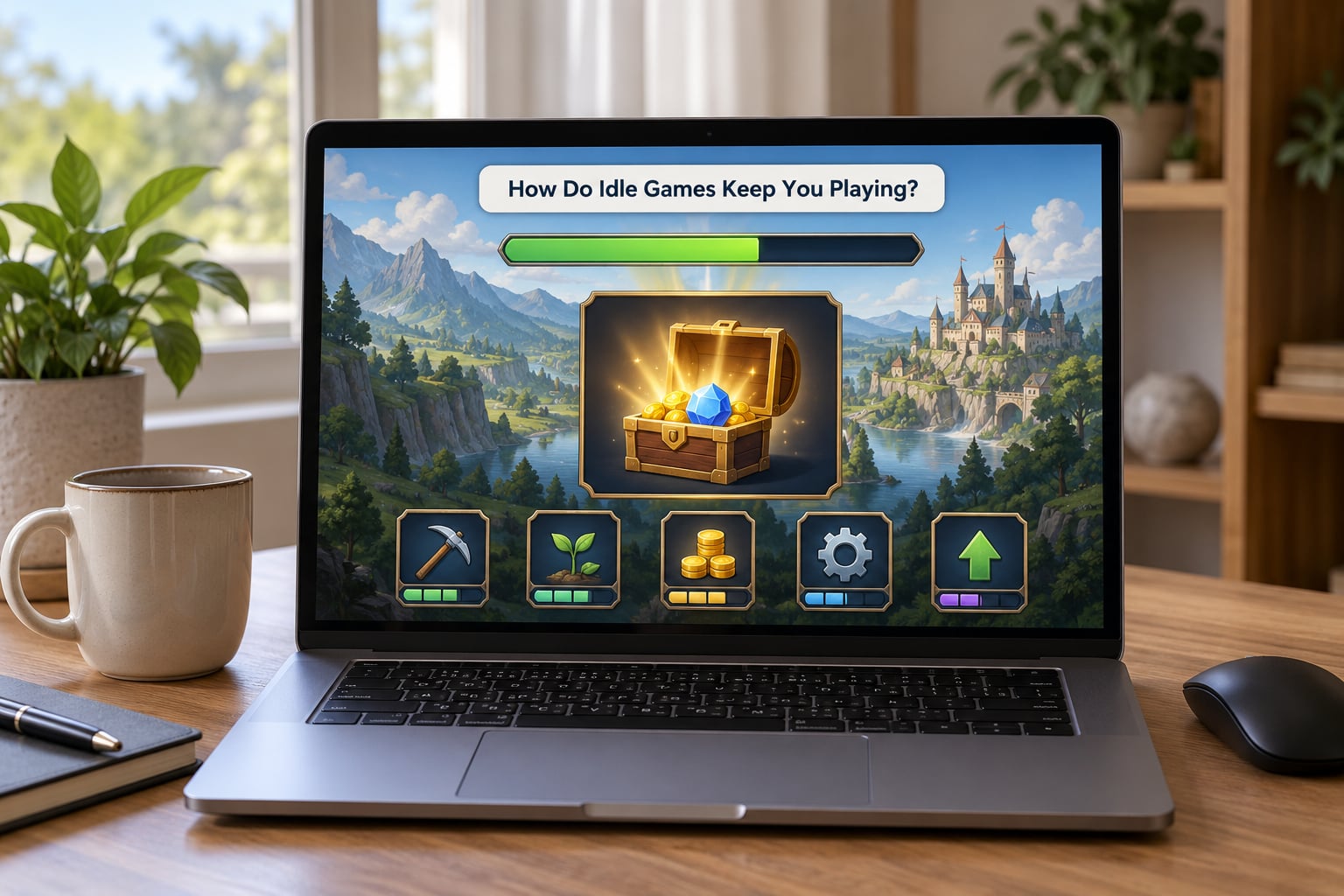
The retention comes from seven mechanisms that stack on each other. Remove any one of them and the genre gets noticeably harder to stick with, which is exactly why the good ones are tuned so carefully.
Seven mechanics behind how idle games keep you playing
Visible progress. The core of the payoff is a number that goes up. Early gains are large and obvious, then the curve steepens so the same actions produce a bigger absolute jump.
Reward feedback. Every purchase produces a sound, a flash, and a new number, so spending is never silent.
Rate upgrades. New upgrades multiply production rather than adding flat amounts, so the same screen shows compounding growth.
Automation. Buying the first auto-collector converts the game from a job into a background process, and that conversion is the point of the whole design.
Offline earnings. Progress that accrues while the game is closed gives you a reason to come back rather than a reason to stay.
Collections and tiered goals. A list of things you do not have yet pulls you forward as reliably as a number does.
Prestige. Resetting your run for a permanent bonus gives an old session a reason to matter after the numbers go back to zero.
How Does Progression Create a Reason to Return?
Progression is what converts a five-second glance into a decision. You open the game, see that the offline total is waiting, and now spending it is a choice with a visible payoff rather than a chore.
Offline earnings are usually calculated at a reduced rate, sometimes with a cap measured in hours. That design choice does two things: it rewards a return after a break, and it creates a reason to come back again soon. A nine-hour capped night and a one-hour workday visit produce very different numbers, and the game quietly teaches you which rhythm it wants.
The curve underneath is exponential. Production rises multiplicatively, so the gap between an early save and a late save is measured in zeroes. Developers quoted in a widely read write-up on the genre put idle titles at roughly 18% stickiness against about 10.5% for hyper-casual games, with Day-1 retention in the high twenties, Day-7 near 8%, and Day-30 under 3% for category averages.
Those numbers describe a genre that holds attention far better than its shallow input suggests, then bleeds players quickly. The early curve is generous on purpose. Cookie Clicker, the 2013 browser game that pulled most of the genre into view, made that generosity a design statement, and later entries like Adventure Capitalist and Antimatter Dimensions kept the shape while changing the theme.
Why Are Rewards and Feedback So Important?

Feedback is what makes the reward legible. A number that increases while nothing visibly happens reads as a bug, so the interface spends a lot of effort making growth observable: progress bars, floating coin text, particle effects, and a distinct sound for each tier.
Part of this is unfinished-task psychology. A bar sitting at 70% is mildly annoying in a way a full bar never is, so partial progress pulls a player back to finish it. Idle games lean into this deliberately with research timers and milestone counters that sit just out of reach.
Currency layers reinforce the same idea. Soft currency is earned constantly and resets with the run. Hard currency is bought or won rarely and never resets. Meta currency comes from prestige and persists across everything, which quietly turns a throwaway session into permanent progress.
The practical test is whether a player can describe why they checked in without looking at a guide. If the answer is “a number went up and a bar filled,” the feedback is doing its job.
How Do Collections and Tiered Goals Encourage Long-Term Play?
Collections pull you forward for a different reason than raw currency. A currency total says grow bigger, while a collection says finish the list, and finishing feels like closure rather than work.
JT Cutting’s 2019 study of idle game play, “Busy doing nothing? What do players do in idle games?”, found that building collections of in-game items is a common motivational pattern whether or not the game rewards the behaviour. Players keep completing lists the developer never explicitly pays them for, because the completion itself registers as progress.
Achievements, stage goals, and tiered milestones work the same way, distributing a long curve into many small endings instead of one distant one. Each tier gives a short session a reason to have a shape.
Prestige, and why throwing progress away feels like a win
Prestige, also called reincarnation, ascension, or reset-for-bonus, wipes your run and grants a permanent multiplier based on how far you got. Nothing about it is obviously good, and that is the design. The multiplier is stronger than anything you could have reached in the same time, so the reset produces a faster next run rather than less progress.
Because the payoff is larger than the sacrifice, the loss registers as investment. This is the mechanic genre veterans argue about most, and the threads on r/incremental_games titled “Prestiging – Yay or Nay?” and “I hate prestiging” make the split obvious.
The well-tuned version lets you reach a comfortable first run before offering a reset, and previews the reward before you commit. The badly-tuned version offers prestige within minutes, repeats it every few hours, and uses it to extend a game that has run out of content instead of adding something new. That version feels like punishment, and veterans describe it as the main reason newer games feel shorter and more formulaic than the older endless ones.
What Role Do Short Sessions and Notifications Play?
Session length in the genre is unusually short, often 30 to 90 seconds, and that constraint shapes the rest of the design. A session has to reach a decision point fast enough to survive a queue or a conversation, so the loop front-loads a purchase or a claim in the first few seconds.
Timers are the counterweight. An upgrade that takes 45 minutes to pay for gives you a scheduled return, and the game pushes notifications at you so the appointment happens without you deciding to make it.
That habit window is the fragile part. A daily check-in at a consistent time is easy to keep. Notifications that fire at 11pm, or that arrive more often than the game has anything new to say, wear the habit down instead. Players describe the intended rhythm plainly: buy a few upgrades, idle for a few hours, come back. The whole experience depends on the return actually happening, which is why notification timing is a design decision with real consequences.
How Can Idle Games Create Suspense Without Feeling Manipulative?
Anticipation is a legitimate tool. A known reward arriving later gives the intervening minutes something to hold, and mystery drops give a reason to keep opening rewards.
The line is crossed when waiting becomes the content. An App Store reviewer describing one mobile idle title wrote that ads were offered constantly, several every minute, with progress blocked past a certain point unless you watched. That is the failure mode: the game stops rewarding playing and starts charging for permission to play.
Common pressure tactics include capped offline earnings that punish a missed check-in, event timers that expire if you look away, rewarded ads sold as the only way to skip a wait, and an upgrade ladder where each tier costs so much more than the last that paying feels required rather than optional. Ad fatigue is the usual result, and so is a player who stops trusting the numbers.
Player trust is the honest measure. In a 2015 idle game diary published on the Coin Arcade blog, the writer described the pull as being encouraged to keep the game running at all times, which reads as a description rather than a complaint because the numbers kept rewarding them. Lose that trust and the same mechanic reads as nagging.
How Do Players Balance Autonomy and New Goals?
Good idle design gives you a choice every session and something new to chase every few hours. Spending currency is the choice, and new tiers, goals, or unlocks are the chase. The tension between them is the whole balance: too much choice and there is no goal, too many goals and the choice stops mattering.
A concrete example is the decision at 4% offline progress. You can spend the small amount you have now on a cheap rate boost, or bank it toward a tier that unlocks a new zone in an hour. Neither is wrong. Both create a reason to open the game again.
It also explains why the genre can feel restful to some people and unbearable to others. One player type wants a low-effort background process; another cannot tolerate repetition at any volume. The Tazy’s Corner essay describes idle games as pulling the curtain back and showing the nervous system of a game with no graphics to hide it.
Guardrails that keep the loop yours
Pick two check-in times and ignore notifications outside them. Turn off the game’s notification permission and open it on your own schedule, which costs almost nothing in progress because offline earnings are waiting either way.
Decide the session length before you open the app, and stop when the timer goes. Ad-gated titles are the ones worth quitting outright rather than budgeting around.
If progress stops mattering and the numbers just rise, that is a signal rather than a failure. It means the loop has worn out, and genre veterans on r/incremental_games talk openly about moving on to something with new systems rather than grinding a dead curve.
What Makes an Idle Game’s Reward Loop Work?
The cycle is act, collect, spend, automate, anticipate, reset. Each mechanic in that chain covers one link, and the loop feels clean when no link is missing and no link is exploitative.
| Mechanic | What the game does | What it feels like to play |
|---|---|---|
| Earn | Raises a resource total on a timer or a tap | A small, frequent win that needs no thought |
| Spend | Converts the total into higher production | A decision with an obvious right answer early on |
| Automate | Buys collectors so income continues unattended | Relief, because the game stops asking for taps |
| Earn offline | Accrues income while the game is closed, often capped | A welcome owed to you, plus a reason to come back soon |
| Prestige | Resets the run for a permanent multiplier | Losing something on purpose in exchange for more |
| Goals and notifications | Sets tiers and timers, then pings you about them | A scheduled appointment with the game |
Read down the feels column and you can see the real product. Not the theme, not the art, not the story. A sequence of small reliefs arranged so that stopping early costs you nothing.
Frequently Asked Questions
Why do idle games make me want to keep playing?
Because progress is visible and the payoff arrives before you lose interest. A number rises while you are away, a reward is waiting when you open the app, and spending it produces immediate feedback. Automation means leaving is not losing, so the game never demands a long session. The short version is a reward loop you can enter, enjoy, and exit inside a minute, which is easy to repeat several times a day without committing to anything.
Do idle games really make progress while I am away?
Most do, and that offline earnings system is the mechanic that creates the return visit. The game calculates what your automated production would have made during the time the app was closed and credits it when you open it. Many titles cap the total at a set number of hours, and some apply a reduced rate to the offline portion. A player who checks in regularly earns noticeably more than one who forgets for a week.
What is the main difference between an idle game and an incremental game?
An incremental game is the broader category, defined by a number that grows over time and a progression curve that shapes how satisfying that growth feels. An idle game is the subset built around progress that continues without your input. A clicker sits on the other end of the same spectrum, where most income still comes from clicking. In practice the terms overlap constantly, so what matters is how much of the loop runs itself.
How do idle games create goals without constant active play?
Through counters that fill on their own. Research timers, milestone bars, and collection lists all advance whether or not you are playing, so the goal keeps moving and your job is only to decide what to spend when you check in. This is also why partial progress matters so much: a bar at 70% pulls a player back to finish it, while a completed list does not. Goals stay alive without demanding attention, which is unusual in games.
Are daily rewards in idle games manipulative?
Sometimes, and the tell is whether waiting is the point or the content is. A daily login that pays a small bonus for showing up is routine design. A streak system where missing a day resets weeks of progress is pressure, and a game that blocks upgrades behind watching ads every few minutes is charging you for the right to continue. If a mechanic makes you feel anxious about a missed day rather than pleased about a returned one, that is the answer.
What is the best way to design a satisfying idle-game loop?
Make every action produce feedback, and make progress survive absence. A short interactive opening should establish a reward, upgrades should raise the rate rather than the total, and automation should arrive early enough that the game becomes a background process. Then add one layer that persists across a reset, such as a prestige multiplier. Finally, name the pacing honestly in advance, so players can plan around timers instead of being surprised by them.
Conclusion: Start With the Core Reward Loop
How idle games keep you playing comes down to a small number of mechanics doing the same job together: a visible number, immediate feedback, offline progress, goals that fill themselves, and a reset that makes the next run faster. Each one covers a different link in the cycle of acting, collecting, spending, automating, anticipating, and resetting.
If you want to know which mechanic has hold of you, start with offline earnings, since that is usually the one shaping when you open the app. From there, look at prestige, because a reset that arrives too early or rewards too little is where good design turns into a grind. Understanding those two is usually enough to make the choice yours again.