
You make money in game economies by finding activities that reliably produce currency or items players want, then selling the output for more than it costs you in time, materials, and fees. Farming, crafting, gathering, trading, quest rewards, production, and event participation all work, but only some of them turn a profit once you subtract the real cost of doing the activity. This guide walks through what you need before you start, the sequence that turns a lucky drop into repeatable income, and the mistakes that quietly turn a good farm into a hobby that costs you money.
Last updated October 2026. Patches move prices around constantly, so the game titles here are examples. The method is what survives.
Table of Contents
- 1What You Need to Make Money in Game Economies
- 2Game knowledge worth more than speed
- 3A starting cushion and something to sell
- 4Tools that take the guesswork out
- 5Account and market conditions
- 6Read the economy before you commit to it
- 7Step-by-Step: How to Build Income That Repeats
- 8Identify What Players Need
- 9Choose a Repeatable Way to Make Money in Game Economies
- 10Buy and Sell With a Margin
- 11Reinvest Without Overcommitting
- 12Track Your Results and Adjust
- 13Common Mistakes That Wipe Out Profit
- 14Frequently Asked Questions
- 15Is in-game currency real money?
- 16Can I earn real money by playing a game?
- 17Can I earn a lot of money in one day by playing games?
- 18What is the easiest game to make money in?
- 19What is the best way to grind money with limited playtime?
- 20Why is my game’s currency losing value?
- 21Conclusion
What You Need to Make Money in Game Economies

You need four things before a single trade: a working knowledge of what the game actually rewards, a small starting cushion of currency, a way to read the market, and a clean account. None of it requires spending real currency, and if a guide tells you to buy your way in, that is the wrong guide.
Game knowledge worth more than speed
Every economy has a faucet, which is any source that adds currency, and a sink, which is anything that removes it. Quests, dungeon drops, gathering nodes, boss kills and crafting refunds are faucets. Repairs, taxes, travel, item upgrades, rerolls and vendor trash sales are sinks.
Where the faucets outrun the sinks, prices fall. That is inflation inside a game, and it is why an item that cost a few hours of farming a year ago can now cost ten minutes. Knowing which side of the ledger an activity sits on tells you whether your income will hold its value.
A starting cushion and something to sell
You do not need a large balance. You need enough to cover the inputs of one full cycle of your chosen method, plus a margin for a bad run. Selling to NPC vendors at face value is the weakest form of income in most games, because vendor markup means a merchant buys cheap and resells dear. Vendor trash can still fund your first trades.
Tools that take the guesswork out
A price history view is the most useful tool in most economies, because it shows you what an item sold for rather than what someone is asking. Beyond that, a spreadsheet for costs, a second character or bank slot for storage, and the community forum where price talk happens will do more for you than any add-on.
Account and market conditions
Check the rules before you trade. Most games forbid real money trading, and some also forbid trading with or sharing an account of unknown ownership. A quiet market with thin daily volume is a bad place to learn. A new season or a fresh server reset usually means prices are still settling and small mistakes cost more.
Read the economy before you commit to it
Fifteen minutes of observation saves you fifteen hours of bad farming. Check how many items actually sell each day, whether completed sales exist at all or only asks, and where the currency goes. Repairs, taxes, travel and upgrades that players cannot avoid are healthy sinks. Currency that piles up in alts with nothing to spend it on is a warning.
Then look for the faucets the developers keep adding. A new dungeon with its own loot table, a seasonal event with generous rewards, or a craft that refunds more than it costs all raise supply. Markets where that has already happened for several updates are usually the worst place to buy in and hope.
Two more questions decide it. Does your character clear content quickly enough for the method to be worth it, and does the method keep working when you are tired? The second one matters more than players expect, because a route that demands a full hour of peak attention will not survive a bad week.
Step-by-Step: How to Build Income That Repeats
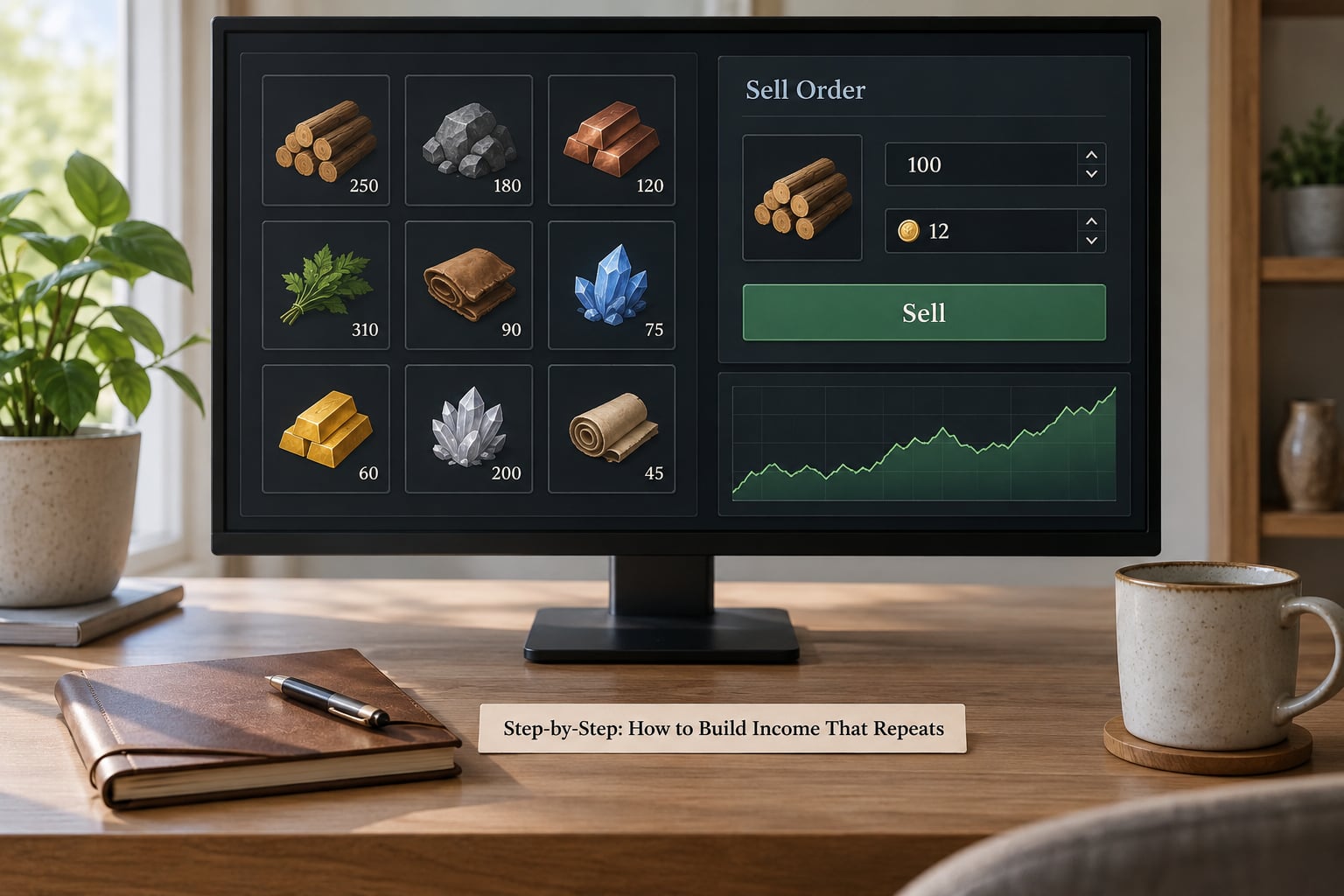
Repeatable income comes from five decisions, in this order. Demand first, then method, then margin, then reinvestment, then measurement. Skipping the first two is how players end up grinding something profitable on paper and worthless in practice.
Identify What Players Need
Start with demand, not with what you happen to produce. Look at what other players are actively asking for: crafting materials that sit empty in the market because nobody wants to gather them, gear upgrades that everyone wants but few can make, and consumables tied to a recurring event. Price history is the honest signal here. A long stretch of unsold listings means no demand, however high the price looks.
Three sources tell you more than guesswork: the order book, the quest list, and the forum. Order books show scarcity in the present. Quest lists reveal what the game wants drained, which often means the designers themselves are paying for the resource. Forums reveal what people are complaining about not being able to find.
Choose a Repeatable Way to Make Money in Game Economies
Every method trades time, capital and risk in a different ratio, so pick the one that matches how much time you actually have.
Gathering is the most reliable and the least lucrative. It scales with your knowledge of nodes, tools and routes, and it keeps producing when everything else dries up.
Crafting and production converts raw materials into something more valuable, and it rewards players who learn recipes and market timing. Production buildings in economy sims follow the same logic at a larger scale, and they keep earning after you log off.
Trading and flipping means buying an item below its going rate and listing it closer to the average. It needs capital and a feel for liquidity, and it carries the risk of buying a falling item and holding dead stock.
Quests, dailies and event rewards pay a fixed amount for a fixed time, which makes them the best starting income and a poor ceiling. Treat them as the floor your other methods are measured against.
Arbitrage is buying where an item is cheap and selling where it is expensive, usually across regions, servers or factions. It is the highest-margin option and the most fragile, because the spread closes the moment other players notice it. Liquidity, the ease of turning an item back into currency at a price you accept, is what separates a method that scales from one that ties up your inventory.
A healthy setup layers these. Dailies cover the basics, gathering feeds the crafting that produces the actual profit, and the occasional flip smooths out a bad week.
| Method | Starting cost | Skill needed | Risk | Scales up? |
|---|---|---|---|---|
| Gathering | Low | Route knowledge | Very low | Slowly, with tools |
| Crafting and production | Medium | Recipes and market timing | Medium | Yes, with capacity |
| Quests and dailies | None | Low | Low | No |
| Trading and flipping | High | Price reading | Medium | Only with more capital |
| Arbitrage across regions | High | Fast execution | High | No, spreads close |
Read the table as a starting point rather than a verdict. Your server, your server’s player base and your character’s clear speed will move every row.
Buy and Sell With a Margin
Profit is not the sale price minus the purchase price. It is the sale price minus everything the cycle cost you, which usually includes reagents, repairs, travel, listing fees, taxes, and the value of the time you spent.
Run it as a formula: net profit equals revenue from sold items minus material costs minus fees minus repair and travel costs, all divided by the hours the cycle took. That last division gives you what players call gold per hour, and it is the only number worth comparing across methods.
Worked example. You list 40 refined ore for 1,200 each, so revenue is 48,000. The ore cost 14,000, the tax and listing fees came to 3,200, and repairs and travel added 1,600. Net profit is 29,200. If the run took two hours including idle queue time, that is roughly 14,600 per hour, which is a completely different picture from the 48,000 headline.
Price against recent completed sales, not the highest ask. Undercutting on a thin market mostly earns you a sale at a price you already regret.
Reinvest Without Overcommitting
Reinvestment pays when it buys throughput, and hurts when it buys optimism. Tools, storage, faster gathering routes and crafting upgrades usually raise your hourly return, because they cut a cost you pay every cycle.
Keep a cash reserve you never reinvest. A buffer of roughly a third of your balance lets you absorb a bad run or a market dip without selling your goods into a panic. Beyond that, spread holdings across two or three goods rather than one, since a single-item portfolio has exactly one failure mode.
Only scale a method after it has proved itself across several cycles. Two good runs in a rising market is not evidence.
Track Your Results and Adjust
Keep one page per method with six columns: hours spent, items produced, revenue, input costs, fees, and net profit. Divide profit by hours and you have a comparable rate, and the trend line over two weeks tells you far more than any single session.
Check the price history of your main goods twice a week rather than every hour, because watching a market tick does not change it. If a rate falls, work out why first: a new faucet opened, a sink got weaker, or a patch changed drop rates. Then move your effort rather than working harder at a worse rate.
Common Mistakes That Wipe Out Profit
Chasing a spike is the most common error. Buy the item the forum is shouting about and you are the exit liquidity for whoever bought it earlier. Fix: list first, then buy only when completed sales support your ask.
Ignoring input costs is the second. A recipe that looks generous becomes a loss once you price the reagents. Fix: total every cost before the first craft, and include the reagents you consume on a failed attempt.
Spending your capital on upgrades before you have income is how beginners stall. Fix: run one full profitable cycle first, then reinvest from profits only.
Copying endgame routes on a starter character is the most common newbie trap, and endgame guides rarely say what gear they assume. Fix: ask what the method needs, then test a cheaper version of it.
Concentrating on one item is fine for a week and dangerous for a season. One patch, one new map, or one duplication exploit can erase the whole position. Fix: never let one good account for more than about half your holdings.
Trading with unverified accounts is where bans and scams live. Trades involving a character someone else logs into, gold bought from a stranger, or a deal that needs you to drop items outside a trade window are the standard pattern, and every mainstream game treats them as cheating. Fix: trade only through the in-game window, never share credentials, and never accept an item hand-off that bypasses it.
Selling or withdrawing at the wrong time means dumping a stack the moment it becomes valuable. Value spikes fade, so build a small buffer before an expected event and sell into it gradually rather than all at once. When a patch is announced, check whether it adds a faucet to your main commodity before you commit another week to it.
And one burnout note, because the grind loops that produce steady income are also the ones players complain about most. If your method needs three hours of the same dungeon to earn one upgrade, no price makes that sustainable.
Frequently Asked Questions
Is in-game currency real money?
No. In-game currency has value only inside the game, and it holds that value because players believe others will want it. It behaves like money in the ways that matter for trading, supply, demand and inflation, but it cannot be converted to cash without a third-party buyer, and those buyers operate against the rules of most games. Treat in-game currency as a working tool for buying upgrades, not as income.
Can I earn real money by playing a game?
Almost never by trading currency or items, which is real money trading and is banned in most games, usually with permanent account loss. The routes that do pay out are outside the game economy: competitive play, streaming, video, tournament winnings and community work. Those are real jobs with real practice hours, and they are not shortcuts to replacing income. Everything in this guide stays inside the rules.
Can I earn a lot of money in one day by playing games?
Claims of a fixed daily figure are usually the wrong measure, because they ignore the costs behind the number. The honest version is your net profit per hour, and the ceiling comes from how fast you can clear content, not from luck. A single great drop day is possible and unrepeatable. Judge a method on a two-week average instead, and treat any headline figure without fees, reagents and hours as advertising.
What is the easiest game to make money in?
The easiest games to earn in are the ones with a liquid market, steady faucets and a low cost of failure, and that changes every season. A new or low-population server often has thin demand, while a mature game has deep markets and more competition. Instead of chasing a title, sample the marketplace of two games you enjoy and check recent completed sales before committing your time.
What is the best way to grind money with limited playtime?
Run several low-intensity sources in parallel rather than one high-intensity farm. Daily quests and dailies pay a fixed amount for a fixed time, gathering gives steady income you can set on a route, and crafting fits into short windows where a dungeon run does not. Diversified, low-effort routines consistently out-earn single jackpot routes for players who cannot play every evening.
Why is my game’s currency losing value?
Because currency is being created faster than it is being removed. Every new quest, extra drop, patched reward or duplicated item is a faucet, and repairs, taxes, upgrades and travel are the sinks that absorb it. When faucets grow or sinks shrink, the same amount of currency buys less. Check the patch notes for changes to reward tables and taxes, since that is usually the cause rather than any change in how you play.
Conclusion
Pick one item or one skill that other players clearly want, work out its full cost including fees and materials, and run a single small trade to test the margin. Record what you spent, what you received, and how long it took. If the net profit per hour is positive after three or four cycles, reinvest a portion of it and widen the routine. If it is not, change the method rather than the volume, and you will stay ahead of the players chasing the loudest price on the forum.