You can usually spot a cheater in a shooter by watching for patterns that skill alone cannot explain: aim that stops dead at full speed, enemies tracked through solid cover, reactions that land on information the player was never given. How to tell if someone is cheating in a shooter comes down to evidence across several rounds rather than one impressive play. The nine-step method below takes roughly fifteen minutes of careful review per suspect, and it works whether the player is a stranger in your lobby or someone you queue with every night.
Cheating claims are cheap and accusations are expensive. Players who mass-report skilled opponents push good people out of the game, and queueing with someone the anti-cheat flags can put your own account at risk. So the goal here is not catching someone out in chat. It is deciding, on evidence, whether a report is worth filing.
Table of Contents
- 1What You Need
- 2Step-by-Step: How to Tell If Someone Is Cheating in a Shooter
- 31. Check movement and positioning consistency
- 42. Compare aim patterns over several encounters
- 53. Look for information they should not have
- 64. Review timing, reaction speed, and damage anomalies
- 75. Check whether the account history matches the play
- 86. Compare the evidence, not one play
- 97. Check whether the result is technically possible
- 108. Ask for context and compare with other players
- 119. Report patterns, not assumptions
- 12Common Mistakes
- 13Frequently Asked Questions
- 14What is the most common sign that someone is cheating in a shooter?
- 15Can very good aim or instant reactions prove that a player is using an aimbot?
- 16How can I tell if a player has a wallhack without seeing their screen?
- 17Should I report a suspicious player immediately or gather more evidence first?
- 18What evidence should I include when reporting cheating?
- 19Can unusual movement or damage be caused by lag instead of cheating?
- 20Conclusion
What You Need
Most failed accusations fail because someone argued from a feeling. Gather these five things before you decide anything:
- The replay or a clip. Most shooters record every match. Without video you are working from memory, and memory of a bad fight is the least reliable evidence you have.
- Two or three separate encounters. One clip proves nothing about a pattern. Three clips of the same behaviour start to mean something.
- Timestamps. Note the round number, the clock, and the moment the suspicious play happened. Reporting is close to useless without them.
- Objective numbers. Kill counts, damage per shot, hit rate, headshot percentage, time-to-kill. Pull them from whatever stats page the game offers.
- Game context. The map, the weapon, the ping, the platform, and the rules the game states for that mode. Half of all false accusations come from ignoring these.
What you do not need is a detector tool or a third-party website. Anyone claiming to show you an exact cheat count per account is showing you an estimate, usually a paid one, and it will not hold up as evidence.
Step-by-Step: How to Tell If Someone Is Cheating in a Shooter
The steps run from cheap and quick to slow and conclusive. Work them in order and stop when the evidence stops.
1. Check movement and positioning consistency
Watch how the player moves rather than what they hit. Strong players hold angles nobody uses, clear corners on a timer, and take routes that save time. That is game sense, and it is the single most common reason a good player gets called out.
What is harder to explain is impossible movement: an instant 180-degree turn while the mouse travels the full distance in a single frame, sliding along geometry that should have caught the model, or a repeat route that passes through the same spot every time regardless of what happened there before. If the player uses the same non-obvious position in three consecutive rounds with no reason to expect you there, that is worth a note. If they move like a top ten player, that is a skill issue until proven otherwise.
2. Compare aim patterns over several encounters
An aimbot is software that detects an enemy and steers your crosshair onto them, sometimes fully, sometimes as a strong pull you can fight. The giveaway is not the shot landing. It is how the crosshair got there.
Human aim has a shape. A flick accelerates over roughly twenty frames, travels, then decelerates as the hand settles on target. Software often skips the deceleration and parks the crosshair at speed. Players on r/FPSAimTrainer built an entire method around this: step through a clip frame by frame, measure how many frames the crosshair takes to travel between two separate enemies, and check whether the aim settles the instant it arrives. A crosshair crossing in three frames, then stopping dead at full speed, is not a hand.
Also look for aim that ignores cover, tracks a moving target perfectly through a slide, or lands the same headshot pixel with an unfamiliar weapon every single time. One incredible flick is not evidence. Six identical ones in three rounds is.
3. Look for information they should not have
A wallhack, usually called an ESP overlay, reads enemy positions through walls and draws them on your screen with names, health, distance and gear. The player is not aiming better. They are playing a different, easier game.
The information tells are cleaner than the aim tells. Players on r/Rainbow6 name two that keep coming up: whipping instantly to snap onto someone who was never visible, and one-tapping you across a map with a non-magnifying red dot SMG where the geometry says that shot should not exist. Add a few more: pre-aiming an angle you have never used, reacting to footsteps you did not make, tracking a target through a visual effect, correcting onto a downed enemy nobody could see, and always holding the exact off-screen lane your push was about to enter.
Map knowledge explains some of this. Holding a common lane for nine rounds running is not cheating. Holding the one lane that only your route uses is.
4. Review timing, reaction speed, and damage anomalies
Numbers are where suspicion turns into a case. Reaction time in competitive shooters usually sits somewhere between 150 and 250 milliseconds. A player answering a peek at 90 milliseconds on a regular basis, from multiple opponents and multiple rounds, is worth examining.
Check the damage side too. Shots landing through solid cover, hitboxes behaving as though they are wider than the weapon should allow, one-tap headshots from weapons that normally take two shots at range, or a fire rate and reload rhythm that no amount of trigger discipline explains. A no-recoil cheat has a flatter signature than you might expect: recoil control that is identical on every weapon, every time, with no learning curve between an unfamiliar gun and a familiar one.
5. Check whether the account history matches the play
If you play with this person regularly, their account history is evidence too. On r/apexuniversity, one player described a friend who started from zero and, by level 17, had piled up nearly a hundred kills on one character and dozens on another. A genuine improvement curve has a ramp. A sudden jump that skips the ramp is the shape of a cheat or a bought account.
The same logic runs backwards. If a player has thousands of hours and their recent form collapsed, that is a slump, not proof of anything. Check recent matches rather than career highlights, and remember that someone switching mouse, sensitivity, monitor or controller can genuinely transform their aim overnight.
6. Compare the evidence, not one play
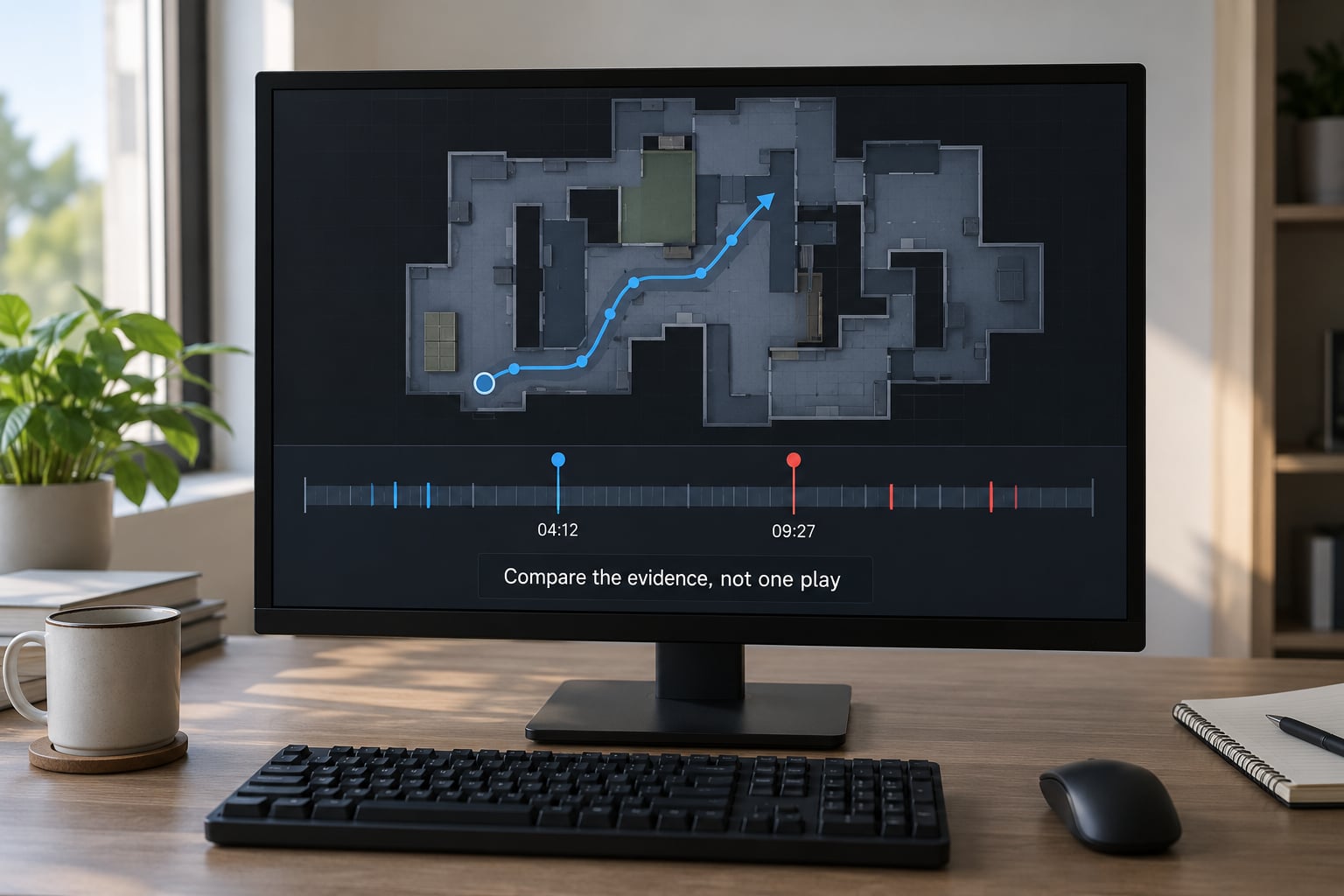
This is where most people go wrong. They pull one ace clip, one suspicious round, and build a verdict on it. Fight context distorts everything: your team is losing, you are behind on utility, the player is duelling four opponents while you have one.
Line up what happened against what usually happens. Does this player normally hold angles like that, or was it one round? Are their hits normal for them, or is this the first time all season? Three rounds of the same unexplained behaviour plus an ordinary baseline is a pattern. One round is an anecdote, and the r/cs2 thread that ended with the community deciding a player was simply pre-aiming well is the standard example of what careful comparison saves you from.
7. Check whether the result is technically possible
Before concluding, rule out boring explanations. High ping causes hits to register where the opponent has already moved, which looks a lot like a tracking aimbot. Low frame rate makes movement stutter and turns normal strafing into erratic bouncing. Server-side hit registration differs by region, and some games deliberately favour the shooter or the host. Menu settings, field of view, sensitivity, crosshair placement and monitor refresh rate all change how a game looks from the inside.
Check the weapon matchup too. Someone mowing down fifteen people with an M1 Garand, as one Hell Let Loose forum poster described it, told you something about the weapon and the lobby, not about macros. A disarm, a lucky spray, and a headshot on a moving target all happen.
8. Ask for context and compare with other players
Pull the wider record. How do other players in the same match describe them? Do the complaints come from a broad spread of opponents or from the one team that lost? Have other people in your friend group played against them and noticed anything, or are you the only one watching?
For someone you actually play with, ask directly and without an accusation. The most useful script sounds like this: I recorded a few rounds and I want to check something with you, can we look at round 14 together? People have answered that question honestly far more often than they respond to a public callout in chat. When cheaters are named out loud in voice chat, the common replies reported on r/Warzone are a flat bro, a skill issue, and then the rest of the lobby piling onto whoever raised it. That reaction tells you nothing about the evidence.
9. Report patterns, not assumptions
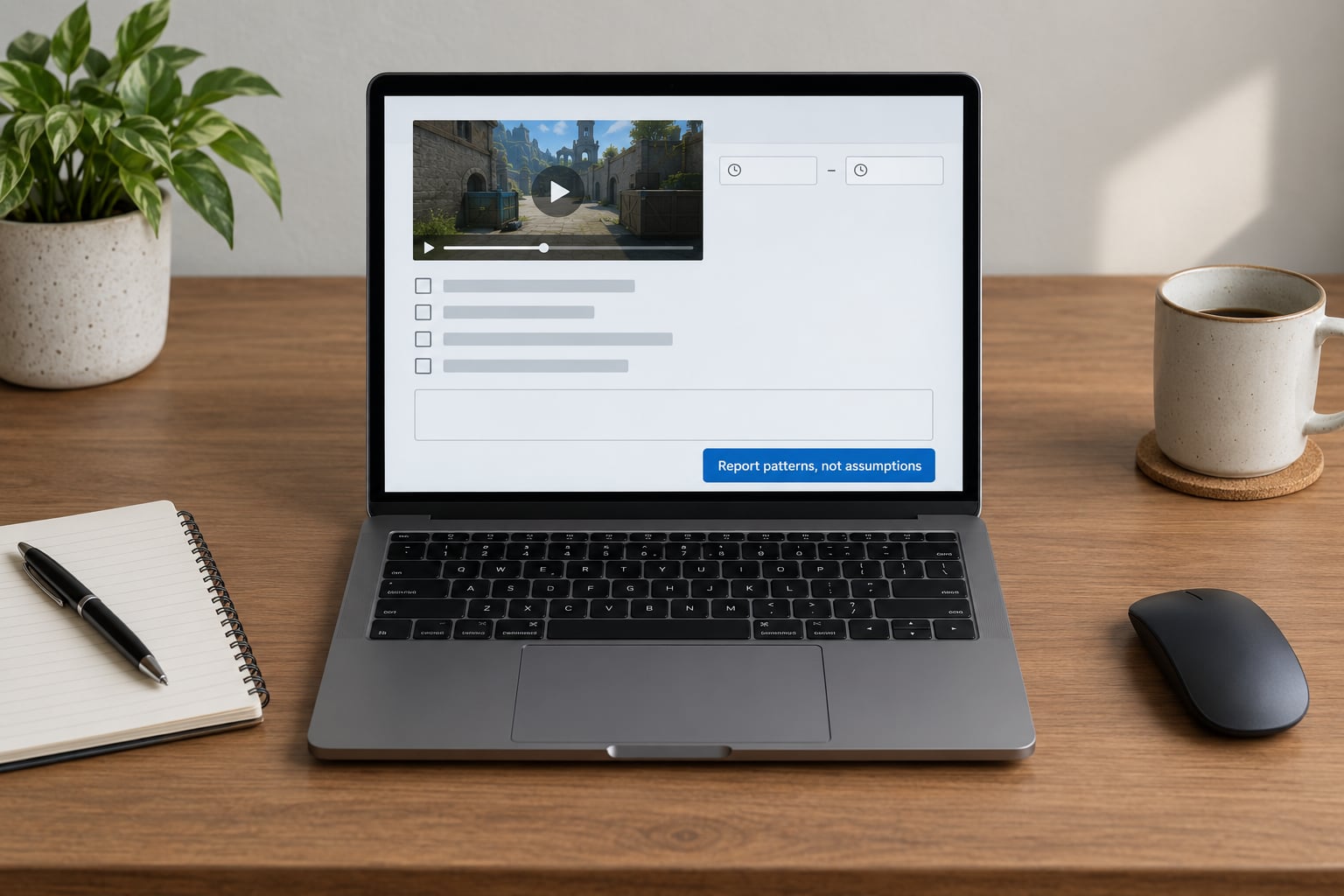
Report through the official channel, in the game’s own menu, as soon as the match ends. Write what you observed rather than what you concluded: round 14 at 1:20, crosshair travelled between two enemies in about three frames and stopped dead, same behaviour in rounds 6 and 19. Attach the clip if the game accepts one and point to the timestamp.
Keep it short, keep it in the system, and keep it to yourself afterwards. Public accusations do not help the anti-cheat team and do a lot of damage to the reputation of whoever files them. If a report comes back with no action, that is genuinely common. Most reports do not produce a visible ban because most reports do not meet the review threshold, which is why specific, repeatable evidence matters more than volume.
Common Mistakes
- Calling someone after one good play. One ace means nothing; plenty of legitimate players take over a match. Correction: require the behaviour to appear in at least three separate rounds before you type anything into a report.
- Treating skill as proof. Pre-aiming, crosshair placement, off-angle discipline and perfect first bullet all belong to good players. Correction: test every suspicion against the physics of human aim, which means deceleration and travel time, not just the result.
- Ignoring ping, frame rate and settings. A 200ms player is going to look like they predicted your movement. Correction: check the opponent’s connection and your own performance before drawing conclusions.
- Arguing in chat. The argument never resolves the question and it turns your lobby against you. Correction: save the clip, leave the chat, file the report.
- Treating other players’ reports as evidence. Someone being loud in voice chat tells you about that person, not the one they accused. Correction: only your own recorded observations go in the report.
- Waiting too long to report. Replays expire and some games only accept reports from the players in the match. Correction: file the same day, while you still have the footage and the in-game menu option.
One more worth naming: playing on after you are sure. A suspected cheater in your party drags your win rate and, in several games, exposes your account to a wave ban or a competitive restriction while the investigation runs. If a friend is convincing you to queue ranked anyway, that pressure is itself information.
Frequently Asked Questions
What is the most common sign that someone is cheating in a shooter?
Aim that settles on target instantly at full speed. Human flicks accelerate, travel and then decelerate over roughly twenty frames, while software often skips straight to the target. Aim that stops dead with no settling phase, repeated across several fights, is the strongest single indicator. Tracking enemies through solid cover is a close second.
Can very good aim or instant reactions prove that a player is using an aimbot?
No. A one-tap with a rifle or a 150 millisecond reaction can both be legitimate skill. Proving an aimbot needs measurable evidence, usually from a replay: measure the crosshair travel time between targets and check whether the aim decelerates on arrival. One impressive clip proves nothing, and accusing on that basis is how good players get pushed out of a game.
How can I tell if a player has a wallhack without seeing their screen?
You are looking for information they should not have. Pre-aiming angles you have never used, reacting to footsteps you never made, instant snapping to a downed or fully covered enemy, and holding the exact off-screen lane your team was about to enter. Reliable crosshair placement on popular angles explains a lot of this, so compare several rounds before you treat any single one as proof.
Should I report a suspicious player immediately or gather more evidence first?
Gather the evidence the same day, then report. Replays expire and some games only accept reports from players in that match, so waiting weeks costs you the option. But do not file on one round. Note the behaviour across three or more rounds, save the clip, write the timestamps, and describe what you saw rather than accusing, since specific observations are what review teams can act on.
What evidence should I include when reporting cheating?
Match details, round numbers, timestamps, the weapon and map involved, and a short description of the behaviour with no adjectives. Aim for something a reviewer can check in under a minute: crosshair travelled between two enemies in about three frames and stopped dead, or one-tapped from across the map with a non-magnifying red dot. Attach the clip if the game accepts it.
Can unusual movement or damage be caused by lag instead of cheating?
Very often, yes. High ping makes hits register on players who have already moved, which looks like a tracking aimbot, and a low frame rate turns normal strafing into erratic bouncing. Weapon spread, server-side hit registration and region rules also change how a fight resolves. Check the connection data and your own performance before treating an odd moment as evidence of anything.
Conclusion
Save the evidence first. That means the replay, the timestamps and at least three rounds of the same behaviour, not one clip you watched twice in chat. Compare those rounds against the player’s normal baseline, check that ping and settings cannot explain it, then describe what you observed in the game’s own report menu and leave the argument out of it.
When in doubt, leave the player alone rather than calling them out. A quiet report costs nothing if you were wrong. A public accusation costs you the lobby and costs a good player their place in a game they were genuinely good at.