A remake rebuilds the game from the ground up on a new engine, with new code, new assets and new design decisions. A remaster keeps the original game intact and re-presents it with higher resolution, a steadier frame rate, cleaner textures, remastered audio and modern control options. That single split explains almost everything else, including cost, timeline and the arguments fans have about each release.
Players usually hit this distinction at the worst possible moment: a game they love is being re-released, the marketing copy uses a word they half-recognise, and they cannot tell whether they are buying a fresh coat of paint or an entirely different game. So this guide breaks down how remasters differ from remakes in plain terms, names specific titles for each category, and flags the awkward middle ground where the labels get muddy.
Table of Contents
- 1How Remasters Differ from Remakes at a Glance
- 2What Is a Remaster?
- 3What a remaster can and cannot change
- 4What Is a Remake?
- 5Graphics and Visual Changes
- 6Gameplay, Controls, and Difficulty
- 7How remasters differ from remakes once you pick up a controller
- 8Story, Characters, and Worlds
- 9Levels, Modes, and Extra Content
- 10Platforms, Release Dates, and Price
- 11Which Should You Choose?
- 12Frequently Asked Questions
- 13Are remakes and remasters the same?
- 14How remasters differ from remakes in practice
- 15Is FF7 Remake a remake or a remaster?
- 16Is Oblivion Remastered a remake?
- 17What does remastered mean in a game title?
- 18A Clearer Way to Judge the Version
How Remasters Differ from Remakes at a Glance
The fastest way to sort any release is to ask one question: is the original game still running underneath? If yes, it is a remaster. If the original was a reference document and the game was built again, it is a remake.
| Category | Remaster | Remake |
|---|---|---|
| Basic definition | The original game, updated and re-presented | A new game built using an older game as the design reference |
| Source code | Original code retained and patched | New codebase written from scratch |
| Engine | Usually the same engine or a light migration | A current engine, often Unreal Engine 5 or a proprietary one |
| Art assets | Textures upscaled, lighting and shadows refreshed, models cleaned up | Models, environments and animation rebuilt for the new engine |
| Gameplay systems | Untouched, with optional quality-of-life additions | Redesigned around what hardware and design conventions now allow |
| Story and levels | The same scenes, dialogue and level layout | Can change plot, characters, pacing and mission structure |
| Audio | Remastered soundtrack, sometimes rerecorded voice lines | New score and new voice cast, often with the original tracks arranged differently |
| Controls | Original scheme plus an optional modern layout | A new control scheme, sometimes with a classic toggle |
| Typical timeline | Roughly 6 to 18 months | Roughly 2 to 5 years |
| Team size | A small, specialist team, often an outsourcing partner | A full production staff across design, art, engineering and audio |
| Examples | Demon’s Souls, Tomb Raider I-III Remastered | Resident Evil 2, Final Fantasy VII Remake |
Every other difference, including who funds the project and how long it takes, follows from that first row. A remaster is maintenance work on a functioning machine. A remake is a new machine built to look like the old one.
What Is a Remaster?
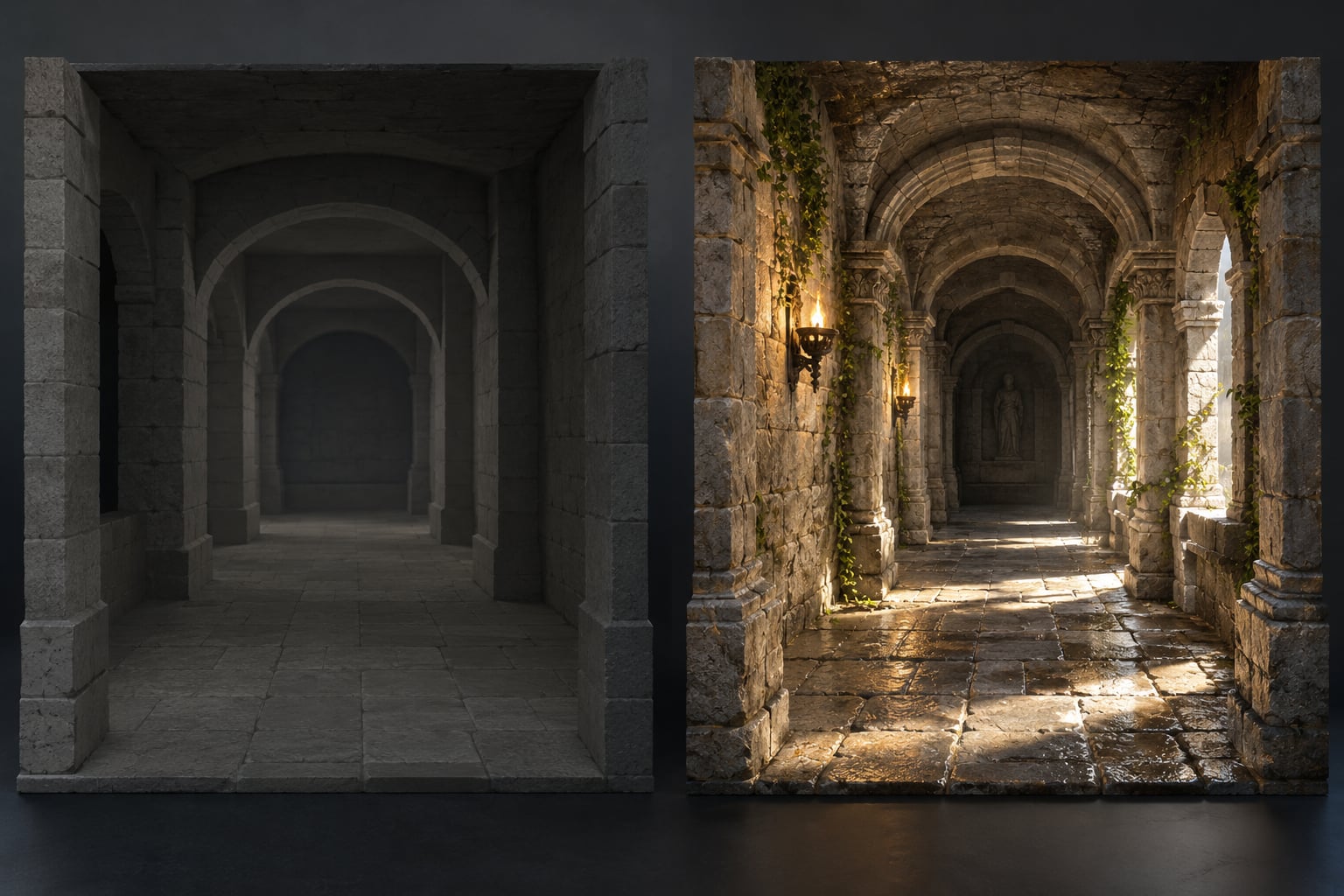
A remaster is a release built on top of the original game. The code, the level geometry, the quest order and the enemy placement stay where they were, and the work happens around them: upscaling textures, raising the frame rate, rebuilding lighting, replacing audio, and making sure the game holds a steady performance on hardware that did not exist when it launched.
Demon’s Souls is the clearest modern case. Bluepoint Games rebuilt the technical foundation while keeping the original logic, maps and rules intact, so the rebuilt version plays with the same rhythm and the same weird shortcuts players spent a decade learning.
Other examples include Tomb Raider I-III Remastered, Mass Effect Legendary Edition, The Last of Us Remastered and Diablo II Resurrected. Across all of them the design document was the 1997 or 2004 original, and the visual upgrade was in service of it.
What a remaster can and cannot change
A remaster can raise resolution and frame rate, upscale textures, rebuild shadows and lighting, remaster the soundtrack, add rerecorded voice acting, modernise the interface, add a modern control option next to the classic one, and add quality-of-life features such as a fast-travel menu or autosaves.
What it should not change is the game’s shape. When a remaster quietly cuts content, players notice, and the reason is often mundane: music and voice licences expired and cannot be renewed. A “remaster” that removes a level is a bad surprise, not a new edition.
What Is a Remake?
A remake is a new game that reproduces the story, setting or central ideas of an older title. The team starts with an empty project, a current engine and a design document derived from the original, then rebuilds every system, asset and animation from scratch.
Final Fantasy VII Remake is the standard example. It keeps the story’s shape and the Midgar setting, but the combat is a different system, the world is open rather than gated, and several characters and plot beats were rewritten. Resident Evil 2 from 2019 rebuilt a fixed-camera survival horror game into a modern over-the-shoulder one, and Resident Evil 4 Remake rearranged the whole village into a hub with open sections.
Remakes are why studios take two to five years and a full production team on a project that looks, on paper, like an old game. Nothing carries over except the idea.
Graphics and Visual Changes
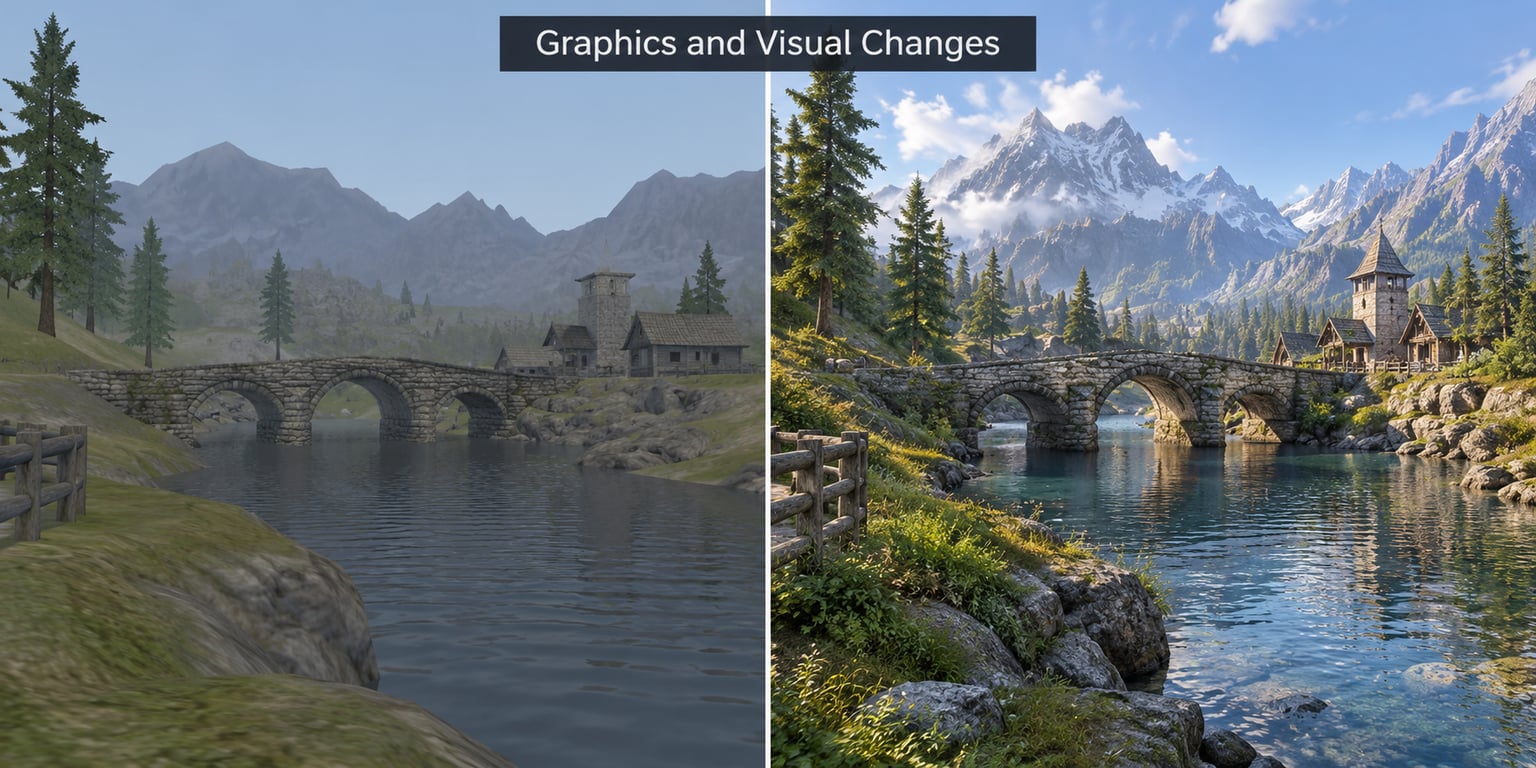
Graphics are where the difference is easiest to see and the easiest to overstate. A remaster improves what already exists. Textures that were 512 pixels become 2048 or 4096, flat lighting gains proper shadows and reflections, low-resolution character models get cleaned up, and the game renders at a resolution the display can actually show.
A remake can go anywhere. Because the art is new, the team can change the camera, the colour palette, the character faces and the entire art direction. Silent Hill 2 Remake rebuilt foggy streets and character models from scratch, and the result looks nothing like the 2001 original even though the locations are the same.
One practical note. A remake’s visuals being better does not make it a remaster, and a remaster’s visuals being sharper does not make it a remake. Visual quality is a consequence of the production approach, not the definition of it.
Gameplay, Controls, and Difficulty
Remasters change how a game feels in small, mostly optional ways. Expect better frame pacing, faster loading, an interface that is easier to read, and a choice between classic and modern control layouts. The moment-to-moment combat, progression and difficulty are meant to stay exactly where they were, because that is what longtime players are attached to.
Remakes change the game itself. Combat can be rebuilt around cover shooting, real-time combos or action points instead of a turn-based grid. Progression, physics, economy systems and mission design all get rebuilt around what modern design expects, and the difficulty gets retuned from scratch, usually in both directions depending on the studio.
How remasters differ from remakes once you pick up a controller
If you die in the same spot, in roughly the same way, with the same weapon, the remake is doing the original’s job. If the encounter, the enemy behaviour or the resource you juggle have changed, you are playing a new game built on old bones.
Control schemes are the most common point of confusion. Several remakes ship a classic toggle, and a few remasters do too. That toggle is a courtesy, not a genre marker.
Story, Characters, and Worlds
A remaster’s job is to keep the narrative intact. The dialogue, the voice cast, the ending and the character arcs are the same scenes you remember. The only common exception is new pre-rendered scenes bundled in as an extra, which is an addition rather than a rewrite.
Remakes treat narrative as a design choice. Dialogue gets rewritten, new protagonists take over, relationships shift, locations are added or removed, and the original ending may no longer be the ending. Players who loved the original often feel replaced rather than upgraded, which is the sharpest version of the remake debate.
Levels, Modes, and Extra Content
Remasters add small amounts: a new game plus the expansions bundled in, an arena mode, photo mode, accessibility options like remappable buttons and subtitle scaling, or post-launch additions on the edition that got them.
Remakes can add structurally new campaigns, branching paths, new characters, open-world extensions of what used to be a corridor, and online modes that did not exist before. They also drop things. A remake that removes content fans relied on is the single most common complaint in the forums, and a remaster that loses a soundtrack to licensing is its close second.
Post-launch support is a decent secondary signal. A remake has room for new missions built around a new engine. A remaster mostly gets patches and balance tweaks, because the systems underneath were fixed years ago.
Platforms, Release Dates, and Price
The gap between the original and its re-release says a lot. A remaster commonly arrives two years after launch, sometimes decades. A remake typically lands five to fifteen years after the original, and the wider the gap, the more design language has moved on.
Platforms are not a reliable tell either. Modern remasters land on current consoles and PC, and remakes launch on the same hardware, so the device list tells you nothing about the production approach. Check the credits and the engine instead.
On value, a remake is a full-priced new release and a remaster is usually cheaper than a new game but more than a bare rerelease. The practical question is what you get for it. If the remake changed the combat, the map layout and the story, you are paying new-game money for a new game, and the original version is still the best way to play the old design.
Which Should You Choose?
Start from what you want to play, not from the label on the box. Here is how the most-asked titles actually fall.
| Game | Official label | What it really is | Pick it if |
|---|---|---|---|
| Resident Evil 2 (2019) | Remake | Rebuilt on a new engine, new camera, reworked layout and dialogue | You want a modern survival horror game |
| Resident Evil 4 Remake | Remake | Rebuilt, with sections rearranged around a new hub | You want modernised action horror |
| Final Fantasy VII Remake | Remake | New combat system, expanded world, rewritten scenes | You want a new JRPG with a familiar story |
| Silent Hill 2 Remake | Remake | New engine, new character models and face capture | You want the atmosphere updated, not preserved |
| Demon’s Souls | Remaster | Original logic and maps, rebuilt technical foundation | You love the original rules and want them on modern hardware |
| Shadow of the Colossus (2018) | Remaster | Faithful rebuild with a new photo mode and controls | You want the original colossus runs intact |
| Tomb Raider I-III Remastered | Remaster | Original trilogy with modern visuals and control options | You want the old Lara on current hardware |
| The Last of Us Remastered | Remaster | Original 2013 game with better textures, lighting and audio | You want the original game, cleaner |
| The Last of Us Part I | Remake | Rebuilt with the Part II engine and gameplay systems | You want the Part II engine and modern controls |
| Oblivion Remastered | Remaster, debated | Labelled a remaster, but rebuilt with an engine upgrade and accessibility work most remasters skip | You mainly want the original game playable on a TV |
Then match the version to your goal. Choose a remaster when the original design is what you love and only the picture or the frame rate has stopped you playing it. Choose a remake when you want a current-era game and you care more about how it plays now than how it played then.
Consider buying both when the remake redefines the original rather than copying it. Most fans who dislike remakes still keep the old release, and that is not a contradiction. The original is a preserved artefact; the remake is a new opinion about it.
If you cannot tell which one you are looking at, check three things. Read the credits for the studio’s name, look at whether the level layout and quest order match the original frame by frame, and see whether the game shipped with new story scenes or new missions. That is usually faster than any label on the store page.
Frequently Asked Questions
Are remakes and remasters the same?
No. A remaster keeps the original game and improves its resolution, frame rate, textures, audio and controls. A remake builds the game again on a new engine, with new code, new assets and new design decisions that can change combat, levels and story. If the original is still running underneath, it is a remaster. If the original was only a reference, it is a remake.
How remasters differ from remakes in practice
The practical difference shows up in how far a studio can go. A remaster can polish visuals, add quality-of-life options and modern controls, but the levels, quest order and difficulty stay put. A remake can rebuild combat, open up the world, rewrite dialogue and add new campaigns. Remasters take months with a small team; remakes take years with a full production staff.
Is FF7 Remake a remake or a remaster?
It is a remake. The combat system was rebuilt, the world was expanded beyond the original structure, and several characters and story beats were changed. Because so much of the design differs from the 1997 game, it is best understood as a new game built on the original story rather than an updated version of it.
Is Oblivion Remastered a remake?
Officially it is a remaster, and technically the original game logic is retained. That said, the upgrade went well beyond typical remaster work, with an engine uplift and accessibility features most remasters skip. Players reasonably describe it as a remake. This is the clearest example of a label describing the intent rather than the amount of work.
What does remastered mean in a game title?
It means the developer took the existing game and improved its presentation rather than rebuilding it. Expect higher resolution, upscaled textures, better lighting and shadows, a more stable frame rate, remastered audio and sometimes modern control options. The levels, story and difficulty should match the original, which is what separates it from a remake.
A Clearer Way to Judge the Version
Before you buy anything new, name the original game for yourself. Then find the announcement and read whether the team kept the old code or wrote new code, whether the level layout and quest order are unchanged, and whether new missions or story scenes were added. Those three answers classify the release better than the store label will.
After that, the choice is simple. You want the original game with a sharper picture and steadier performance, so take the remaster. You want a game built for how things are played now, and you are comfortable with a new combat system, a wider world and possibly a rewritten story, so take the remake. And if the remake changes the things you loved most, keep the old release and treat the new one as a separate game.