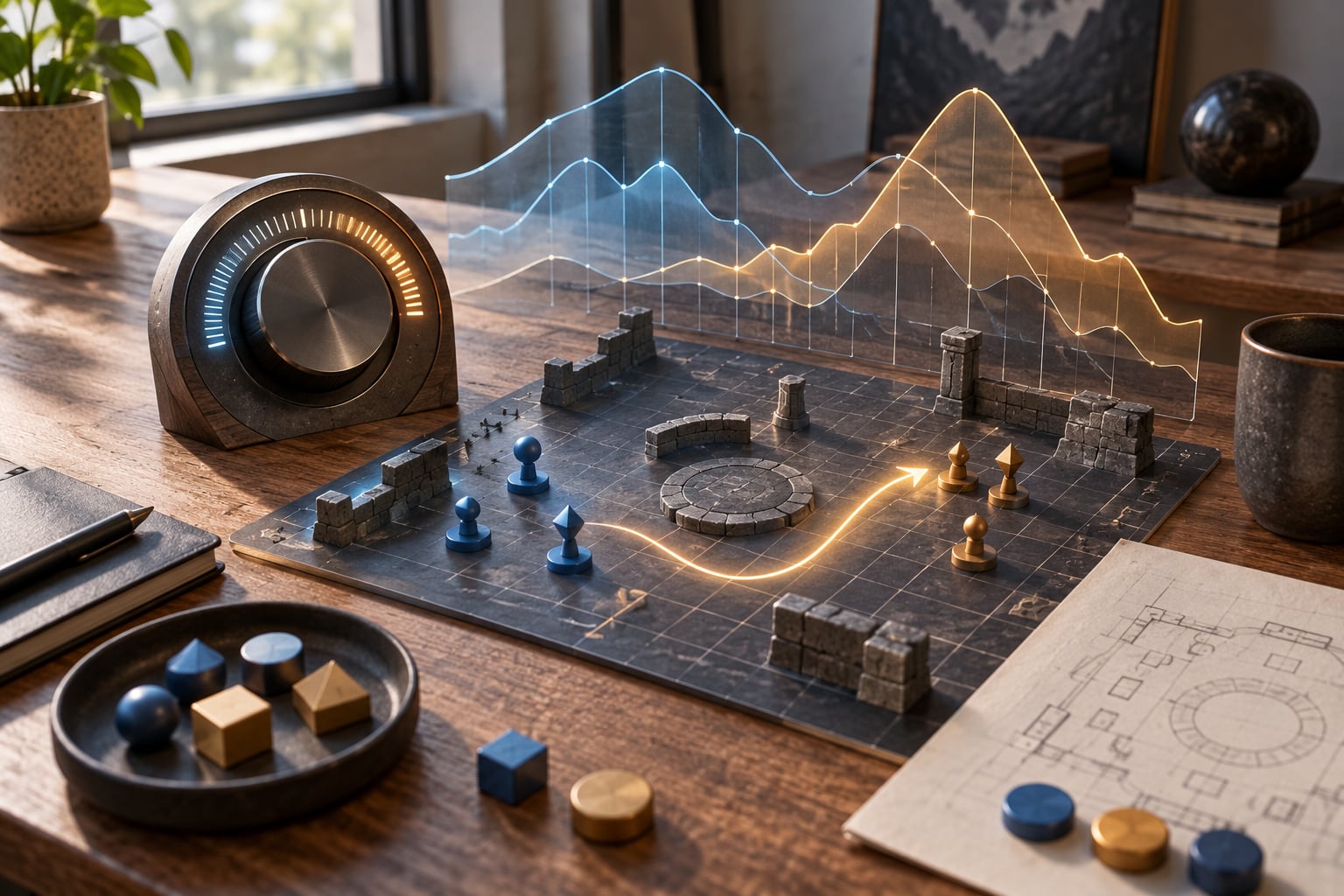
Adaptive difficulty is a system that watches how you are playing and quietly changes the game to match. It measures your performance, compares it against a target, then adjusts enemy health, damage, spawn rates, item drops or pacing so the challenge keeps up with your skill instead of drifting away from it.
That is the whole idea in two sentences. The interesting part is what happens underneath: which numbers a game watches, what it does with them, and how you can tell when it is happening to you.
This guide walks through the loop step by step, the four ways developers build these systems, how the terminology actually gets used, and a practical method for testing whether your current game is adapting in real time.
Table of Contents
- 1What Is Adaptive Difficulty in Games?
- 2How Does a Game Measure Player Performance?
- 3Performance metrics developers track
- 4What Data Does Adaptive Difficulty Use?
- 5How Adaptive Difficulty Changes the Challenge
- 6How Adaptive Difficulty Works Step by Step
- 7Step 1: Measure
- 8Step 2: Evaluate
- 9Step 3: Adjust
- 10Step 4: Apply and re-check
- 11What Is the Difference Between Adaptive and Dynamic Difficulty?
- 12What Are the Main Adaptive Difficulty Examples?
- 13Enemy stat scaling
- 14Director systems
- 15Puzzle hints and unobtrusive assistance
- 16Rubber banding in racing and party games
- 17Resource and drop balancing
- 18Adaptive enemy AI
- 19Layered or hybrid systems
- 20How Can Players Tell If a Game Is Adapting?
- 21Five clues the game is reacting to you
- 22A simple test routine
- 23Is Adaptive Difficulty Fair?
- 24What Are the Benefits and Drawbacks for Players?
- 25Where it helps
- 26Where it hurts
- 27Frequently Asked Questions
- 28Does adaptive difficulty make a game easier automatically?
- 29Is adaptive difficulty the same as dynamic difficulty?
- 30How can I tell whether enemies are scaling to my skill?
- 31Should I play on the easiest difficulty to see adaptive systems?
- 32Can adaptive difficulty help new players improve?
- 33Why can adaptive difficulty feel unfair?
- 34What Should Players Do First?
What Is Adaptive Difficulty in Games?
Adaptive difficulty is the automatic adjustment of game parameters based on a player’s measured ability. You will also see it called dynamic difficulty adjustment (DDA), dynamic game difficulty balancing (DGDB), or dynamic game balancing (DGB). All four names describe the same family of systems.
The key word is automatic. A difficulty setting is chosen by a human, usually before you press start, and stays put. An adaptive system measures you during play and changes things while you are in the middle of a fight, a race or a puzzle.
Developers reach for it because a fixed difficulty setting is a guess. Pick it too low and skilled players disengage within an hour. Pick it too high and everyone else leaves during the tutorial. Adaptive systems turn that one guess into an ongoing conversation.
The goal behind most of them is keeping the player inside something designers call a flow state: engaged, absorbed, and challenged, but not bored and not overwhelmed. When you win easily, the game raises pressure. When you keep failing, it eases off.
How Does a Game Measure Player Performance?
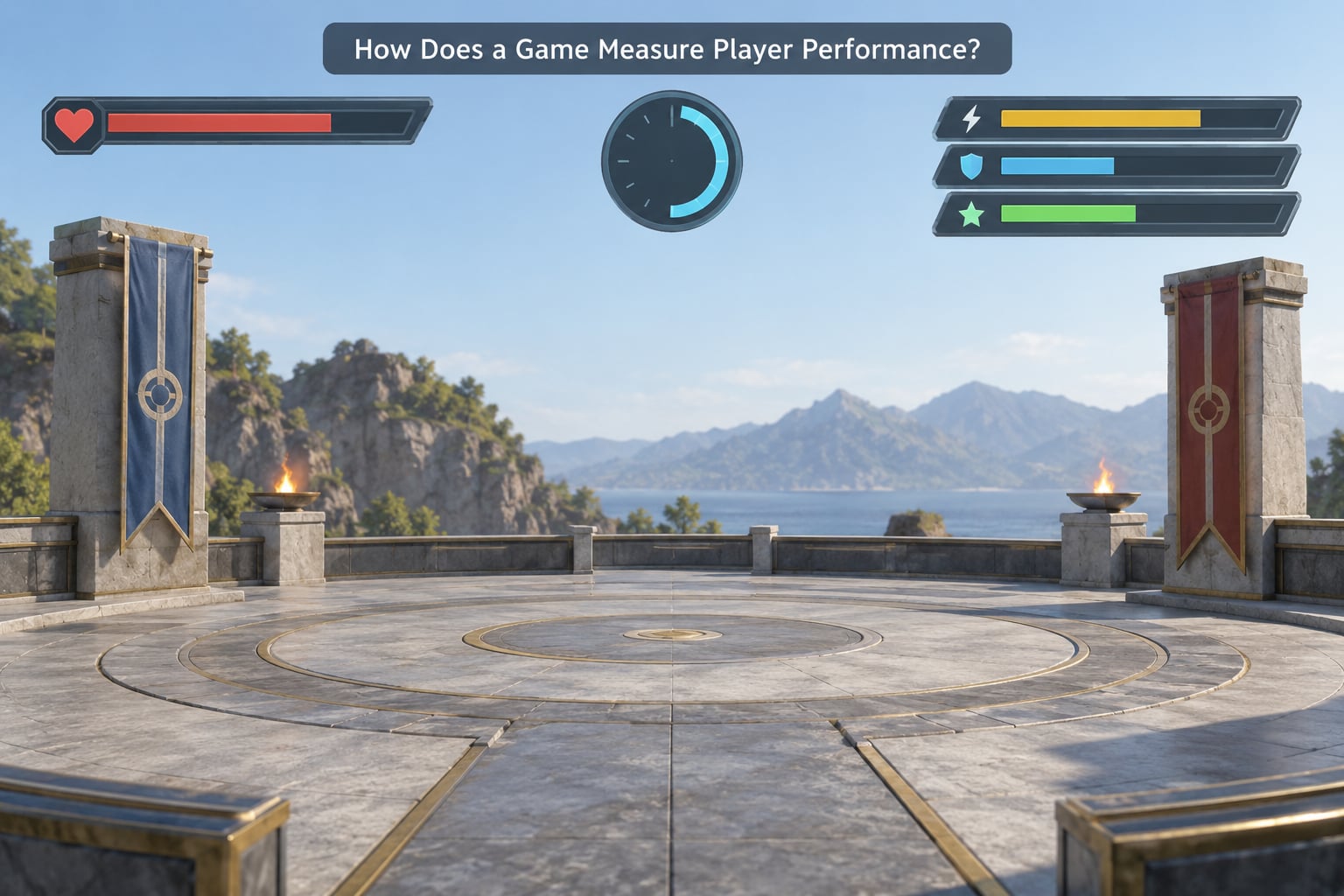
A game cannot read your mind, so it reads your behaviour instead. Most systems measure a handful of numbers that are already being generated by normal play.
Performance metrics developers track
- Success rate — how often you clear an encounter, a floor or a puzzle on the first attempt.
- Failure rate — deaths, retries, and how quickly a retry follows a failure.
- Time to complete — fight length, puzzle solve speed, or how long a whole level takes.
- Accuracy — hits landed against shots fired, hits taken against hits possible.
- Health remaining — how much of your bar is left at the end of an encounter.
- Resource use — how much ammunition, healing, or consumables you consumed.
- Damage dealt and taken — the raw exchange, including whether you one-shot anything.
- Behaviour patterns — crouching behind cover, kiting, rushing, or how quickly you explore.
Most well-built systems watch several of these together, because any single one is easy to fool. A player who dies constantly but clears rooms fast is not struggling, and a system tracking only deaths will punish them for it.
What Data Does Adaptive Difficulty Use?
The signals fall into four groups, and a system may use one, or several at once.
| Data source | What it looks like | How the system uses it |
|---|---|---|
| Explicit settings | The difficulty you picked at the start | Sets the baseline target level and often sets a floor and ceiling for adjustments |
| Real-time performance | Live combat and puzzle data from the current encounter | Triggers immediate changes to the encounter you are in |
| Historical data | A rolling record of past rooms, levels or runs | Estimates your overall skill so pacing stays consistent across a whole campaign |
| Behavioural signals | Movement, positioning, and time spent idle | Spots hesitation or a specific tactic and shapes the response to it |
The last group is the interesting one. A system can notice you camp a corridor, never use a particular item, or clear a room in half the intended time, and treat each of those as performance data in its own right.
How adaptive difficulty works in practice usually comes down to how much history a system keeps. A system with one encounter of memory reacts quickly and visibly. A system with a whole campaign of memory is calmer, harder to notice, and better at holding a consistent difficulty curve.
How Adaptive Difficulty Changes the Challenge
Whatever the game decides, it has to change something. These are the levers almost every system pulls.
- Enemy health and damage — the plainest option, and the easiest for players to spot.
- Enemy behaviour — aggression, accuracy, flanking, how quickly enemies react, which tactics they pick.
- Spawn timing and volume — how many enemies appear, how often, and from where.
- Resource availability — ammunition, health pickups, and drop rates shifting after a bad stretch.
- Pacing — quiet stretches stretched out, or compressed so you are rarely idle.
- Objective complexity — extra tasks, shorter timers, more simultaneous problems to solve.
- Assistance — aim correction, clearer hints, a highlighted path, or slowed obstacles.
- Map layout — a different route or room arrangement chosen for how you handled the last one.
Which lever a studio picks tells you what they were optimising for. Changing damage output keeps the encounter intact. Changing the layout changes the encounter itself, and is far more noticeable.
How Adaptive Difficulty Works Step by Step
Every adaptive system, from a simple trigger to a machine learning one, runs the same four-step loop over and over.
Step 1: Measure
The game records what just happened. Every shot, every death, every second on the clock feeds into the system’s running totals.
Step 2: Evaluate
The system compares those numbers against a target level for this encounter, expressed in game literature as a challenge function or heuristic function. Your recent performance is usually smoothed over a short rolling window rather than judged on a single fight, so one bad minute does not swing everything.
Step 3: Adjust
The system picks a change and a size. A small nudge, or a large one, depending on how far you sit from the target and how quickly it wants to close that gap. Good systems apply a decay factor so old performance counts for less and less, which stops them oscillating between extremes.
Step 4: Apply and re-check
The change lands on the next encounter, or on the current one if the system is reactive rather than predictive. Then the loop starts again from fresh data.
The rolling window matters more than players realise. A developer working in game design described using z-scores over a short moving window with kill-death ratios, and only settling the stability problems by adding exponential decay so recent play outweighs old play.
What Is the Difference Between Adaptive and Dynamic Difficulty?
In practice the two words are used interchangeably, and most searchers mean the same thing when they type either one. There are useful distinctions underneath, though.
| System | What drives it | When it changes | Player feels it as |
|---|---|---|---|
| Fixed difficulty setting | A human choice, made once | Never, unless you change it yourself | A consistent, predictable challenge |
| Adaptive difficulty | Your measured performance, possibly with history | During play, from encounter to encounter | Pressure rising or easing with your skill |
| Dynamic difficulty | The current moment rather than your overall history | Mid-encounter, sometimes instantly | Enemies reacting to what you just did |
| Rubber banding | Your position relative to opponents or a leaderboard | Continuously, usually silently | Catch-up help, or a punch in the face when you lead |
Rubber banding is the odd one out. It is not measuring your skill so much as your rank. Catch-up mechanics in arcade racers and party games scale opponents based on where you sit in the standings, which is a form of adjustment without being a form of adaptation.
The distinction that matters for you: adaptive difficulty responds to performance, dynamic difficulty responds to the present moment, and rubber banding responds to position. Some games run all three at once.
What Are the Main Adaptive Difficulty Examples?
These are the patterns you will run into most often. Each one is common enough that you have probably played it without being told.
Enemy stat scaling
The most direct pattern. Enemies gain health or damage as you perform better. Nothing else changes, which makes it easy to miss if you are not comparing encounters.
Director systems
A separate AI layer manages pacing instead of individual enemies. It decides when pressure rises, when it releases, and which enemies appear. Co-op shooters made this model famous, and its stated goal was producing horror-movie pacing: something happening constantly, with room to breathe, then something happening again.
Puzzle hints and unobtrusive assistance
Extended objective markers, a highlight on the interactable object, a slightly more forgiving timing window. Most players never see this happen because it is designed not to interrupt the fiction.
Rubber banding in racing and party games
Opponent speed and item distribution shift with your race position, keeping the field close. Classic racing games, kart games and sports titles all use some version of it.
Resource and drop balancing
Ammo, health and item drop rates move with your recent luck. The most contentious version of this is systems that tune drop rates alongside spending behaviour, which is exactly the area that produced a real class action against a major publisher over loot boxes.
Adaptive enemy AI
The enemy learns your habits rather than your statistics. It flanks more when you camp, or waits when you rush. No numbers on the health bar change; only the behaviour does.
Layered or hybrid systems
Most shipped games combine several of the above. A fixed difficulty setting sets the target, a director shapes pacing, and individual enemies scale within limits.
One thing these patterns share: almost none of them are documented in detail by their developers, so treat any specific claim about how a particular title works as worth checking against real play rather than taking on faith.
How Can Players Tell If a Game Is Adapting?
You can test for it yourself. It takes a repeatable approach rather than a hunch.
Five clues the game is reacting to you
- The same encounter kills you several times, then becomes noticeably easier on the next attempt without any change in your gear or loadout.
- Enemies that soaked a lot of damage on one run die almost instantly on the next.
- A hint, marker or assisted line appears that was not there before.
- Resources become easier to find after a long dry stretch.
- A hint you can see but no enemy stands near, or an enemy stops following you after you break line of sight.
A simple test routine
Run one route deliberately badly. Miss shots, take a long path, fail on purpose. Note how the encounter goes. Then run the same route carefully, with the same loadout, and compare health pools, enemy count, hit registration and drop rates.
Change one variable at a time. Use the same weapon, the same character, the same route. Swap your difficulty setting between runs and you cannot tell which change caused what.
If a game is adapting, the difference will show up in the same encounter. If nothing changes between a sloppy run and a clean one, you are probably looking at fixed difficulty, random variation, or a system reacting on a longer timescale than a single fight.
Is Adaptive Difficulty Fair?
It depends entirely on whether the player was told.
A fair system respects player agency. It stays inside the boundaries of the difficulty you selected, it never makes a fight unwinnable, and it does not quietly tax you for playing well. Hidden systems break the agreement in a subtle way: the rules changed and you did not know it, so a victory tells you less than it should.
That is why the visible-versus-hidden argument comes up so often in player forums. A visible meter that shows the system reacting is trusted. An invisible one that players only discover by comparing forum posts feels like a bait and switch, and players on the Resident Evil 2 board said exactly that in plain terms: many never noticed the adjustment and would have cared either way if they had known.
Player reaction is genuinely mixed on the same system. In the same threads, some players said they did not mind it because the mercy made a hard game playable, and others resented having their performance recalibrated without warning. Nothing in the design resolves that split. Transparency does, partly.
Accessibility sits on the same spectrum. For some players, assistance that scales with performance is the difference between finishing a game and abandoning it. For others, the same assistance undermines a difficulty they specifically chose to face.
What Are the Benefits and Drawbacks for Players?
Where it helps
- Accessibility — players with motor, vision or reaction differences get a path through content that fixed settings exclude them from.
- Pacing — a campaign can stretch or compress itself to match how long you actually take.
- Retention — a wider range of skill levels stays engaged with the same game.
- Fewer dead ends — repeated failure on one room stops being a wall.
Where it hurts
- Earned victories feel hollow — a win on an eased encounter does not carry the same weight.
- Inconsistency — an enemy that takes twenty hits on one run and one on the next feels broken, not adaptive.
- Predictability — once players spot the pattern, some of them play badly on purpose to hold the difficulty down.
- Mastery players lose control — speedrunners and completionists often want the raw version.
- Trust erosion — a hidden system discovered through forum threads instead of in-game information damages confidence in everything else the game does.
Speedrunners have a specific complaint worth naming. If your times or completion ranks shift with a system you cannot see or fix, records stop being comparable. That is why competitive and mastery-focused players tend to want it off or opt-in, and why the loudest complaints come from communities that care most about consistent rules.
Frequently Asked Questions
Does adaptive difficulty make a game easier automatically?
Not automatically. An adaptive system adjusts in both directions: it eases off when you are failing repeatedly and raises pressure when you are clearing encounters comfortably. If a game only ever made things easier, that would be assistance or rubber banding, not a system responding to your measured performance. The tell is that the change tracks your recent results, not your chosen difficulty setting.
Is adaptive difficulty the same as dynamic difficulty?
In everyday use, yes, the two phrases mean the same thing and both describe systems that adjust challenge based on player performance. The useful distinction is timing and scope: dynamic difficulty usually reacts to the current moment, such as enemies changing behaviour mid-fight, while adaptive difficulty often tracks a longer history of your play across encounters or a whole run. Many games implement both.
How can I tell whether enemies are scaling to my skill?
Run the same encounter twice with an identical loadout: once playing badly on purpose, once playing carefully. Compare enemy health, hit registration, enemy numbers and drop rates. Real scaling shows up as a measurable difference in the same encounter with nothing else changed. Keep difficulty settings fixed across both runs, and remember that a system with a long memory window may not react within a single encounter.
Should I play on the easiest difficulty to see adaptive systems?
Not really. Easiest difficulty usually sets a floor that limits how far the system can lower things, which makes adjustments harder to observe. If you want to see a system clearly, keep the difficulty setting fixed and vary your own performance instead. That isolates the system response from the setting change, which is the variable most players accidentally confound.
Can adaptive difficulty help new players improve?
It can keep a beginner in the game, and that has real value: more play means more practice. It is not a substitute for good instruction. Because the system targets challenge rather than teaching, it will not fix a control scheme you cannot read or a mechanic you never understood. If you want to actually get better, turn assists off or set them low and learn the underlying mechanics.
Why can adaptive difficulty feel unfair?
Usually because it was invisible. Player agency and transparency are the core of the fairness argument: the rules of the encounter changed mid-play and the player had no way to know. Adjustments that stay inside the difficulty you selected feel fair. Adjustments that quietly widen it, or that tax efficient play, read as manipulation. That is why visible systems tend to draw far less complaint than hidden ones.
What Should Players Do First?
Pick a game you have played a lot of and run one encounter twice with an identical loadout, playing badly on the first run and carefully on the second. If the second run is measurably gentler, the game is adapting.
Then check the settings and any official documentation for a difficulty or assistance toggle. Plenty of games ship one, most players never look.
After that, stop treating every swing in difficulty as intentional. Random variation, unbalanced encounter design and your own habits explain more of what players notice than adaptive systems do. Keep consistent habits, watch the same encounter change, and only then decide the game is reacting to you.