Deciding what to play next comes down to shrinking the decision: name how much time you have and what kind of energy you brought, cut your candidates down to three, and give each one a fair trial before you commit. A practical system for how to decide what to play next takes about five minutes to set up, and most of the work happens once rather than every evening.
The reason this feels so hard is not that the games are bad. It is that your library grew faster than your free time did. Choice overload research found that past a certain number of options, people stop making good picks and start avoiding the choice altogether, so you end up browsing storefronts, watching videos about games and going to bed without launching anything.
Players describe this loop constantly. On r/GamePassGameClub people talk about scrolling a subscription catalog and Reddit for longer than they play, and on ResetEra a few regulars keep a running queue instead, one racer, one RPG, one strategy game, and cycle through them. Both are reasonable. The queue works because it removes the nightly decision.
Table of Contents
- 1What You Need
- 2Step-by-Step
- 31. Set Your Non-Negotiables
- 42. Name the Mood You Want
- 53. Separate Wants From Wishlist Games
- 64. Build a Shortlist by Fit
- 75. Check Your Current Commitment
- 86. Test Before You Commit
- 9How to Decide What to Play Next After the First Session
- 107. Commit and Avoid Rebrowsing
- 11Common Mistakes
- 12Frequently Asked Questions
- 13How many games should I put on my shortlist when I cannot decide what to play next?
- 14Should I finish a game I do not enjoy before starting another?
- 15Is it better to choose by genre, mood, or game length?
- 16How long should I try a new game before deciding whether to keep playing?
- 17What should I do when friends want to play a game I do not want to start?
- 18Conclusion
What You Need
You do not need a new tracker app or a spreadsheet template. You need six inputs, and you already know five of them.
Time available. Be specific, because “an hour or so” is the answer that picks the wrong game. Thirty minutes, ninety minutes, or a whole evening on Saturday are three different problems.
Current mood and energy. Not genre. Energy covers everything from mentally fried after a bad day to locked in and ready for something difficult.
Platform and input method. Console, PC, handheld, phone, TV, and whether you want a controller, mouse and keyboard, or nothing in your hands at all.
Practical constraints. Accessibility needs, the input lag or controller drift that ruins your evening, whether you can play while someone else is talking, and any parental or shared-screen limits.
Recent history. The last five things you actually played, including the ones you dropped. This tells you your real pattern better than any genre preference list.
A manageable candidate list. Three to five games max, drawn from what you already own or have access to. Not the whole catalog.
Set up the list in whatever you already use. A note on your phone, a text file, a Discord channel with friends, or the notes app is plenty. Players on ResetEra described keeping a plain text file of unplayed games that they delete entries from as they finish, and that habit alone removes half the friction.
Step-by-Step
1. Set Your Non-Negotiables
Write down the constraints that eliminate games instantly, before you look at anything. Session length, platform, input method, accessibility needs and your realistic ceiling on a game’s total length.
That last one matters more than people expect. If you have one free evening a week, a fifty-hour RPG is not a bad game, it is a bad fit this month. On ResetEra, several people said they check HowLongToBeat before starting anything, specifically so the commitment is visible before it begins.
You know this worked when a title can be ruled out in about two seconds, without opening a review or a trailer.
2. Name the Mood You Want
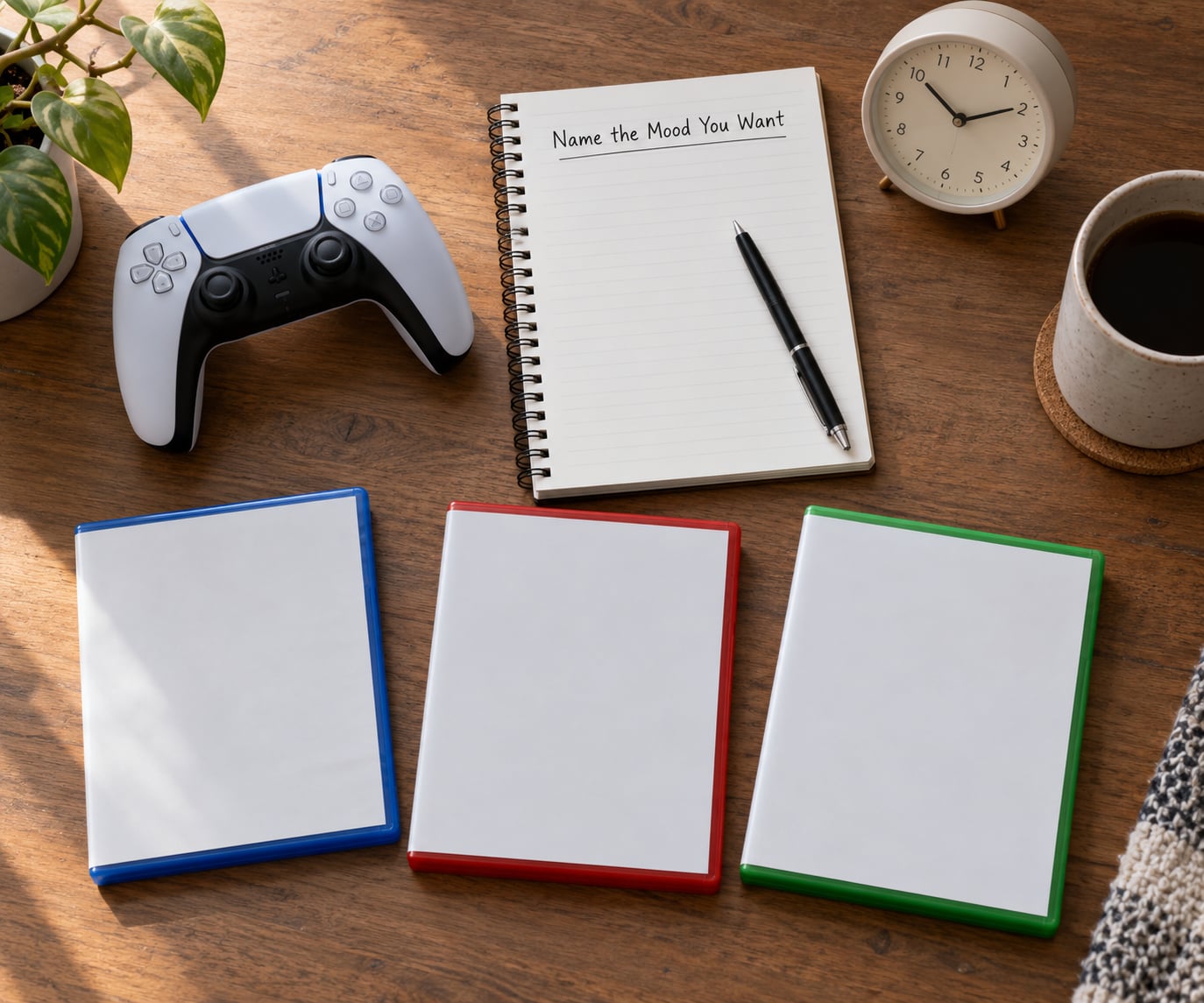
Translate the vague feeling into a mood with a shape. The useful ones are relaxing, competitive, exploratory, social, creative and story-focused, and each points toward different game characteristics rather than different genres.
Relaxing favors low-friction systems where losing costs little. Competitive favors short, repeatable runs with clear rules. Exploratory favors open-ended spaces with no checklist. Social favors anything with drop-in sessions.
Energy matters as much as mood. On a tired Tuesday, a demanding strategy game will lose to the same game on a Saturday, and that is not a flaw in the game. Here is the rough matrix I use:
20 to 30 minutes, wired but shallow. Cozy games, comfort games, a familiar replay.
30 to 45 minutes, wanting a small win. Roguelikes, roguelites, pick-up-and-play titles.
90 minutes, focused. Story games and RPGs with good save points.
Half a day, restless. Open world, survival, long adventure arcs.
Any, with friends online. Co-op and multiplayer with short queue times.
This worked when you can name the mood in three words and two games immediately fit it. If nothing fits, your mood is probably “something new and short”, which is a real answer, not a failure.
3. Separate Wants From Wishlist Games
Most games on your list are there for the wrong reasons. They are popular right now, they were inexpensive, a friend mentioned them, or they are eighty percent finished and finishable guilt feels productive.
Sort each candidate into one of two buckets: games you would actually want today, and games that arrived through attention rather than desire. Popularity, discount depth and a friend’s enthusiasm are weak signals. Your own last five sessions are strong ones.
Keeping the second bucket is fine, just stop pretending it is a shortlist. Players who describe the strongest systems all do the same thing here, they keep a wishlist separate from what is actually up for tonight.
4. Build a Shortlist by Fit
Take your wants bucket and cut it to three. Three is the number that works because two creates coin-flip anxiety and ten recreates the problem you started with.
Score each one out of five against six criteria: mood match, time available, platform fit, energy match, prior interest, and current backlog pressure. Prior interest means how much you already want it, not how loud the discourse is. Backlog pressure means whether adding this makes everything else feel worse.
Ties are the normal case, and that is fine. When two games score the same, prefer the one with better stopping points, since a game you can pause cleanly is easier to return to than one that saves in the middle of a bad decision.
The step worked when you could defend your first pick in one sentence that includes a time and a mood, for example “a fifty hour RPG on a Saturday” or “a twenty minute run tonight because my head is done.”
5. Check Your Current Commitment
Before starting anything new, look at what is already open. Most libraries hold one game you are genuinely mid-way through, and it is usually the game that deserves the next slot.
There are four honest answers. Resume it if you enjoy it and stopped for outside reasons. Finish it quickly if it is within a few hours and nagging at you. Shelf it deliberately, meaning write a one line note on where you are and why you stopped, then let it go. Or move on, and stop pretending you will return.
The one-line note is the part people skip, and it is the part that matters. Players on ResetEra described exactly this habit, writing down where they were in a game and coming back later, with the reminder that games are meant to be fun, not work. Without that note, the confusion of re-entering becomes its own reason to avoid the game.
Sunk cost is not a reason to keep going. Hours already spent do not make the next ten hours more likely to be good, and completionism is a very common way to turn a hobby into an obligation.
6. Test Before You Commit
Make the first session cheap. Demos, free trials, a save file, a friends session, or just fifteen minutes on your own is enough to rule a game out.
Set the trial up so it tests the right thing. A game’s opening hour is designed to hook you, so a positive first impression tells you very little. What tells you something is whether the core loop holds up after the tutorial ends, whether the controls feel right in your hands, and whether you would accept a third hour of this.
A concrete signal for the exit: if you spent most of the trial reading menus and adjusting settings rather than making decisions, the game is asking for setup attention you probably do not have.
How to Decide What to Play Next After the First Session
Judge the first real session against what you expected, not against how good the game is objectively. A seven hour game that delivers exactly the forty minutes of atmosphere you needed is a win. A forty hour epic that gives you nothing on a thirty minute evening is not.
There are four outcomes, and each has a matching move. Continue if the core loop pulled you forward and you can name what you want to do next. Stop cleanly, with a note, if it is fine but not for now. Request a refund where the store allows it if the mismatch was clear and early. Rotate, meaning go back to a comfort game for a week, if you are simply out of the capacity to evaluate anything new.
Rotating is not failure. On r/patientgamers the argument runs constantly between playing slowly for immersion and clearing the backlog fast, and both camps end up at the same place, one game at a time.
7. Commit and Avoid Rebrowsing
Give the chosen game a fair window, roughly three sessions, before you evaluate it again. One confusing session is not evidence of a bad game, especially with a long or unfamiliar system.
Then close the loop. Decide in advance what success looks like, meaning a number of sessions, a milestone, or a specific feeling, and write it down with the stopping point. Write the note about where you are now while it is fresh, so returning later costs nothing.
The last part is the one that stops the whole cycle: put the store in do-not-disturb mode, or at least leave the library screen. Most re-deciding happens because the storefront is one click away at the exact moment you are tired and unsure. Browsing a catalog while too tired to judge anything is how an hour disappears.
Common Mistakes
Choosing on hype alone. If your only reasons are a trailer, a trending video or a large review count, you are picking for an audience rather than for your evening. Fix: require one personal reason in the sentence, a mood or a genre you already enjoy.
Sorting by genre while ignoring energy. Genre tells you what a game is, energy tells you whether you can meet it tonight. Fix: match energy first, genre second.
Letting the backlog run without limits. A hundred untouched games is not a to-do list, it is a wall. Fix: the only list that matters is the three-game shortlist. Everything else is a wishlist, and wishlists are allowed to be long.
Treating every game as a commitment to finish. Games are entertainment, not homework. Fix: write the stopping note and let the shelf decision be a real option.
Dropping something after one confusing session. Learning a system takes longer than the first hour suggests. Fix: three sessions minimum before you judge, unless the mismatch is instant and obvious.
Researching indefinitely. Trailers, reviews, wikis and videos feel productive and end in no playtime. Set yourself a limit, one trailer and one review, and stop there.
Ignoring subscription deadlines. Games leaving a service or a rotating catalog add artificial urgency to a decision that should be about fit. If you are only playing a game because the clock is ticking, you are being rushed into it. Check the dates once, then decide on fit alone.
A few decision tips that hold up: decide for the whole session rather than the whole week, keep one comfort game in reserve for bad days, tell a friend what you are starting so somebody notices if you drift, and delete or archive anything you have no intention of playing instead of leaving it in the way.
Frequently Asked Questions
How many games should I put on my shortlist when I cannot decide what to play next?
Three. Two turns the choice into a coin flip you overthink, and ten recreates the choice overload you are trying to escape. Pick three that already fit your mood, available time and platform, then score them out of five on fit rather than hype. If you cannot fill three, that is real information about your library, not a failure.
Should I finish a game I do not enjoy before starting another?
No, unless you are close to the end. The hours you already put in are gone, so they cannot make the next ten hours more enjoyable. Write one line about where you are, then start something you actually want. Plenty of players keep a small shelf of shelved games they return to months later, and that is the normal way a library works.
Is it better to choose by genre, mood, or game length?
Energy first, mood second, length third. Genre is a weak filter because it says nothing about how demanding a game feels tonight. Mood narrows the field to two or three candidates, and then length rules out anything that will not fit your window. Start with how much time you have, and most of the choice resolves itself.
How long should I try a new game before deciding whether to keep playing?
Give it three sessions or roughly ninety minutes, whichever comes first. A single confusing hour tells you about the tutorial, not the game. A useful system for how to decide what to play next treats that window as the test: if you cannot name one thing you want to do next, shelve it with a note and move on without regret.
What should I do when friends want to play a game I do not want to start?
Say what you are playing instead, and pick something that supports drop-in play. Most friends are not asking for a specific game, they are asking for company at a specific time. If they genuinely need that exact game, treat it as a scheduled session with a start and an end time, and return to your own shortlist afterwards.
Conclusion
The whole system is small: name the time you have, name the energy you brought, cut the list to three, test each one honestly, then commit to one for three sessions and write down where you left off. Do that once and the nightly decision mostly disappears.
Start tonight with the first move. Pick one mood, list three games that genuinely fit it, and compare them against your real time, your platform and whatever is already in progress. The catalog you own in 2026 will keep growing. The system is what stops that from mattering.