How to stretch between matches comes down to one idea: use the gap you already have to move slowly, breathe, and take your eyes off the screen. Nothing fancy, no equipment, no flexibility test you can fail. Five minutes of easy, held movement is plenty, and even thirty seconds beats nothing at all.
Most players skip that gap because they do not realise it exists. The queue timer runs, the match ends, and the next one loads while you are still sitting in the exact position that was making your wrist ache. The break is not wasted time. It is the only window you control all match.
This guide covers general movement and comfort habits. It is not medical advice. If something hurts, persists, or keeps coming back, talk to a doctor or a physical therapist who works with people who sit at desks all day.
Table of Contents
- 1What You Need
- 2Step-by-Step: How to Stretch Between Matches
- 3How to Stretch Between Matches: 1. Set Up Safely
- 42. Move Your Feet, Calves, and Shins
- 53. Open Your Hips and Chest
- 64. Release Your Neck, Shoulders, and Wrists
- 75. Finish With Easy Re-Activation
- 8Common Mistakes
- 9Frequently Asked Questions
- 10Can I stretch in-game between matches?
- 11How many minutes should I take to stretch between matches?
- 12Is it better to stretch before or after a match?
- 13Which stretches are unsafe for frequent gamers?
- 14What should I do if stretching causes pain or numbness?
- 15Conclusion
What You Need
A stable chair with a flat seat, or enough floor space to stand comfortably. That is the whole equipment list.
A water bottle within arm’s reach matters more than most stretch guides admit. Players who stand up for a movement break and then sit back down dehydrated usually queue the next match feeling worse, not better.
A timer is optional but useful. Your phone’s built-in timer works fine, and it keeps you honest. Without one, five minutes quietly becomes fifteen, which eats the mental reset you also need.
Wear whatever you would move in comfortably. Loose clothing lets you reach your feet and your shoulders without fighting a drawstring. No stretching straps, no blocks, no resistance bands, no foam roller.

Step-by-Step: How to Stretch Between Matches
The sequence below runs five minutes if you work through it at an unhurried pace. Use whatever small break you get. Nothing here asks you to force a range of motion, and the goal is comfortable movement rather than maximum flexibility.
How to Stretch Between Matches: 1. Set Up Safely
Before the first movement, check in with your body. Any sharp pain, active numbness or tingling, or a dizzy feeling means you skip the routine today and sit still with water instead.
Clear the floor. Cables underfoot and a rolling chair turn a side bend into a trip, and the only thing worse than a stiff neck is a bruised shin.
Sit with both feet flat and sit securely, or stand with one hand on a desk or wall. Take three slow breaths before you start. If you cannot breathe normally in the position, change the position.
2. Move Your Feet, Calves, and Shins
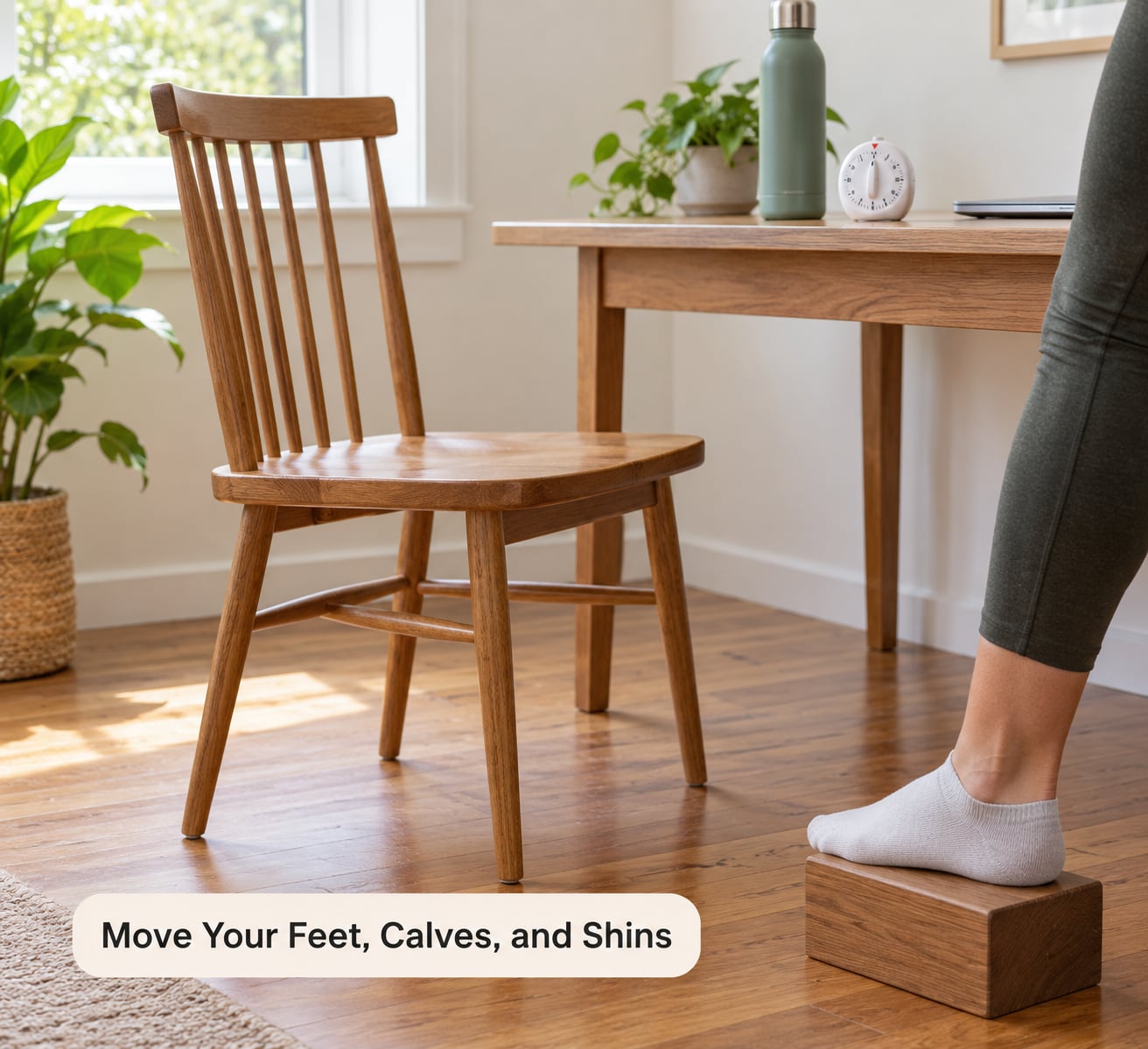
Sitting still pins your ankles in one shape for an hour. Gentle movement gets them back.
Draw ten slow circles with each foot, five in each direction. Follow with fifteen heel raises, lifting both heels off the floor and lowering them with control. Then press a forearm into a wall and lean gently forward to stretch the calf, holding about thirty seconds per side.
Finish with a shin stretch: step one foot back, keep the heel down, and lean into a supporting wall or desk until you feel it across the front of the lower leg. Thirty seconds per side, knees soft.
You will know it worked when your ankle moves through its full circle without feeling like it catches.
3. Open Your Hips and Chest
Seated, keep both feet planted and shift your weight gently from one sitting bone to the other, six times per side. This looks almost too small to count, which is exactly why it works in a tight booth.
For hips, step one foot forward into a supported lunge with your hands on the desk, and hold thirty seconds per side at a depth that keeps the front knee behind the toes.
For the chest, stand in a doorway or a corner and rest a forearm on the frame, or clasp your hands behind your back and let the shoulders draw back. Hold about thirty seconds.
Breathe out as you go. The signal that tension has eased is easier breathing, not a burn. If you are holding your breath, you are past the useful range.
4. Release Your Neck, Shoulders, and Wrists
This is where most of the tension actually lives. Your upper traps hold the stress of a bad round and your forearms absorb every click.
Roll your shoulders backward ten times, then pin them down and back while you breathe, as though you are trying to hold a pencil in place with your shoulder blades. That cue, plus ten slow breaths, releases more upper-back tension than any single neck move.
For the neck, tip one ear toward one shoulder and let the opposite arm hang heavy. Hold twenty to thirty seconds per side. Skip full circles. Circles push the head through ranges the neck was not built to travel, and they are a fast route to a headache.
For wrists and forearms, extend one arm forward with the palm up and use the other hand to gently draw the fingers down and back, twenty to thirty seconds per side. Then flip the palm down and repeat. For the forearm itself, press the knuckles of that hand together as if showing someone your middle finger, then point the wrist down and away.
For the gamer’s thumb, rest your forearm on the desk, keep your elbow bent, and slowly spread your thumb away from your fingers against light resistance from the other hand. Ten slow reps per side. If the thumb base aches on the thumb side of your wrist, that release matters more than any back stretch you are skipping.
Stop the whole sequence if symptoms get worse, not better. Relief that arrives gradually is normal. Sharp pain, spreading numbness, or a grip that suddenly feels weaker is not.
5. Finish With Easy Re-Activation
Stand up. Take five relaxed breaths and let your arms hang.
Then swing one arm forward and back gently for about fifteen seconds per side, keeping the movement loose rather than fast. Roll your shoulders a few more times.
The final check is simple: does moving feel easier than it did before you started? That is the whole success criterion. Flexibility you cannot feel during the next round is not what you are after here.
Common Mistakes
Bouncing is the most common error. Pumping through a stretch without holding teaches the tissue nothing and can strain it. Hold still, breathe, and let time do the work.
Forcing range is the second. If you are pushing into a stretch so hard that your breathing goes shallow and your grip on the desk turns white, you have gone past the pain-free range that makes this useful.
Skipping the break because the queue feels too short is the third. Most competitive players report the gap between matches is somewhere around five to eight minutes, and they rarely notice it because the loading screen eats their attention. Set a timer alert for match end and treat it like a round start.
Stretching in a cramped setup is the fourth. A booth with a hard seat and no floor space does not need the lunges. The seated hip shift, the shoulder pin, the neck side bend and the wrist stretches all work as-is.
Treating numbness as normal tension is the one worth flagging hard. Numbness, tingling, and weakness in a hand are not tight muscles. Stop and see a clinician.
Then there is timing. Long static holds right before you queue can leave you feeling loose but slow, which is the wrong state for a match where reaction time decides the round. Between matches, short holds and normal movement work better than a two-minute cold stretch. Save the long holds for the end of a session.
One more pattern shows up on gaming fitness boards more than any other: playing volume spikes. Someone who normally queues two evenings a week plays six in a week and their hands pay for it. The routine helps, but it does not cancel out a sudden jump, and no amount of stretching makes an escalation safe.
If you only have ninety seconds, cut the lower body and do the shoulder pin, one neck side bend per side, and one wrist stretch per side. Short and consistent beats long and occasional.
Frequently Asked Questions
Can I stretch in-game between matches?
Yes, as long as you are not in an active round. Most competitive titles have a post-match screen that lasts from a few seconds to several minutes, and that window is exactly the gap this routine is built for. Anything you can do seated works well there: shoulder rolls, the shoulder pin, wrist stretches and neck side bends. Save the lunges and shin stretches for a proper break, where you can stand up safely.
How many minutes should I take to stretch between matches?
Five minutes covers the full sequence above. Thirty seconds still helps if that is all your queue gives you, and eight to ten minutes after a long session is better than nothing at all. The timing matters less than doing something consistently. Players who take breaks every match tend to feel the difference within a few weeks, while players who stretch once at the end of a six-hour session usually notice nothing.
Is it better to stretch before or after a match?
Both have a place, and they do different jobs. Before a match, favour dynamic movement like arm swings and ankle circles, because long static holds can leave you temporarily slower. Between matches and after a session, static holds are the right tool, since you are trying to release tension rather than prepare for output. Many players do a short dynamic warm-up before playing and the fuller routine between matches.
Which stretches are unsafe for frequent gamers?
Full neck circles, bouncing, and any stretch pushed into sharp pain are the ones to drop. Neck circles push the head through ranges the cervical spine is not built for, and bouncing turns a hold into a strain. Also skip deep spinal flexion or extension while seated if you have any back history, and do not attempt hamstring stretches by bouncing off a desk. Gentle, held, pain-free movement is the rule that keeps all of this safe.
What should I do if stretching causes pain or numbness?
Stop the movement immediately and do not push through it. Pain that sharp, or numbness and tingling that do not clear within a few minutes, are not normal tension. Rest the hand or neck, and contact a doctor, physical therapist or qualified clinician if the sensation returns or keeps recurring. This guide offers general comfort habits only and cannot diagnose an injury or replace professional advice.
Conclusion
Start with one minute. Shoulder pin, neck side bends per side, wrist stretches per side, a few breaths. That is enough to find out whether a real break changes how the next match feels.
Once it does, keep the rest of the window for water and a mental reset. The movement matters, but so does coming back focused rather than still annoyed about the last round.
And if you get sharp pain, numbness, dizziness, or a grip that keeps weakening, stop stretching and talk to a qualified clinician. Movement habits keep you comfortable. They are not a substitute for medical advice.