Open world games design side content by attaching a short, self-contained activity to a place on the map: something worth the walk, readable in under a minute, and rewarding enough that the player chooses it over the critical path. The mechanics underneath are surprisingly consistent, and you can learn them from any region you like.
Players notice the difference immediately. A complaint about a fetch quest is really a complaint about a side activity with no promise, no choice and no consequence, and the argument about side content volume is still running hot on player forums in 2026. This guide takes that noise and turns it into design principles you can actually apply.
I’m not writing this as a studio insider. I am writing it as someone who has spent far too long clearing icons off a map and then wondering why half of them felt like homework.
Table of Contents
- 1What Is Side Content in an Open World Game?
- 2Why Good Side Content Adds Value to the Main Story
- 3Pacing the critical path
- 4World believability
- 5Player agency
- 6Retention after the credits
- 7How Open World Games Design Side Content Around Player Goals
- 8How open world games design side content around discovery
- 9Combat, puzzles and mastery
- 10Collecting, customisation and social play
- 11Roleplay and identity
- 12The Core Building Blocks of Memorable Activities
- 13How Exploration, Rewards, and Progression Keep Players Engaged
- 14Environmental clues
- 15Reward variety
- 16The short loop
- 17Progression and secrets
- 18How Open World Games Make Side Activities Feel Different
- 19How NPCs, Writing, and Consequences Strengthen Side Quests
- 20Characterisation before plot
- 21Dialogue that reflects state
- 22World state and consequences
- 23Where the reaction comes from
- 24How Players Experience Side Content Across Different Play Styles
- 25Common Side Content Design Mistakes
- 26A Practical Framework for Designing Better Side Content
- 27Frequently Asked Questions
- 28What is side content in an open world game?
- 29What makes a side quest good game design?
- 30How do developers make side quests discoverable?
- 31Why do open world side quests feel repetitive?
- 32Can procedurally generated side quests replace hand-authored ones?
- 33How much side content should an open world game have?
- 34Conclusion
What Is Side Content in an Open World Game?
Side content in an open world is everything the game offers outside the main quest’s critical path: optional quests, world events, monster contracts, errands, activities, collectibles and ambient encounters. It is designed so the player pursues it rather than being required to, and it usually pays out in one of four currencies: story, items, skill or knowledge about the map.
The vocabulary players use is loose, so it helps to have a taxonomy. Studios draw these lines deliberately, and the line between them tells you how much the interaction is worth.
- Side quest — a hand-authored story with named characters and a beginning, middle and end. The Witcher 3 monster contracts sit here.
- Side adventure or side activity — a shorter, often repeatable challenge with a rule set and a reward. Assassin’s Creed world events and Elden Ring remembrance dungeons live here.
- World event — a scene the player stumbles into that resolves itself, usually within minutes. No quest log entry, no follow-up.
- Systemic or ambient content — rules that produce situations without an author writing them. Campfires, patrols and merchant inventories reacting to you.
- Collectibles — persistent finds that reward curiosity rather than skill. Armour sets, maps, photographs, buried histories.
Collectibles are the weakest kind by design and the strongest kind by retention, which is why the good ones give you a reason to care: a note that names the people in the house you just robbed, or a set that quietly changes a shopkeeper’s inventory later.
Why Good Side Content Adds Value to the Main Story
Side content earns its production cost because it does jobs the critical path cannot. It paces the story, makes the setting feel lived in, gives the player a second goal to hold, and keeps the game worth opening after the credits roll.
Pacing the critical path
A main story delivers one beat at a time, so it needs valleys. Optional activity placed near a story beat gives the player somewhere to put attention that is not the story, which is why a good open world alternates rather than hoards. When everything exciting is on the critical path, the map becomes scenery between cutscenes.
World believability
A village with one quest-giver standing still in a field is a level, not a place. Side content is where a settlement gets its second life, because errands, disputes and requests are the cheapest way to imply that other people have problems you are not required to solve.
Player agency
Optional content is the only place in a story-driven game where the player sets the agenda. Nobody scolds the player for skipping it, which means the choice to engage is genuinely theirs, and that choice is what makes the payoff land. Talk to anyone who finished a long RPG and the optional content comes up far more often than the ending did.
Retention after the credits
Optional content is where completionism lives. Hunt lists, achievement percentages and the replay pull of a game all run on the question of whether there is more to do, and side content is the answer.
How Open World Games Design Side Content Around Player Goals
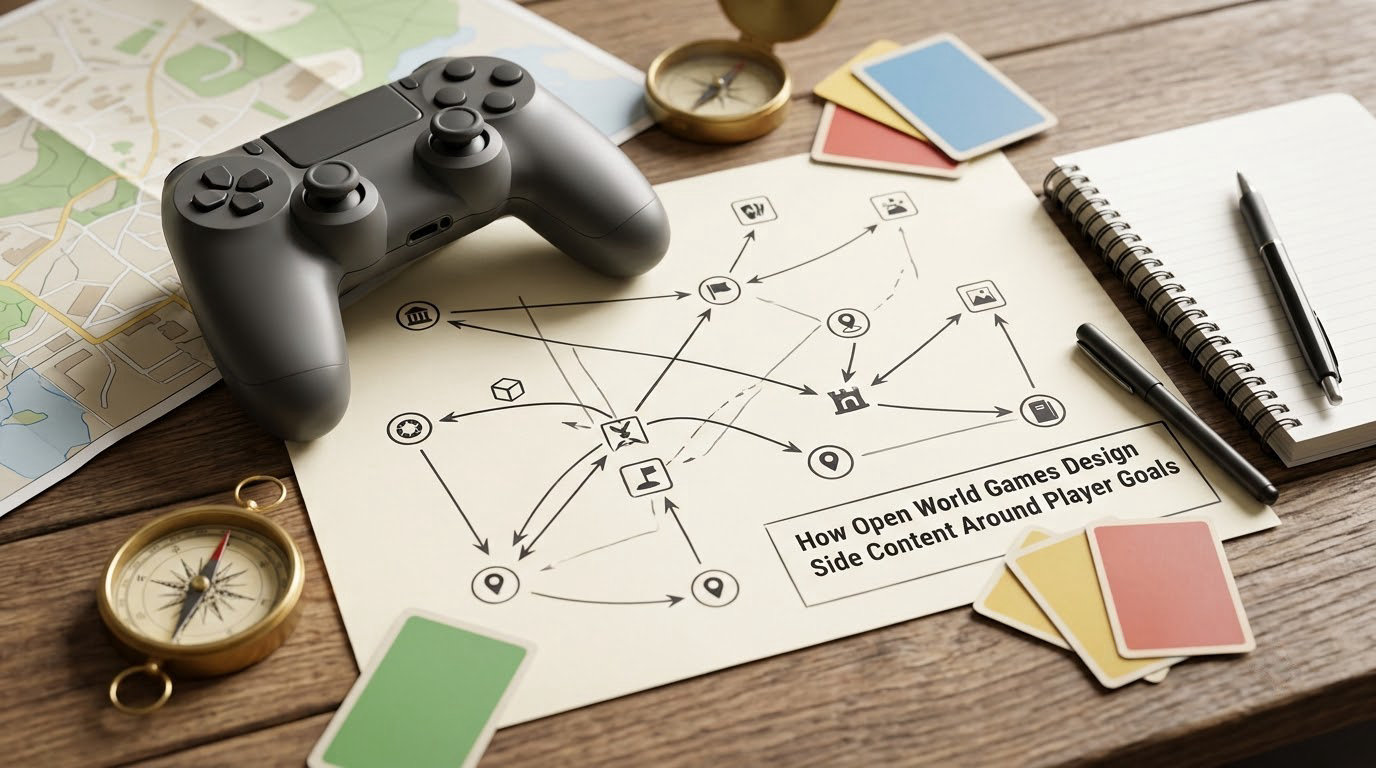
Designers rarely invent new activities from nothing. They start from what the player already wants to do on any given day, then build an activity that delivers that want with a twist.
How open world games design side content around discovery
Exploration is the base motivation in most open worlds, so discovery content works by being visible from a distance and rewardable on arrival: a silhouette on a ridge, a tower you can see from three regions away, a locked door with a key you have not met yet. The twist is that the reward is information. Finding the viewpoint tells you where you have not been yet.
Combat, puzzles and mastery
Players who want a fight want a specific fight. Combat side content changes the terms: a boss with a visible gimmick, an arena with a rule, enemies that need a different tool from the one you just used. Puzzles work the same way, but the hook has to be legible from the doorway or the player writes the room off as decoration.
Collecting, customisation and social play
Collecting content works when the reward joins a set rather than sitting alone in a menu. Cosmetic and appearance rewards are the cheapest content a studio can ship and among the most used, because they change something the player sees every frame. Social side content — co-op contracts, world events with other players in them — is the strongest driver of organic discovery in live games, since the player finds it by finding people.
Roleplay and identity
Roleplay players want friction with rules they can interpret. A quest that lets you lie, bribe, threaten or walk away satisfies that, and it is also the cheapest way to make the same content feel different to two players. Background and faction tags are the cheapest implementation: they cost nothing at runtime and change what NPCs will say to you.
The Core Building Blocks of Memorable Activities
Every activity that players remember has the same six parts. Strip out any one of them and the interaction usually flattens into something forgettable.
- A hook in the first few seconds — something visible and specific. A hunter’s guild board with three posted contracts beats a quest marker labelled errand.
- Rules the player can hold in their head — one objective, maybe two. Complexity is fine in the moment-to-moment combat; it is fatal in the setup.
- A meaningful choice — not a dialogue wheel with two colours, but a decision with a cost: take the reward now or investigate the trap, help the hunter or take the payment.
- Escalating challenge — the activity should get harder inside its own runtime, not only across a difficulty slider.
- Readable feedback — screen shake, a sound cue, a changed world state. If the player cannot tell what their choice caused, they learn nothing.
- A reason to come back — a new entry in the codex, a rumour that pays later, a faction standing that changes prices.
The hook is where most weak content fails, because it is the part that has to survive being noticed from a distance. Everything after the hook can be generous. The hook cannot.
How Exploration, Rewards, and Progression Keep Players Engaged
Engagement in open worlds comes from a loop, not from a reward sitting at the end. The player sees something worth checking, spends a short time on it, gets a payoff, and learns something that makes the next walk more efficient.
Environmental clues
The cheapest signposting in games is a trail someone else left. Footprints, smoke, scattered crates, a door standing open in a building that has been locked for a century. Clues cost nothing and reward attention, which is exactly the player trait you want to train.
Reward variety
A reward list that is only money produces a game where every activity feels identical, because money has no flavour. Spread the currencies: equipment with a visible effect, a new fast travel point, a map fragment that fills in a region, a permanent speed or carry upgrade, a rumour that later becomes a quest, and cosmetics. Death Stranding is often criticised for having hundreds of repeatable orders that resolve into the same cargo delivery, and the complaint lands precisely because the reward and the flavour do not vary.
The short loop
A widely repeated design rule says an optional interaction should communicate its purpose within about forty seconds, or the player leaves to find something else. It is a useful test for world events and repeatable activities: if a player has not understood what the interaction is by the time they could have walked away, the design has spent thirty seconds of their attention on nothing.
Progression and secrets
Optional content is the safest place to teach a mechanic, because a failed tutorial there costs the player nothing they were already invested in. Secrets work the same way in reverse: a hidden area that rewards patience is one of the few experiences a player can still feel genuinely earned rather than handed.
How Open World Games Make Side Activities Feel Different
Repetition is not the problem. A thousand quests built from one template is. The fix is variation along a small number of axes, so the content costs the same to produce but reads differently in play.
- Location — the same objective type feels different on a rooftop than in a swamp. Designers call this contextual dressing, and it does more work per asset hour than anything else on this list.
- Enemy composition — swap the mix, not the numbers. Archers on a roof with a shield bearer is a different fight from three melee.
- Rule modifiers — the activity gains one twist: no healing, a timer, allies who flee, a storm. One modifier is cheap to author and reshapes the whole encounter.
- Narrative twist — the person who asked for the job is not who you expected. This is the cheapest form of variation when the design already has characters worth using.
- Optional risk — let the player take a worse reward for a bigger payoff, or add an optional objective that most players will skip.
Assassin’s Creed Odyssey and Valhalla leaned on world events precisely because they are cheap: a short scene, a distinctive silhouette, a reward, done. The weakness of that approach shows up when the silhouette repeats and the twist is always the same ambush.
How NPCs, Writing, and Consequences Strengthen Side Quests
Systems carry volume. Writing carries memory. A side quest that changes something permanent in the world feels like a story even if nobody filmed a cutscene for it.
Characterisation before plot
A named person with a specific grievance is already better content than a generic villager. Give the requester a name, a job, a visible problem and a line of dialogue that changes depending on what you have already done. The cheapest trick in the genre is an NPC who mentions something the player did two regions ago.
Dialogue that reflects state
A dialogue tree is only worth building if its branches depend on flags the player actually changes. Branches that only change tone produce a conversation. Branches that change who will help you later produce a world that remembers.
World state and consequences
Baldur’s Gate 3 is the reference point here because it tracks a large number of quest states at once and lets other systems react: a village that emptied out, a shop that closed, a companion who changed their opinion of you. The lesson for a smaller team is that you do not need the volume, only the wiring. A handful of boolean flags, read by a handful of NPCs, produces most of the same feeling.
Where the reaction comes from
The best consequence is local. Burn down a mill and the mill’s neighbours mention it; kill a faction leader and that faction’s banners come down at their next camp. The loudest complaints about quest design in games like The Witcher 3 are almost never about the content being bad. They are about not knowing what was missable, and the game never telling you.
How Players Experience Side Content Across Different Play Styles
The same map serves very different players, and a design that only serves one of them is leaving most of the audience idle.
- Exploration players want landmarks, vertical routes and secrets. They are the group most likely to find everything, and the group most annoyed by fog walls.
- Combat players want escalation and new rules. Give them a reason to try a different build.
- Puzzle players want the solution to be discoverable and the answer to be interesting. Ambiguity is fine; unfairness is not.
- Roleplay players want expressive options and consequences. They are also the group that roleplays the failure states, so make failure narratively survivable.
- Completionists want a clean checklist with no ambiguity about what counts.
- Casual players want twenty-minute chunks and no penalty for being lost.
Each archetype wants a different entry point into the same content. A long investigation with a fast-travel marker at the start serves the completionist; the same investigation with three optional leads you can smell from across a street serves the roleplayer. Debate about open world design keeps returning to the gap between what is placed and what is actually found, and the answer is usually that density beats distance.
Common Side Content Design Mistakes
These are the failures that show up again and again in player complaints, and each one has a fix that is cheaper than the content it replaces.
| Mistake | Why it fails | Fix |
|---|---|---|
| Objective with no reason | The player has no model of what the activity is for | Write the requester’s problem first, then the objective |
| Same template, new location | Players recognise the structure and skip it | Add one rule modifier per new instance |
| Rewards that ignore the fiction | A costume for a tragedy feels like a coupon | Let the reward be information or access, not just gear |
| Backtracking dressed as content | Travel time is not difficulty | Fast travel from the start, or shorten the walk |
| Lore that contradicts the main story | Players read it as a canon error | Grade side lore as rumour, not fact |
| Instructions that assume the tutorial | The player is lost and blames the game | Show the goal in the world before the marker appears |
| No agency in the outcome | The player watched instead of played | Allow refusal, delay and the messy ending |
One more deserves its own paragraph: making everything missable. Some players argue the opposite position, that optional content nobody can miss is a waste of a studio’s effort. Both sides are describing the same problem. Optional content that can be entirely skipped needs better signposting; content that is missable needs the player to feel they chose it.
A Practical Framework for Designing Better Side Content
Before a side activity goes into the map, run it through eight questions. If it fails more than two, the idea is not ready.
- What is the promise? One sentence the player could repeat to a friend. If you cannot, the hook is not written yet.
- What is the context? Who asked, why now, and what does this place look like before and after.
- What are the rules? The full interaction in two sentences, with no implementation detail.
- Where is the choice? At least one decision with a cost the player can feel.
- What makes it harder? The escalation inside the activity, not the difficulty setting.
- What is the payoff? Item, skill, information or access. Name all four options before choosing.
- What does the world remember? At least one flag that another system can read later.
- How does it differ from its neighbours? Compare it against the three closest activities on the map, not against an ideal.
That last question is the one most teams skip, and it is the cheapest way to catch map bloat before it ships. Lay your activity icons out on a printout of the map and look for three in a row that would be interchangeable.
Frequently Asked Questions
What is side content in an open world game?
Side content is everything a game offers outside the main quest’s critical path: optional quests, world events, contracts, errands, repeatable activities, collectibles and ambient encounters. It is designed so the player chooses to pursue it, and it pays out in story, items, skill or knowledge about the map rather than in progress toward the ending.
What makes a side quest good game design?
A good side quest has a hook the player understands in seconds, rules simple enough to hold in your head, at least one choice with a cost, escalation inside the activity itself, readable feedback, and a payoff that is not just money. The best ones also leave a trace on the world, so an NPC or a location reflects what you did.
How do developers make side quests discoverable?
Discovery comes from signposting rather than map markers: visible silhouettes, environmental clues someone else left behind, landmarks you can see from a distance, and rumours that point somewhere new. Layers of guidance work best, from a vague hint at a tavern to an exact marker for players who want it. A dense map also helps, because content near other content gets found.
Why do open world side quests feel repetitive?
Repetition usually means one template was reused without variation. The fix is to change one axis at a time: the location, the enemy composition, a rule modifier, a narrative twist, or an optional risk. If three activities in a row would be interchangeable in a player’s description, they are map bloat, not content.
Can procedurally generated side quests replace hand-authored ones?
Procedural systems scale far better than hand-authored quests, but they rarely carry a specific voice, and that specificity is what players remember. The workable approach is hybrid: procedural scaffolding for repeatable activities, hand-authored structure for anything with a named character, a consequence, or an emotional beat the game wants remembered.
How much side content should an open world game have?
Enough that the map changes character as you clear it, and not so much that removing ten percent would leave a visible gap. Volume is the wrong measure. Judge it by whether each activity has a purpose a player could describe, and whether the regions feel different from one another rather than merely larger.
Conclusion
Open world games design side content the same way they design anything optional: with a promise the player can understand in seconds, a decision that costs something, a payoff that is not just currency, and a trace the world keeps afterwards.
If you are working on one now, evaluate the three activities closest together on your map before anything else. Print the region, look for three icons a player would describe the same way, and rewrite the weakest one’s hook. That single pass fixes more complaints than a new content patch will.