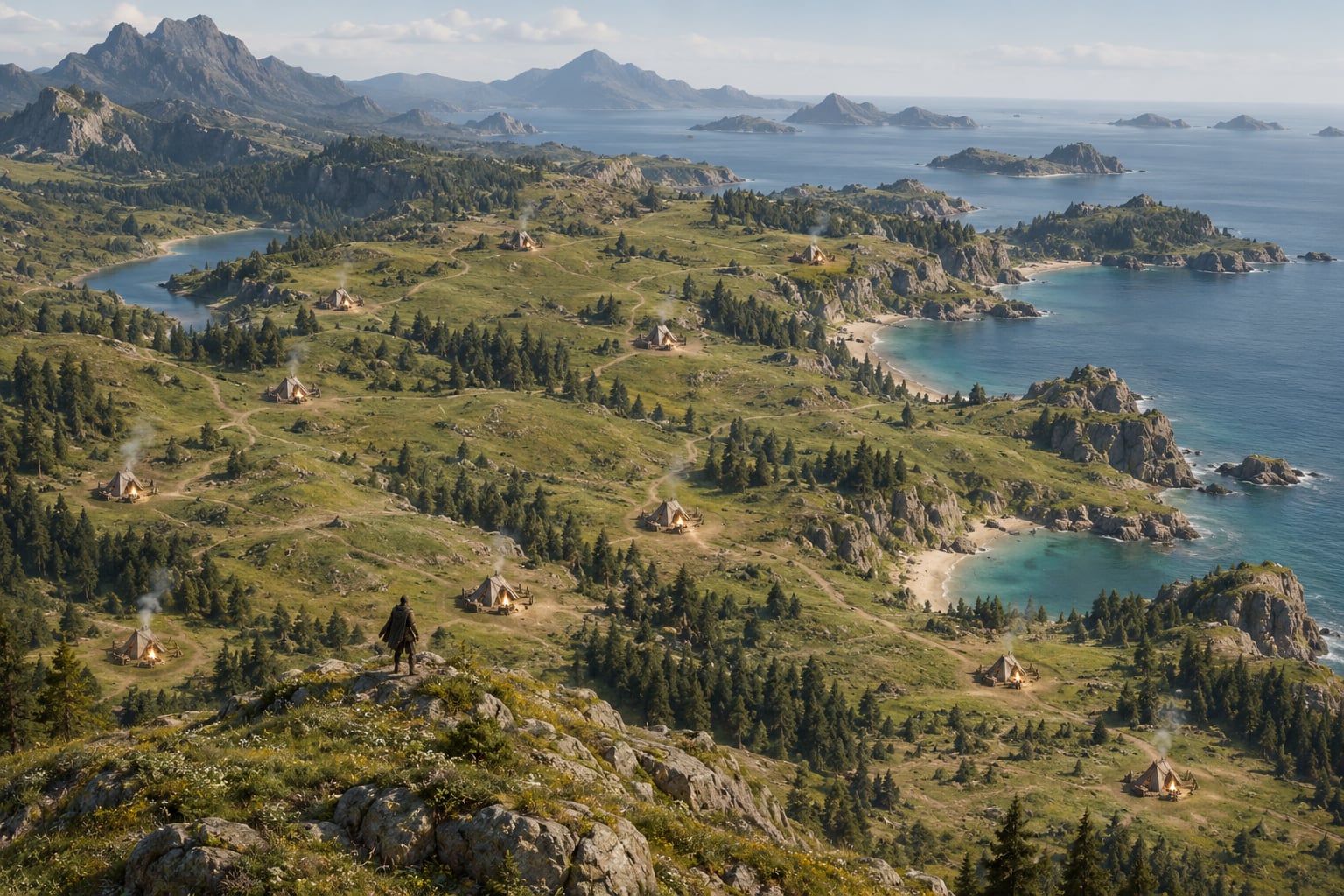
Open world games feel repetitive because the map keeps growing while the amount of genuinely new content does not. Studios budget a fixed amount of handcrafted content, then fill the remaining space by copying one proven activity: the camp, the tower, the fetch quest, the collectible. Add quest markers that remove discovery and enemy scaling that flattens difficulty, and a huge explorable world turns into one long checklist.
I have put maybe two hundred hours into open world games and abandoned half of them for the same reason. Not because they were bad. Because I realised at hour twenty that I was not exploring, I was clearing icons, and the map had nothing left that I had not already seen a version of.
The useful thing about that feeling is that it usually points at something specific. It is not a vague complaint about the genre, and it is not nostalgia for older games, even though the older ones genuinely were different. Repetition in open world design has recognisable patterns, and once you can name the pattern you can tell whether a game is doing it deliberately or because it ran out of budget.
This piece walks through those patterns: what creates the loop, what makes it worse, what good variation looks like, and what to do when you feel the repetition ten hours in.
Table of Contents
- 1Why Open World Games Feel Repetitive
- 2How Repetition Creates the Open World Loop
- 3The Design Patterns That Make the Feeling Worse
- 4Copy-pasted activity structures
- 5Fetch and kill quests as the default side activity
- 6One combat verb for the whole game
- 7Uniform rewards that only go up
- 8Fixed-order objectives
- 9What Makes an Open World Feel Varied Instead
- 10How to Enjoy Repetitive Open World Games
- 11Frequently Asked Questions
- 12Are open world games supposed to be repetitive?
- 13Why do open world side quests feel the same?
- 14Is grinding the same activities necessary in open world games?
- 15Does a bigger open world automatically feel less repetitive?
- 16How can players make repetitive game systems more enjoyable?
- 17What is the difference between repetition and boring repetition?
- 18Conclusion
Why Open World Games Feel Repetitive
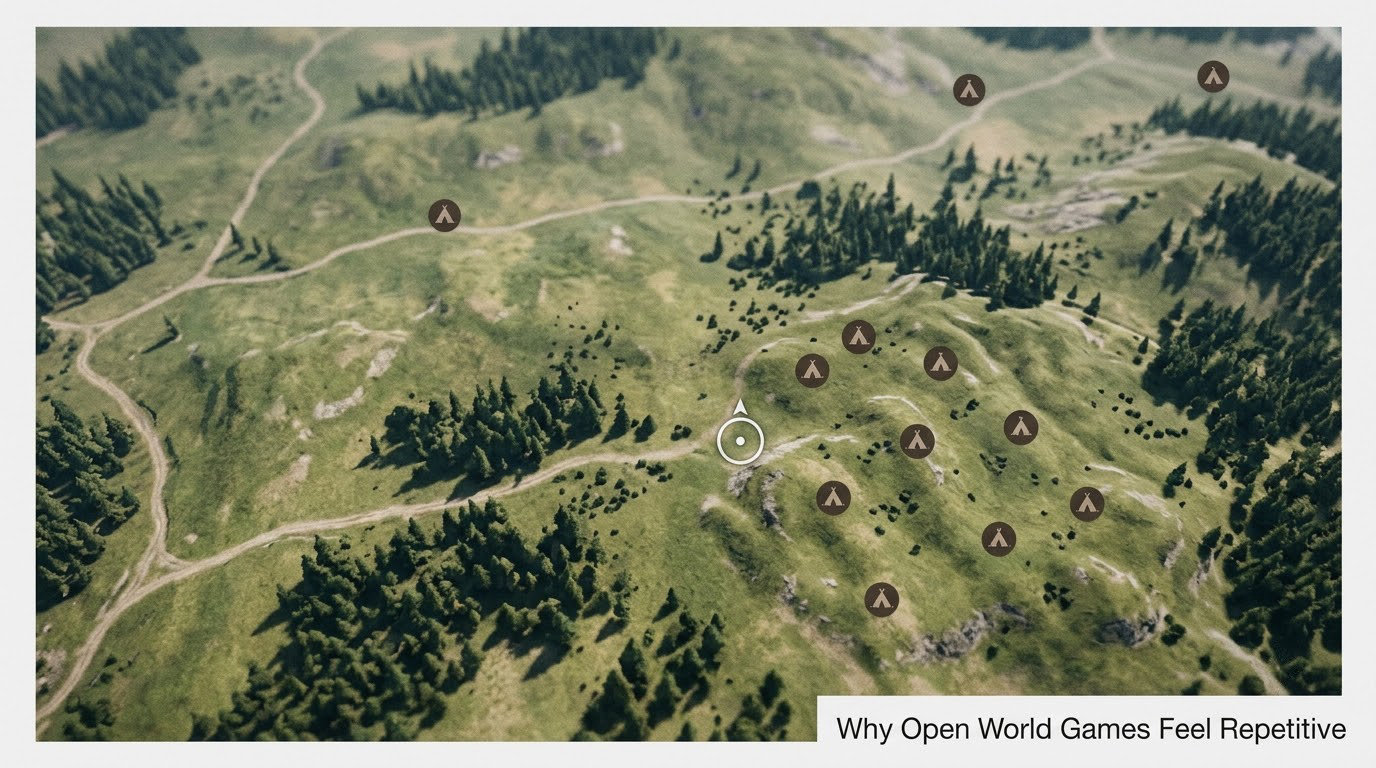
The core problem is arithmetic. A very large map needs a lot of distinct points of interest to stay interesting, and content is the most expensive line item a studio has. Map size, though, is nearly free to inflate. So the map doubles in area while the content budget stays where it was, and unique content per square kilometre falls past the point where wandering feels rewarding.
Once that happens, the studio copies whatever already worked. That single template then shows up at scale, and repetition stops being an accident and becomes structural. On r/gaming, the consensus summary of open world games usually lands in the same place: they end up feeling either empty or like the same thing repeated. That is a design outcome, not a player failing.
There is a useful distinction here, and it is the one most arguments about the genre skip. Long is not the same as repetitive. A 100 hour game with genuinely different encounters, regions and problems in each is not repetitive. A 12 hour game where every bandit camp is the same fight in a different field absolutely is. The metric that matters is variety per hour of play, not the hour count on the box.
The history helps explain how we got here. The Assassin’s Creed era solved exploration with towers: climb one, unlock a region, see the map fill in. It was a clean solution to a real problem and most players accepted it. What followed was the cluttered icon map, where every activity had a symbol and the minimap became the primary way you played. The newer approach, associated with Zelda: Breath of the Wild and Elden Ring, leans on landmarks and sightlines instead: you navigate by looking at the horizon, not by reading a list.
Players who cut their teeth on the tower era sometimes misread newer games as repetitive because the loops are more visible. Climbing towers looks repetitive only if the map under it is repetitive. In a game with real regional variety, the same traversal action carries you somewhere genuinely new each time.
How Repetition Creates the Open World Loop
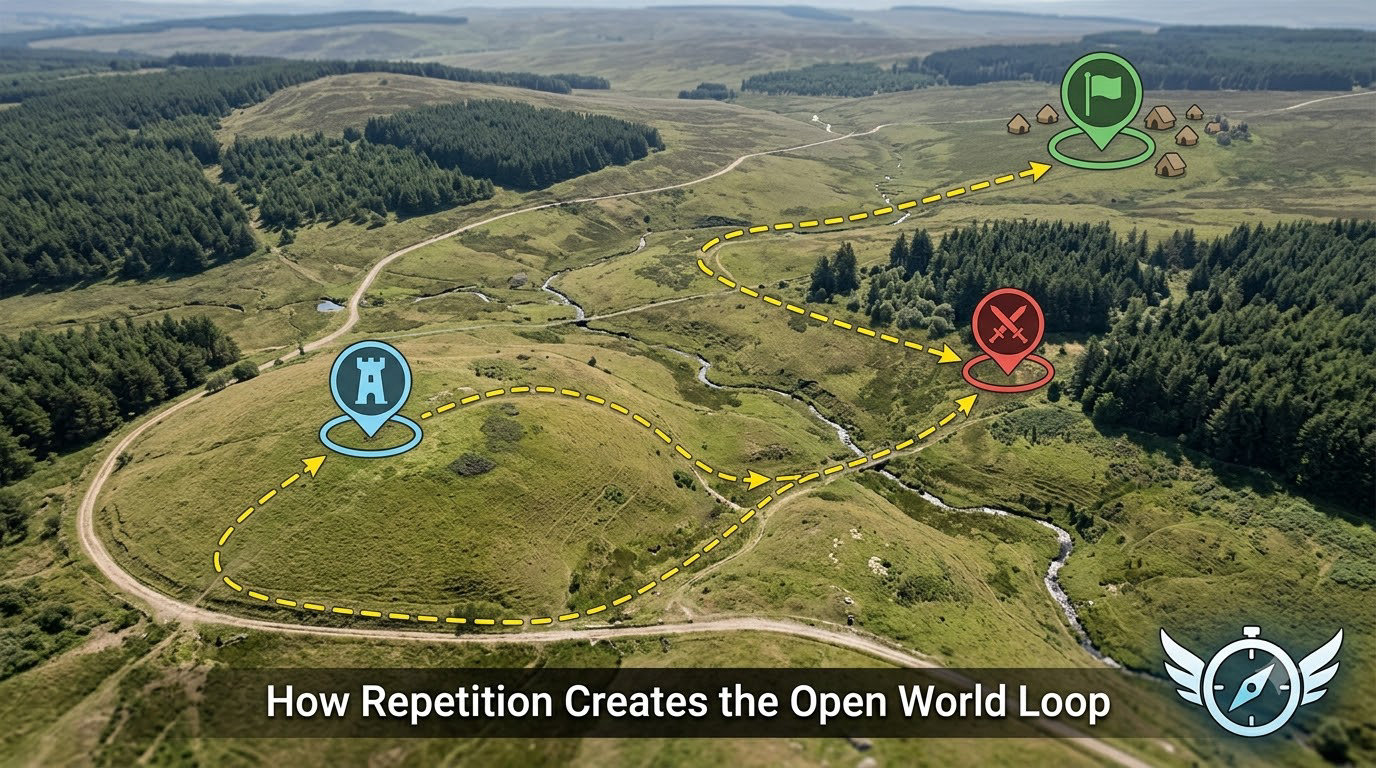
Most open world filler is built around the same five-step loop: travel to a marker, activate the activity, complete a short objective, collect a reward, fast travel to the next marker. Each step is deliberately low effort, because the activity is designed to be repeatable rather than memorable.
That is not laziness in the individual case. It is a sensible engineering choice at scale. A loop that asks for a fresh thought every time cannot be instantiated forty times. A loop that asks for one dodge roll and one loot pickup can be instantiated anywhere, on any terrain, by any enemy archetype the team already built.
Fast travel is what makes the loop tolerable, and it is also what makes it feel endless. Without it, the travel step would impose a real cost and the repetition would be visible as boring. With it, each iteration takes a couple of minutes, so a player who has learned the loop can burn through a dozen activities without a single interesting decision. Fast travel availability is the factor players mention most often when they talk about whether a world feels tedious, and it cuts both ways.
Then there is the compliance trap, which is the part almost nobody writes about. Players skip the filler. They route around bandit camps, they buy upgrades and speedrun the story. The telemetry reads as engagement, because skipping still takes time, so the studio concludes the activity is popular and adds more of it. The world gets fuller and the player gets more bored, and both sides honestly believe they are responding to what the other one wants.
That feedback loop is why the genre piles up rather than curates. Nothing in it rewards a smaller, tighter map.
The Design Patterns That Make the Feeling Worse
Some repetition is unavoidable in a game with hundreds of locations. Specific patterns make it land much harder, and they are worth learning to spot.
Copy-pasted activity structures
The clearest tell is structural sameness. The twelfth camp has the same layout as the eleventh, the same guard count, the same elite at the back, the same reward at the end. You are not learning the activity, you are executing a procedure. Dragon’s Dogma 2 gets praised partly because encounters arrive organically rather than at a marked spot, so you actually have to decide what to do about them.
Fetch and kill quests as the default side activity
When a side quest is retrieve this item or clear this camp, the writing is usually just scaffolding to justify a fight. ResetEra threads about Final Fantasy VII Rebirth and the Assassin’s Creed Valhalla and Odyssey run long for exactly this reason: when the main story is gated behind filler side quests, the filler stops being optional. Players there pushed back hard on the idea that padding is acceptable as long as it is skippable, on the grounds that a developer choosing to put something on the map is making a statement about what the game is.
One combat verb for the whole game
This is the most immediate thing you feel and the least discussed. If every fight is dodge, roll, punish, execute, and nothing changes from the first camp to the last boss, sixty hours of combat is one long encounter. GameFAQs abandonment threads mention this almost as often as they mention empty maps, alongside NPC barks that repeat until players mute the game, and stamina systems that make crossing a region feel like a commute.
Uniform rewards that only go up
When every activity pays the same currency into the same upgrade track, choices collapse. Nothing you do changes how you play later, so nothing is really a decision. A reward that alters future play, a shortcut that opens, a dialogue option that unlocks, makes the next iteration interesting in a way a bigger number never does.
Fixed-order objectives
Objective lists given in a fixed order train you to stop reading. Once you know that marker three always follows marker two, you stop paying attention to any of it. Optional content with no stated order keeps you deciding.
| Symptom you notice | What is usually behind it | What better design does |
|---|---|---|
| Clearing icons feels like a job | Map size outran unique content | Denser map with fewer, deeper points of interest |
| The same fight over and over | Single combat verb, no enemy variety | Encounters that demand different tactics |
| Collectibles feel like an errand | Checklist reward design | Fewer collectibles that each grant something real |
| You never feel lost | Quest markers and map icon clutter | Landmarks and sightlines you navigate by eye |
| Every region looks the same | Regional identity was never a priority | Distinct terrain, architecture, factions per area |
| Bored and underpowered at the same time | Power scaling out of sync with your route | Scaling that respects where you chose to fight |
Fast travel availability belongs on that list too. It is the single most cited quality-of-life factor in whether a player describes a world as tedious, and it cuts both ways: convenient, but it flattens the distance that used to make discovery feel earned.
What Makes an Open World Feel Varied Instead
Variety does not require more content. It requires content that differs from itself. The games players hold up as proof the format works all share a few traits.
Regional identity. Breath of the Wild feels different in the cold plateau than it does near the starting plateau, because weather, resources and enemies change with the region. Red Dead Redemption 2 and Ghost of Tsushima get the same effect from scenery and architecture doing the work. When you can tell where you are from the ground alone, travel keeps producing information.
Choices that persist. In a game where a reward changes how you approach the next region, iteration has a purpose. Dragon’s Dogma 2 works partly because the world responds to what you did to it. Contrast that with an activity whose entire reward is currency for a linear upgrade track, and the fourth run through teaches you nothing.
Systems that intersect. Outer Wilds is the clearest example: knowledge is the progression, and each loop gives you information that reframes what you already did. Nothing repeats because you are not repeating an action, you are repeating a place with more information. On ResetEra, it gets named as handcrafted content where no discovery is recycled, alongside Xenoblade Chronicles 1.
Content the player directs. Elden Ring has vast stretches of nothing, and that is the point. You choose what to engage with, which means the gaps never read as filler. Baldur’s Gate 3 runs past a hundred hours with no repetition complaints in the same threads, partly because the content answers what you did rather than what the designer assumed you would do.
A second hand on the controls. In a good open world, the same traversal verb produces different situations. A glider means something different over a canyon than over a convoy camp. When one action covers every situation identically, no amount of map size fixes it.
How to Enjoy Repetitive Open World Games
Sometimes the design is the problem. Sometimes you can still get a good run out of it, and this is where most of the practical advice lives.
First, know which kind of repetition you have. The famiboards thread draws a line that is genuinely useful: relaxing repetition has a rhythm you settle into and stops asking anything of you, tedious repetition demands constant effort for no change in state. A fishing minigame in a village you like is relaxing. The same fishing minigame in each of four identical fishing villages is tedious. Same verb, different result, and you can feel which one you are in.
Beyond that, a few things that work for me:
- Set a personal rule and stick to it. I decide before I start whether I am doing the region for the story or for the collectibles. Mixing both means doing everything badly.
- Turn off the markers for a region. Walk a compass bearing and see what you hit. This is the cheapest fix and it works on games you thought were empty.
- Change the build between regions. Different tools turn a familiar camp into a different problem, which is closer to real variety than any amount of new content would be.
- Read the quest text. Thin quest writing is a symptom, but the writing is often the only handcrafted part left, and it costs nothing.
- Aim for mastery instead of novelty. Some systems genuinely get better with use. That is a legitimate way to enjoy them and it costs you nothing but patience.
- Watch for the mid-game signal. If you have been ignoring markers for two hours and nothing surprised you, you are not discovering, you are commuting. That is the moment to put it down, not twenty hours later.
And one honest reframe. The strongest counter-argument on those forums is that player expectations are part of the equation. If you buy a 60 hour open world expecting every hour to feel new, you will be disappointed, because that is not a thing any developer has shipped. ResetEra made this point hard and mostly correctly: the framework of whether a game respects your time is incoherent, because time is not what players are actually measuring. Length, repetition and pacing are three different complaints wearing the same coat.
Keep the separation. A long game that varies is worth your weekend. A padded game that repeats is not, and no amount of player effort makes it one.
Frequently Asked Questions
Are open world games supposed to be repetitive?
Repetition itself is expected. A large map cannot handcraft something new for every corner, so studios rely on recurring verbs like climbing, gliding or riding. What players object to is repetition with no variation between iterations, where the twelfth camp plays exactly like the eleventh. Repetition becomes a problem when the same activity produces the same outcome and teaches you nothing new.
Why do open world side quests feel the same?
Most side quests use a small number of templates, usually retrieve an item or clear a camp, with different names and rewards bolted on. Side quests are also cheaper to generate procedurally than main missions, which get handcrafted dialogue and set pieces. When the template, the reward and the pacing all match, only the labels change, and that sameness is what players notice first.
Is grinding the same activities necessary in open world games?
Usually no, unless the main story is explicitly gated behind it, which is where the argument gets heated. Optional farming exists to support a build or a completion goal, not to unlock critical path progress in most well-regarded examples. Games where the story forces filler side quests draw the heaviest complaints, because optional content stops being optional in practice.
Does a bigger open world automatically feel less repetitive?
Not at all. In fact map size often makes repetition worse, because content budgets stay roughly fixed while area grows. What matters is density: how many genuinely distinct things exist per square kilometre. A smaller map with varied encounters beats a huge one with the same camp reskinned, and players tend to notice the smaller game as more interesting for exactly that reason.
How can players make repetitive game systems more enjoyable?
Change your approach rather than the game. Set a personal rule about what you are doing in a region, navigate by landmark instead of by marker, and rotate builds so the same camp becomes a different tactical problem. Focus on mastery if you enjoy systems that reward practice, and treat collectibles as optional rather than as a checklist. Most of all, decide early whether the game is worth continuing instead of drifting for twenty hours.
What is the difference between repetition and boring repetition?
Repetition is doing something again with the outcome, cost or meaning changing. Boring repetition is doing the same thing again and getting the same result, which costs effort and returns nothing. A relaxing loop like fishing in a village you enjoy is repetition that works. The identical fishing spot copied into four villages is tedious repetition. The variable is whether the loop rewards you, not whether it repeats.
Conclusion
Open world games feel repetitive when the map outruns the content, and the gap gets filled with copies of the same activity. Everything else, the fetch quests, the icon clutter, the single combat verb, the collectible checklists, is a symptom of that one arithmetic problem.
So check one thing first when a world starts to bore you: does doing the same activity again change anything, or teach you anything, or let you do it differently? If the answer is yes, you are looking at repetition that is doing its job. If the answer is no, no amount of hours will fix it, and the honest move is to put the game down and find one with a denser map.