A game sales cycle is the repeating shape of a video game’s revenue, from the moment it goes on sale through the years that follow: a large launch spike, a decay period where daily sales shrink, fresh spikes when the game is featured in a platform sale, and a long tail of steadier discounted sales. Understanding how game sales cycles work tells you when the money actually arrives, why a game can look dead in month three and still out-earn its launch later.
One note before we start. Searches for this term are crowded with B2B content about the length of time it takes to close a software deal. That is a different thing entirely. Here we mean game revenue over time, also called a game sales life cycle.
Table of Contents
- 1How Game Sales Cycles Work: Quick Guide
- 2The typical game sales-cycle curve
- 3Why Do Most Games Sell Most at Launch?
- 4What Happens During the First Weeks After Launch?
- 5How Do Discounts Affect Game Sales?
- 6When a discount can restart a sales cycle
- 7How Do Updates and Expansions Change Demand?
- 8How Do Reviews, Visibility, and Backlogs Shape the Cycle?
- 9Which Numbers Game Sales Teams Watch?
- 10How Does a Typical Multiplayer Game’s Sales Cycle Differ?
- 11How game sales cycles work in free-to-play multiplayer
- 12A Simplified Game Sales Cycle Example
- 13Frequently Asked Questions
- 14What is a game sales cycle?
- 15How long does a game sales cycle usually last?
- 16Why do sales spike again after a game launches?
- 17Does putting a game on sale always increase revenue?
- 18How do reviews and updates affect long-term game sales?
- 19Conclusion
How Game Sales Cycles Work: Quick Guide
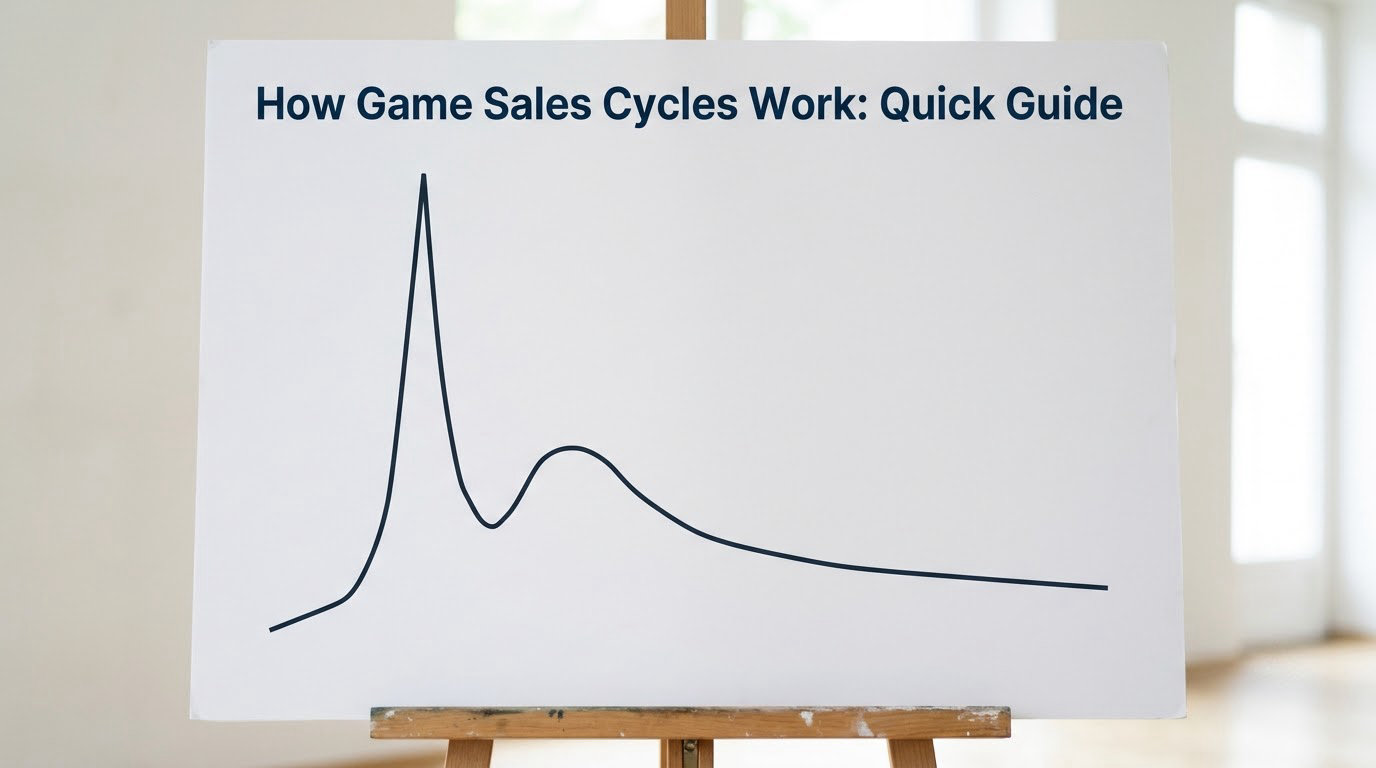
The whole model rests on five phases, and the cycle repeats: pre-launch, launch, stabilization, expansion, and evergreen or decline.
| Phase | Typical timing | What drives it | Share of lifetime revenue |
|---|---|---|---|
| Pre-launch | 6 to 24 months out | Wishlists, preorders, demos, announcements | Almost none |
| Launch spike | First 7 to 14 days | Press, platform featuring, creator coverage, backlog demand | The largest single block |
| Stabilization | Day 15 to day 90 | Reviews settling, refunds, word of mouth, patch response | Steady decline |
| Expansion | Months 3 to 18 | Updates, expansions, seasonal sale inclusion, a platform subscription | Second bump, often the surprise |
| Evergreen or decline | Year 2 onward | Backlist discovery, deep discounts, bundle inclusion | A long, low, sometimes surprising tail |
The seven stages underneath those phases are what most people are actually looking for when they search this question.
- Pre-launch build. Wishlists accumulate and the store page gets traffic without a single copy sold. This is the leading indicator for everything that follows.
- Launch spike. Notifications fire, press runs, curated lists pick the game up, and everyone who was holding a grudge buys on day one.
- First-90-day decay. Daily sales fall steeply as the curious run out. Most games lose the majority of their launch-week momentum before month three.
- Early Access or live service. A staged release turns one launch into a series of smaller ones, each with its own news cycle.
- Seasonal sale spike. Winter, Summer, Autumn, and Spring sales, plus weekly events such as Midweek Madness and Daily Deals, deliver a bump that is mostly buyers who were never going to pay full price.
- Discount ladder. Depth increases with age: a first anniversary discount, then deeper cuts in year two, then clearance pricing at end of life.
- Evergreen long tail. The game keeps selling for years, usually at a low price, and for many titles this tail is a large share of lifetime revenue.
The typical game sales-cycle curve
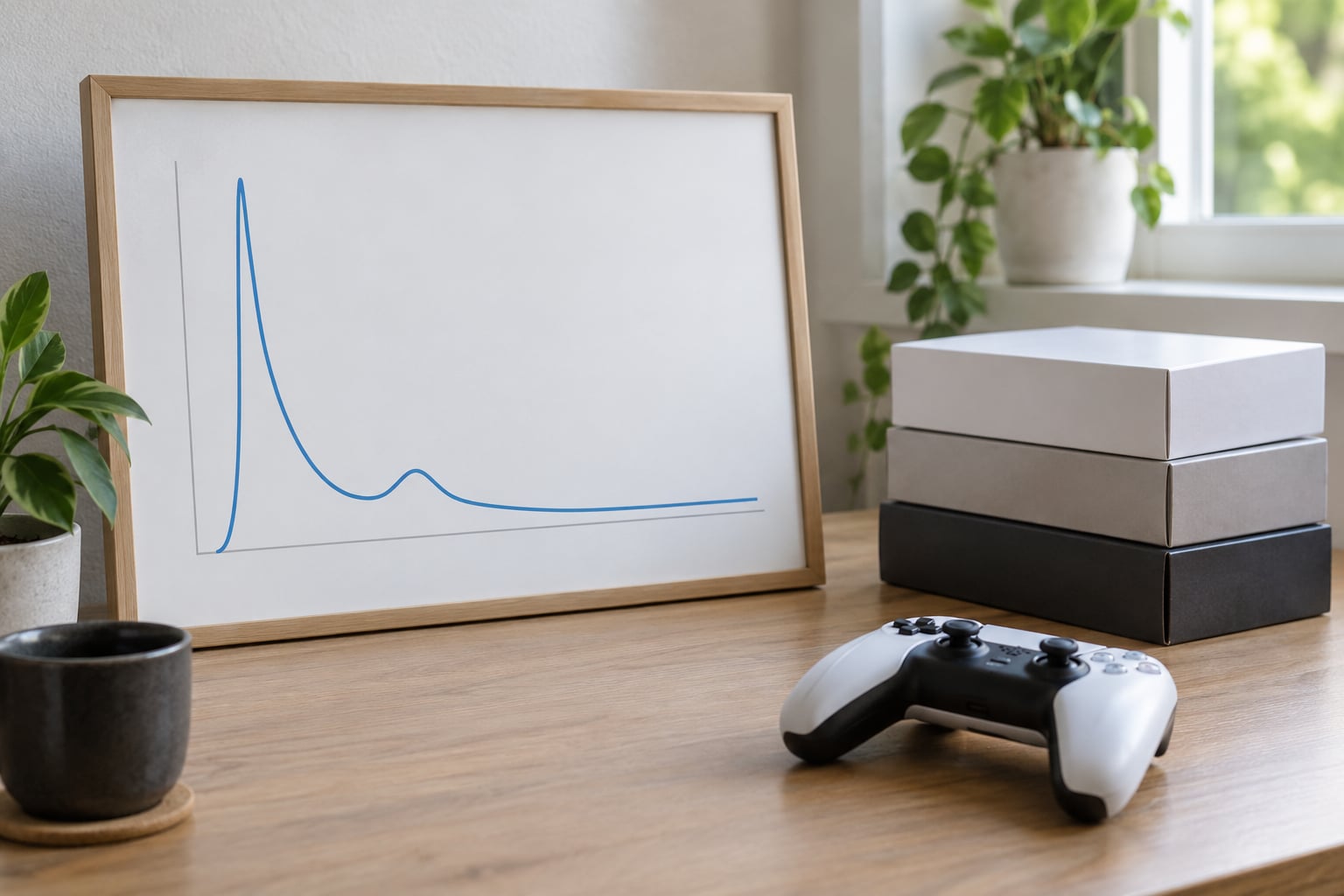
The curve looks like a cliff followed by a whisper. A tall narrow spike in week one, a steep slide over the following months, occasional smaller bumps when the game is on sale, and then a long flat line that is easy to underestimate.
The pattern varies by genre, price, platform, audience, and marketing budget, and the two variables that shift it most are updates and visibility. A game with a steady content cadence has a bumpier curve than a finished, self-contained release. A game with a large direct audience has a flatter one.
Why Do Most Games Sell Most at Launch?
Because launch demand is created once and spent once. Awareness peaks, purchase intent converts, and then the audience moves on to the next release.
Seven things drive the spike. Platform featuring puts the game in front of people who were not searching for it. Press coverage converts curiosity into preorders. Creator coverage substitutes for marketing budget, and a handful of large channels can move a sales curve over several weeks on their own. Backlog demand is the quiet one: plenty of players mean to buy, and a new release is the only reliable deadline for doing it.
Wishlists are the mechanism underneath all of it. A wishlist entry fires a notification the moment the game goes on sale, which is why a game with tens of thousands of wishlists can outsell a game with better marketing but fewer of them. One published case study found that roughly a fifth to a quarter of a title’s lifetime wishlist balance eventually converts, and that is why developers worry so much about the pre-launch number.
Preorders follow the same logic a little earlier, moving money before the game exists and giving launch-week numbers a flattering boost.
What a launch spike does not prove is that the game has sustainable demand. A spike measures curiosity as much as satisfaction, and the honest test comes in week three.
What Happens During the First Weeks After Launch?
The stabilization phase is where the real curve shows itself. For the first 30 to 90 days, sales are being decided less by advertising and more by what buyers are telling each other.
Review aggregation settles fast, and buyers searching in week four see a score that is essentially the week-one score, softened slightly by later opinions. Refund windows add noise, since refunded copies show up as negative signals and recovered revenue. Early bugs generate videos, and videos travel further than patches do.
Platform visibility decays independently of quality. A game that held a front-page slot in week one competes against a dozen other releases by week six, and the browse traffic it depended on has moved on.
The useful distinction here is retention versus a social spike. A social spike shows up as a burst of mentions and concurrent players that fades in two weeks. Retention shows up as people still playing in month three, still generating reviews and recommendations, and still buying expansions.
How Do Discounts Affect Game Sales?
Lowering the price unlocks buyers who were never going to pay full price, so copies sold can multiply faster than the price drops. The important part is that units moving and revenue moving are two different things, and only one of them reliably goes up.
| Discount | New price on a 20-point launch price | Copies needed to match full-price revenue | Typical observed lift in major sales |
|---|---|---|---|
| 10% | 18 | 1.1x | Modest, often under 2x |
| 20% | 16 | 1.25x | 2x to 4x |
| 30% | 14 | 1.43x | 3x to 6x |
| 50% | 10 | 2x | 10x to 20x in big seasonal events |
| 75% | 5 | 4x | Large, but it resets the reference price |
The math is simple. A game priced at 20 needs 1.25 times as many copies at 16 to earn the same money, and twice as many at 10. Published analysis of Steam sale data puts the typical lift during major seasonal events at 10 to 20 times, which clears the break-even bar easily at shallow and moderate discounts.
It also clears it at deep discounts more often than developers expect, because a cut of 75% on a game with a big wishlist or backlist audience can sell several times the break-even volume. The cost is not arithmetic. The cost is anchoring: players who see a game at 5 remember 5, and some of them stop buying it at full price for the rest of its life.
Two rules shape when a game can be discounted at all. A launch discount can run for roughly 7 to 14 days, ending at a fixed hour Pacific on the applicable day. After a discount ends, there is a cooldown period, generally about 28 days, before the title is eligible for another one. Scheduling around that cooldown is most of what a sale calendar actually is.
When a discount can restart a sales cycle
A discount restarts a cycle when there is new information attached to it, not just a lower number. That means a major update, a content drop, a review score that improved, a first anniversary, or inclusion in a seasonal sale.
Cutting the price on the same build with no other change mostly pulls forward demand that already existed. Cutting it after a substantial update lets you reach a different set of buyers, because the reason to look again has changed.
How Do Updates and Expansions Change Demand?
Updates create new reasons to buy, to return, or to recommend a game. That is the whole mechanism, and it splits into two very different categories.
Content aimed at existing players, such as balance changes, new modes, seasonal events, and bug fixes, mostly drives people back into a game they already own. It shows up in concurrent players and playtime rather than in new sales.
Content aimed at everyone else, such as a substantial free update that changes the game’s reputation, a priced expansion, or a remaster, creates a fresh reason for a non-owner to spend. The remaster case is the clearest example: the same game becomes a new purchase with a new price and a new audience, and the sales curve effectively starts again.
Developers on forums describe updates as the cheapest sales tool they have, because a good patch generates coverage that no discount can buy. Others describe the opposite experience, watching a much-anticipated update land and change almost nothing, which usually means the update addressed problems without changing the core loop.
How Do Reviews, Visibility, and Backlogs Shape the Cycle?
Reviews and visibility decide how long the launch spike turns into a tail. They also decide how much discount depth a sale can absorb before it starts costing money, which is why how game sales cycles work differs so much between a well-reviewed indie and a polarizing one.
Strong early reviews extend the tail in two ways. They improve conversion for shoppers who were already on the store page, and they make a deeper discount survivable, because buyers accept a big cut on something they were already confident about. Mixed or poor reviews have the opposite effect, which is why so many troubled releases get a content update and a second discount six to eight weeks in.
Wishlists, user ratings, platform rankings, search demand, creator coverage, and release calendar crowding all feed the same loop. A busy week in the same genre means a game competing for the same attention, and a game that slips into a crowded window often performs better six months later in a quieter one.
Platform rankings matter more than most developers expect. Storefront browse traffic is heavily shaped by category and ranking placement, so a title sitting in the top sellers list for a few days can outsell a week of ordinary visibility.
Which Numbers Game Sales Teams Watch?
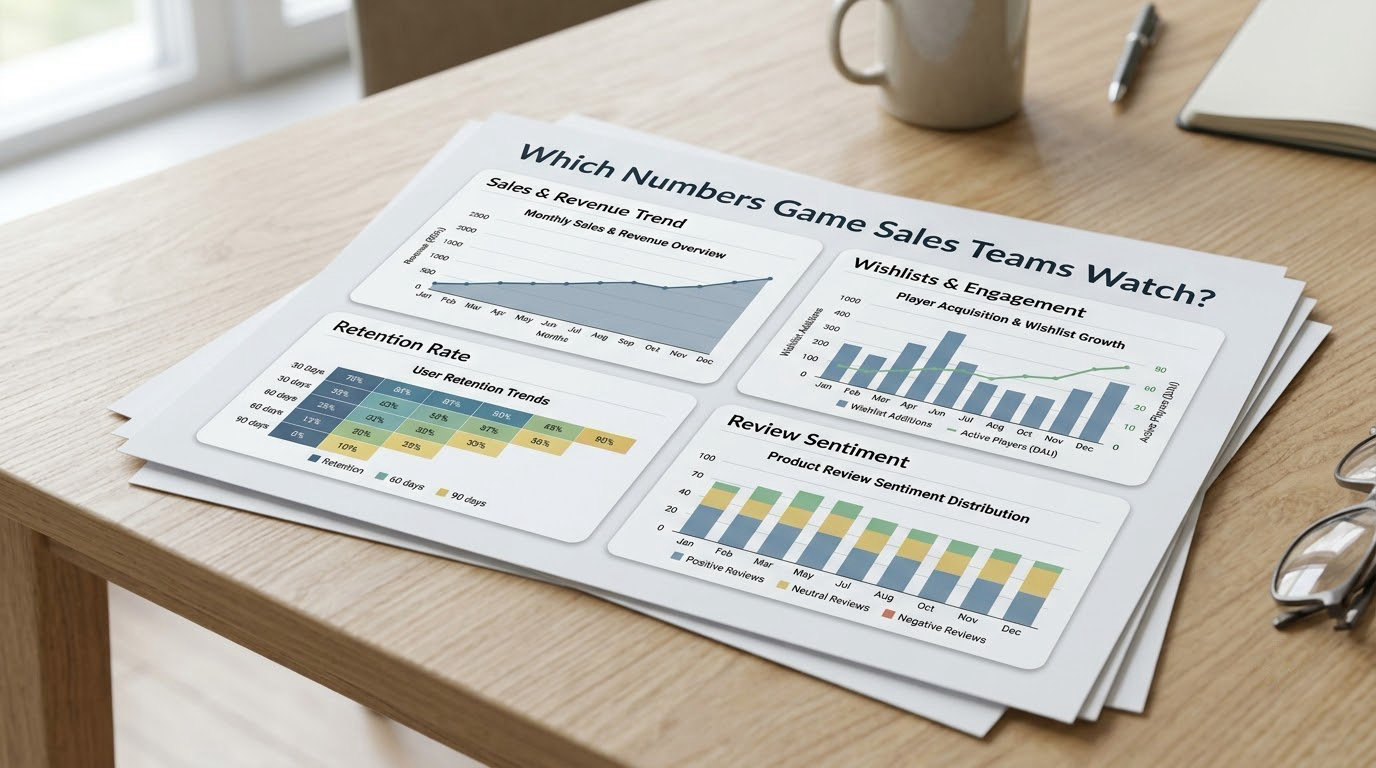
These are the metrics that describe the cycle, and each one has a reading that will mislead you if you take it alone.
| Metric | What it tells you | What it looks like on its own |
|---|---|---|
| Copies sold | Demand volume over time | Revenue, when per-copy value is falling |
| Net revenue | What actually reached the studio after the platform cut, refunds, and taxes | Gross, which is the number people quote |
| Wishlists | Forward demand and launch-day reach | Sales, which it is not |
| Preorders | Committed buyers and platform reach | Revenue that has not arrived yet |
| Wishlist conversion rate | How effectively the audience converted | Quality, which it does not prove |
| Concurrent or active players | Whether the game holds attention | Sales, especially for a free-to-play title |
| Retention | Whether players came back | Popularity, which is a different question |
| Review score and volume | Social proof for shoppers who arrive later | Quality of the game, which is partly taste |
| Average playtime | Depth of engagement per player | Fun, which one player does not determine |
| Refund rate | How many buyers rejected the purchase | Happiness, which it exaggerates |
| Repeat purchases | Whether DLC and expansions are landing | Loyalty, which is not the same thing |
The gross-to-net gap is the one that surprises people most. In a widely cited case study, one indie title earned more than 1 million in gross sales across 26 months and received roughly 529,000, netting about 423,000 after an investor share and running at roughly 8,800 per month for a six-person studio. Net landed near 60% of gross, and closer to 50% once withholding was included.
That gap is why forecasts built on gross figures fail. Budgeting on net is dull and it is the only number that pays anyone.
How Does a Typical Multiplayer Game’s Sales Cycle Differ?
Multiplayer games mostly run on the opposite model. There is no launch spike in copies sold, because entry is free. The spike moves to concurrent players, and revenue arrives through optional purchases over months.
How game sales cycles work in free-to-play multiplayer
In a free-to-play multiplayer title, the cycle is a recurring seasonal pattern rather than a single curve. A battle pass or season resets every few months, which recreates urgency on a schedule, and spending is concentrated in the opening days of each season before the majority of players decide to wait.
Server population is the leading indicator, the way wishlists are for a premium game. Revenue lags engagement, and engagement drops when a competing game launches or when a season feels thin. A live-service title with a content gap in the middle of its life has a predictable dip, and good teams plan content against it rather than reacting to it.
Premium multiplayer, subscription catalogs, and free trials split the difference differently. A game entering a subscription catalog at launch trades a spike in owned sales for a long tail of subscriber hours, which is great for reach and poor for near-term cash. Regional pricing multiplies the effect of every sale by giving cheap markets local price points that unlock a much larger pool of buyers.
A Simplified Game Sales Cycle Example
Take one hypothetical premium action game, list price 20, released on PC and console. The cycle looks like this.
Pre-launch. The studio announces early and collects wishlists over eight months, ending with a healthy number and a demo that plays well. That wishlist total is the launch forecast.
Launch week. It launches into a moderately crowded week, takes a curated slot, and one large creator covers it. The launch discount runs 10 days. Sales spike, and the score settles slightly below what the studio hoped.
Months 2 and 3. Decay is steep and a refund wave follows the first patch. Nothing is broken, but the score keeps sliding, so the studio schedules a balance pass rather than a discount.
Month 6. The Summer Sale arrives with the game included. A 20% discount lifts copies past 1.25x the full-price baseline, and net revenue for the event beats a quiet month at full price comfortably. Wishlists added during the event seed the following year.
Month 9. A substantial free update adds a new mode and the review score ticks up. That is the signal to run a deeper discount later, because the new content gives a non-owner a fresh reason to look.
Month 12. First anniversary, a 30% discount, and the curve shows a second bump that is smaller than launch but larger than any month between them.
Year 2 onward. The game enters bundles and winter sale rotations at deeper cuts. Copies sold keep climbing while revenue per copy falls, and the annual total from the tail eventually rivals a good chunk of the launch window.
That is how game sales cycles work in miniature: one spike, a long decline, and a series of smaller bumps that only appear when the studio gives people a reason to look again.
Frequently Asked Questions
What is a game sales cycle?
A game sales cycle is the repeating pattern of revenue from the day a game goes on sale: a large launch spike, a decay period where daily sales shrink, new spikes when the game appears in a platform sale or receives a major update, and a long tail of steady discounted sales. It is also called a game sales life cycle, and it is unrelated to the B2B sales cycle used in business software.
How long does a game sales cycle usually last?
The active cycle usually runs 3 to 12 months, defined as launch through the last major content update or discount event. Sales do not stop after that; they flatten into an evergreen tail that can run for years. How much revenue arrives in that tail varies enormously by genre, price, updates, and how much direct audience the studio owns.
Why do sales spike again after a game launches?
Later spikes come from reasons that did not exist at launch. A seasonal sale, a Daily Deal, a big update, a streamer covering the game again, a review score that improved, or a price drop that reaches buyers who refused full price all create a fresh reason to look. That is why timing matters as much as the discount itself.
Does putting a game on sale always increase revenue?
No. Revenue needs copies sold to rise faster than the price falls, which means clearing the break-even multiplier for that depth. Shallow discounts clear it easily. Deep discounts can clear it too, but they also reset the reference price players remember, so some of them stop buying at full price for the rest of the game’s life.
How do reviews and updates affect long-term game sales?
They extend the tail. Strong reviews raise conversion for shoppers arriving weeks later and let you discount deeper without losing buyers. Updates aimed at existing players bring people back, while updates that change the game’s reputation, priced expansions, and remasters create a new reason for non-owners to spend. Without either, the curve flattens toward zero.
Conclusion
Work out which phase the game is in, then read the one indicator that leads revenue in that phase rather than the one that flatters it.
In pre-launch, that is wishlists. At launch and through the first 90 days, it is reviews and retention, not launch-day copies. After that, it is how much of the audience is still playing and whether anything has given non-owners a fresh reason to buy. Once you are discounting, the number to watch is net revenue per event, not copies moved.
A spike tells you a game is interesting. The long tail tells you whether anyone stayed.