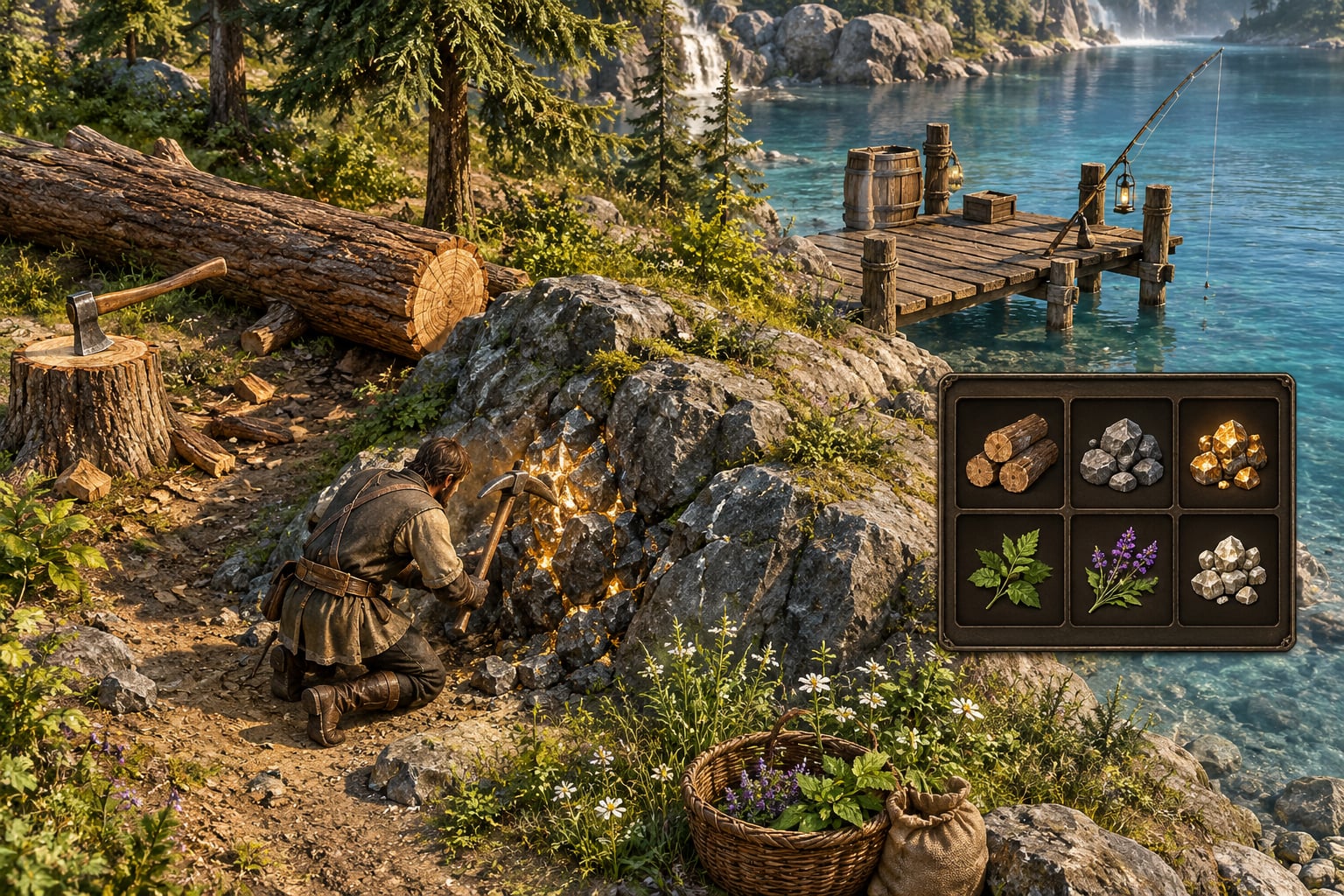
Gathering professions in MMOs are the harvesting skills — mining, logging, herbalism, fishing, hunting and farming — that you level by collecting raw materials from resource nodes. Those materials feed the crafting professions and the player-driven economy, which makes gathering the bottom layer of how an MMO world produces its swords, potions and furniture.
Everything else in this guide is detail on top of that loop. How a node spawns, why you sometimes get three logs and sometimes one, when a bag fills up, and which of those materials are worth keeping.
Table of Contents
- 1What Are Gathering Professions in MMOs?
- 2How Gathering Professions Work in MMOs
- 3What Tools and Character Skills Do You Need?
- 4How Do Resource Nodes and Drop Rates Work?
- 5How Do You Level a Gathering Profession Efficiently?
- 6How to gather efficiently as a beginner
- 7What Happens to the Materials You Gather?
- 8How Do Specializations Change Gathering?
- 9How Do You Manage Inventory and Gathering Limits?
- 10How Do Economy and Demand Affect Gathering?
- 11Which materials are usually worth keeping?
- 12Frequently Asked Questions
- 13Can gathering professions be played with friends in MMOs?
- 14What should I do with duplicate gathering materials?
- 15Should every character learn a gathering profession?
- 16What happens when a gathering check fails?
- 17Which gathering resources should beginners prioritize?
- 18Conclusion
What Are Gathering Professions in MMOs?
A gathering profession is a skill you raise by harvesting a specific resource. Each one ties a tool to a category of node: a pickaxe to ore, an axe to timber, a sickle to herbs, a fishing rod to water, a skinning knife to bodies.
Most games cover the same core set. Mining pulls ore and stone from underground nodes. Logging chops timber. Herbalism cuts herbs, roots and fungus. Fishing works rivers, lakes and open ocean. Hunting and skinning take materials from creatures. Foraging picks up anything scattered in the world that has no node at all, and farming is the grown version of herbalism, where you plant and harvest instead of searching.
The distinction that trips up newcomers is between gathering and crafting. You gather raw stuff; you craft it into finished goods. Crafting is downstream, and a lot of modern games let you buy your way past it.
| Term | What it means | Example |
|---|---|---|
| Gathering profession | Harvests raw material from nodes or creatures | Mining copper ore |
| Crafting profession | Turns gathered material into items other players buy | Smithing a pickaxe from copper bars |
| Processing or refining | The middle tier, turning raw into intermediate | Smelting ore into ingots |
| Life skill | Umbrella term for every non-combat skill | Fishing plus cooking plus alchemy |
| Pseudo-profession | A gathering-adjacent job without a skill bar | Trading, auction brokering |
How Gathering Professions Work in MMOs
The loop is the same nearly everywhere: find a node, equip the right tool, pull a resource, manage what you are carrying, then process or sell it. Names and menus change between games, but the six steps underneath them do not.
- Find or unlock the node. Nodes sit in the world, or you reveal them with a prospecting skill. Some games show markers, others hide them until you are close enough.
- Equip the matching tool. Wrong tool, no gather. Your tool tier also decides which node tiers you can touch at all.
- Gather. One action produces a random number of items, sometimes zero. A depleted node disappears.
- Watch weight, stamina and durability. Heavy loads slow you, some games drain stamina per pull, and worn tools gather worse or stop working.
- Process when the recipe allows it. Raw ore sold as ore earns a fraction of what ingots earn, because somebody downstream has to do the work.
- Sell or store. Surplus goes to the auction house or a vendor. Materials you need yourself go to your bank.
Each successful pull gives profession experience, so the loop raises two things at once: your skill level and your stock of raw material. Once you master a category in a zone, you move on.
What Tools and Character Skills Do You Need?
You need the right tool, a tool good enough for the node tier, and enough character investment that the yield is worth the trip. Games layer this in different orders, but the pieces are similar.
Tool tier gates access. A starter pickaxe will not touch iron nodes in most systems, so your first upgrade is usually the thing standing between you and a better zone. Some games tie the tier to your character level, others to a separate gathering rank that you pay for with materials.
Quality changes the value of what comes out. A low-grade log refines into a low-grade plank. A high-grade one can hit the top of a crafting recipe, and that difference is worth real money at the market.
Bonuses come from three places. Class and job skills add yield rates or extra gathering attempts. Gear does the same thing with better numbers. Food and potions give a short timed bonus, usually a percentage boost to gathering speed or yield for a few minutes.
Stack those three carefully. A gatherer with a yield bonus, a gathering-rate bonus and a food buff is not three times as fast, because most of those bonuses multiply rather than add. A 20 percent yield bonus on top of a 20 percent rate bonus lands near 44 percent, not 60. Players who assume otherwise buy too many buffs and wonder why the gains flatten out.
Durability is the mechanic that catches out new players. If your tool loses condition with each use and breaks mid-run, you either carry spares or you gather slower than you should. Repairs are cheap, but the moment you stop watching the bar is the moment you waste a circuit.
A simple example: if your axe yields an average of four logs per pull and a quality upgrade raises that to six, a zone with a hundred usable trees gives you roughly two hundred more logs per circuit. Nothing about the zone changed. Your tool did.
Compare a tool swap against a gear swap before buying either. A gathered material that goes from three to five per pull pays for a new tool faster than a five percent bonus does, because the tool compounds across every other stat you will ever buy.
How Do Resource Nodes and Drop Rates Work?
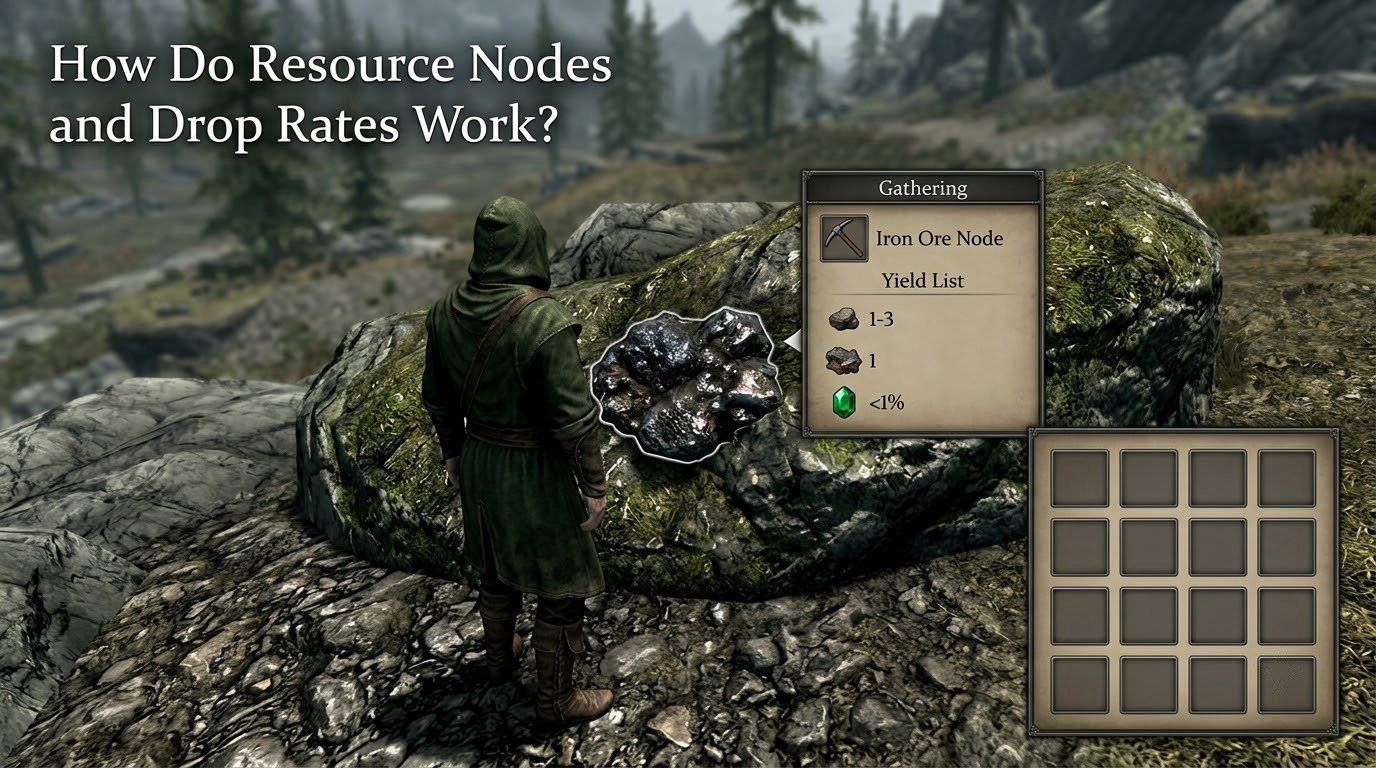
Resource nodes spawn at fixed points in a zone, wait on a respawn timer, then come back for the next player. Some games personalise that timer so your node is ready for you while it still looks depleted to everyone else. Others share one timer across the zone, which turns gathering into a race.
Inside a single node, output is usually random within a range. A node might give 1 to 3 logs, or 0 to 5 if the game is punishing. Some resources are exceptions: fish and some herbs have fixed counts, so you always get the same result from that spot.
Cached nodes complicate the picture. Some games remember what a node gave you and only rebuild it to that state, so an empty node is genuinely empty for everyone rather than rolling fresh each time. Others hide a rare node inside an ordinary one at a low chance, which means the same ore node can be worth a fortune or worth nothing.
| Source | How output is decided | What changes it |
|---|---|---|
| Fixed node yield | Same result every time, or near it | Tool tier, quality roll |
| Randomised drop | Number rolls inside a range | Yield bonus, gathering rate, luck |
| Skill-based bonus | Extra roll or extra attempt on a chance | Prospecting, specialisation, mastery |
| Combat or skinning drop | Table roll after a kill | Luck, thresholds, node rarity |
Skill checks are the mechanic that separates older games from modern ones. In a check-based system you get a timing or accuracy prompt, and your character skill decides whether you get the bonus yield, the standard yield, or nothing. More skill narrows the failure window. It is the main reason a veteran gatherer out-earns a beginner in the same zone.
Node competition is where server type bites hardest. On a populated server, popular nodes get emptied within minutes of resetting, and the fastest route to a good circuit is a quieter zone rather than a better one. On a low-population server the same zone stays full, and the only limit is how fast you can move.
Some games let you group and share. In those, a party can pull from one node together and split the yield, which is convenient and also means four people earn what one person earned alone. Gathering in a full party is efficient in time and poor in gold per hour.
The last node variable is timing. Harvest events, weekend bonuses and new-zone launches briefly multiply what a node is worth, and they are the one window where it makes sense to interrupt a levelling plan and go farm.
How Do You Level a Gathering Profession Efficiently?
Level fast by working zones just above your skill level, keeping a tool upgrade ahead of your gather rate, and not wasting a node. Level slowly by sitting in starter zones gathering materials that have stopped moving on the market. That last one is the mistake most new players make, because starter zones are safe and safe feels efficient while a full skill bar sits there unused.
Watch what the game is actually rewarding. A profession skill bar that only matters when it unlocks a node tier is a gate rather than a progression system, and the fastest route through it is the shortest route to that tier. A skill bar with real abilities behind it is worth spending time on, because those abilities keep paying after the tier is unlocked.
Two things make the first fifty levels faster than the last fifty. Early nodes are dense and rarely contested, so a full circuit pays out every time. Later zones spread nodes across a larger map and put them behind enemies you cannot outrun, so the same circuit takes twice as long for a fraction of the experience.
That is also when buying starts to make sense. Once a material is cheap on the market and slow for you to farm, the market is faster than your pickaxe. Save gathering for the materials that are expensive, rare or simply not sold, and buy the rest.
Start in the zone that matches your tool, not your character level. Move up when a zone stops giving you skill-ups quickly or when you have simply run the safe nodes dry. Higher-tier nodes also pay better per pull, so the jump is worth planning a route for.
Learn the whole category before you max one part of it. A gatherer who can do every node type in a zone never waits, and waiting is where the time actually goes.
Keep an eye on rare spawns while you are out there. One rare drop can outweigh an hour of common ones, so a slow circuit through the back of a zone is often the better route.
How to gather efficiently as a beginner
- Plan a loop before you teleport. A circuit of ten known nodes beats wandering for forty minutes.
- Bring stackable bags or a mount with storage so a full pack never ends your run.
- Note the respawn pattern of the zone. Come back to the nodes you emptied instead of hunting for fresh ones.
- Avoid areas with high-level enemies until your gear can survive a mistake. Death costs more time than the grind saves.
- Bank crafting materials on the way past a city rather than carrying them all the way home.
- Do one session with the auction house open in a second tab. Prices move faster than new players expect.
What Happens to the Materials You Gather?
Most gathered material goes to one of six places: your own crafting, processing into intermediates, quest turn-ins, guild or alliance projects, supplying alts, or the market. Where it goes decides whether the hour you spent gathering was worth it.
Crafting yourself is the best rate per item and the worst rate per hour, because you also have to learn a second skill. If you only need a few stacks of a reagent, buy them. If you need thousands and you enjoy the second skill, gather.
Processing sits in the middle and it is where a lot of the money hides. Ore sold raw earns less than ore sold as ingots, because someone has to smelt it. That someone can be you.
Quests and guild projects turn surplus into reputation or a fixed reward rather than gold, which is useful early and low value later.
Alts are the quiet destination nobody plans for. A fresh character arriving with nothing needs starter tools, cheap food and a stack of healing potions, and the cheapest source is a gathering character you already own. Filling three alts this way takes an evening of gathering instead of an evening of shopping.
Guild and alliance supply lines are the same idea at scale. A guild that needs forty flasks for raid night has a standing demand that does not care what the auction house is doing, which makes it the most stable buyer in the game.
The same material changes value constantly. A herb needed for a starter potion is cheap on day one and expensive in the week before a new raid tier, when hundreds of healers need the same flasks.
How Do Specializations Change Gathering?
A specialisation is a focused branch inside a gathering skill. Prospecting reveals hidden nodes, herbalism rewards plant-based gathering, forestry concentrates on timber and by-products, fishing adds rare catches and water-specific bonuses.
Bonuses are usually one of three things: more yield, access to a resource other gatherers cannot see, or a discount on a related product. The tradeoffs are usually a narrower focus. A herbalist who ignored ore nodes has a bad time when the market wants both.
Some games charge a real cost for specialising. FFXIV, for example, makes a specialisation a full job with its own action bars and quest line, which means your gathering character takes one path rather than all of them. That is a design choice, and a good one, because it stops one character from being the best gatherer in the world at everything.
Some games also cap how many professions one character can learn at once, which is the same design argument from the other side: a narrower character has to specialise, and specialising costs the player time they would rather spend gathering.
Compare bonuses before you commit. A specialisation that reduces your gathering rate by a few percent but saves you an hour of prospecting every session is a clear win. One that only helps content you never touch is not.
How Do You Manage Inventory and Gathering Limits?
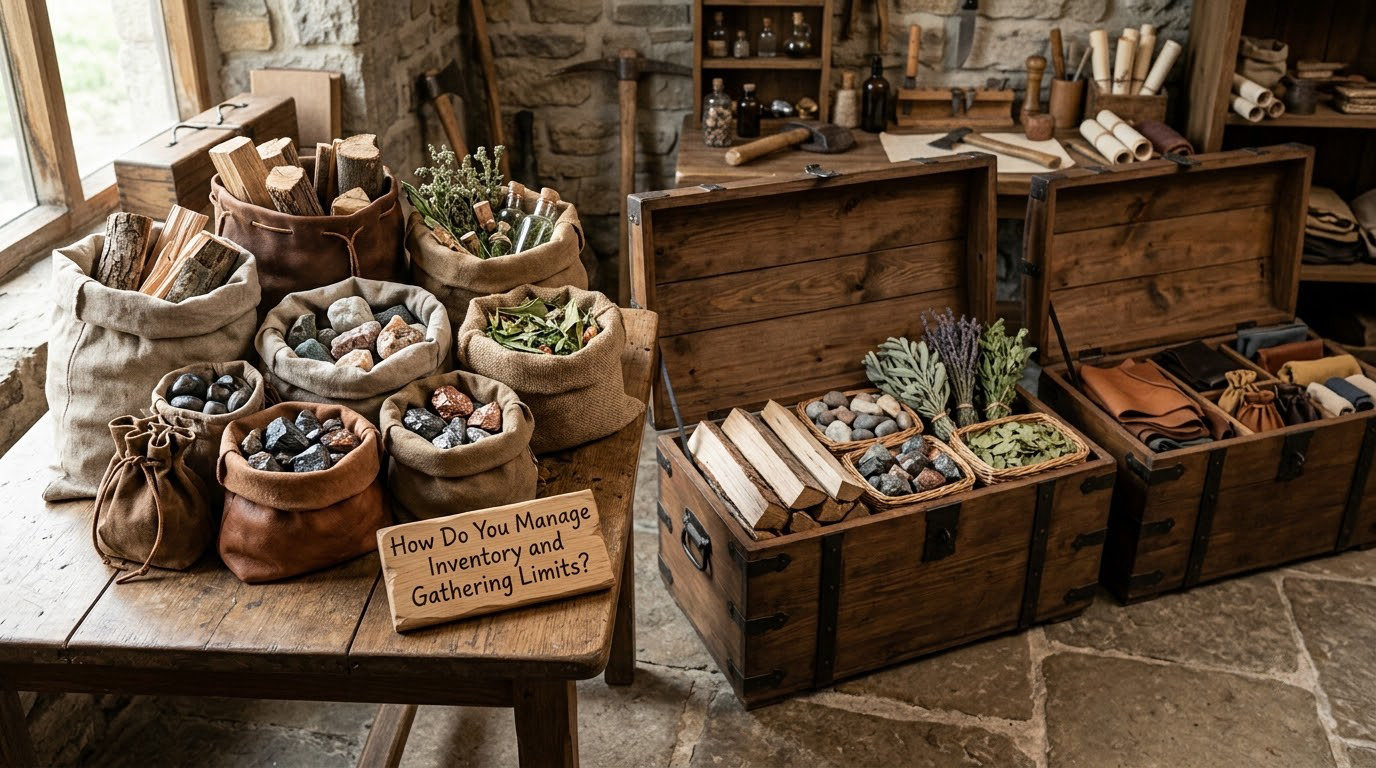
Bag space is the real limiter on gathering. A full pack turns a good circuit into a wasted one, because nodes do not wait and you cannot gather a full inventory.
Stack limits decide how much one type of material you can carry. Weight, where it exists, decides how much of everything you can carry. In games with either, over-encumbered characters move slower or cannot mount, which is worse than being slightly over capacity.
Every game gives you out-of-bag storage and the details matter a lot. Item stacks, temporary bags that expire on a timer, mount-attached satchels, mail, auction-house depots you can withdraw from directly, and bank tabs all exist for one reason: so you can keep gathering instead of walking back.
Hoarding is the other limit nobody sets for you. If your bank has forty stacks of a material whose price has halved since you started, the solution is selling or processing, not a bigger bank.
A simple audit works better than guessing. Empty one bank tab onto a spreadsheet or a notepad, group everything by type, and mark each stack with one of three words: keep, process, sell. Most banks clear in twenty minutes and lose about a fifth of their contents to the market.
Set a soft cap per material and stop when you hit it. A cap turns the decision into a rule, which means you can gather on autopilot instead of re-evaluating every drop. It also stops the classic late-game mistake of a full bank blocking the very gear upgrades you need room for.
How Do Economy and Demand Affect Gathering?
Gathered materials are priced by what the player economy needs this week, not by how much work they took. Prices rise when demand rises and fall the moment more people farm the same node, which is why a hot material can be worthless by Friday.
Crafted gear drives most demand, because crafting pulls raw material off the market. Crafting orders create steady baseline consumption. Dungeon progression spikes it: a new tier means a run of new consumables, and every healer in the server wants the same reagent on the same night.
Server population and server type matter more than most players expect. A small, tight server pays well for basic materials because few people bother to farm them. A large, farming-heavy server has thousands of people hitting the same copper nodes.
NPC demand is the floor under all of this. Quests and NPC vendors keep low-level materials worth something after the first wave of new players quits.
There is a short version of the maths. A material takes a gathering time, a bag slot, and a tool wear cost. Its price has to clear all three before you bother. Raw ore that takes forty seconds a pull and sells for almost nothing loses to ore you process into ingots even when the per-item numbers look bad, because the ingot version uses the same forty seconds.
Undercutting is the other half of the market problem. When a bag of crafted goods lists below the raw materials needed to make it, no gatherer can compete with the seller, because you cannot sell ore for less than it costs you to mine it. When that happens, the fix is to move up the chain into processing rather than keep mining.
Which materials are usually worth keeping?
- Anything a crafting recipe on your character needs. You will use it, and the market rate is irrelevant at that point.
- Rare spawns and event-only materials. Limited supply keeps their price up long after ordinary materials collapse.
- Materials for new-tier crafting. If an update is coming, gather the inputs before demand spikes.
- Large stacks of anything common. Easy to sell in volume and worth the bag slot when demand is normal.
- Intermediates like bars, planks and refined powders. A crafting character uses them immediately, so you can sell the raw and buy these back cheaper on a bad day.
Frequently Asked Questions
Can gathering professions be played with friends in MMOs?
Yes, and in some games it is easier with a party. Group content such as fishing minigames, timed gathering nodes and harvest events gives everyone a reward instead of one player taking the node. Outside those systems, gathering is mostly solo, though a party speeds up travel and covers you from enemies. Some games also let you gather at reduced rates in a party so nobody loses much.
What should I do with duplicate gathering materials?
Three options, in order of value. Process them into intermediates if you or your crafting character needs those. Keep rare drops and anything tied to a crafting recipe. Sell the rest in bulk, since duplicate common materials are the easiest gold in the game. Avoid hoarding identical stacks across alts; one shared bank beats five characters each holding a fraction.
Should every character learn a gathering profession?
Usually one, not all. A dedicated gathering character can carry more, gather at higher tiers and feed your main without being slowed by combat gear. Learning one gathering profession on your main is still worth it because you can supply your own reagents. Learn several only if you enjoy the gathering itself or want to cover several crafting disciplines.
What happens when a gathering check fails?
In check-based systems a failed check costs you the bonus yield, and often the normal yield too, and the node is depleted either way. That is why skill matters: higher skill narrows the failure window and increases the number of guaranteed yields. In games without checks, nothing fails, but random output can still give you zero from a pull.
Which gathering resources should beginners prioritize?
Herbs, ore and fish cover the widest range of early crafting needs, and each has steady demand from potions, tools and food. Pick the one that matches the crafting profession you actually want, then gather only what that profession consumes. Avoid spreading across four gathering professions at once early on, because the skill levels stay too low to be useful anywhere.
Conclusion
Pick one gathering profession and go deep on it for the first fifty levels. Learn where its nodes sit and how the skill check or quality roll works, because that is where the difference between a beginner and an expert lives. Work zones just above your tool tier, upgrade the tool before you move zones again, and keep everything a crafting recipe on your character needs.
Then check the market before you sell anything. Compare your material price against the processed version and against the auction listings, and sell in the gap between them.