How to flip items for profit in MMOs comes down to one loop: buy an in-game item below its market value, relist it a few points higher, and repeat with the profit. It works anywhere players trade — the WoW auction house, the OSRS Grand Exchange, the FFXIV Market Board, the Hypixel auction house. This guide is about digital items inside MMO economies, not reselling physical games or console carts.
Most beginners lose money in the same three places: they buy at the average price instead of the low one, they ignore the fee every listing charges, and they commit their whole balance to one item. Fix those three and flipping becomes a slow, boring, repeatable income stream rather than a lottery ticket.
Here is the process I use, in the order I use it.
Table of Contents
- 1What You Need
- 2Step-by-Step: How to Flip Items for Profit in MMOs
- 31. Choose a market and item category
- 42. Research demand, supply, and recent prices
- 53. Calculate the real profit margin
- 64. Buy inventory at the right time and price
- 75. List items competitively and safely
- 86. Track results and improve each trade
- 9Common Mistakes
- 10Frequently Asked Questions
- 11How much money do I need before I start flipping?
- 12Can you actually make money flipping items?
- 13What is the most profitable item to flip?
- 14How do you flip on the auction house in WoW?
- 15Why do my margins keep shrinking?
- 16Is flipping better than farming for gold?
- 17Conclusion
What You Need
Flipping asks very little of you. It needs no rare spawns, no best-in-slot gear and no quest log. It needs five things.
- A character with market access. A level requirement usually gates the auction house or trade screen, and a bank alt with a mail tab makes moving stock painless.
- Starting capital. Enough currency to buy inventory and cover listing fees before anything sells. Even a modest balance works if you pick a fast-turning item.
- A tracking method. A spreadsheet works. A price-check addon or site works better. What does not work is holding prices in your head.
- A category, not an item. Beginners who succeed flip a family of items — reagents, bars, food, ammo — rather than chasing whatever looks cheap today.
- Patience and a routine. One commenter on the Hypixel forums made roughly 10% per cycle on end-game items, and made 15 million in a day doing it. That is many hours of scanning, not one lucky snipe.
Step-by-Step: How to Flip Items for Profit in MMOs
1. Choose a market and item category
Start with the game you actually play, because that is the market you can read daily. Each MMO exposes a different flavor of the same loop: WoW’s auction house runs bids and buyouts with listing fees, OSRS’s Grand Exchange runs instant buys and timed offers with a tax on sale, FFXIV’s Market Board takes a cut per listing and retains a deposit for a period, and games like Hypixel and Lost Ark run simpler timed auctions.
Within that market, pick a category that satisfies three tests. It must stack into volume, it must be bought by players every single day, and it must not require a rare drop you cannot farm. Players on r/OSRSflipping treat ore, bars, food and ammo as the safe staples for exactly this reason, and they call speculating on unreleased patch content high risk for good reason.
2. Research demand, supply, and recent prices
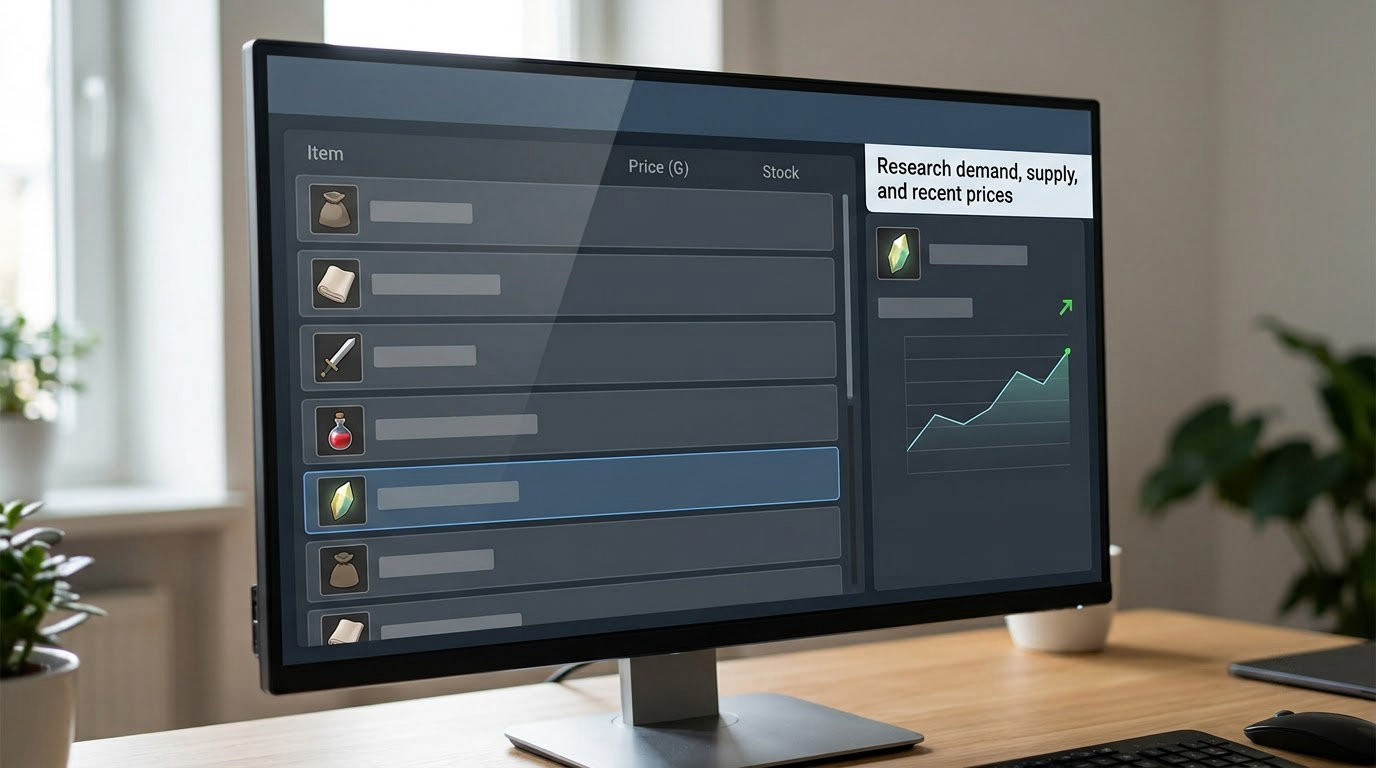
Read completed sales, not asking prices. A seller asking 500 for an herb means nothing if the last forty sales cleared at 180. What matters is the settled price, the volume behind it, and how many sellers are undercutting that number right now.
Sort by the lowest unit price, then check how many listings are stacked above it. If the cheapest twenty listings are all the same seller selling in bulk, the price you see is a floor set by one person, and it will move the moment they restock. If the cheap listings are spread across a dozen sellers, that is a real market price.
Track the history too. A price that has fallen for a week is a price you do not want to be holding, and the long-running r/woweconomy advice is blunt about this: never buy an asset right as its price is turning down.
3. Calculate the real profit margin
Margin is where most beginners lie to themselves. Here is the full calculation, using a made-up example in a game with a 5% listing fee and a 3% sale tax.
You buy 200 units at 40 each, so the purchase is 8,000. You list at 52 each and every one sells, giving 10,400 gross. The listing fee takes 520. The sale tax takes 312. Your net profit is 1,568, which is about 19.6% on capital — per completed cycle, and only if the whole stack clears without you touching the price.
Now the part nobody calculates. Another seller will almost certainly undercut you before that stock moves. Assume one undercut per cycle and you relist at 50: gross drops to 10,000, and net drops to 1,180. Assume two price changes and you are at roughly 790. That is your real expected profit, and it is roughly half of the number a naive calculation promises.
Set a floor before you buy. A flip that nets under 5% after fees is not a flip, it is a chore, and the thin-margin squeeze players complain about on r/OSRSflipping after tax changes is exactly what happens when you ignore that floor.
4. Buy inventory at the right time and price
Buy when supply is heavy and demand is idle. The Hypixel forum guide makes this the core of its method: shop at 2am, sort by Ending Soon, work through the last page, and list when the server population peaks. Fewer players listing means fewer people undercutting you on the way in.
Set a hard buy limit per item and respect it, even when the market is obviously wrong in your favor. Keep a slice of your balance unspent at all times; the commenter advice to never put all your money into one item to flip is the single most repeated warning across these communities, and concentration is how a bad patch wipes out a beginner’s entire balance in one evening.
5. List items competitively and safely
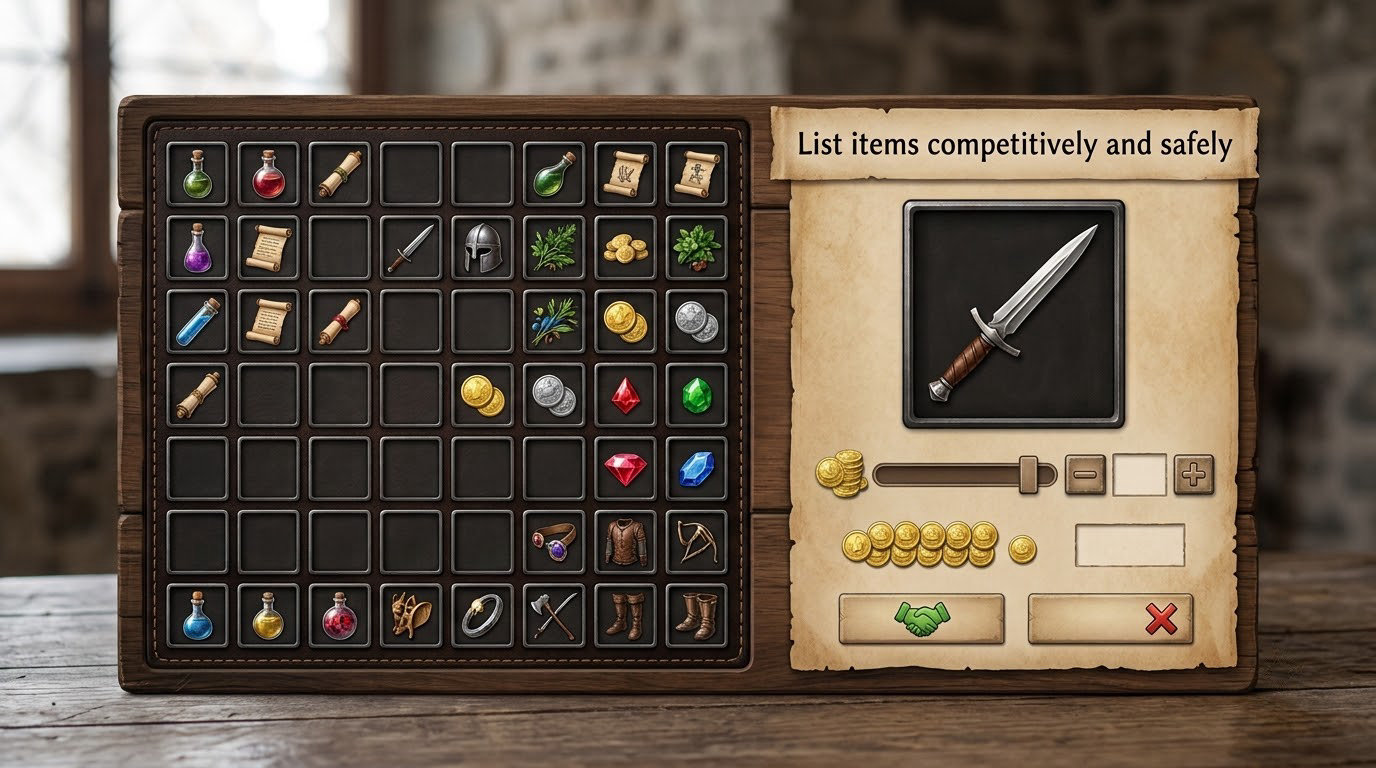
Price one increment under the current cheapest competing listing, not under the average. On markets with bids, set your bid a step below the standing bid and your buyout near the expected sell price, so you get both the quick sale and the full margin. On timed markets, choose a listing duration that lands your sale in a busy window rather than the middle of the night.
Guard the underpricing mistake, because it is the one that actually costs real money. Many games let you hold shift while entering a price, which drops a trailing zero. A listing that undercuts your own floor by a factor of ten is how a profitable stack becomes dead capital, and the refund usually does not cover the lost margin.
6. Track results and improve each trade
Log five numbers per cycle: buy price, sell price, fees, net profit, and days held. After twenty cycles the sheet tells you things no price-check site can, like which of your three categories actually cleared fastest and which one quietly tied up capital for a week.
Compare net profit per hour, not per item. A 2,000 profit that takes four days is worth less to you than a 600 profit that clears in six hours, because the fast one can run again the same evening. Once you know your real hourly return, you can decide honestly whether scaling up is worth it or whether you would rather farm and treat flipping as a bonus.
Common Mistakes
Almost every loss traces back to one of these eight.
- Buying at the average price. If the market clears at 180 and you paid 400, no relist strategy recovers that. Buy the low listings or do not buy.
- Ignoring fees and taxes. FFXIV’s Market Board takes a listing cut plus a sales tax, OSRS taxes sales, and most auction houses cut a percentage per listing. Net profit is the only number that counts.
- Underpricing to sell fast. Dropping 30% below the competition to clear a stack in an hour usually costs more than the wait would have.
- Tying up all your capital. A full inventory of unsold goods means no response to the next opportunity, and no cushion when a price moves against you.
- Chasing hype and patch speculation. The r/OSRSflipping crowd treats stocking an unreleased item as a gamble, not a flip. If the item is not already consumed daily, you are betting, and the margin math above does not apply to bets.
- Trusting price-check sites blindly. Players across these communities complain that price-check sites disagree with each other and with live prices. Treat them as a starting point and confirm against your own settled sales.
- Buying into a rising-then-falling chart. A spike is someone else’s exit. Look at the trend, not the current number.
- Skipping the auction house scan. Most profitable finds are sitting in the last pages, on cheap listings, at odd hours. The players who do well are the ones who logged in and looked.
One more habit worth naming: a long-running r/woweconomy write-up documents going from 20 gold to 5 million in about nine weeks, and it credits a steady farming routine with flipping as a bonus, not flipping alone. The same post admits that finding lucky flips relies on a bit of luck. That is the honest version of this income.
Frequently Asked Questions
How much money do I need before I start flipping?
Enough to buy inventory and cover listing fees before anything sells. Beginners do fine on a small balance if they pick a fast-turning staple like bars, food or ammo, because low unit cost means many cycles instead of one big bet. Avoid spending it all on a mount or a carry first, since that leaves nothing to reinvest. Add profit back in as you go.
Can you actually make money flipping items?
Yes, but expect a thin, steady return rather than a windfall. Net profit per cycle is usually a modest percentage of capital once fees, taxes and undercutting are subtracted, and a veteran account on r/woweconomy attributed a long growth arc to a farming routine with flipping on the side. Flipping reliably grows a balance; it rarely replaces active income on its own.
What is the most profitable item to flip?
There is no single best item, because profitability depends on your market, fees and capital. In practice the best flips share four traits: they stack into volume, players consume them daily, they cost little enough that your capital can hold several cycles at once, and they are not tied to a rare drop. Stackable consumables and crafting materials fit that profile far more often than rare mounts or vanity items.
How do you flip on the auction house in WoW?
Scan for the cheapest listings on the last pages, sorted by unit price, and check how many sellers sit at that level. Buy a stack below the settled sale price, relist one increment under the current cheapest competing listing, and set your buyout near the expected sell price. Repeat after each sale, and recalculate the margin after every fee change in the patch notes.
Why do my margins keep shrinking?
Usually one of three things: a tax or fee change in a patch, an influx of bots and high-volume sellers, or your own habit of buying at the average price instead of the low one. Check the current fee schedule first, then re-run your margin math on the cheapest live listings. If the real margin is under 5% after costs, the item is not worth flipping right now.
Is flipping better than farming for gold?
They do different jobs. Farming produces gold at a predictable rate and is easy to measure; flipping converts existing capital into slightly more capital but returns nothing if your balance is tied up in slow stock. Most experienced players run both, treating farming as the base income and flipping as the accelerator, and reinvesting part of the profit back into the next cycle.
Conclusion
Here is how to flip items for profit in MMOs, shortened to one session: pick a single stackable category players use every day, check the completed sales rather than the asking prices, subtract the listing fee and tax from the spread, and buy one small stack as a test. Log the real net profit and how long it held. If the hourly return is worth your time, scale the next buy and reinvest the profit. If it is not, you have learned that in an hour instead of a month.