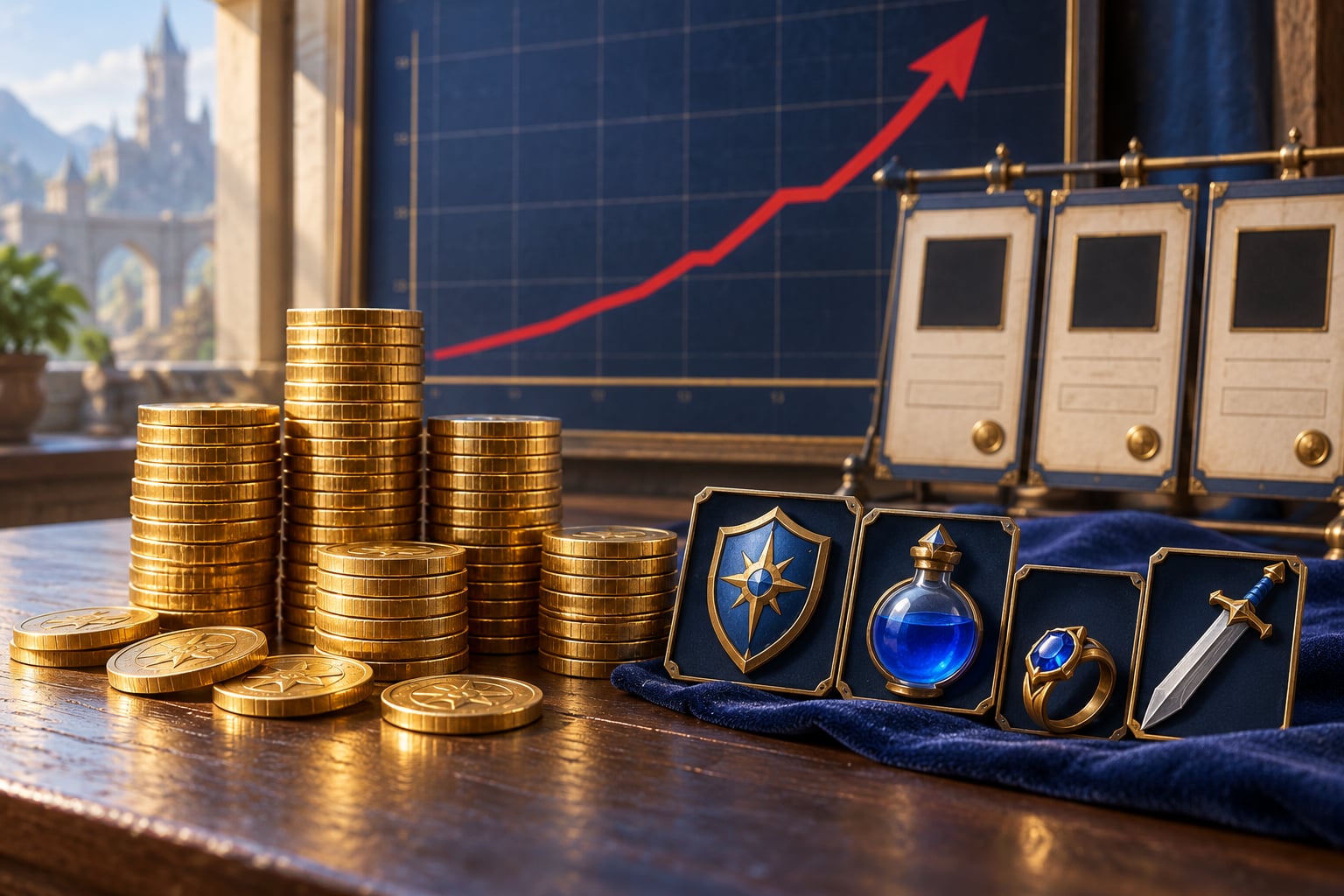
In-game inflation is the steady loss of what a game currency can buy: the game creates gold faster than content removes it, so the same coin buys less every month. That is how in-game economies suffer from inflation, and it shows up as veteran savings turning worthless while new players grind for weeks and still cannot afford basic gear.
The mechanism matters because the damage is not only financial. Once players stop believing the currency has value, no patch can restore that trust, and markets quietly move to barter outside the game.
TL;DR — four reasons game economies inflate:
- Faucets outrun sinks. Quests, kills and mail pay currency faster than repairs, taxes and upgrades take it back.
- No scarcity cap. A sword is copied for free every time one drops, so the only limit on supply is player time.
- Hoarding concentrates wealth. A few players absorb most of the gold, and each new gold pile gets bid into rarer items.
- Patches print more gold. Catch-up grants for new and returning players add supply without removing any.
Table of Contents
- 1How In Game Economies Suffer From Inflation
- 2How in game economies suffer from inflation in practice
- 3What causes inflation in online game economies?
- 4How currency supply and player demand create rising prices
- 5How farming rewards can unintentionally inflate prices
- 6How progression systems contribute to currency inflation
- 7How inflation differs from normal price changes
- 8How to tell whether an in-game economy has inflation
- 9Why inflation hurts players and game economies
- 10How game designers can control in-game inflation
- 11How to add currency sinks without frustrating players
- 12How to recover a game economy after inflation
- 13How players can respond to an inflationary market
- 14Frequently Asked Questions
- 15Is more money in a game always bad?
- 16Why do old game items lose value when new content arrives?
- 17Can adding more valuable rewards help stop inflation?
- 18Should developers lower prices when an in-game economy becomes inflationary?
- 19What data is needed to identify inflation in a game marketplace?
- 20Conclusion
How In Game Economies Suffer From Inflation
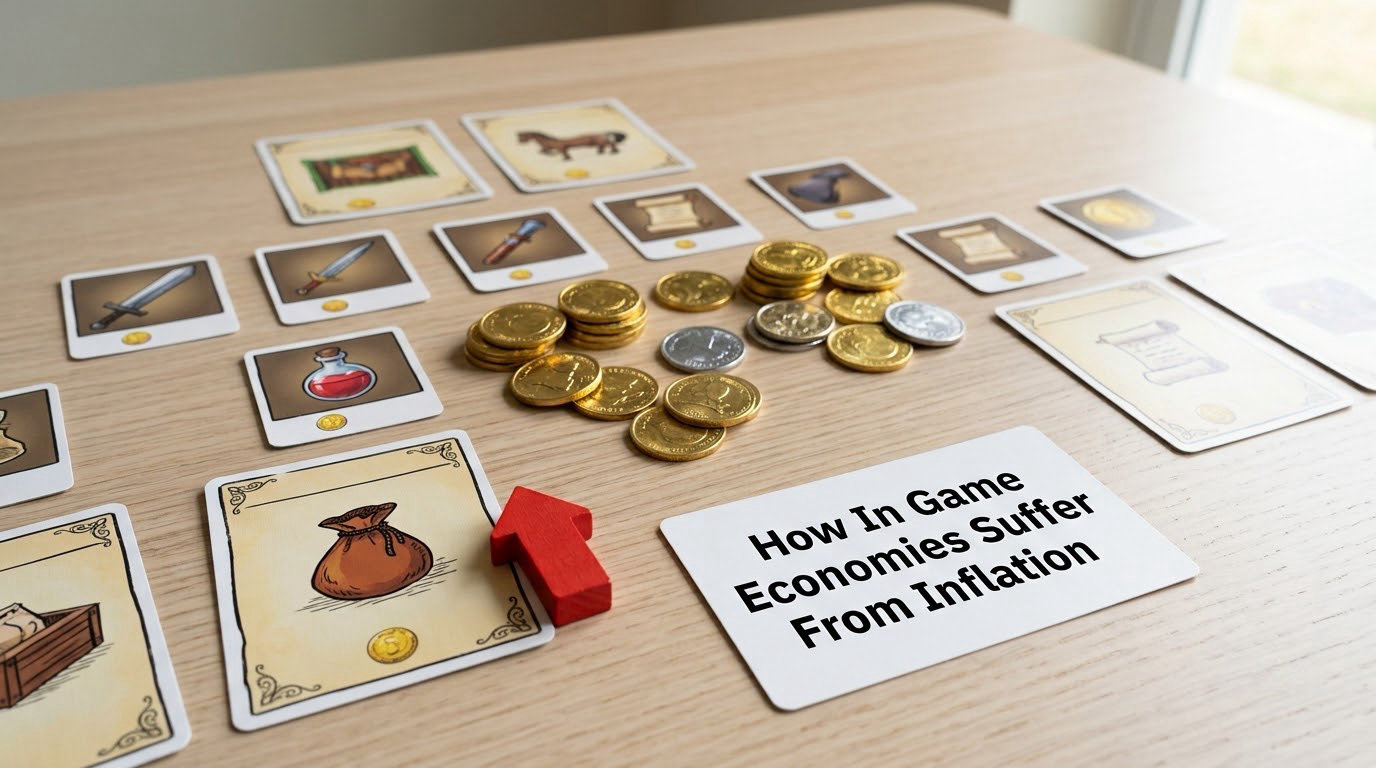
Ordinary price movement is a single item shifting because demand spiked for a week. Inflation is the whole economy moving together, item after item, so the same basket of goods costs more over time than it did a season ago.
Both look identical from inside a single auction house listing. The difference shows up when you track median prices over time rather than the price of the thing you happen to want today.
How in game economies suffer from inflation in practice
Take a standard crafting axe. At launch, an average player farms it in six hours and the auction floor sits near 100 coins. Three months later the drop rate is unchanged and the crafting recipe is unchanged, but the floor sits at 1,000 coins.
Nothing about the axe changed. What changed is that the median player holds roughly ten times as many coins as at launch, and every one of them is bidding on the same limited supply of axes. Ten times the money chasing the same number of goods produces a price near 1,000 coins, and that is inflation, not a content change.
Players on r/MMORPG describe this same pattern in almost every thread: the veteran with a hundred million coins cannot buy anything meaningful, and the fresh character has to grind for a week to afford the first upgrade.
What causes inflation in online game economies?
Every inflationary economy comes down to one measurement: money entering the system against money leaving it. Design communities call the inflows currency faucets and the outflows currency sinks. The famous bathtub metaphor comes from a 2013 design post, and it still holds up.
A currency faucet is any source that creates coins: quest payouts, monster drops, mail rewards, event prizes, a new-player starter grant. A currency sink is anything that removes them: repair bills, crafting fees, auction house taxes, travel costs, vendor upgrades, respec fees.
| Currency faucets (adds gold) | Currency sinks (removes gold) |
|---|---|
| Quest and daily-task payouts | Repair and durability bills |
| Monster and dungeon loot | Crafting and enchanting fees |
| Gathering and farming loops | Auction house listing cuts |
| Mail rewards and event prizes | Vendor buyback prices set below market |
| New-player starter grants | Teleport, flight and mount upkeep |
How currency supply and player demand create rising prices
The classic pull is simple. Gold enters the economy faster than new gear leaves it, so more players hold more money and bid for the same limited stock. Less supply of a desirable item, more demand for it, and more players with gold to spend: prices climb.
There is a second mechanism that players rarely notice. When drop tables hand out duplicates, the duplicates have almost no value because nobody wants a second one. That surplus gets sold for gold, which adds even more gold to the system while the rare version stays scarce. Supply of money grows, supply of the good item does not.
How farming rewards can unintentionally inflate prices
A farming route is any loop that pays out faster than the time it costs. When designers add a double-xp weekend or a temporary loot buff, the faucets spike. The problem is what happens after the event ends.
Players who farmed during the bonus are now sitting on a stockpile, and they keep it. The temporary faucet became a permanent stock of gold held by whoever happened to play that week. A r/starcitizen thread complained that there was nothing meaningful left to spend large sums on, which is the tell-tale sign: coins with nowhere to go start competing purely for scarce items.
How progression systems contribute to currency inflation
Progression is the quietest faucet of all, because each reward feels generous at the time. Level-up bundles, first-clear dungeon bonuses, achievement payouts and login streaks all add supply, and every one of them scales with the player count.
Catch-up mechanics are the sharpest edge. A new-player grant of 100,000 coins feels like a welcome, but it hands every new account the same purchasing power as a character who played for a month. If that grant scales with the account age and the player base keeps growing, the money supply grows with it.
On games with real-money markets this gets sharper. Star Wars: The Old Republic players on r/pcgaming describe a market where a million credits once signalled wealth and now changes hands for goods that used to cost hundreds. A community wiki entry for RuneScape runs to more than 2.1 billion gold for a single item, a number far past what the design could have intended.
How inflation differs from normal price changes
Not every rise is inflation. Four patterns look similar at first glance and mean very different things.
Demand spikes come and go. A new raid lands, its materials triple for two weeks, then settle back. The currency did not change.
Local shortages affect one item in one region. A server with a botting problem sees that one herb climb while everything else holds steady.
Seasonal events create predictable demand curves that unwind on schedule. If prices return to baseline afterwards, the economy is stable.
Intended rare pricing is a designer decision. A unique mount costs a fortune because scarcity is the feature, not because the currency is devaluing.
Real inflation is different in three ways: it affects unrelated items at once, it persists across months rather than weeks, and it keeps going even when nobody wants the goods any more. A price that rises only because everyone is bidding on the same item is a market event. A price that rises because the currency buys less everywhere is inflation.
How to tell whether an in-game economy has inflation

The quickest test is to track a basket of everyday items, not the shiny ones. Pick ten things new players need constantly, record their median auction prices once a month, and look at the direction of the line.
| Metric | What to compare | What it indicates |
|---|---|---|
| Median price index | A fixed basket of 10 items, month over month | Sustained rise across unrelated items is the clearest signal |
| Purchasing power | Coins needed for a standard upgrade | Falling power means the currency is inflating |
| Transaction volume | Sales per day in the auction house | Falling volume plus rising price points to speculation |
| Gold held by the top 10% | Share of total money supply | A widening gap means hoarding, not spending |
| Time to first upgrade | Hours for a new character | The fairest measure of what inflation costs players |
| Sale rate of junk items | Share of listings that sell in 24 hours | Collapsing rate means the market stopped clearing |
| Sink-to-source ratio | Gold removed per day against gold created | A ratio under one means the money supply is growing |
Players often say a game is suffering inflation when the real problem is deflation, or when an item simply reached the end of its lifecycle. Holding the basket constant is what separates the three.
Why inflation hurts players and game economies
New players get priced out. This is the harm players complain about most. A fresh character grinding for days and still unable to afford basic gear is not a balance nitpick, it is the game telling new arrivals to leave.
Old rewards stop meaning anything. A drop that felt enormous in year one buys nothing now, which retroactively cheapens the entire reward history.
Markets concentrate. When a few players hold most of the money, small buyers get outbid and the player-driven market stops being player-driven. r/swtor threads argue that credit sinks are only a band-aid, and the recurring alternative is to vendor goods cheaply rather than tax players.
Trading moves off-platform. Once nobody trusts the currency, real-money trading and barter between friends replace the auction house, taking a cut of the game’s social life with it.
Real-money stores become the only rational spend. When gold inflates while store prices do not, the sensible move is to buy premium currency and skip the market. The economy ends up monetising fine and playing badly.
Not every price rise is harmful. A rare item staying expensive because demand is genuinely high is a healthy market. Inflation is harmful when it is broad, persistent, and driven by currency supply rather than by players wanting the item more.
How game designers can control in-game inflation
Controlling inflation means changing the ratio between faucets and sinks, and doing it without wrecking the game that players came for. Seven levers cover most cases.
1. Reduce faucets. Cut duplicate drop rates before touching payouts. If a drop table hands out three useless copies instead of one useful one, trimming that table removes both item clutter and gold supply.
2. Add sinks that scale. A flat repair cost matters less in year five than in year one. Sinks indexed to level, gear tier or market value keep pulling as the economy grows.
3. Tax trades selectively. An auction house cut removes currency on every transaction without adding a chore. Black Desert Online players argue about whether marketplace taxes feel punishing, and that argument is worth having: taxes on high-volume low-value items annoy more than taxes on rare ones.
4. Introduce consumable upgrades. Gear that degrades with use creates a permanent, self-balancing sink. It also gives crafters a reason to keep running the economy instead of hoarding.
5. Gate repeat rewards. First-clear bonuses should stay first-clear. A repeatable dungeon that pays full value every week is a faucet disguised as content.
6. Repair market bottlenecks. Price-holding bots and empty listings break price discovery long before any macro imbalance does.
7. Test across cohorts. Veteran, new and returning players feel inflation differently. Ship changes to a slice first and watch the basket index, not just revenue.
How to add currency sinks without frustrating players
A sink feels fair when players can see what they bought with it. Repair bills, crafting fees, travel costs and vendor upgrades all do that: the gold leaves, something visibly improves.
The sinks that backfire are the invisible ones and the retroactive ones. A tax applied silently to every sale reads as a punishment, and a patch that adds a sink after years of low prices feels like confiscation.
Quality-of-life purchases work well here. Cosmetics, housing, faster travel, storage tabs and name changes absorb currency from players with money to spare, without touching anyone who is already struggling to keep up.
How to recover a game economy after inflation
Recovery is slower than inflation and rarely feels good while it happens. The workable moves are mostly small.
Trim faucets at the specific sources causing the flood rather than across the board. Add a reward tier priced well above the inflated average so there is something to save toward again. Change market rules, such as listing limits or cooldowns, to break bot-driven bidding.
Relabel untouched items where possible, so old content keeps its meaning. What to avoid is a blanket currency reset, an abrupt confiscation, or printing catch-up gold without removing supply. Every one of those was tried and criticised in player threads I read while researching this, and none of them rebuilt trust.
There is a structural proposal players keep coming back to: cap the total currency and make useful items, rather than coins, the tradable unit. It is the barter endgame, and it is rare because it guts the number screens players read as progress.
How players can respond to an inflationary market
You cannot fix the economy, but you can stop being the reason it feels worse.
Find stable stores of value. Items that persist across expansions, or currency tied to a real-money token such as the PLEX in EVE Online or the WoW Token, tend to hold value better than a seasonal consumable.
Compare utility, not just rarity. A common item that every healer buys holds its price better than a rare item nobody wants.
Time purchases when you can. If a price spike is event-driven, waiting usually costs nothing.
Do not borrow to speculate. Player-run economies have no lender of last resort, and a bad month on leverage ends the account.
Track community price history, not in-game dashboards. Players trust third-party trackers far more than developer charts, and rightly so.
Report manipulation. Price-fixing bots and multi-account bidding do more damage than any design flaw when they set the reference price everyone else reads.
Frequently Asked Questions
Is more money in a game always bad?
No. Currency only inflates when it enters faster than it leaves and player demand for scarce goods stays high. A healthy economy can grow its money supply if sinks scale at the same pace, and plenty of coins is what makes crafting, upgrading and trading feel affordable. The problem is not abundance, it is abundance with nothing to spend it on.
Why do old game items lose value when new content arrives?
Because new gear competes for the same gold, and each tier is priced against the money in circulation at that moment. When supply of coins grows faster than the number of players who want a new item, prices drift down. Old items keep their utility value but lose relative value, so a drop from year one can end up buying less than a common material.
Can adding more valuable rewards help stop inflation?
Yes, indirectly. A reward tier priced well above the current average restores a reason to hold currency instead of spending it immediately on whatever is cheapest. That slows velocity, which is one of the things driving prices up. It does not remove coins, so it works best alongside a faucet cut or a new sink rather than instead of one.
Should developers lower prices when an in-game economy becomes inflationary?
Usually not. Lower vendor prices without lowering the player-driven market just moves the problem, since vendors then become the cheapest source and drain demand instead of correcting it. Better to trim faucets, add sinks that scale, and fix market bottlenecks. Prices on player-traded goods fall on their own once excess coins have somewhere else to go.
What data is needed to identify inflation in a game marketplace?
Four numbers do most of the work: a median price index for a fixed basket of common items, the sink-to-source ratio, the share of total money held by the richest players, and hours needed for a new character to reach a standard upgrade. Add daily transaction volume, since falling volume with rising prices points to speculation rather than genuine demand.
Conclusion
In-game inflation is arithmetic, not opinion. Games create currency through quests, loot, events and catch-up grants, and remove it through a much shorter list of sinks. When the first list grows faster than the second, the same coin buys less each month, and that is how in-game economies suffer from inflation.
Before touching prices or crafting costs, check four things: how much currency entered yesterday, where it went, what a fixed basket of common items costs now versus three months ago, and how many hours a new character needs for the first upgrade. If faucets outrun sinks, adding sinks or trimming drop tables fixes the mechanism. If the faucets are fine and only one item is expensive, you are looking at a market, not an economy.
And keep an eye on the coin you cannot get: the pre-order bundles, the collector items and anything you would hate to sell. Those tend to outlive whatever number the economy is printing this season.