An MMO auction house is an in-game marketplace where players list items they no longer need, pay a deposit to post them, and let other players bid or buy them out instantly. The game holds the item in escrow and takes a percentage cut of every completed sale. Learning how auction houses work in MMOs matters because this market sets the price of nearly every material, upgrade and piece of gear you will ever buy.
I have watched new players spend an evening listing twenty items that nobody wanted, for almost no return, because nobody told them the mechanics first. So this guide walks the whole thing end to end: what the house is, how a listing flows, what it costs, how prices move, and how to trade without the mistakes that quietly drain an account.
Table of Contents
- 1What Is an Auction House in an MMO?
- 2How an auction house differs from other in-game shops
- 3How Auction Houses Work in MMOs: The Basic Process
- 4How Do Players List Items for Sale?
- 5What Is the Difference Between a Bid and Buy Now?
- 6How Do MMO Auction Fees Work?
- 7Who pays what, game by game
- 8Worked example: where a 100-gold sale actually goes
- 9What happens to items that do not sell
- 10How Can Players Tell What an Item Is Worth?
- 11Why Do MMO Auction Prices Change?
- 12How Do You Buy an Item Safely in an Auction House?
- 13How Do You Sell Items Successfully in an Auction House?
- 14When the auction house is the wrong choice
- 15Frequently Asked Questions
- 16Who pays auction fees, the buyer or the seller?
- 17How do I access the auction house in WoW?
- 18Does Elder Scrolls Online have an auction house?
- 19What happens to items that don’t sell at auction?
- 20What percentage do most auction houses take?
- 21What are the most common auction mistakes?
- 22Conclusion
What Is an Auction House in an MMO?
An auction house is a digital shop window inside a game, operated by the game rather than by another player. It exists because MMO economies produce a constant surplus. Every dungeon run drops materials, every crafting session outputs more ore than you need, and every gear update leaves last season’s armour sitting in bags with no purpose.
Direct player-to-player trading works, but it is slow. You post in trade chat, wait for replies, argue about the price, and hope the other person shows up. An auction house removes all of that. You set a price, the game handles the handoff, and the listing stays searchable for hours or days while you do something else.
How an auction house differs from other in-game shops
| Trading method | Who sets the price | When it is available |
|---|---|---|
| Auction house | The seller, from a market of competing listings | Always open, searchable, no meeting needed |
| Direct trade | Whatever two players agree on | Only while both are online and in range |
| NPC vendor | The developer, at a fixed rate | Always, but you cannot sell to them |
| Player-run vendor or guild store | A guild leader running an NPC storefront | While the guild is online and stocked |
| Real-money marketplace | A third-party site, paid for in cash | Always, but with real money involved |
The distinction matters most for players who want to earn currency rather than spend it. In games like Throne and Liberty, selling through the in-game house is a legitimate way to earn the premium currency rather than buy it, though only base-level, non-upgraded gear can be listed there.
How Auction Houses Work in MMOs: The Basic Process
The whole system runs on escrow. When you list an item, the game takes it out of your inventory and stores it until a buyer pays. Nothing can be traded out of the house, nobody can loot it from a corpse, and you cannot cancel a listing to grab the item back once the auction starts.
From there the cycle is simple. A seller posts an item with a starting price and an optional instant-buy price. Buyers browse, search or filter the listings, then either place a bid or take the buyout. When a bid wins or a buyout happens, the item lands in the winner’s mailbox, the gold leaves their inventory, and the seller receives the price minus the auction house cut.
Where the listings come from is worth knowing too. Nothing is generated by the house. Everything in it came from another player who killed something, crafted something, or bought it earlier and decided it was no longer worth keeping.
Items that sit unsold usually come back to you, but the details vary by game and by how long you left them listed. That escrow lifecycle is covered in full below, because it is where a lot of beginners lose their deposit without noticing.
How Do Players List Items for Sale?
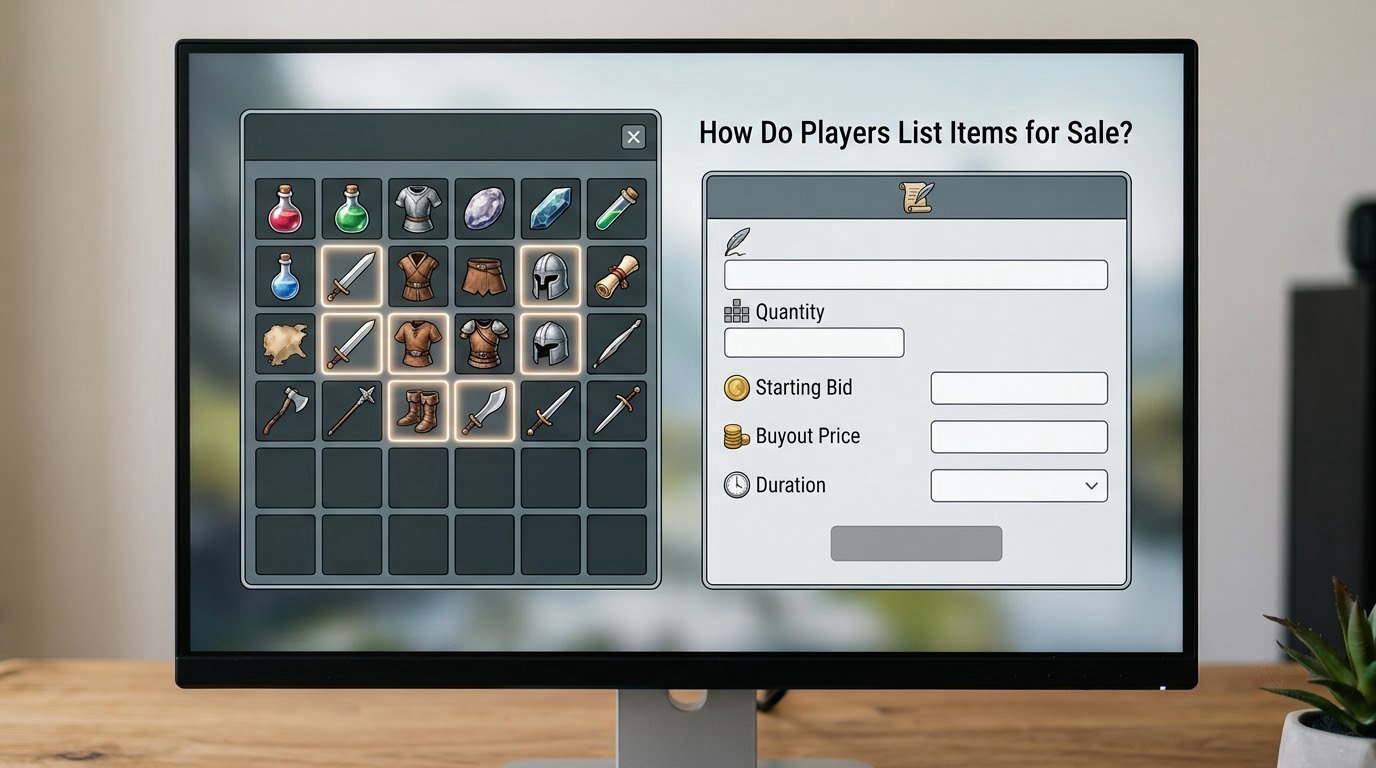
Listing takes about a minute once you know the fields. Across most games the flow looks like this, and the order is the same in World of Warcraft, the Final Fantasy XIV Market Board, the Guild Wars 2 Trading Post and New World’s Marketboard.
- Open the auction house. In WoW, visit an auction house NPC in a major city or use the faction’s auction house. FFXIV players interact with a Market Board retainer in any free company that has one. Guild Wars 2 puts the Trading Post in the menu, and New World opens the Marketboard from the map or the inventory panel.
- Pick the right category. Weapon, armour, consumable, crafting material, gem, mount and so on. Listings filed in the wrong category are effectively invisible to searchers, so this step decides whether anyone sees your item at all.
- Select the item and the quantity. You can list a single item or a full stack. For a stack, some games let you set a unit price so buyers can purchase partial amounts, while others only sell the whole stack at one price. A single sword priced 200 gold and a stack of twenty ore priced 200 gold read very differently to a buyer.
- Check whether the item can actually be listed. Bound gear, quest items and anything inside your bank or another account’s mailbox is usually ineligible. Some games also restrict upgraded or endgame items, which is the case in Throne and Liberty.
- Set a starting bid. This is the floor the first bidder must meet. Pick a number you would be happy to accept, not a hopeful one, because a too-low start attracts undercutting wars and a too-high start attracts nothing.
- Set a buyout price. The buyout is the instant-purchase price and it usually needs to sit noticeably above the starting bid. Leave it empty and the listing becomes a pure bid auction that can run for days.
- Choose the duration and pay the deposit. Longer listings stay visible longer and usually cost more, or take a larger slice of the sale price. The deposit is charged when you post and its fate depends on the game and on whether the item sells fast.
One habit worth building early: list several smaller stacks instead of one enormous stack. It lowers the price a new buyer has to commit and makes your listing more competitive against bigger sellers.
What Is the Difference Between a Bid and Buy Now?
A bid is an open-ended offer that other players raise, and buy now is a fixed price you can pay on the spot. Both exist in most MMO houses, and which one a listing uses changes who it is right for.
| Model | How a price forms | Best for |
|---|---|---|
| English auction (bid) | Price climbs as buyers bid against each other until the timer runs out | Rare items where the market needs time to find a buyer |
| Buyout or instant sale | Seller sets one price and the first buyer to click pays it | Materials and gear where you want a fast, certain sale |
| Dutch-style descending price | Price starts high and drops on a timer until a buyer accepts it | Players hoping to catch a sudden dip in demand |
| Order book (buy orders) | You post what you want to pay; the sale fires when a seller meets it | Buying in bulk without watching listings all day |
Bid-based systems balance supply and demand more honestly than pure buyout systems, and that is exactly why Guild Wars 2 and City of Heroes get praised for their auction halls. When every seller sets a fixed price and only the cheapest shows up at the top, sellers compete on price alone and the floor gets dragged down. A live bidding system lets a genuinely rare item find the buyer who values it most, even if that buyer is not the one who refreshed the page first.
For buyers, the practical difference is speed and risk. A buyout locks the price the moment you click. A bid can be beaten, and some games let you raise your own maximum bid and only pay what it takes to stay ahead. Minimum bid increments keep the price moving in controlled steps rather than doubling overnight.
How Do MMO Auction Fees Work?
Almost every auction house charges twice: something when you list and something when the item sells. The listing fee or deposit is the first. The auction house cut, usually a percentage of the final sale price, is the second. The buyer usually pays extra too, in the form of a sales tax charged at the point of purchase.
Who pays what, game by game
| Game | What it is called | Model | How fees work | Server scope |
|---|---|---|---|---|
| World of Warcraft | Auction House | Bid plus buyout | Percentage cut on completed sales, plus a deposit charged at listing that is refunded if the item sits long enough | Per realm, with cross-realm trading posting to a shared pool |
| Final Fantasy XIV | Market Board | Bid plus buyout | Free to list, sales tax taken on the buyer’s purchase, plus a retention fee on items left uncollected at a retainer | Per data centre |
| Guild Wars 2 | Trading Post | Bid plus buyout | Listing fee based on the sale price when you post, plus a sales tax on buyouts | Per shard, with cross-shard posting available |
| The Elder Scrolls Online | No central auction house | Guild stores | Seller sets the price, the game takes a cut on sales through guild storefronts | Per account, with a shared player market for some goods |
| New World | Marketboard | Listing with a buy price | Percentage fee at listing and a tax on completed purchases | Per world, with world hopping to browse others |
| Albion Online | Player-run market | Order book, sell orders and buy orders | Percentage sales tax on every completed trade | Open, cross-server market |
| Throne and Liberty | Auction House | Listing with a buy price | Listing uses premium currency that is earned through play; only base-level gear is listable | Server based, with matching for listings |
| EVE Online | Regional market | Order book, sell orders and buy orders | Sales tax and broker fees set by station and system | Regional, split by solar system and security zone |
Most percentage cuts land somewhere between 5% and 15% once you stack the seller’s fee and the buyer’s tax. What bites beginners is not the rate itself but the discovery. Forum reports from Albion Online describe a trader turning a small profit into almost nothing once the market tax came off the top, and that pattern shows up everywhere: the sale looks successful and the balance barely moves.
Worked example: where a 100-gold sale actually goes
| Line | Amount | Notes |
|---|---|---|
| Sale price | 100 gold | The number the buyer agreed to |
| Auction house cut | -5 gold | Typical percentage fee |
| Deposit not returned | -2 gold | Charged at listing, forfeited on a quick sale |
| Net to seller | 93 gold | What actually lands in your mailbox |
| Buyer sales tax | +5 gold | Usually charged on top for the buyer |
Exact percentages change with patches and balance passes, so check the current numbers in your own game’s auction house interface rather than trusting a guide written last year.
What happens to items that do not sell
When a listing expires without a buyer, the game returns the item to your mailbox or inventory, and the deposit is refunded only under certain conditions. In most games a deposit that sits on a listing long enough clears back to you, but a listing that sells within that window forfeits the deposit instead. In FFXIV the item waits at your retainer and accrues a retention fee if you do not collect it. Leaving goods sitting in a mailbox for months is a common way new players lose an item entirely.
How Can Players Tell What an Item Is Worth?
The only honest way to price an item is to look at what other people actually paid for it recently, not at what someone is asking for it. Ask-for prices float far above real value, especially when a handful of sellers decide to test the market.
Start with unit price rather than stack price. Sorting a listing of twenty-five ore by the stack total makes everything look cheap; sorting by the price per unit makes the real number visible. Then check four things.
- Completed sales. Price history tools show what listings actually sold for, which is more useful than the current lowest asking price.
- Level and requirement gates. An item that only a veteran can equip has a smaller buyer pool, so rarity and usefulness trade off against each other.
- Crafting demand. Ore, cloth, leather and essence almost always have steadier demand than finished gear, because crafters consume them constantly.
- Server scope. Prices differ sharply between a full realm and an empty one. What looks cheap on your shard can be unobtainable, or wildly overpriced, on a more populated shard.
Free players in games without history add-ons have a harder time here. One recurring complaint on the Elder Scrolls Online forums is that reading price history and scanning for the best deal requires add-ons, which leaves new players guessing. Checking what your own guild members paid last week is a reasonable fallback.
Why Do MMO Auction Prices Change?
Prices move because the supply and demand for an item change, and in an MMO both sides are on a patch schedule. The core drivers are predictable once you know them.
- Patch balance. A crafting nerf doubles demand for a material overnight. An XP buff empties the market of anything low level.
- New player flow. Starting gear floods the market early in a season and dries up as the population matures.
- Drops and crafting rates. When a dungeon stops dropping an item, its price climbs fast, and the reverse happens when a new source appears.
- Crafting investment. When a recipe becomes profitable, every crafter on the server targets the same output and prices fall.
- Market saturation. Too many sellers listing the same thing drags the floor down until undercutting wars start.
- Bots and manipulation. Automated posting floods thin markets. Players on Path of Exile forums ask for WoW-style auction limits specifically because rapid item flipping from bots warps prices.
- Server population. A shard that empties out has no market at all, which is why some players ask New World whether they can move to an auction realm.
Macro events matter too. Weekend evenings, holidays and paid boosts all shift volume. A listing that sat untouched for a week can sell in an hour after a big update.
How Do You Buy an Item Safely in an Auction House?
Buying through the house is safer than face-to-face trading because the game handles the exchange, but a few traps still catch people. Run this checklist before you confirm any purchase.
- Confirm the server scope. Some listings are visible in search but only biddable from their home realm or shard. Read the listing details, not just the price.
- Check the item requirements. Verify the level, class and stat requirements before you pay. The house will happily sell you something you cannot equip.
- Look at the unit price, not the total. Cheap-looking stacks are the most common bait in every market.
- Work out your real cost. Add the sales tax the buyer pays on top. A 100-gold buyout that costs 105 in practice changes the comparison against a 99-gold bid.
- Check for an implausibly low price. A rare item at a tenth of its normal price is either a scam listing, a misidentified name or an item with a binding condition nobody mentioned.
- Collect from the mailbox promptly. Some games charge retention fees or eventually return uncollected items to the seller.
- Never pay gold outside the game. Real-money trades carry no in-game protection at all, and trading one for gold is a bannable offence in most games.
Duplicate items, usually called dupes, are a real problem. They enter the market through exploits and then get sold as rare drops. You cannot detect one reliably by eye, so treat an unbelievable price as a reason to walk away rather than a bargain.
How Do You Sell Items Successfully in an Auction House?
Selling well comes down to research before you post anything. The single biggest beginner mistake is listing whatever happens to be in the bags without knowing whether anyone wants it.
- Research comparables. Search the item name and look at what similar items sold for. Addons help: TradeSkillMaster in WoW, Auctionator in WoW as well, and The Undermine Journal as a web-based price history tool for World of Warcraft all pull on historical data rather than current asking prices.
- Check what your competition looks like. Count how many identical listings sit at or below your target price. Ten cheaper listings means you need a different price, not a better description.
- Start slightly under the market. One increment below the cheapest comparable listing usually sells a commodity item without triggering a long price war.
- Set a buyout as well as a bid. The buyout captures the impatient buyer, and the bid captures everyone else at close to your target.
- Pick a sensible duration. A short listing that fails gives you no price data. A week is a reasonable default for materials.
- Relist with a lower price if nothing happens. Two or three relists at reduced prices beat waiting a month for a single buyer.
Steer clear of the undercutting trap. Two guilds in a bidding war can push a common material down to almost nothing, and both end up losing money for a week of effort. If you find yourself dropping your price every time you relist, you have entered one. Step back and price at the market average instead.
When the auction house is the wrong choice
Use direct trade or a guild store instead when the item is worthless in volume but valuable to one person, when you are selling a large personal stash and want a real conversation about the price, or when the guild already runs a storefront with cheaper listing fees. The Elder Scrolls Online community has argued for years about this: guild stores often undercut the official system, and plenty of players treat the absence of a central auction house there as a reason to play elsewhere.
Frequently Asked Questions
Who pays auction fees, the buyer or the seller?
Usually both. The seller pays a listing fee or deposit when posting and a percentage cut when the item sells. The buyer pays a sales tax charged on top of the purchase price. In Final Fantasy XIV listing is free and the 5% tax falls on the buyer, while in Guild Wars 2 the seller pays a listing fee based on the sale price and buyouts add a tax on the buyer.
How do I access the auction house in WoW?
Visit an auction house NPC in a major city on your realm, or use the auction house option from your minimap and faction interface. Cross-realm trading lets you post to a shared pool and reach buyers on other realms, though listings stay tied to the realm where you posted them. You need to be connected to the auction house as a neutral or faction-aligned character.
Does Elder Scrolls Online have an auction house?
No, not in the classic sense. ESO uses guild stores, where a guild buys an NPC vendor licence and sells items at prices the guild leader sets. Several other games fill that gap with a separate market or consignment system. ESO players have asked the developers for a central auction house for years, treating the guild store setup as an inadequate substitute.
What happens to items that don’t sell at auction?
The item normally comes back to your mailbox or inventory once the listing expires. The deposit is the part to watch: in several games it is refunded only if the listing sits untouched long enough, and forfeited if the item sells quickly. In Final Fantasy XIV, uncollected items stay at your retainer and accrue a retention fee until you pick them up.
What percentage do most auction houses take?
Most fall between 5% and 15% once the seller’s cut and the buyer’s sales tax are counted together. World of Warcraft takes a percentage cut on completed sales, Final Fantasy XIV taxes purchases, and Albion Online charges a sales tax on every completed trade through its order book. Rates change with patches, so check the current figure inside your own game.
What are the most common auction mistakes?
The big ones are listing below the real market, ignoring unit price when sorting stacks, filing an item in the wrong category, setting a buyout too close to the bid, and getting pulled into an undercutting war. Overpaying for an implausibly cheap rare item is also common. The cheapest fix for all of them is checking price history before you commit.
Conclusion
The auction house model is simple once you see it: your item goes into escrow, the market finds a price, and the game takes its cut on the way through. Everything else, from bid increments to retention fees, is a variation on that loop.
Start with three things. Check recent completed sales rather than asking prices, sort by unit price every single time, and post one small test listing before you move anything you care about. Once those three habits are automatic, the market becomes predictable, and the fees stop feeling like a tax on your time.