To build a gaming community from scratch, you need three things: one clearly defined audience, one place where that audience already gathers, and a repeatable weekly reason to come back. Pick a niche, set up a single home such as a Discord server or forum, and host a small recurring event you can run without help. Budget six to twelve months before the group sustains itself.
That timeline comes from Community Roundtable research on community critical mass, and it trips up nearly everyone who starts out. Founders measure week three like week thirty and assume the community is failing.
A gaming community is a persistent, self-organising space where players talk, organise squads, share guides and shape the culture around a game. An audience is rented — followers arrive because an algorithm served them a post. A community is owned: members post, answer each other and bring friends.
Below is the roadmap I would hand a solo developer starting from zero members.
Table of Contents
- 1What You Need
- 2Step-by-Step
- 3How to Build a Gaming Community from Scratch by Defining Your Community
- 42. Choose One Place to Build the Community
- 53. Create an Onboarding Experience
- 64. Establish Useful Rules and Roles
- 75. Make the First 100 Members Feel Welcome
- 86. Create Regular Reasons to Return
- 97. Give Members Ways to Contribute
- 108. Measure Engagement and Improve
- 11Common Mistakes
- 12Frequently Asked Questions
- 13How many members are needed to launch a gaming community?
- 14Should I start with Discord, a forum, or a social media group?
- 15How do I promote a new community when I have no followers?
- 16How can I keep a small gaming community active?
- 17Should I add more features to my community early?
- 18Conclusion
What You Need
You need five prerequisites, and three of them cost nothing.
- A defined niche. Not “gamers” — a genre, a play style, a skill band, a platform, or a shared goal. Narrow is easier to promote and far easier to serve.
- Something to gather around. A playable game works best. A clear concept, a mod, a tournament series, or a squad-finding tool can work just as well if people get value on day one.
- One welcoming home. A Discord server, a forum, a subreddit, a Telegram group, or a site with comments. One. Not four.
- Basic community tools. Free tiers cover almost everything a small group needs: role-based permissions, a bot or two for welcome messages and moderation, a shared calendar, and a channel for rules.
- Consistent time. Two to four hours a week, protected. The community remembers gaps faster than it remembers launches.
The tooling is the easy part. Plenty of solo devs run large servers on free plans, and an indie dev in r/SmallStreamers described the move that mattered most as unglamorous: always have a community Discord server, no matter how small it is.
Step-by-Step
Eight stages, in order. Each one exists to answer a single question from a member’s side — why would I join, why would I come back, and why would I help someone else here?
How to Build a Gaming Community from Scratch by Defining Your Community
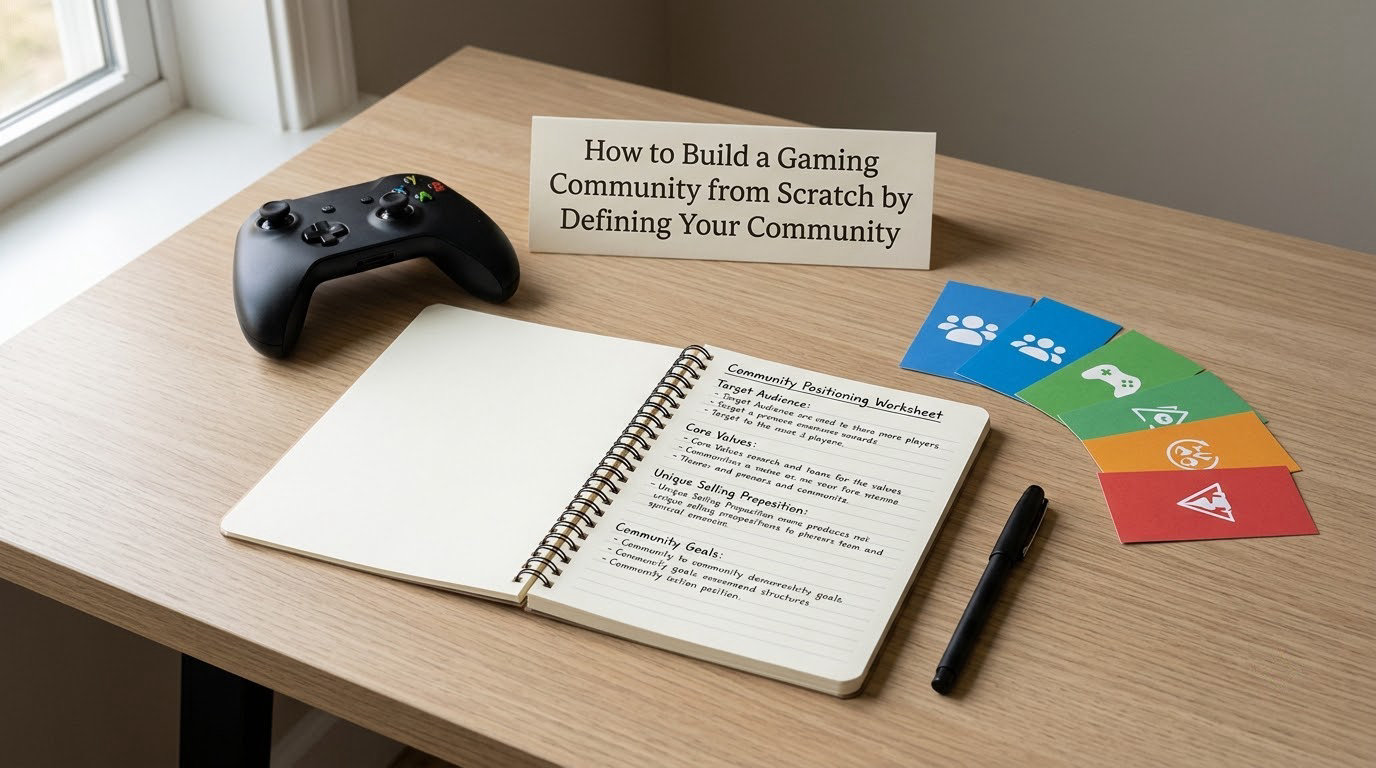
Start by writing one sentence: “This community is for people who ___, and we help them ___.” If you cannot finish it, your niche is still too wide.
Narrow along one of five axes. Pick a genre (“co-op survival crafting”), a play style (“players who solo but want a group when it matters”), a skill band (“beginners who want to improve without being destroyed”), a platform (“owners of one handheld”), or a shared goal (“finishing the seasonal ladder this season”).
That sentence drives everything downstream: channel names, event format, which forums you post in, who you recruit. A community of identity — interest, practice, or purpose — gives members something to describe themselves with, which is what makes them introduce themselves instead of lurking.
A useful test: could a member explain your community to a stranger in ten seconds without hesitating? If not, keep narrowing.
2. Choose One Place to Build the Community
Build where your intended players already spend time, not where you would prefer them to spend time. Pick one home and treat every other platform as a signpost pointing into it.
| Platform | Best for | Cost at small scale | Watch out for |
|---|---|---|---|
| Discord server | Live chat, squads, voice, events, indie launches | Free tier covers most small groups | Poor search for old answers; channel sprawl |
| Forum (Discourse, XenForo, Flarum) | Long-lived guides, searchable answers, strategy discussion | Free and open-source options exist | Slower; needs steady posting volume to feel alive |
| Subreddit | Discovery — new people can find you without an invite | Free, but strict self-promotion limits | You do not own it; strict subreddit rules apply |
| Telegram group | Fast news, small international groups, mobile-first play | Free | Search is weak; older members find it hard to navigate |
Most founders end up on Discord and land in the trap described in r/discordapp: five tiers of main chat rooms, which feels organised and reads as chaos to a newcomer who has to choose between options on arrival. Start flatter. Three or four channels, one of them clearly the main room, and let structure grow out of actual conversation.
Plan on hosting a searchable archive eventually — guides, patch notes, event write-ups — even if your main home is chat-first. Players search for answers far more often than they search for opinions.
3. Create an Onboarding Experience
Design the path from landing link to first real interaction. It should take under five minutes and end with a new member having said something and received a reply.
That reply matters more than you would think. A mature gaming forum thread captures the core problem plainly: posting a first message feels overwhelming and people fear making a bad impression. Forum and chat newcomers are not shy by nature — they are unsure whether anyone is listening.
A workable onboarding flow has four parts: a short welcome post that states what the community is and what happens this week, the rules in plain language, the essential channels, and one low-pressure starter action like a “introduce yourself” prompt, a role picker, or a no-stakes practice night.
Automate the boring half. A welcome bot can send the message, hand out a starting role, and point to the rules, but never let it stand in for a human reply.
4. Establish Useful Rules and Roles
Rules exist to protect the vibe, not to list crimes. Six lines beat six paragraphs: be decent, no harassment or slurs, no cheating or account trading, spoiler tags for story content, one promotional post per week per person, and take arguments to DMs instead of the main channel.
Write the consequence next to each rule. “Be decent” means nothing; “harassment gets a warning, then a timeout, then removal” means something.
Set up a small role ladder so authority is earned in public. New member gets posting access. Regular gets event-ping access and can mute their own notifications. Trusted gets the ability to pin, organize, and approve other members’ guides. Moderator comes later and is granted, not applied for by strangers.
Publish an escalation path: member, regular, trusted, moderator, lead. Write down who to contact when a moderator is the problem, because there will come a day.
5. Make the First 100 Members Feel Welcome
The first hundred are the hardest and the most valuable. A member who joins in week one and is welcomed becomes the person who greets strangers in month six.
An indie dev in r/SoloDevelopment described exactly this stage — roughly 70 Discord members, and a real struggle to keep things active. That 50 to 200 member band is the dead zone: enough people to feel public, too few to create a conversation on their own.
What works there is volume of personal attention. Reply individually to every new member for the first fifty. Ask one question about why they joined and actually remember the answer. Introduce them to two other members. Tell them which channel they should post in tomorrow.
Then watch for the gap. A channel with 300 messages and no replies teaches newcomers that posting here is pointless. If a room goes quiet for a week, either seed it with something specific or archive it. Empty rooms are the loudest message a community sends.
Watch your date range and your churn together. Three signups a day with twenty percent of week-one members still active is healthy. Sixty signups a day with nobody returning is a funnel that dumps people at the door.
6. Create Regular Reasons to Return
Growth comes from a rhythm, not a push. Members do not need new reasons to join — they need the same reason to show up on a day they were planning to do nothing.
The strongest options for gaming groups: a weekly practice night, a weekend tournament bracket, a themed challenge with a public leaderboard, a patch or update discussion held the same day the update drops, a lore or theory session, and a monthly member showcase for clips, screenshots, and handmade mods.
Publish the schedule a week ahead and keep it. Cancelling twice is how a ritual stops existing. If you must cancel, post why and give a new date in the same message.
Small and consistent beats large and occasional. A forty-person weekly scrimmage is worth more than a two-thousand-person tournament you run once a quarter, because it happens while people are still deciding whether you are going to be around in a month.
7. Give Members Ways to Contribute

Asking people to chat gets you silence. Asking them to run something gets you volunteers.
Contribution here is broader than posting. Members can organize an event, write or maintain a guide, teach a newcomer a mechanic, record and post match clips, correct a page in your wiki, recruit for a team, or propose a change to the rules.
Each contribution wants three things: a clear path in, visible recognition, and a guardrail. A member-run event template with date, format, sign-up thread, and a note about what happens if nobody shows helps more than an open invitation to “organize stuff.”
Recognition should be cheap and public. Role colours, a shout-out in a weekly post, a badge, first pick in a community tournament. Costly or rare rewards turn contributions into transactions, and you cannot afford a transaction economy.
Guardrails keep quality up without blocking beginners: event slots booked through one calendar, guides reviewed by a regular before pinning, clips labelled so spoiler policy applies.
8. Measure Engagement and Improve
Track returning members first. Followers and member totals can rise on a server where nobody talks. Returning members — people active across two separate weeks in the last month — tell you whether there is something to come back to.
Also watch event attendance, reply rate as a share of posts that get any answer, the share of new members who post in their first week, moderator workload in hours per week, and where new members actually come from.
Set milestone targets rather than member totals. By day 30 you want a working weekly event and twenty people who have posted. By day 90 you want a named regular crew, three members able to moderate, and a searchable archive. By day 180 you want most activity coming from members rather than from you.
That last one is the real threshold. Community builders who use lifecycle framing treat critical mass as the point where members generate more than half the activity, and self-sustaining as the point where they generate nearly all of it.
Review monthly and change one thing at a time. Quiet channels, low reply rates, and heavy moderator hours each point to a specific fix, and changing three at once leaves you guessing which worked.
Common Mistakes
Building on every platform at once. Four half-empty spaces is worse than one busy one. Pick a home, grow it, then add a second only when the first has a queue of people wanting in.
Waiting for an audience before speaking. Nobody is watching a new server before it exists. Post answers in the forums your players already use, and let the community find you. Member count is not the same as engagement — studios in r/IndieGaming report the same engagement worries at six thousand members that solo devs have at sixty.
Copying another community wholesale. Borrow the format, not the content. A stranger’s culture does not transfer.
Changing rules unpredictably. If rules shift every time something gets messy, members stop investing. Publish changes in advance with a reason.
Relying on giveaways. Prizes bring numbers, not belonging, and they attract people who joined for one specific thing. Reward participation instead — early access, a role, a say in the schedule.
Letting moderation turn controlling. Deleting every argument creates a quiet server, and quiet reads as dead. Moderate the behaviour, not the disagreement.
Treating criticism as disloyalty. Feedback from players is the cheapest research you will ever get. The hard version is that some of it will be right, and a community that cannot hear it stops telling you anything.
Ignoring burnout. One person running every shift of a global server eventually stops. Publish coverage hours, hand off before you are exhausted, and recruit a second moderator early rather than urgently.
Not planning for the game to change. Servers can fracture when a developer adds cross-server tooling, or collapse after a single bad patch — the “watching it die in real time” thread in r/vrising is the version everyone cites. Keep some activity that is not about the current meta: events, art, lore, off-topic rooms.
A few practical tips to close out: post your schedule a week early, answer every new member for the first fifty, keep one flat main channel, archive what nobody uses, and write down what happens when a moderator is the one causing trouble.
Frequently Asked Questions
How many members are needed to launch a gaming community?
Launch small, around 30 to 50 members who actually know each other by name. Under 20, every silence is visible and every conversation depends on you. Between 50 and 200 you hit the dead zone, where the room feels public but too small to sustain itself, and the work becomes personal outreach rather than broadcasting. Many founders treat this band as the real launch, since that is where the first habits form.
Should I start with Discord, a forum, or a social media group?
Start where your players already are, and start with only one. Discord suits live chat, squads, and voice. A forum suits guides and searchable answers that stay useful for years. Reddit gives you discovery but enforces strict self-promotion limits and you do not control it. A subreddit or group is fine as a signpost into your own home, not as the home itself.
How do I promote a new community when I have no followers?
Answer questions where your players already talk instead of posting a link. Share something genuinely useful in forums, subreddits, and Discord servers that allow it, then let people see your server’s activity before you invite anyone. Cross-post your best member content outward rather than announcing the community itself. Invite people individually by name, because a personal note converts far better than a mass ping.
How can I keep a small gaming community active?
Run one thing, every week, at the same time, and keep it small enough that the same people return. Weekly practice nights, a short tournament, or a patch discussion all work. Reply personally to every new member, since under two hundred people that is the activity that pays off most. Archive unused channels so newcomers only see rooms with life in them.
Should I add more features to my community early?
No, not yet. Bots, rank systems, and elaborate channel trees cost attention you should spend on people, and they make a newcomer face more choices before they have any context. Add features when a repeated question or repeated complaint shows up, not because a competitor has them. Three well-run channels beat ten tidy empty ones, and structure should follow real conversation.
Conclusion
Learning how to build a gaming community from scratch comes down to three decisions: one audience, one home, one weekly rhythm. Everything else — channels, bots, badges, roles — is a detail you can adjust in month three, and most founders adjust too early anyway.
Before you invite anyone, write the one sentence describing who this is for and what you help them do. Then pick three channels, write six lines of rules, and schedule the first recurring event with a date and a time.
Post that schedule somewhere your players already are, answer ten questions personally, and come back next week with the same event. Expect a slow first couple of months, keep going anyway, and the six-to-twelve-month mark is where communities stop needing you to carry every conversation.