To warm up before ranked matches, spend about ten minutes: two minutes settling your breathing and body, two minutes on hands and eyes, five minutes on low-intensity drills in your practice mode, and one minute naming a single tactical intention before you queue. The point is not to grind, it is to arrive at round one already warm instead of spending the first three rounds of a ranked game remembering how to aim.
Most people get this backwards. They open the game, run a twenty-minute aim session, queue, and then play worse than if they had not touched the mouse at all. Warm-up and training are different jobs. A warm-up prepares the motor patterns you are about to use for fifteen minutes. Training builds patterns over weeks. Do the second one after your matches, never before.
The routine below works across shooters, MOBAs, fighting games and racing games, and it fits on a weeknight. Menus and control schemes differ between titles, so treat every example as something to translate rather than copy.
Table of Contents
- 1What You Need
- 2How to Warm Up Before Ranked Matches Step by Step
- 31. Settle Your Body and Breathing
- 42. Do a Brief Physical Activation
- 53. Warm Up Your Hands and Eyes
- 64. How to Warm Up Before Ranked Matches by Phase
- 75. Run a Short Practice Drill
- 86. Set Match Intentions and Queue
- 9Common Mistakes
- 10Frequently Asked Questions
- 11How long should I warm up before a ranked match?
- 12Is warming up before ranked actually necessary?
- 13Should I aim train before or after playing?
- 14How do I warm up my hands before gaming?
- 15How do I know if my warm-up is working?
- 16Warm Up, Then Queue With a Plan
What You Need
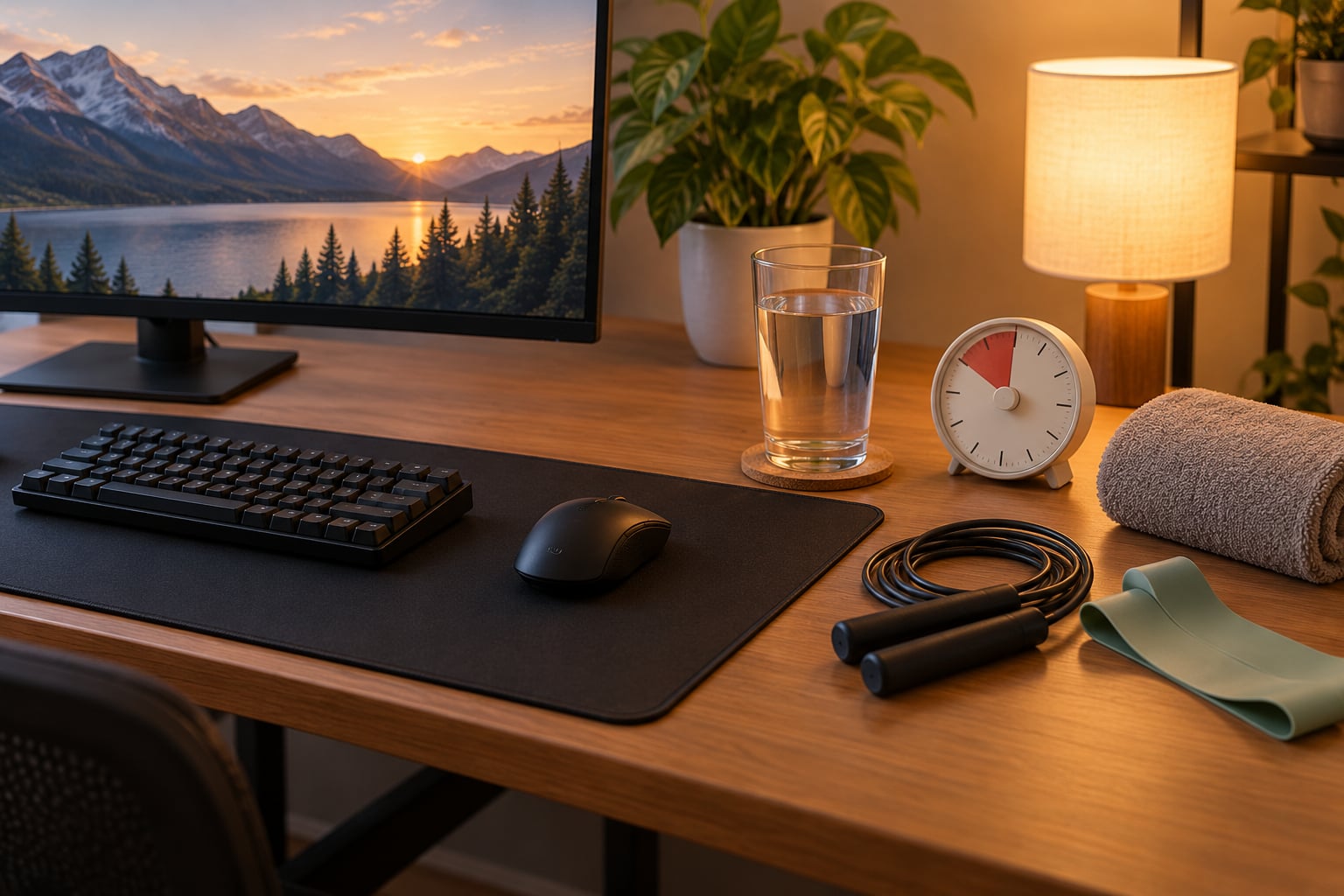
Nothing here needs buying. You need the game with its practice or training mode available, roughly ten uninterrupted minutes, and a place where you can hear the game clearly.
- The game and a practice mode. Every competitive title has something: a firing range, a practice range, a warm-up lobby, a free-for-all, or a custom bot match. If you are not sure where yours lives, search the in-game mode list for the word practice before queueing.
- Water. A glass within arm’s reach. Dry hands and a dry mouse pad are a bigger source of inconsistency than most players suspect.
- A quiet space and a consistent grip. Same mouse, same hand position, same chair height as you use in ranked. Changing your setup before a match is a small self-inflicted handicap.
- Your settings already decided. Sensitivity, DPI, cm/360, controller deadzone, paddles, stick deflection, crosshair and audio. Warm up with the settings you will queue with.
- Optional: a light resistance band. Useful for the hand block, though a rolled towel works nearly as well if you have nothing on hand.
- Ten to fifteen minutes. If you only have five, use the emergency version in step six rather than skipping the physical block.
How to Warm Up Before Ranked Matches Step by Step
Here is the full schedule, so you can follow it without deciding anything in the moment. The blocks are ordered deliberately: body first, hands and eyes second, game third, intention last.
| Minutes | Block | What to do | Why |
|---|---|---|---|
| 0 to 1 | Settle | Slow nasal breathing, shoulders down, jaw loose | Drops the physical tension that makes the first minutes twitchy |
| 1 to 3 | Activate and loosen | March in place, bodyweight squats, light shadowboxing | Wakes up the legs and shoulders before long sitting |
| 3 to 5 | Hands and eyes | Open and close hands, wrist circles, near-to-far focus shifts, one tracking drill | Prepares grip and fine motor control without stretching anything hard |
| 5 to 9 | Game drills | Micro-flick calibration, then burst control, then stop-shoot timing | Rehearses the exact mechanics ranked will ask for |
| 9 to 13 | One real game | Deathmatch or three to four unranked games, played with rules not kill-chasing | Bridges static targets to moving opponents before the stakes rise |
| 13 to 15 | Intention and queue | One tactical intention, settings check, no loss review | Removes indecision and carries the tilt you arrived with nowhere |
Two minutes here, five minutes there, one minute on the intention. Total cost: one match of queue time.
1. Settle Your Body and Breathing
Spend one to two minutes doing almost nothing. Sit back, let your hands rest in your lap, and breathe in through your nose for a count of four and out for a count of six. Longer exhale than inhale is the whole trick.
Then roll your shoulders backward five times, open and close your jaw a few times, and shake your hands loose. The goal here is comfort and alertness, not intensity. A static stretch held for thirty seconds on a cold morning can make your aim feel slower for the next ten minutes, which is the exact opposite of what you want.
How do you know it worked? Your breathing is quiet enough that you can hear footsteps in the game, and your hands feel heavy rather than ready to grab something.
2. Do a Brief Physical Activation
One to two minutes of low-intensity movement, standing up if you can. Marching in place with tall knees, ten to fifteen bodyweight squats, or a round of light shadowboxing at half speed all fit. Pick one, not all three.
Ranked is ninety minutes of sitting still with your eyes locked forward and your right hand making tiny precise movements. That is a genuinely awkward posture, and most players spend the first ten minutes of a session fighting it. Moving first makes the transition into the chair less abrupt, and the hand that holds a controller or a mouse usually feels a little more accurate in the first minutes afterwards.
Keep it below the point where you are breathing hard. This is not a workout, and if you are gasping you have gone too far for a pre-match warm-up.
3. Warm Up Your Hands and Eyes
Your hands are the tools here, and cold fingers send sloppy inputs. Start with ten open-and-close hand repetitions, then slow wrist circles in both directions, ten each. If you have a resistance band, open your hand against it for ten seconds, rest, repeat three times per hand. That is enough.
Next, your eyes. Focus on something about arm’s length away, then on something across the room, and back again, twenty times. Then do a short tracking drill: follow a single moving point in your practice mode for sixty seconds without flicking to anything else. Overwatch players in particular find that side-to-side tracking work matters more than flicking drills.
Keep everything gentle. Stop immediately if anything causes pain, dizziness, tingling or numbness, and do not push through a stretch that resists. Persistent wrist, finger or shoulder discomfort is a question for a doctor or a physiotherapist, not something to work around with a longer warm-up. None of the drills below need force to work.
4. How to Warm Up Before Ranked Matches by Phase
Now the game block. Work through it in four short phases, and the same structure ports between genres because the phases are mechanical rather than genre-specific.
Phase one, learn the objective. Thirty to sixty seconds in your practice mode. Read what the mode wants, confirm your loadout works, and fire a handful of shots so the game stops feeling unfamiliar. Skipping this is the most common waste of a warm-up.
Phase two, test the core mechanic. Ninety seconds of small controlled adjustments. In a shooter that is micro-flicks onto a small target, placed at the height where enemies actually appear. In a fighting game it is a short chain or a single reversal. In a MOBA it is a last-hit attempt on a practice dummy. In a racing game it is three clean laps with no contact.
Phase three, rehearse one decision. Pick the single habit you want to carry into the match. Crosshair at head height before you move. One burst, then stop. Do not go second after an opponent’s turn. Finish the corner in training mode. One decision, repeated, beats five decisions tried once each.
Phase four, simulate a short sequence. Sixty to ninety seconds that resembles actual ranked. A pistol round, an eco situation, a full-health duel, a single push. This is where your hands meet real movement and real pressure.
Translation by genre, if you want the specifics:
- Valorant and other tactical shooters: range wall for micro-flicks at head height, then burst control and a recoil reset on a wall, then stop-shoot timing where you stop, fire, and re-strafe in one smooth motion, then one Deathmatch played on the rules below.
- CS2 and CS:GO: bot or custom map with crosshair placement first and raw aim second, movement shots on a workshop map, then Deathmatch or two to three casual games.
- Apex Legends and other battle royales: the firing range doubles as queue time, so drill rotations, first-bullet accuracy and one short match rather than a full lobby warm-up.
- Overwatch and hero shooters: practice range with hero-specific tracking, side-to-side movement while keeping the target on screen, then a short deathmatch where you play to survive rather than to farm damage numbers.
- Call of Duty and military shooters: range for recoil patterns, then a bot match on the map you are queuing for, which is also the fastest way to learn an unfamiliar map.
- Fighting games: fifteen minutes of movement practice, then your bread-and-butter combo, then reversal drills, as many players in the Super Smash Bros. community already do before an online set.
- MOBAs: last-hit practice on a dummy, a rotation through a jungle route, then a short custom or unranked game with one clear focus such as map awareness or trading.
- Racing games: three clean laps without contact, then five aggressive laps, then one standing-start test from a slow speed.
Console and controller players get the same phases with different content. Replace flick drills with stick deflection drills: short flicks in each direction, then tracking a target across the screen, then the same movement-plus-aim sequence you will need in a fight. Your warm-up map is usually a smaller version of the same idea, and the queue time built into firing ranges means many players warm up and queue at the same time.
5. Run a Short Practice Drill
Finish with one focused drill, four to five minutes maximum, and stop the moment your performance starts drifting.
In a shooter that is typically aim tracking or a small-target flick set. In a fighting game it is your most reliable combo plus a reversal. In a racing game it is three clean laps. Whatever it is, you are looking for the feeling of the game, not a new skill.
The stopping rule matters more than the drill. When your hit rate, lap times or combo success start falling off noticeably, you are past useful and into fatigue. Finish the drill at that point even if the clock says you have time. Players who push a tenth longer routinely show up to ranked already worse than they started.
Do not change your sensitivity or crosshair in this block, or at any point in the session. The whole purpose is to wake up the settings you already have, not to install new ones. Changing sensitivity the night before a match means your warm-up trains one hand position and ranked tests another.
Warm up before, train after. This is the distinction most people get wrong, so it is worth being blunt. A warm-up is short, low-intensity, and finishes while you still feel like you could go again. Training is longer, harder, and targeted at building something over weeks. Warming up prepares your muscles for the session ahead; training exhausts them. If you queue immediately after a hard aim session, you are starting a match with fatigued muscles and an inflated sense of your own warm-up score. Aim training belongs at the end of a session, or on a rest day, not in the ten minutes before ranked.
How do you know the warm-up worked? Track three things across about ten sessions and stop guessing. First, your first-round or opening-death stat compared with your match average, which shows whether your cold start still costs you. Second, whether your first Deathmatch was better than your fourth, which tells you if you warmed up too little or too much. Third, a single note after each session: warmed, flat, or heavy. Most players who track this for ten sessions find their answer immediately, usually that they warm up too long rather than too little.
6. Set Match Intentions and Queue
The last minute decides the mood of the session more than the drills do. Before you press queue, do three things in order.
- Name one intention. A single sentence for this match. Hold more angle in the opening duel. Do not force the third rotation. Take the fight when I have the spike. One sentence, not six.
- Confirm the setup. Settings, audio level, and that no notifications are about to interrupt. This takes fifteen seconds and prevents the worst version of a match: the one you lose to a Discord ping during the clutch.
- Do not review your losses. This is the step people skip, and it is the one that matters most. Reading your last two losses right before queueing is a reliable way to bring frustration into a fresh game. Whatever happened is still going to be there in ten minutes. Queue first, review later.
If you only have five minutes, do the two-minute body and breathing reset, ninety seconds of hands and eyes, ninety seconds of one game-specific drill, and state the intention. If you have thirty, you are not warming up, you are training, and it belongs at the end of a session instead.
There are also days when the right answer is to skip ranked entirely. If you lost several in a row and you can feel the frustration in your hands, a routine will not remove it, and warming up while tilted tends to feed the tilt. If you slept badly, or you have been at a desk all day and your back and wrists are complaining, the honest move is unranked or nothing. A ten-minute routine makes you better at a match you have already decided to play. It does not make you ready to play, and that is a separate decision.
Common Mistakes
Skipping the physical part. Cold hands, stiff shoulders, and a tight grip are a real accuracy problem, not a comfort preference. Fix: do the two-minute body reset before you touch the game, every time, even on the days you think you are fine.
Treating the warm-up as a training session. Long drills before ranked leave you fatigued before round one. Fix: cap the game block at five minutes and put the rest of your practice after the session.
Rushing to feel fast. Slamming large mouse movements and spamming the trigger trains shaky aim and increases tension. Fix: small, controlled adjustments, and slow down when you catch yourself cranking.
Playing Deathmatch like it is ranked. Chasing kills, panic-peeking, and sprinting into fights turn a warm-up into a stress test and rehearse bad habits. Fix: play to a small goal instead, such as one kill per life, clean first shots, or staying alive for 20 seconds at a time. Five rules help:
- Play to a limit, not a scoreboard.
- Stop shooting once you win the duel.
- Keep crosshair at head height whether or not anyone is there.
- No re-peeking after you win.
- If you notice yourself tilted inside the Deathmatch, end it early rather than finishing the block.
Changing sensitivity, crosshair, or loadout. This resets the pattern your warm-up just installed. Fix: keep the exact settings you queue with, and change them only between sessions, never immediately before one.
Playing until you are tired. The drill has an end condition, not just a duration. Fix: stop the block the first time your performance clearly drops off, and go queue while it is still fun.
Testing a single perfect sequence. If your warm-up is one flawless run on an easy bot setup, you have rehearsed a best case. Fix: make part of the block deliberately messy, with movement, at your real sensitivity, so the match feels familiar rather than surprising.
If you take one thing from all of this, take the ordering. Body, then hands and eyes, then drills, then one real game, then one intention, then queue. The routine is ten minutes, and doing it in that order most days will beat a heroic version you attempt once a month.
Frequently Asked Questions
How long should I warm up before a ranked match?
Ten to fifteen minutes is the range most competitive players land on, and it covers the physical, mechanical and mental work without tiring you out. Two minutes for breathing and movement, two for hands and eyes, five for game-specific drills, and one to set your intention. If you only have five minutes, do the body reset plus a single short drill and skip the unranked games rather than cutting the physical block.
Is warming up before ranked actually necessary?
For most players, yes, mainly because the first few rounds of a cold session are decided by rust rather than skill. A short warm-up does not change your rank, but it makes your opening rounds look like your middle rounds. The exception is a player who is already tilted or badly rested, where a routine will not fix the problem and unranked or a night off is the better call.
Should I aim train before or after playing?
After. Training builds patterns over weeks and exhausts the muscles you need for a match, while a warm-up only prepares you for the next ten minutes. Aim training before a queue leaves you fatigued and prone to over-flicking, which is a common reason players feel their aim got worse after warming up. Keep hard aim sessions at the end of a play session or on a rest day.
How do I warm up my hands before gaming?
Ten open-and-close hand repetitions, slow wrist circles in both directions, and about a minute of near-to-far focus shifts, followed by gentle movement of the hand you use. A light resistance band helps if you own one. Keep every movement easy and stop if you feel pain, tingling or numbness. Persistent wrist or finger discomfort is worth raising with a doctor or physiotherapist rather than training through.
How do I know if my warm-up is working?
Track three things across roughly ten sessions: your opening-round or opening-death stat against your match average, whether your first Deathmatch was better than your fourth, and a one-word note afterward reading warmed, flat, or heavy. Most players who do this find the answer fast, and it is usually that they need a shorter game block and a longer physical block rather than more drilling.
Warm Up, Then Queue With a Plan
Start tonight with the part that takes least effort. Do the two-minute body and breathing reset before you open the game, run one drill that matches the game you are about to queue, and write down a single sentence you want to play on. Then queue. That is the whole routine, and it is worth far more than a long session that leaves you tired before round one.
Stop any physical warm-up that causes pain rather than working through it, and talk to a doctor or qualified physiotherapist about recurring wrist, finger, shoulder or back problems before adding more sessions to your week.