
Writing good rules for a gaming community comes down to this: keep them short, make each one describe a single visible behaviour, and attach a stated consequence to every line. A first draft takes about two hours, and a weekend of editing gets it into a shape you can actually enforce.
The failure modes are predictable. Either the rules are a legalistic wall nobody scrolls to the end of, or they say “be nice” and give a moderator nothing to point at when someone is being awful. Both problems come from the same cause, a ruleset written before anyone decided what the community is for and who enforces it.
Below is the process I use, plus the specific rewrites that turn mushy wording into something you can act on.
Table of Contents
- 1What You Need
- 2What is this community for?
- 3What problems are actually happening?
- 4What can the platform actually enforce?
- 5Who enforces, and who decides?
- 6What are your limits?
- 7Step-by-Step: How to Write Good Rules for a Gaming Community
- 8Step 1: Define Your Community’s Purpose and Values
- 9Step 2: Write Short, Specific Rules
- 10Step 3: Cover Behaviour, Cheating and Communication
- 11Step 4: Explain Consequences and Exceptions
- 12Step 5: Make Rules Easy to Find and Understand
- 13Step 6: Publish, Explain and Review the Rules
- 14Common Mistakes
- 15Writing rules that are far too long
- 16Promising punishment you never deliver
- 17Mixing etiquette with hard rules
- 18Applying rules inconsistently
- 19Banning legitimate criticism
- 20Over-moderating the fun
- 21Never updating the rules
- 22Frequently Asked Questions
- 23How many rules should a gaming community have?
- 24How strict should gaming community rules be?
- 25How do I make people actually read my Discord rules?
- 26Should moderators follow the same rules as members?
- 27How do I handle a player who argues with every punishment?
- 28When should I update my community rules?
What You Need

You cannot write rules until you can answer five questions honestly. Most rushed rulesets fail because two of these were never answered at all.
What is this community for?
A ranked ladder group, a roleplay server, and a clan that scrims twice a week need completely different rules. Write one sentence naming the kind of play you are running for, because every later decision gets checked against it.
What problems are actually happening?
Pull your last month of reports, deleted messages and modlog entries. The three issues your members complain about most often are the three your rules need to cover in detail. Everything else can be a single line.
What can the platform actually enforce?
Discord can mute, kick, ban and delete. In-game chat usually offers nothing beyond a host mute. A forum has a post deletion history but no way to stop someone joining back tomorrow. Write the consequence you can genuinely deliver, not the one you wish you could.
Who enforces, and who decides?
Name the mod team, say who can issue each level of punishment, and decide who handles appeals. A ruleset with no named owner is a wishlist.
What are your limits?
Check the age rating, the platform terms of service and any clip or screenshot permissions before you promise anything about spoilers, NSFW channels or sharing gameplay footage.
Step-by-Step: How to Write Good Rules for a Gaming Community
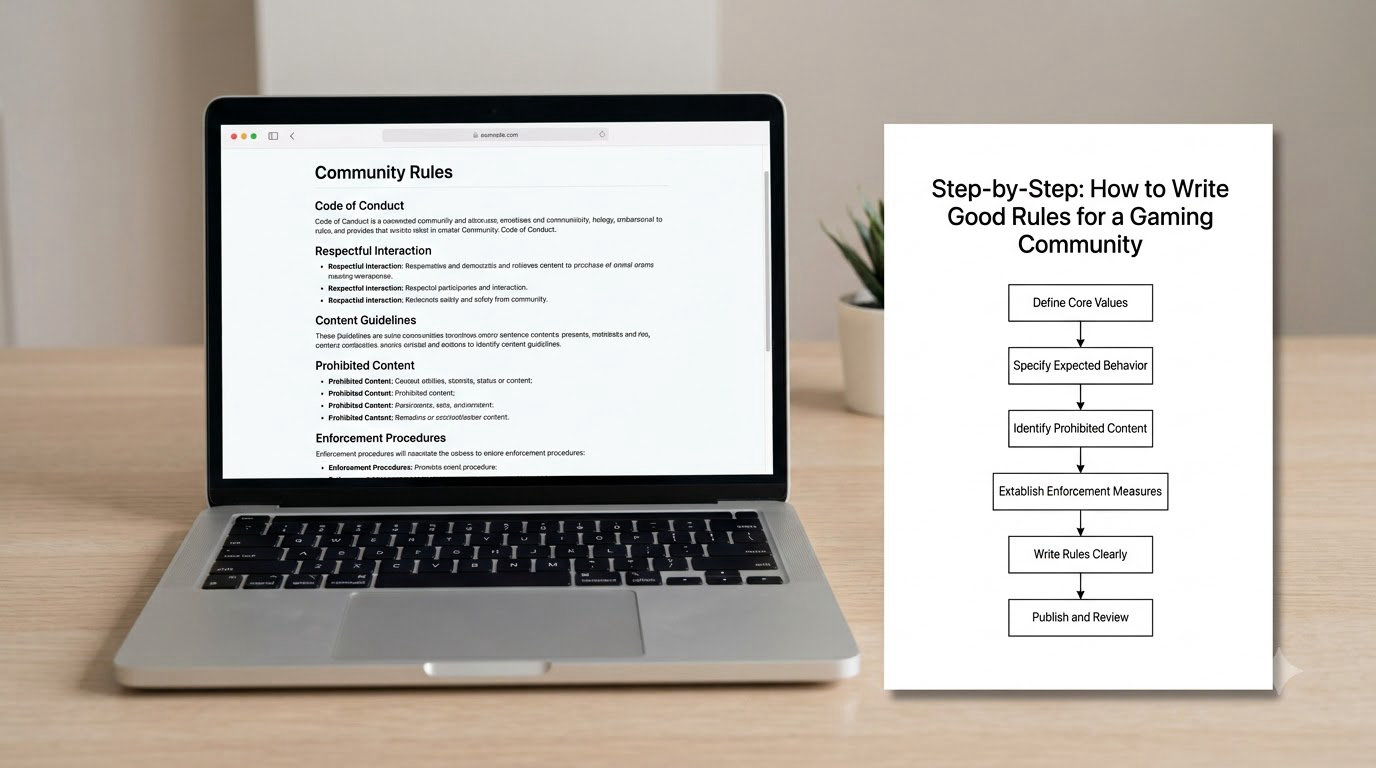
Step 1: Define Your Community’s Purpose and Values
Write three to five values in plain language, then test every rule against them. If a rule cannot be traced back to one of those values, it is usually a personal preference that leaked in and should go.
“Respect” is too vague to build on. “Assume the person you are queued with is having a bad night” is a value you can point at in a conversation. Step 1 is where you find out that your real value is competitive honesty rather than friendliness, and that changes the whole ruleset.
How to tell it worked: a member who disagrees with a rule can point to the value behind it, and you can point to the same value.
Step 2: Write Short, Specific Rules
One rule, one observable behaviour. “No toxicity” fails because nobody can observe toxicity; “no slurs or targeted insults in voice or text chat” passes because a moderator can quote the exact words in a report.
Write positive first where you can. “Assume good faith” reads better than “do not accuse your teammates of feeding,” and it produces the same behaviour.
| Weak wording | Strong rewrite |
|---|---|
| Be nice to other members | No personal attacks in chat. Disagree with the play, not the player. |
| No cheating | Third-party software, stream sniping and account sharing end your membership. |
| Keep chat on topic | Use #general for off-topic chat; gameplay discussion stays in the game channels. |
| Don’t be toxic | One warning for a targeted insult, then a 24-hour mute. |
| Follow the rules | Spoilers go in spoiler channels until a week after release. |
| No spam | No repeated adverts, server invites or links in chat or voice. |
How to tell it worked: a new member reads a rule and can say with confidence whether they broke it.
Step 3: Cover Behaviour, Cheating and Communication
Group your rules under headings a player can scan: conduct, integrity, communication, content. Under them, cover harassment and slurs, cheating and exploit abuse, spam and self promotion, backseat gaming, spoilers and leaks, disputes in voice chat, and the fact that moving to a private DM does not make anything acceptable.
That last one matters more than people expect. Most communities discover their rules do not survive the jump from public channel to private message, and a rule set that quietly stops applying the moment someone types in a DM has a very obvious hole in it.
How to tell it worked: every complaint from your last month maps to a specific numbered line.
Step 4: Explain Consequences and Exceptions
Publish the ladder before you need it. Escalation keeps punishments proportionate and stops moderation from looking arbitrary, which is the complaint that shows up most often in gaming communities.
| Tier | Typical trigger | Action | Usual duration |
|---|---|---|---|
| 1 | First minor offence | Verbal warning, noted in the modlog | No restriction |
| 2 | Repeat offence or a heated callout | Voice or text timeout | 1 to 24 hours |
| 3 | Continued abuse, targeted harassment | Kick from the server | Permanent until rejoin review |
| 4 | Slurs, threats, cheating, ban evasion | Permanent ban | Indefinite |
Set the number of strikes you allow before the ladder skips ahead, and say what happens when someone joins on a new account to dodge a ban. Turning off read messages and visible status on an alt is the clearest ban evasion there is.
Add the exceptions section too. Minor members, moderators acting in good faith, and reports filed inside a stated window all need a line written for them before the first argument, not during it.
Moderators are bound by the same rules as everyone else. Write that sentence in the ruleset itself, and give the mod team a named person outside the team to handle appeals against them. Moderating the moderators is genuinely hard, and the usual fix is that it does not get quietly skipped.
How to tell it worked: give two moderators the same report and they choose the same tier.
Step 5: Make Rules Easy to Find and Understand
Placement decides whether anything gets read. On Discord, pin a short #rules channel, put the full version in the readme, and send the link as the very first message a new member sees. In-game, keep the lobby message under a screen of text and mirror it in your Discord. On a forum, make it a sticky post and link it from the signup page. On Twitch, pin it in chat and keep channel rules to one line each.
Structure matters more than length. Bold headings, numbered rules, one behaviour per line, and a summary block at the top will outperform a long paragraph every time.
How to tell it worked: drop the link in your main channel and see whether anyone still asks where the rules are.
Step 6: Publish, Explain and Review the Rules
Do not post rules and vanish. Announce them with the reason each exists, so people understand the intent rather than memorising the line. Leave a two-week feedback window, read the complaints, and change what needs changing in public.
Then run a review cycle. Put a quarterly check in the mod calendar and add a standing agenda item for member proposals. People are far more willing to follow rules they helped shape, and a ruleset that never changes signals that nobody is paying attention.
How to tell it worked: you can point to a specific rule that changed because of member feedback, and to the date it changed.
Common Mistakes
Writing rules that are far too long
A rulebook nobody finishes is worth less than a short one people remember. If a new member cannot read it in under three minutes, split it: a short summary in chat and the full version one click away.
Promising punishment you never deliver
Announcing zero tolerance and then not acting on the third incident teaches the community that your rules are decorative. Fix it by deciding which tier you can reliably enforce this week and writing that.
Mixing etiquette with hard rules
“Try not to backseat the jungler” is advice. “No unsolicited advice during a match” is a rule. Keeping them separate means your enforcement record stays clean and nobody gets warned for having an opinion.
Applying rules inconsistently
The same behaviour getting a warning on Monday and a ban on Friday is the fastest way to lose a community. Fix it with the published ladder, a modlog entry for every action, and a second moderator reviewing tier 3 and above.
Banning legitimate criticism
Rules that read as “no complaining” push out the people most likely to tell you the rules are broken. Protect bad-faith conduct, not honest criticism of the game, the community or the mod team.
Over-moderating the fun
Trash talk between teammates, off-topic chatter and jokes about the game are not harassment. When enforcement starts killing the banter, membership churn rises quietly and you will not see it in reports.
Never updating the rules
Games change, and so do the arguments. Set a review date, archive the old version with a date stamp, and post the change with one line on why it changed.
Frequently Asked Questions
How many rules should a gaming community have?
Ten to fifteen is the useful range for most servers. Fewer than eight usually leaves the real problems uncovered, and more than twenty gets skimmed. Group them under short headings, keep one behaviour per rule, and move anything rarely relevant into a linked sub-page. If you cannot say what moderator action a rule triggers, it is not earning its line.
How strict should gaming community rules be?
Strict on conduct and integrity, relaxed on taste. Harassment, slurs, cheating and threats deserve firm consequences with no negotiation, while off-topic chat, banter and bad opinions rarely justify anything above a warning. The test is whether the rule protects other members rather than the mood of the mod team. Over-moderating banter is the fastest route to quiet churn.
How do I make people actually read my Discord rules?
Stop expecting them to. Put the link where joining happens, send it as the first message a new member receives, and keep the summary to five lines in your rules channel. Repeat the one rule that matters most, usually about conduct, at the top of the channel people use most. If members keep asking where the rules are, the placement is wrong, not their attention span.
Should moderators follow the same rules as members?
Yes, and say so in writing. Hold moderators to the same behaviour rules, with the added standard that they must never use their role to win an argument. Give appeals against a moderator to a named person outside the mod team, and log those decisions separately. Communities that skip this step are the ones where members stop trusting the rulebook entirely.
How do I handle a player who argues with every punishment?
Handle it once, in writing, then stop engaging. Explain which rule was broken, quote the line, name the tier and state that appeals go through one channel. If they appeal, a second moderator who was not involved in the decision reviews the modlog entry. Repeated arguing after a decision is final is itself a breach, and adding that to the ladder in advance keeps it from being a judgement call.
When should I update my community rules?
Review on a schedule and on events. Put a quarterly review in the mod calendar, and add a special review after a major game update, a platform policy change or a controversy that exposes a gap. Members should be able to propose an amendment in a fixed channel with a clear response window. Archive every version with a date so you can show what changed and why.
Start with one hour today. The quickest way to work out how to write good rules for a gaming community that holds up is to write the three values, pull your last month of reports, then draft ten numbered lines with the ladder attached underneath. Show the draft to one moderator who was not in the room when you wrote it, because they are the person who will tell you what is missing.