
How leaderboards verify records is a question with a layered answer: the game server generates the score instead of trusting the player’s device, automated rules reject impossible results on the spot, anti-cheat software flags suspicious behaviour, and on community boards a human moderator watches the evidence before a run moves from pending to verified. No single check covers everything, which is why the strength of a board depends on how many layers it runs and whether it publishes them.
The interesting part is that a rank is never self-validating. It is a sorted number that summarises one attempt under a specific set of rules, on a specific platform, in a specific game version. Everything below explains which checks sit behind that number, and how you can tell the difference between a board that verifies records and one that just collects them.
Table of Contents
- 1What Does It Mean to Verify a Leaderboard Record?
- 2How Leaderboards Verify Records in Online Games
- 3How leaderboards verify records at submission time
- 4Which Evidence Does a Leaderboard Use?
- 5How Does Server-Side Validation Work?
- 6How Do Replays, Clips, and Proof Submissions Work?
- 7Can Anti-Cheat Software Prove a Record Is Cheating?
- 8How Leaderboards Handle Ties, Corrections, and Disputes
- 9How Can Players Tell Whether a Leaderboard Is Trustworthy?
- 10Frequently Asked Questions
- 11Can a leaderboard verify every record automatically?
- 12Is a video proof enough to confirm a leaderboard record?
- 13Does anti-cheat detection prove that a player set an invalid score?
- 14How are ties and equal scores ranked?
- 15Can private, offline, or console-only records be verified?
- 16Conclusion: What to Check First
What Does It Mean to Verify a Leaderboard Record?
Record verification means confirming that a submitted result actually happened, under the rules the board says it must happen under. Two different jobs sit inside that sentence, and confusing them is the most common source of player frustration.
Score validation asks whether the number is achievable. An anti-cheat system asks whether the software the player was running behaved normally. A run can pass every anti-cheat check and still be a rules violation, and a run can be completely clean by the board’s rules while the board has no way to detect the tampering underneath.
That gap is why no leaderboard can automatically guarantee that every entry is legitimate. Verification reduces how much cheating survives, and tells you who is responsible when something does slip through.
How Leaderboards Verify Records in Online Games
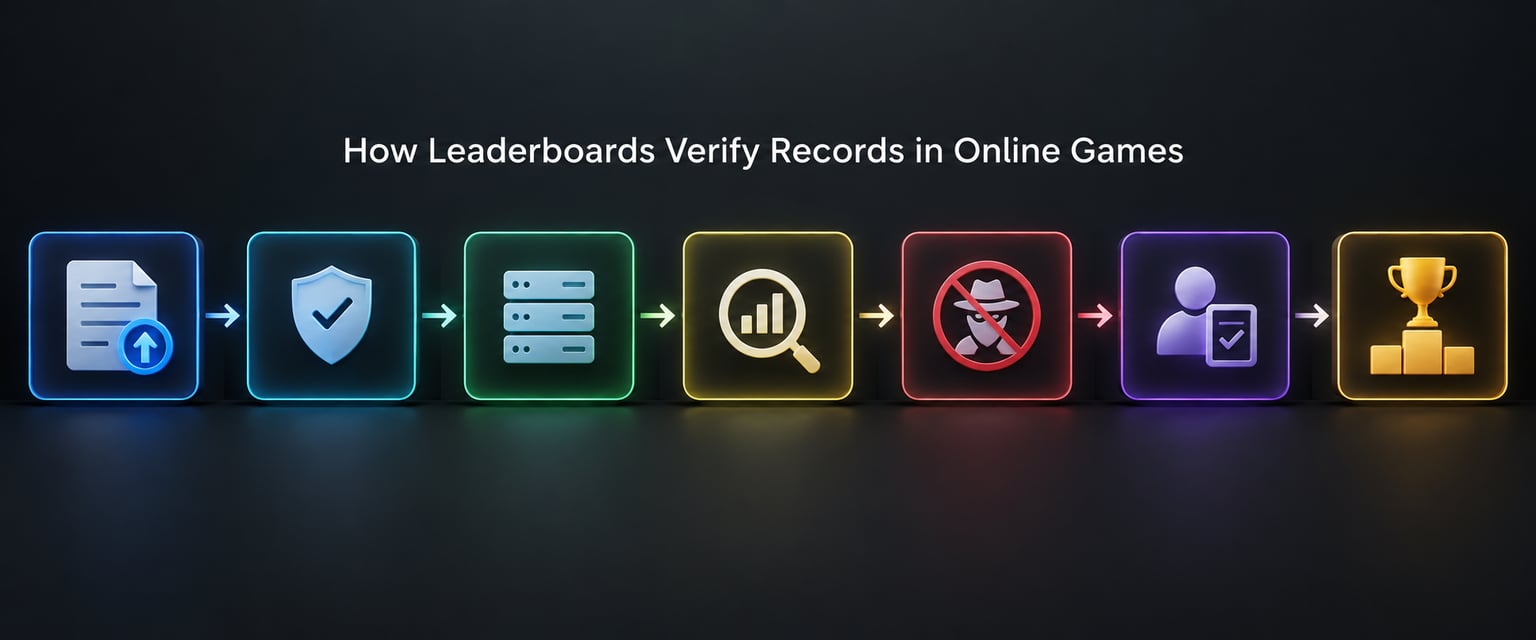
Online verification runs as a pipeline. Your device asks the server to record a result, the server checks that the request is well-formed and belongs to a real match, the outcome is compared against what the game state allows, anomaly systems take a look, and the entry is published with a status attached.
Here is how leaderboards verify records step by step, in the order the checks usually happen.
How leaderboards verify records at submission time
- Submission. The game client tells the backend a result exists, usually with the match identifier, the score or time, the ruleset version and the platform tag.
- Payload integrity. The server checks that the request is well formed and untampered. Some platforms sign the payload or route writes through a server-held key so the client can only ever ask for a score to be recorded, never set one directly.
- Server-side validation. The server compares the claim against what it recorded about the match itself. If the match never existed, the player was not in it, or the result arrived after the session closed, the submission is dropped.
- Plausibility checks. Anything outside physically possible bounds fails immediately: a time under the known floor, more points than the level contains, a speed no movement model allows.
- Anti-cheat signals. Kernel-level and behavioural systems feed detections into the same decision. A flagged run usually gets held rather than deleted.
- Review. On boards with human moderators, the run waits in a pending queue until someone reads the evidence and accepts or rejects it.
- Publication and rollback. Accepted results are written to the board with a status. If a record is later found to be invalid, it is removed, everyone below it moves up, and the change is usually logged.
Steps one through four take milliseconds. Steps five and six are where the waiting happens.
Which Evidence Does a Leaderboard Use?
Each evidence type proves something different and misses something different, which is why serious boards combine them rather than trusting one.
| Evidence | What it proves | What it cannot prove | Used when |
|---|---|---|---|
| Server event log | The actions the server recorded and the score it computed | Anything the client did before it sent data | Always, on server-authoritative games |
| Submission token or signature | The request came from the real client and was not edited in transit | Whether the result itself is fair | Any board with an active backend |
| Server timestamps | Start and end times that no local clock can fake | Rule violations hidden inside the run | Timed categories and ladders |
| Replay or input log | The full sequence of inputs that produced the result | Anything happening on a second device or account | Games that record and replay matches |
| Anomaly statistics | That a score is far outside the normal distribution | Why it happened, or whether it is innocent | Long-running boards with volume data |
| Human review of video | Whether the run matches the published rules on sight | Edited or spliced footage it cannot cross-check | Community speedrun boards |
The gap between the first four rows and the last one is the whole argument for server-authoritative design, which is the point an engineer made bluntly on Hacker News: the server must be authoritative or the rest is guesswork.
How Does Server-Side Validation Work?
Server-side validation means the number that ends up on the board is calculated somewhere the player cannot edit. Your client sends intent and state; the server decides what happened and what it is worth.
In practice that means several checks firing on the same submission:
- Impossible movement. A character covering more ground than the movement model permits in a tick gets rejected at the source, not at the leaderboard.
- Invalid items or states. A weapon, character or power-up that was not obtainable in that run is treated as a zero-value event.
- Duplicated events. The same kill, pickup or objective firing twice is collapsed or discarded.
- Altered values. Because the server owns health, damage and time, memory editing on the client changes nothing that the board ever sees.
- Results outside an active match. A score submitted with no open session, or after the session closed, does not exist as far as the board is concerned.
When the server owns the scoring, the leaderboard becomes a sorting problem instead of a crime problem. That is why official and platform boards usually reach a verdict without a human ever looking at anything.
How Do Replays, Clips, and Proof Submissions Work?
Community speedrun boards work differently because the timing often lives inside the game, not on a server. There, verification is a person watching footage against written rules, and the run sits in a pending queue until they get to it.
On speedrun.com, players have described the wait as a few days on average, which is normal rather than a sign the run is being rejected. If yours has been pending longer, the usual causes are a busy queue or a submission that needs something the moderator asked for.
A submission that speeds things up carries the obvious stuff: the platform and version, the category and sub-category, any declared variables, a video with the run unbroken, and enough context that a moderator does not have to ask twice.
Video is weaker evidence than it looks. It can be trimmed at the start, replayed during a single frame, or captured on a different build than the one claimed. That is why boards that care publish the exact start and end frames and the timing method, so a moderator knows what to look for. The Klonoa Wii board on speedrun.com is a clean example of rules doing verification work: the moderator moved away from the in-game timer toward RTA-style timing because pausing could be abused to calm nerves or set up tricks, and rather than banning the strategy, the board declared things like enemy-carry and checkpoint respawn as named variables so they could be checked instead of guessed at.
Can Anti-Cheat Software Prove a Record Is Cheating?
No. Anti-cheat is a detection layer with a false-positive rate, not a verdict. It answers whether the software on your machine was tampered with, which is a different question from whether the score satisfies the rules.
What it does well is speed. Behavioural systems and kernel-level drivers compare inputs against a model of normal play and catch the broad categories fast: injected code, impossible reaction times, behaviour that never occurs in real play. Those signals usually do not delete anything on their own; they move a result into a review state.
Where it struggles is the edges. Overlay tools, latency tricks and unusual but legal inputs can look identical to cheating from the outside. Plenty of legitimate players have had a good run flagged and later reinstated, which is exactly why mature boards keep a human decision and an appeal path after the automated one.
How Leaderboards Handle Ties, Corrections, and Disputes
Rankings break ties by a stated rule, not by whoever refreshed first. The usual order is the better raw result, then the earlier verified submission, then a documented tie-breaker like fewer deaths or fewer retries.
Corrections follow the same logic in reverse. A result under review can stay visible while it is checked, which annoys people who were beaten by it, but removing everything on suspicion destroys the board faster than leaving it up. When a record is disqualified, everyone below it moves up, and the board keeps a record of what was removed and why.
Disputes go somewhere on purpose. Official boards route reports through in-game reporting and support tickets; community boards have forum threads and moderator inboxes. A board with no published route for challenging a result is telling you something about how it handles the other hard cases too.
How Can Players Tell Whether a Leaderboard Is Trustworthy?
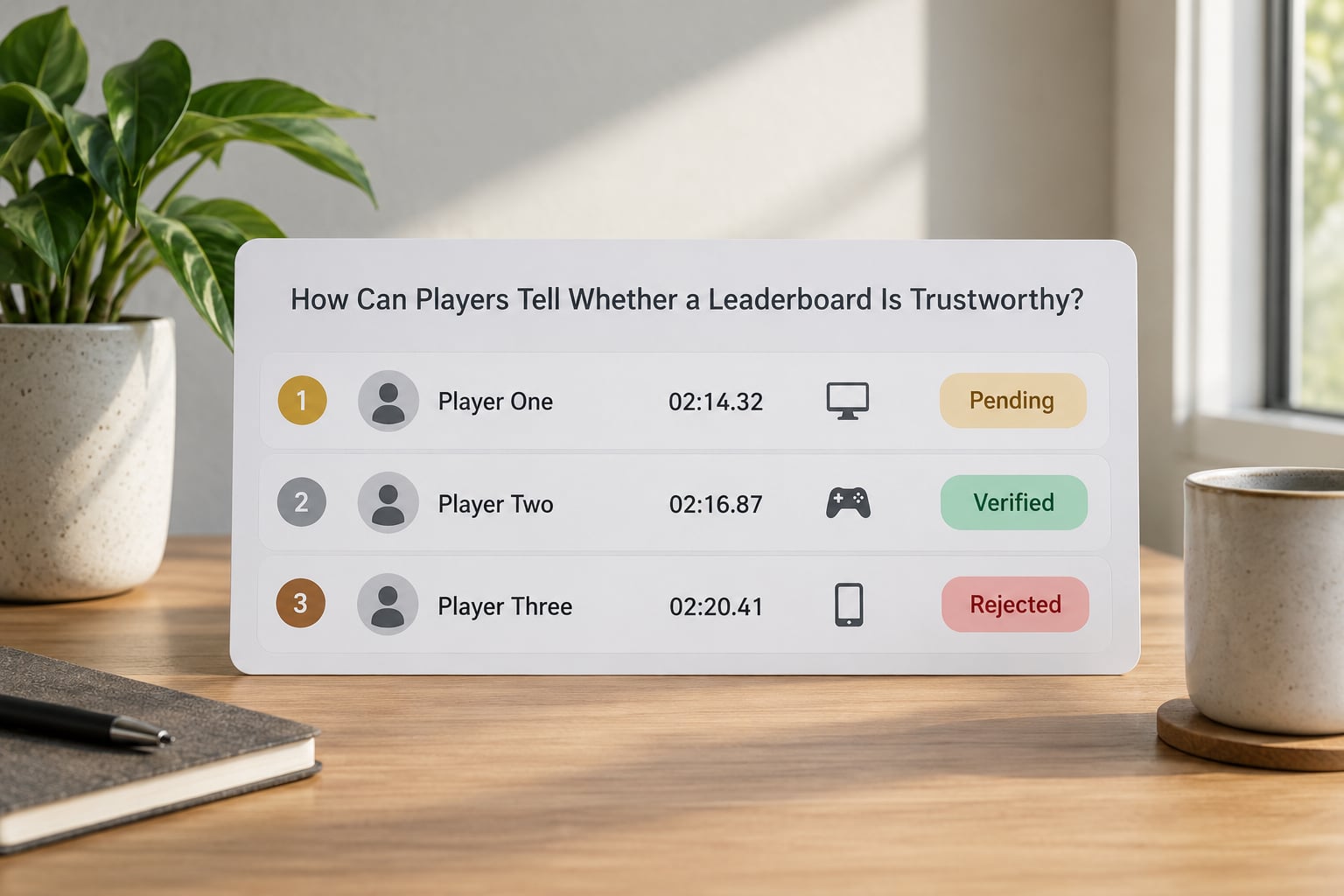
You cannot inspect a leaderboard’s code, so you read its behaviour instead. Seven checks cover most of it.
- Rules with a named timing method. If the board does not say whether it uses RTA or an in-game timer, nobody can verify a run against it.
- Per-entry status. Pending, verified and rejected should be visible on the entry, not hidden in a moderator’s inbox.
- Platform splits. Console, PC and emulator boards kept separate, because load times and timing methods differ between them.
- Declared variables. When a new strategy appears, a good board writes it into the rules as a named variable rather than quietly deciding case by case.
- Server-side scoring in competitive modes. In anything with rating at stake, results should come from the server that ran the match.
- A record of removals. Boards that publish removals and rule revisions are showing you their work.
- A way to report. An active report or appeal path with visible moderators is the strongest signal of all.
Ranked ladders deserve their own note. A rating such as ELO or Glicko is not measured directly; it is computed from match results, so it inherits their validity completely. If results can be manipulated, the rating inherits that too, and no amount of rating maths repairs it.
Offline and mobile boards sit at the weak end for the same reason. With no server watching the session, the only evidence is what the player hands over, which is why those boards are treated as casual rather than competitive.
Frequently Asked Questions
Can a leaderboard verify every record automatically?
On server-authoritative games, most of it, yes. The server computes the score, so invalid results never enter the list and automated plausibility checks reject impossible ones in milliseconds. What automation cannot do is judge rule violations that happen inside the game, which is why community speedrun boards still need a moderator to read the evidence before a run counts.
Is a video proof enough to confirm a leaderboard record?
On a community board, video is usually the required evidence, but it is judged against written rules rather than accepted on its own. A moderator looks for the declared start and end frames, the correct category and platform, and any variables the run uses. Footage can still be trimmed or spliced, which is why boards that publish their rules catch far more than boards that ask for a clip and hope.
Does anti-cheat detection prove that a player set an invalid score?
No, and treating it as proof is the most common mistake players make. Anti-cheat reports that software on a machine looked tampered with or behaved strangely, which is a signal for review rather than a verdict on a run. Mature boards hold the result, let a person review it, and keep an appeal path, because legal tools and unusual inputs can trip the same detectors.
How are ties and equal scores ranked?
Every board publishes a tie-break order, and the usual sequence is the better raw result first, then the earlier verified submission, then a secondary rule such as fewer deaths or retries. Timestamps recorded by the server decide the middle step on official boards, while community boards rely on the order submissions clear review. Boards that leave this unstated tend to argue about it in public.
Can private, offline, or console-only records be verified?
Not to the same standard. When no server is watching the session, the board has only what the player submits, so verification depends on footage and moderator judgement rather than recorded events. Console leaderboards are stronger than mobile ones but still weaker than competitive ladders. Treat private and offline results as personal bests rather than competitive records, because that is what they can honestly be.
Conclusion: What to Check First
If you take one thing from how leaderboards verify records, make it this: the number on the board means only as much as the checks behind it. Server-side scoring, plausibility limits and anomaly screening happen in milliseconds; anti-cheat supplies signals rather than verdicts; and anything judged inside the game needs written rules and a human.
So start with the rules page. If the board names its timing method, its platforms and its variables, it is telling you exactly how it will check you. Then look for a status on every entry, a visible history of removals, and a report route that goes somewhere. That combination tells you more about whether the top spot is real than any rank ever will.