Speedrunning is the act of playing a video game, or a section of one, with the single goal of finishing it as fast as possible. Runners study a game’s mechanics, plan the fastest legal route through it, practise until the inputs are automatic, then submit their attempt to a leaderboard where a moderator checks it. That is how speedrunning works, from the first frame of a timer to a ranked time.
The confusing part for newcomers isn’t the goal. It’s everything layered around it: categories, timing rules, splits, verification queues. This guide walks through each piece in the order you’ll meet them.
Table of Contents
- 1What Is Speedrunning?
- 2How Speedrunning Works on a Run
- 3RTA, IGT, and game time compared
- 4How Speedrunning Works Step by Step
- 5Speedrunning Categories and Rules
- 6What categories always ban
- 7Timers, Splits, and Route Planning
- 8How Speedrunning Leaderboards and Verification Work
- 9How to Improve Without Burning Out
- 10Frequently Asked Questions
- 11What is an any% speedrun?
- 12What is the easiest game to speedrun for beginners?
- 13How do I start the timer in LiveSplit?
- 14What is the difference between RTA and IGT timing?
- 15What is a good speedrun time?
- 16Do speed runners get paid?
- 17Where to Start with Speedrunning
What Is Speedrunning?
Speedrunning is completing a game or a defined objective within it as quickly as possible, measured against the clock rather than against other players’ progress. A normal playthrough asks whether you can finish. A run asks how few seconds it can take.
That shift changes everything about how you play. Instead of exploring, you move through the level along a line someone already mapped. Instead of fighting an enemy until it dies, you find the input that skips the fight entirely. Progress stops being about the game and starts being about the seconds.
People end up here for different reasons, and the honest answer is that most runners mix a few of them. Some want a personal record they can beat again next week. Some like the puzzle of finding a route nobody has published. Some like the leaderboard fight. A few just want to see the credits roll faster than the developers intended.
You don’t need to be good at the game. A surprising number of popular speedrun games are ones most players beat in an afternoon, because the run is short, fast to restart, and easy to compare.
How Speedrunning Works on a Run
Every attempt follows the same chain, whether it takes six minutes or six hours. First you pick a category, because a category decides which rules apply. Then you learn the route for that category, since the fastest line through a game is not the one you’d find on your own.
You start a timer, execute the route in one unbroken attempt, and compare the result to your personal best. If leaderboard participation is allowed for that game and platform, you submit the run with video proof. Then a moderator watches it and either ranks it or asks questions.
The one rule that never bends is single segment. A run is one attempt from the first input to the final input. You cannot pause, you cannot load a save, and you cannot take a break and come back to it later.
RTA, IGT, and game time compared
How time gets counted is another category-level decision, and it’s the part beginners miss most often. Three systems are common, and they don’t always produce the same number for the same run.
| Timing method | What it measures | Where it shows up |
|---|---|---|
| Real-time attack (RTA) | Wall-clock time from your first input to your last, including load times and menu waits | The default for most PC and console leaderboards |
| In-game time (IGT) | The clock the game itself keeps, which usually excludes loading screens | Games with a built-in timer, and runs on emulators |
| Game time | Time as counted by the game engine, sometimes faster than real time and sometimes slower | Retro titles and anything with its own internal timer |
Because these methods disagree, two times are only comparable when they were measured the same way. A 22-minute IGT run and a 24-minute RTA run of the same category can both be correct.
How Speedrunning Works Step by Step
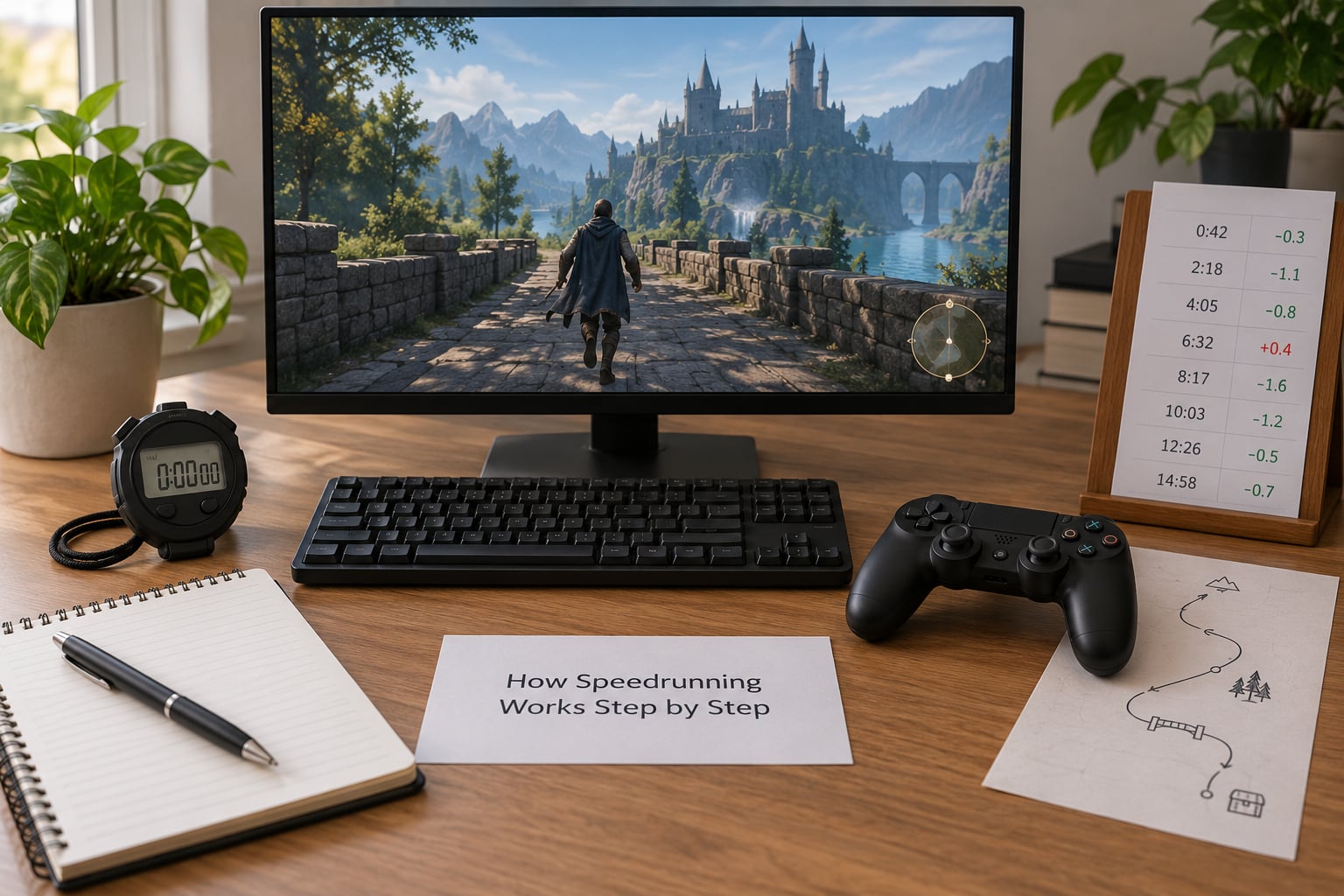
Here is the practical loop, in the order you’ll actually move through it.
- Read the category rules first. Open the game’s page on the leaderboard site and read the rules for the category you want. Rules differ on save loading, emulator use, and handcam requirements, and reading them takes five minutes.
- Watch a run at a level below the record. A world record run is so optimised that the inputs make no sense yet. Find a runner with a mid-range personal best and copy that.
- Write the route down. A list of segments with a target time for each is more useful than any video once you start repeating them.
- Set up a timer with splits. Splits mark the end of each segment so you can see where time goes.
- Practise one segment at a time. Load a save state, run the segment, compare, reset, repeat. Do not run the whole route fifty times hoping for a good one.
- Attempt a full run. This is where it counts. Expect it to be slower than your segment practice predicted, and that is normal.
- Record and submit. Capture the attempt, check the recording, and upload it with your splits file attached.
That loop repeats. Each pass through it should end with a cleaner run than the one before, and the segment where you lose time is the only place that needs your attention.
Speedrunning Categories and Rules
A category is a rule set that defines what a run has to do and what it is allowed to do. Speedrunning works because categories separate runs that aren’t comparable. Without them, a run that skips half the game and a run that does everything would be sitting on the same board.
| Category | Rule | Typical pace |
|---|---|---|
| Any% | Reach the credits using anything the game’s rules allow, including glitches | Fastest, and the most competitive |
| 100% | Collect everything the game contains | Far longer, often hours |
| Low% | Reach the credits with a low percentage of the game’s items | Medium, highly route dependent |
| Glitchless | Any% with all glitches banned | Slower than Any%, very technical |
| No Major Glitches (NMG) | Small time-savers allowed, anything that skips substantial content is not | Usually between glitchless and Any% |
| Individual level (IL) | Run one level or segment instead of the whole game | Short, ideal for beginners |
Games also grow their own subcategories, sometimes dozens of them, defined by whatever produces an interesting comparison: a specific item order, a race route, a random seed, a modified control scheme. Funny categories are common, since anyone with a leaderboard account can propose one. A “no sprinting” run or a “100% blindfolded” run sitting next to a serious Any% board is normal, not a sign that anything is broken.
What categories always ban
Load-state abuse outside of practice, macros, external assistance software, and emulator features that alter the game are the usual bans. Arbitrary code execution, where a glitch runs code the developers never wrote, is a special case: many categories allow it and some prohibit it, so the rule text matters more than general reputation.
Runners on forums describe the etiquette the same way. Use other people’s routes, credit the runner who taught you a trick, and don’t publish tricks you found yourself without saying where you found them.
Timers, Splits, and Route Planning
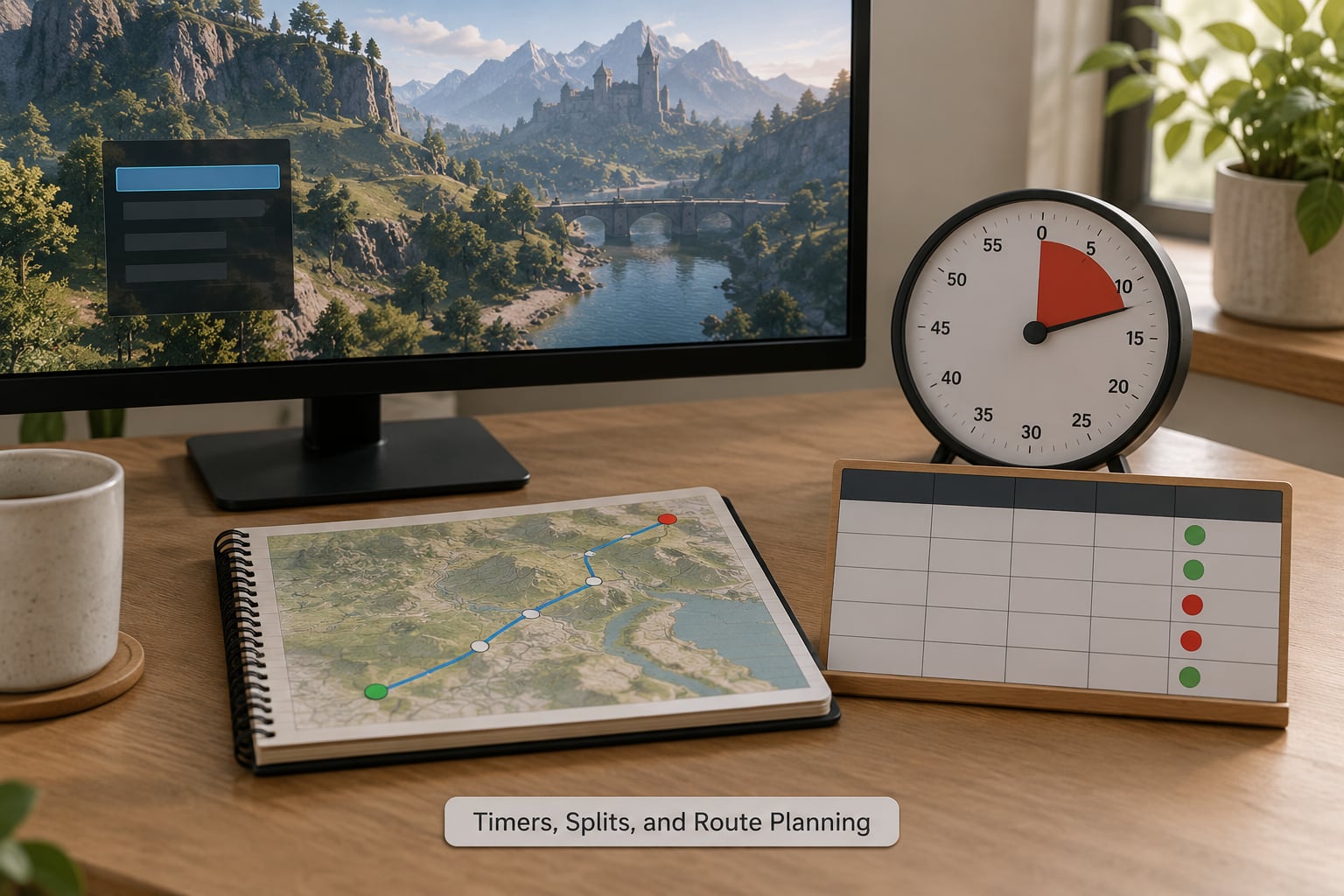
A timer alone tells you how long the run took. Splits tell you what to fix. A split marks the end of a segment and shows three numbers: the segment time, the total time at that point, and the difference against your best run. That last column is the whole point.
LiveSplit is the tool most runners use because it is free, has existed for decades, and supports autosplitters that start and split the timer for you by reading the game’s memory. An autosplitter removes the reaction-time cost of pressing start at exactly the right moment, and it removes the matching cost at every segment boundary.
Runners say autosplitters save more setup time than any other single tool, and the difference is easy to feel once you switch. Timing by hand and timing with an autosplitter can be a whole segment apart on a short run.
Route planning is the other half. Break the game into segments short enough that you can restart one in seconds, give each a target time, and total them up. If the targets add up to less than your current best, the route is worth learning. Segments with subsplits, sub-timings inside a segment, are useful for the dense middle of a run where a whole segment is too coarse to diagnose.
Test risky skips in isolation before you try them in a full run. A shortcut that saves four seconds but only lands a third of the time is a net loss, and you find that out in practice rather than during an attempt that mattered.
How Speedrunning Leaderboards and Verification Work
A leaderboard is a ranked list of times for one game, one category, and one platform. Each list has a world record at the top, a set of ranked placements beneath it, and a large unranked pool of submitted runs that are recorded but not placed. Those unranked runs are called gold, silver, and bronze, and holding one is how most runners build a history before a time qualifies for ranking.
Every submission comes with video proof. A moderator watches the run, checks it against the category rules, and looks for the two things a clock cannot show: that inputs are being executed in real time, and that no loading or assistance is happening mid-run. Games with difficult tricks sometimes require a handcam so the moderator can see your controller.
So a displayed time is not automatically verified. It sits unranked until a moderator says otherwise, and that review can take anywhere from a few hours to a few weeks depending on the game. Rejections are common early on and runners describe them as frustrating mainly because the feedback can be thin. Reading the rules carefully before submitting is the cheapest way to avoid one.
There is also a layer above the official boards. Community records, Discord leaderboards, and personal spreadsheets track runs that fall outside a category, or that use a rule the official site doesn’t host. Official and community can disagree about what counts, and a time that means something in a community Discord may have nowhere to go on the main board.
How to Improve Without Burning Out
Most of the progress in speedrunning comes from a small number of habits, and almost none of them involve playing more hours.
Practise one segment and stop when it stops improving. Twenty focused attempts on a twenty-second segment teach you more than an hour of full runs that fail in the same place. The segment practice is where the input timing gets locked in, and full runs only tell you whether you survived.
Compare attempts calmly. Look at which split was worst and why, not at the final number. A run that beats your best by four seconds with two clean segments and one disaster is a route to more time; a run that beats it by one second with everything clean is a fluke.
Set one goal per session. A session goal might be landing a specific skip three times in a row. Runner forums are full of people who mention months on a single game before submitting anything, and the ones who keep going tend to be the ones with a small target for each evening rather than an open-ended session.
Protect the reset habit. Restarting quickly after a failed attempt is the difference between two hundred practice runs this month and twelve. If the reset is slow, do the reset anyway.
And remember the game underneath it. The first PB is often two to three times the record time, which sounds like failure and is completely normal. Watching a marathon, or a runner a few minutes ahead of you, does more for your motivation than any time comparison.
Frequently Asked Questions
What is an any% speedrun?
An Any% run finishes the game as fast as possible with no requirement to collect anything. Glitches and sequence breaks are allowed as long as the category’s rules permit them, which is why Any% times are usually the shortest on a leaderboard. Because almost anything goes, Any% has the deepest field of runners and the most competition.
What is the easiest game to speedrun for beginners?
Short games with a small active community and a forgiving leaderboard are easiest. Individual level categories in a game you already know beat a full-game category, because a run takes minutes and restarting costs nothing. Pick a game with an autosplitter if you can, since it removes most of the timer setup.
How do I start the timer in LiveSplit?
Open LiveSplit, load the game’s splits file from your layout, and set Start Timer and Split keys to buttons you can reach while holding the controller. Set Split and Reset to keys that do not overlap with in-game inputs. Then test the hotkeys in a menu before you ever start a real attempt, and keep the window above the game.
What is the difference between RTA and IGT timing?
RTA, real-time attack, measures wall-clock time, so load screens and menu waits count against you. IGT, in-game time, uses the clock the game itself keeps and usually excludes loading. The two produce different numbers for the same run, so only compare times that were measured the same way.
What is a good speedrun time?
There is no universal good time, because every game and category has a different ceiling. For your own progress, a good time is one that beats your previous personal best, and your first full run may be several times slower than the record. Check the leaderboard’s ranked and unranked lists to see where you actually sit.
Do speed runners get paid?
Almost never for running itself. Runner payouts come from marathons, where prizes go to specific fundraisers, donations, and sometimes game publishers paying for an event. Recordings of runs can earn ad revenue or sponsorship on streaming channels, but that is streaming work rather than a payment for the run. The competitive part of speedrunning is unpaid by design.
Where to Start with Speedrunning
Pick one game and one category tonight. Read the category rules on the leaderboard site, then watch a run from a runner sitting a few minutes above the record rather than the record holder.
Install LiveSplit, load that game’s splits file, set the hotkeys somewhere your hands can reach, and add an autosplitter if one exists. Write down your first three segments with a target time for each.
Then practise those segments, one at a time, until each one lands a few times in a row. Run the full route once for the timer alone, without any pressure, so you learn what the whole attempt feels like.
Record that run, upload it, and let it sit unranked. Compare it with your next attempt, split by split, and see which column tells you where the seconds went. That comparison is the whole craft — everything else on this page is detail hanging off it.